
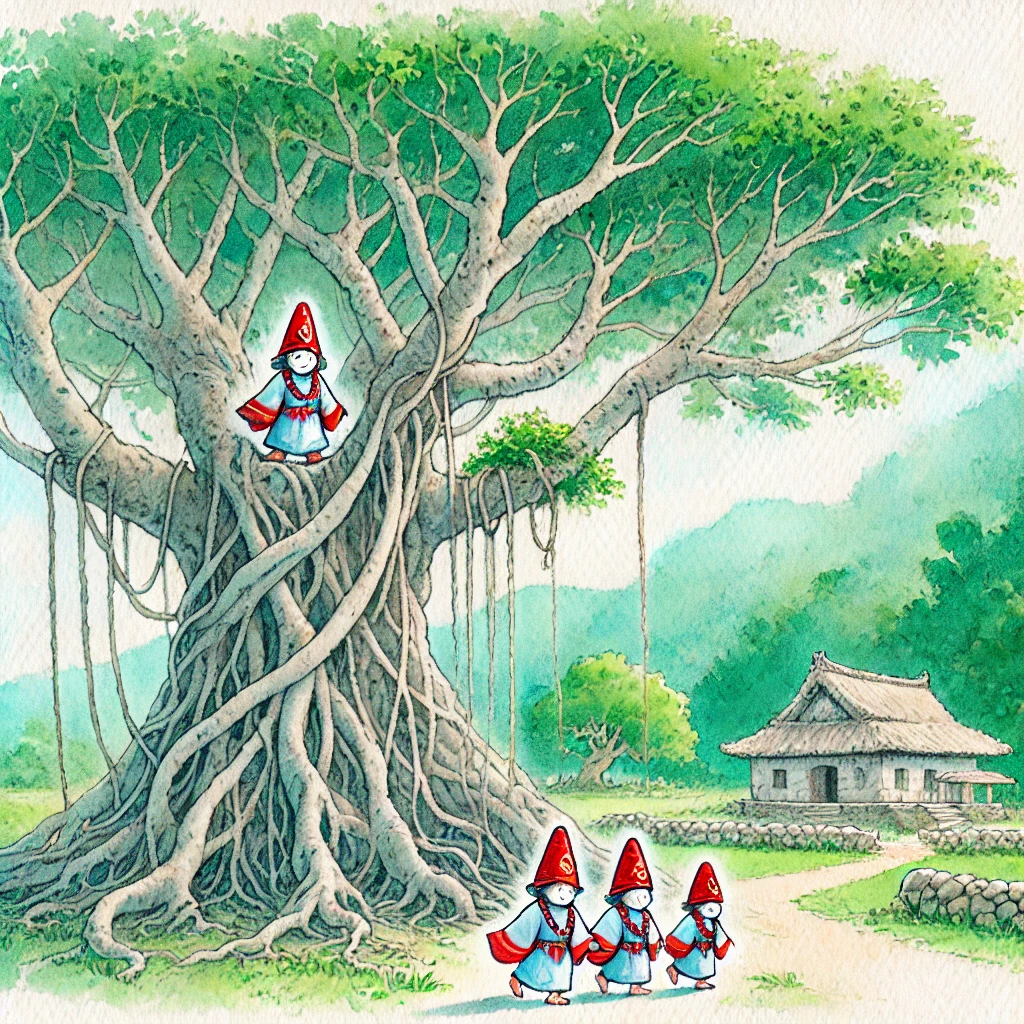
There is an ancient belief deeply rooted in the land of Okinawa. It is the belief in the spirits residing in the banyan trees.
The banyan tree is an essential part of Okinawa’s nature and culture, its mystical appearance captivating many. These large trees can grow up to 20 meters tall and have the unique ability to drop aerial roots from their branches, which, upon reaching the ground, become new trunks. This feature almost seems to symbolize the cycle of life.
The people of Okinawa believe that spirits, especially small ones known as “Kijimuna,” dwell in these banyan trees. It is believed that by venerating the banyan, people can receive blessings from these spirits.
However, the spirits of the banyan can also be terrifying. There are legends that say if you cut the tree, it will bleed, or that harming the tree will bring curses. These stories reflect the strong power attributed to the spirits of the banyan.
The belief in the spirits of the banyan is not mere superstition. It reflects the worldview and perspective on nature that the people of Okinawa have developed over their long history. It encompasses a deep respect for nature and ancestors, values that modern society may be losing.
In this article, we will delve into the world of the spirits residing in banyan trees, exploring the depths of Okinawa’s spiritual world. Through ancient legends and actual mysterious events, we will uncover the true nature of the banyan spirits.
We will also consider the lessons modern society can learn from the belief in these spirits. Reflecting on the relationship between humans and nature, and learning from the wisdom of our ancestors, the spirits of the banyan teach us the fundamentals of a way of life.
The belief in the spirits of the banyan has been passed down through generations in Okinawa. Let’s explore this mystical world together. By believing in the unseen and living in harmony with nature and our ancestors, we can find new insights into our own way of living.
About the Banyan Tree
The banyan tree is an indispensable part of Okinawa’s nature and culture. Its distinctive appearance has fascinated many people, and it has long been revered as a sacred tree. In this article, we will explore the charm of the banyan tree and delve into the spiritual world of the people of Okinawa.
Characteristics of the Banyan Tree
The banyan tree, a member of the fig family (Moraceae), is an evergreen tree that can reach heights of up to 20 meters. Its most striking feature is its ability to drop aerial roots from its branches, which, when they reach the ground, become new trunks. This unique growth pattern allows the banyan to cover vast areas, giving it the presence of an entire forest.
The banyan tree’s large, sturdy leaves can withstand heavy rains and typhoons. This resilience symbolizes the tree’s ability to adapt to Okinawa’s harsh natural environment and its enduring vitality.
Revered as a sacred tree for centuries, the banyan has become a cornerstone of the spiritual life of the Okinawan people. It embodies the reverence for nature and the wisdom passed down from ancestors.
Distribution of Banyan Trees in Okinawa
Numerous banyan trees are scattered throughout Okinawa Prefecture. They can be found in villages, sacred sites, and castle ruins. Among the most famous is the banyan tree at the Shurijo Castle Park in Naha City, known as the “Zuisenmon Banyan.”
Zuisenmon is the main gate of Shurijo Castle, and the banyan tree standing beside it is said to be several hundred years old. With a root circumference of over 10 meters, it exudes a commanding presence. This ancient tree has witnessed the history of Okinawa.
Another well-known banyan is on Yagaji Island in Nago City, northern Okinawa. This tree is approximately 300 years old, standing about 25 meters tall with a trunk circumference of about 20 meters. Cherished and protected by the local people, it has lived alongside the island’s history.
Banyan trees found throughout Okinawa are closely tied to the history and culture of each region. When visiting, be sure to seek out the local banyan tree, as it offers a glimpse into the deep charm of Okinawa.
The Spirits Residing in Banyan Trees
For the people of Okinawa, banyan trees are more than just trees. They believe these trees harbor powerful, mystical forces and have been objects of worship for centuries. The belief in the spirits residing in banyan trees holds a significant place in Okinawan tree spirit worship.
Here, we will delve deeper into the spirits believed to reside in banyan trees, exploring the overall concept of tree spirit worship and the various types of spirits said to dwell within banyans.
Overview of Tree Spirit Worship
Tree spirit worship is the belief that spirits inhabit trees. Trees with long lifespans or distinctive shapes are believed to possess strong spiritual power.
In Okinawa, tree spirit worship has long been rooted in the culture, with sacred trees being revered across the islands. Among these, the banyan is particularly known for its strong spiritual power due to its unique appearance and vitality.
It is believed that the spirits residing in banyan trees can hear people’s prayers and grant them strength. As a result, the practice of praying before banyan trees has been passed down through generations.
Tree spirit worship is also deeply connected to a respect for nature. The people of Okinawa have always revered the trees as part of nature, giving thanks for their blessings. The belief in the spirits of the banyan trees is an expression of this worldview.
Types of Spirits Residing in Banyan Trees
Various types of spirits are believed to dwell in banyan trees. The most famous of these are the small spirits known as “Kijimuna.”
Kijimuna are said to take the form of children wearing red caps. They are known to offer advice to humans and sometimes play tricks, embodying a somewhat whimsical nature.
There are both good and bad Kijimuna. The good ones are believed to help people and bring good fortune, while the bad ones are thought to mislead and bring misfortune.
Other spirits believed to inhabit banyan trees include “Busa,” a great snake spirit, and “Maarei,” a female spirit.
These spirits are deeply connected to the banyan tree, considered the source of the tree’s vitality. They have also significantly impacted people’s lives.
The existence of spirits in banyan trees reveals the richness of Okinawa’s spiritual world. Though invisible, these spirits are a real presence for the people of Okinawa, shaping their culture and history.
Legends and Incidents Related to Banyan Trees
Banyan trees hold a special place in the hearts of the people of Okinawa, and numerous legends and stories have been passed down over the years. These tales not only highlight the mystical nature of the banyan but also the depth of tree spirit worship.
Here, we will examine some representative legends and actual incidents related to banyan trees. These stories offer valuable insights into the spiritual world of Okinawa.
Legend 1: The Tree That Bleeds
One of the most famous legends about banyan trees is that “cutting the tree will make it bleed.” This legend suggests the presence of spirits within the banyan.
According to the legend, cutting a banyan tree causes a red liquid, resembling blood, to flow from it. This phenomenon is believed to be the manifestation of the spirit’s life force.
While this phenomenon may lack scientific explanation, it is a well-known fact among the people of Okinawa. They consider harming a banyan tree equivalent to harming the spirit.
This legend indicates that the banyan is more than just a tree; it is a living entity. It also reflects the deep respect for nature held by the people of Okinawa.
Legend 2: The Curse of Cutting the Tree
Another widely known legend is that harming a banyan tree brings a curse from its spirit. A curse refers to retribution or punishment from the spirit.
The legend states that those who cut or harm a banyan tree, or their families, will face various misfortunes, including illness, injury, and even death.
There are numerous stories of unfortunate events occurring after a banyan tree was cut, such as livestock dying or family members falling ill.
These stories reflect the powerful nature of the banyan spirits and serve as a warning against underestimating their power.
Revering the banyan is wisdom passed down from ancestors. These legends continue to play a role in conveying this wisdom today.
Actual Incidents
Legends about banyan trees are not just stories. There are reports of actual incidents where unfortunate events occurred after a banyan tree was cut.
One notable example is an incident from the 1980s when a construction company cut down a banyan tree for a project. Subsequently, many associated with the project experienced misfortunes, including accidents, illnesses, and even deaths.
This incident is widely remembered as a reminder of the banyan spirits’ power and led to increased efforts to protect banyan trees.
Today, cutting banyan trees is prohibited by law, reflecting the importance placed on banyan trees by the people of Okinawa.
The legends and incidents related to banyan trees offer a glimpse into the spiritual world of Okinawa, showing the people’s belief in the unseen and their coexistence with nature.
Why the People of Okinawa Fear Banyan Spirits
The belief in the spirits residing in banyan trees is deeply ingrained in the hearts of the people of Okinawa. However, many also fear these spirits.
Here, we will explore why the people of Okinawa fear banyan spirits. This fear is rooted in a deep
respect for nature and a connection to ancestor worship.
Reverence for Nature
For the people of Okinawa, nature is sacred. They have long believed that gods reside in every part of nature, including the sea, mountains, and trees.
The banyan tree is revered as a special part of nature, symbolizing the awe and respect for its vitality and mystique.
However, reverence often comes with fear. Nature’s power is beyond human control. The fear of banyan spirits reflects this awe of nature’s immense power.
Moreover, the respect for nature is linked to the admonition not to harm it. Harming a banyan tree is believed to anger its spirit, bringing severe retribution.
This perspective on nature remains significant in modern society. The belief in the spirits of banyan trees teaches us the importance of coexisting with and respecting nature.
Connection to Ancestor Worship
Ancestor worship is deeply rooted in Okinawa, closely tied to the belief in banyan spirits.
Banyan trees have lived for centuries, seen as embodying the spirits of ancestors. Thus, venerating the banyan is akin to venerating ancestors.
Ancestor spirits are believed to protect and guide their descendants. However, angering these spirits is thought to bring severe retribution.
The fear of banyan spirits stems from this fear of angering ancestor spirits. Respecting the banyan means respecting ancestors, preventing potential curses.
This view on ancestor worship is also crucial in modern society. Amid globalization, we risk losing our cultural roots.
However, the wisdom and values passed down from ancestors provide strength during challenging times, as shown in Okinawa’s history.
The belief in banyan spirits teaches the importance of learning from ancestors. This practice of learning from the past and connecting it to the future forms the basis of cultural heritage and societal development.
In conclusion, the fear of banyan spirits among the people of Okinawa is rooted in reverence for nature and ancestor worship. It reflects a respect for forces beyond human control and a deep respect for ancestors.
These emotions are essential in modern society, teaching the importance of harmony with nature and learning from ancestral wisdom.
Learning from the Spirits of Banyan Trees: The Spiritual World of Okinawa
The belief in banyan spirits is not mere superstition. It reflects the worldview and perspective on nature that the people of Okinawa have cultivated over their long history.
There are many lessons to be learned from the spirits of the banyan. Here, we will examine two particularly important teachings: coexistence with nature and respecting ancestors. These themes hold significant relevance for us today.
Coexistence with Nature
The belief in banyan spirits reflects the deep connection between the people of Okinawa and nature. For them, nature is not just a resource but a companion in life.
The banyan, with its enduring vitality, symbolizes resilience in the face of Okinawa’s harsh natural conditions. Its strength and longevity provide hope and courage to the people.
The belief in banyan spirits teaches the importance of respecting nature and living in harmony with it. Humans are part of nature and must remember the blessings they receive from it.
In modern society, the need for coexistence with nature is becoming increasingly critical, given issues like global warming and environmental destruction.
The belief in banyan spirits may offer a solution to these problems. Respecting and living in harmony with nature is essential for building a sustainable society.
Respecting Ancestors
The spirits of the banyan are also deeply connected to ancestor spirits. Respecting the banyan is akin to respecting ancestors.
In Okinawa, ancestor worship is ingrained, valuing the culture and wisdom passed down through generations. This is reflected in the belief in banyan spirits.
The banyan, having lived through centuries, is believed to harbor ancestral wisdom. Respecting it means valuing the knowledge and culture inherited from ancestors.
In today’s society, it is crucial not to forget the importance of respecting ancestors. As globalization progresses, we risk losing sight of our roots.
However, the wisdom and values passed down from ancestors provide significant strength in overcoming challenges, as evidenced by Okinawa’s history.
The belief in banyan spirits emphasizes the importance of learning from ancestral wisdom. This practice of learning from the past and connecting it to the future forms the basis of cultural heritage and societal development.
In conclusion, the belief in banyan spirits embodies the rich spirituality of Okinawa. By believing in the unseen and living in harmony with nature and ancestors, the people of Okinawa have created a unique cultural heritage.
These traditional values offer significant insights into contemporary issues, teaching us about harmony with nature and the importance of ancestral wisdom.
The spiritual world of Okinawa, as taught by the spirits of the banyan trees, is a valuable foundation for us to revisit.
Q&A
What are the characteristics of the banyan tree?
The banyan tree is an evergreen tree in the fig family (Moraceae) that can reach heights of up to 20 meters. Its distinctive feature is that it drops aerial roots from its branches, which become new trunks upon reaching the ground. This tree has long been revered as sacred.
Why do the people of Okinawa consider the banyan tree to be sacred?
The people of Okinawa believe that spirits reside in banyan trees. In particular, small spirits called “Kijimuna” are thought to dwell in them. It is believed that by venerating the banyan tree, people can receive blessings from these spirits.
Is it true that there is a legend saying banyan trees bleed when cut?
The belief that banyan trees bleed when cut is a legend without scientific basis. However, this legend suggests the presence of spirits in the banyan tree and reflects the view of the people of Okinawa who regard the banyan as a living being.
What famous incidents are associated with the banyan tree?
One famous incident occurred in the 1980s when a construction company cut down a banyan tree, and the people involved experienced a series of misfortunes. This incident heightened awareness of the importance of preserving banyan trees.
What lessons can modern society learn from the belief in banyan spirits?
The belief in banyan spirits teaches the importance of coexistence with nature and respecting ancestors. Even in modern society, it is essential to live in harmony with nature and learn from ancestral wisdom. The belief in banyan spirits provides a fundamental example of such a way of life.
Conclusion
We have explored the mysterious world of the “spirits residing in banyan trees,” an ancient belief in Okinawa. The banyan tree is an indispensable part of Okinawa’s nature and culture, captivating many with its unique appearance.
The people of Okinawa believe that spirits, especially small ones called “Kijimuna,” reside in banyan trees. They believe that by venerating the banyan, they can receive blessings from these spirits.
There are also legends that cutting the banyan tree will make it bleed or bring curses. These legends suggest the presence of spirits in the banyan tree and reflect the Okinawan view of the banyan as a living being.
The belief in banyan spirits is deeply connected to the Okinawan worldview of nature and ancestor worship. The importance of coexisting with nature and respecting ancestors are lessons that modern society can learn as well.
The belief in banyan spirits embodies the rich spirituality of Okinawa. It reflects the way the Okinawan people have lived in harmony with nature and ancestors, providing valuable insights for addressing various issues in modern society.
Through the world of the spirits residing in banyan trees, we have touched on the depths of Okinawa’s spiritual world. Reflecting on the relationship between humans and nature and learning from the wisdom of our ancestors, the spirits of the banyan tree may teach us the fundamentals of such a way of life.

コメント