
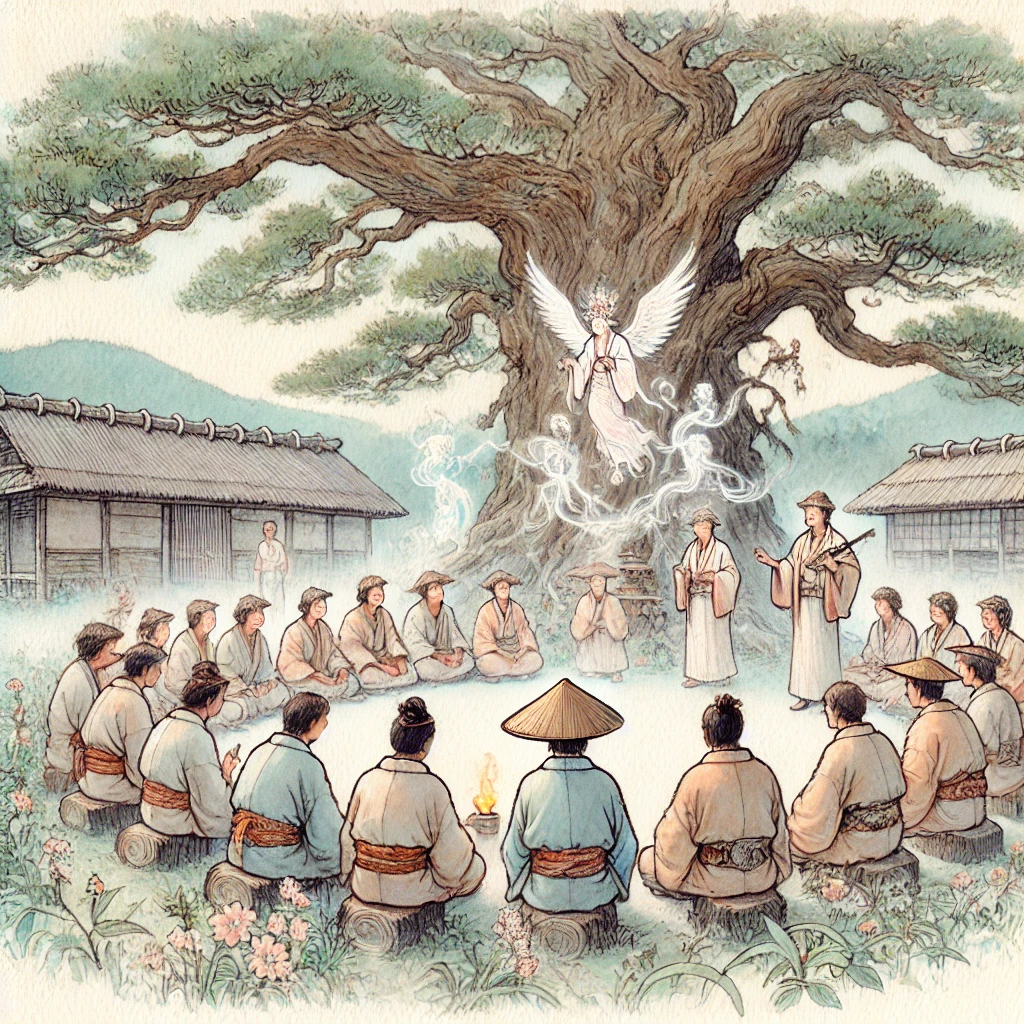
Okinawa has a traditional gathering called “Yurigwa.” This assembly, where village members discuss important matters and perform rituals and ceremonies, is indispensable for the people of Okinawa. However, did you know that sometimes inexplicable events occur during Yurigwa?
During these gatherings, people have reported hearing the voice of gods, sensing invisible presences, experiencing sudden chills, and falling ill. What do these mysterious occurrences signify? These inexplicable events are deeply connected to the spiritual world of the Okinawan people. Reflecting Okinawa’s unique worldview, which includes nature worship, ancestor worship, and the presence of Yuta (shamans), these events hold significant meaning.
Yurigwa also plays a crucial role in preserving Okinawan traditions and strengthening community bonds. Through these mysterious occurrences, people support each other and share traditional values. In modern society, Yurigwa provides important insights into the inheritance and reevaluation of traditional values and community dynamics. In an era where individualism is on the rise and regional connections are weakening, the experiences from Yurigwa can teach us a lot.
This blog will explore the secrets behind the mysterious events that occur during Yurigwa from the perspective of Okinawan folklore and spirituality. We will also delve into the significance of Yurigwa in contemporary society. Let’s step into the world of Yurigwa, an essential aspect of understanding Okinawa’s culture and spirituality.
- Introduction
- Mysterious Occurrences During Yurigwa
- The Spiritual World of Okinawan People
- The Impact of Mysterious Events During Yurigwa
- Summary
- Q&A
- Summary
Introduction
About Okinawan Folklore
The Unique History and Culture of Okinawa
Okinawa is known for its unique history and culture within Japan. From ancient times, Okinawa has engaged in exchanges with China and Southeast Asia, developing its own language and customs. During the Ryukyu Kingdom era, it established a unique political system and religious views, influences of which remain strong today. From a folkloric perspective, the distinctiveness of Okinawan history and culture is a fascinating subject that attracts many researchers.
The Importance of Folkloric Research in Okinawa
Folkloric research in Okinawa is not only about recording past customs and traditions but also plays a significant role in understanding contemporary Okinawan society. The spirituality, worldview, and values of Okinawan people can be elucidated through folkloric studies. In today’s globalized society, investigating how traditional culture is inherited and transformed in Okinawa is one of the major challenges in folkloric research. Such studies help in widely disseminating the diversity and significance of Okinawan culture.
What is Yurigwa (Gathering)?
The Origin and Purpose of Yurigwa
Yurigwa refers to the traditional gatherings held in Okinawan villages. Its origins are believed to date back to the Ryukyu Kingdom era. During those times, regular gatherings were held to manage village communities, perform rituals, and resolve conflicts. Even today, Yurigwa is preserved in many Okinawan villages, playing an important role in strengthening community ties.
The Frequency and Participants of Yurigwa
The frequency of Yurigwa varies by village. Some villages hold it on fixed dates every month, while others hold it a few times a year. The participants are typically all adults living in the village, with no gender distinction. However, in some villages, women primarily run the gatherings. During Yurigwa, important village matters are discussed, and ceremonies and rituals are performed. These traditional gatherings are indispensable for the people of Okinawa and are also of folkloric interest.
Mysterious Occurrences During Yurigwa
Specific Case 1: Hearing the Voice of Gods
The Scene and Situation of Hearing the Voice of Gods
There are stories of people suddenly hearing the voice of gods during Yurigwa. These voices warn or advise the villagers. For example, in one village, during Yurigwa, people heard a voice saying, “Do not go to the sea tomorrow.” The next day, the fishermen followed the warning and stayed ashore, avoiding a disaster when a large typhoon struck and damaged their boats. These voices are seen as important omens or revelations by the villagers.
The Content and Interpretation of the Voice of Gods
The content of the voices heard during Yurigwa varies with the situation. They might warn or advise, predict bountiful harvests or fish catches, or forewarn of diseases. Villagers listen carefully to the voice and strive to interpret its meaning. The messages are conveyed to others through the person who heard them. This response to the voice reflects the spirituality and worldview of the Okinawan people and is an intriguing subject from a folkloric perspective.
Specific Case 2: Sudden Chills and Illness
Characteristics of Those Who Feel Chills and Illness
Some participants in Yurigwa suddenly experience strong chills or deteriorating health. These symptoms often appear in specific individuals. For instance, in one village, a woman felt severe chills and her health worsened during Yurigwa. This woman was known for her strong connection with gods and ancestors. Villagers believe that such special individuals receive messages from unseen entities.
Considerations on the Causes of Chills and Illness
There are various interpretations of the causes of chills and illness during Yurigwa. Some believe it is a warning or call from unseen entities. Others interpret it as symptoms caused by ancestors’ spirits. Some think it might be due to the tension and stress of Yurigwa. These physical reactions are closely linked to the spirituality and beliefs of the Okinawan people, making it a noteworthy theme from a folkloric perspective.
Specific Case 3: Sensing Invisible Presences
Experiences of Those Who Sense Invisible Presences
Many people report sensing invisible presences during Yurigwa. These presences can sometimes be gentle or sometimes threatening. In one village, during Yurigwa, the temperature in the room suddenly dropped, and someone felt as if they were touched by an unseen entity. In another village, ancestors’ spirits appeared during Yurigwa and provided guidance. These experiences are widely shared among Okinawans, expressing their awe and respect for unseen presences.
Speculations on the Identity of Invisible Presences
There are various interpretations of the identity of invisible presences felt during Yurigwa. Some believe they are gods. Okinawans believe that gods reside in nature, and mysterious occurrences during Yurigwa are interpreted as messages from these gods. Others think that ancestors’ spirits are appearing. The belief in ancestor worship is strong in Okinawa, and it is thought that ancestors’ spirits guide their descendants. This faith in invisible presences forms the foundation of Okinawa’s spiritual world and is a crucial theme from a folkloric perspective.
The Spiritual World of Okinawan People
Coexistence with and Awe of Nature
Okinawa’s Natural Environment and People’s Relationship with It
Okinawa is blessed with a warm climate and rich nature. People have lived closely with nature, which includes mountains, seas, and rivers. For example, the sea is a crucial source of food and a sacred place. Before going fishing, there is a tradition of praying to the sea gods, which is still observed today. This idea of coexistence with nature is the foundation of Okinawa’s spiritual world.
The Expression of Nature Worship and Awe
Okinawans perceive nature not just as resources or environment but as sacred entities. They believe that gods reside in nature and respect its power. This nature worship is expressed in various forms in daily life. For instance, certain mountains and forests are considered sacred, and people are expected to follow specific rituals when approaching these places. Natural disasters and anomalies are sometimes seen as expressions of gods’ anger. This nature worship and awe are essential elements in understanding Okinawa’s spiritual world.
The Existence and Role of Yuta (Shamans)
Conditions and Training to Become a Yuta
In Okinawa, there are shamans called Yuta. Yuta communicate with gods and ancestors, providing advice to solve people’s troubles and problems. Becoming a Yuta requires certain conditions. Usually, individuals who show communication abilities with gods and ancestors from a young age are chosen. Additionally, becoming a Yuta involves rigorous training, which varies among Yuta but generally includes learning methods of communication with gods and ancestors and prayer techniques.
The Role of Yuta in Ceremonies and Rituals
Yuta play crucial roles in ceremonies and rituals. For example, during Yurigwa, Yuta communicate with gods and ancestors to provide advice to villagers. During illnesses or disasters, Yuta offer prayers to the gods to seek solutions. Yuta are positioned as vital connectors between gods and people in Okinawa’s traditional beliefs.
Okinawan Society’s Perception of Yuta and Changes
The role of Yuta in Okinawan society has changed over time. Once, Yuta were respected and held important roles in the villages. However, with modernization, Yuta’s presence was criticized as superstition, and their role diminished, especially under American cultural influence post-WWII. Nevertheless, there is a growing re-evaluation of Yuta’s role with the increasing interest in traditional Okinawan culture. Yuta remain essential for understanding Okinawa’s spiritual world and are a significant subject from a folkloric perspective.
Ancestor Worship and the Concept of Soul
Characteristics and Significance of Ancestor Worship in Okinawa
Ancestor worship remains a deeply rooted belief in Okinawa. People believe that ancestors’ spirits protect and guide their descendants. This belief in ancestor worship strengthens family bonds. In
Okinawa, it is customary to welcome and honor ancestors’ spirits during Obon and New Year’s. Additionally, major life events like weddings and funerals involve reporting to ancestors’ spirits and seeking their blessings. This ancestor worship forms the foundation of Okinawa’s spiritual world and is an essential theme from a folkloric perspective.
The Concept of Soul and View of Life and Death
Okinawans have a unique concept of the soul. They believe that the soul continues to exist even after separating from the body. Moreover, they believe that the soul travels between the world of ancestors and the present world. This concept of the soul influences Okinawa’s view of life and death. Death is seen as the soul leaving the body and journeying to the world of ancestors. Funerals involve rituals to send the deceased’s soul to the ancestral world. This view of life and death is closely linked to ancestor worship and highlights Okinawa’s spiritual characteristics.
The Transformation of Ancestor Worship in Modern Society
The practice of ancestor worship in modern society is changing from traditional forms. With nuclear families and urbanization, family bonds are weakening, and ancestral worship customs are declining. Additionally, the management of cemeteries and methods of rituals are changing. However, there is also a renewed recognition of the importance of ancestor worship. For instance, the traditional practice of visiting ancestral graves, known as “Shima-mō,” is being reevaluated in Okinawa. This involves visiting the ancestors’ graves and communicating with their souls. Such movements are attempts to explore the way of ancestor worship in modern society.
The Impact of Mysterious Events During Yurigwa
Strengthening Community Consciousness
The Sense of Unity Brought by Mysterious Events
Mysterious events during Yurigwa play a role in strengthening the bonds among villagers. Through shared experiences, people reaffirm the importance of supporting and helping each other. For instance, when someone hears the voice of gods, the message is shared and discussed among all villagers. Similarly, when someone senses an invisible presence, their experience is passed on within the community. These shared experiences enhance the sense of unity and strengthen community consciousness.
The Spirit of Mutual Assistance Fostered by Community Consciousness
The community consciousness fostered by mysterious events during Yurigwa generates a spirit of mutual assistance. Villagers are expected to help each other in times of difficulty. For example, during natural disasters or illnesses, villagers collaborate to cope. Additionally, in life events like weddings and funerals, the entire community comes together to support. This spirit of mutual assistance is a crucial element that sustains Okinawan village society. The mysterious events during Yurigwa provide a foundation for nurturing this spirit.
Preservation and Protection of Traditions
The Connection Between Mysterious Events and Traditions
The mysterious events during Yurigwa are closely linked to Okinawan traditions and culture. The voices of gods and invisible presences are considered reflections of Okinawa’s traditional beliefs and worldview. Through these mysterious occurrences, Okinawan traditions are passed down to future generations. For instance, experiences during Yurigwa are shared with children, who then inherit traditional values and worldviews. Additionally, the ways of dealing with mysterious events are passed down as traditional wisdom. Through this process, Okinawan traditions continue to live on in modern society.
The Importance and Challenges of Preserving Traditions
Preserving Okinawan traditions in modern society holds significant meaning. As globalization progresses, regional uniqueness and diversity are being lost. In such a situation, protecting and passing down Okinawan traditions to future generations is essential for maintaining cultural diversity. However, there are various challenges in preserving traditions, such as the outflow of young people from rural areas and the decline of traditional livelihoods. Additionally, there is a gap between traditional values and modern societal values. Overcoming these challenges is necessary for preserving Okinawan traditions.
Summary
The Depth of Okinawan Folklore
The Complexity of Okinawan Spirituality as Seen in Yurigwa
The inexplicable events that occur during Yurigwa highlight the complexity of Okinawa’s spiritual world. Voices of gods and unseen presences are not merely superstitions or ghost stories but reflect the worldview and beliefs of the Okinawan people. This spiritual world is formed through a combination of nature worship, ancestor worship, and the presence of Yuta (shamans). Traditional wisdom and values are reflected in how people deal with these mysterious occurrences. This intricate spiritual world underscores the depth of Okinawan folklore.
The Future Prospects of Okinawan Folklore
Okinawan folklore continues to hold significant meaning in modern society. As globalization progresses and regional uniqueness and diversity fade, recording and researching Okinawa’s traditional culture is an urgent task. Folkloric insights can also provide valuable perspectives on contemporary social issues, such as the relationship between nature and humans or the structure of communities. Moving forward, Okinawan folklore must address these modern challenges while incorporating new perspectives and methodologies, all while preserving traditional knowledge.
The Significance of Yurigwa in Modern Society
The Inheritance and Re-evaluation of Traditional Values
In modern society, traditional gatherings like Yurigwa hold important meaning. Yurigwa serves as a place to inherit and re-evaluate Okinawan traditional values. For example, the concepts of nature worship and ancestor worship offer valuable insights into contemporary environmental issues and family dynamics. The mysterious events during Yurigwa challenge the rationality and efficiency emphasized in modern society, prompting a reconsideration of traditional worldviews. The inheritance and re-evaluation of these traditional values are essential for enriching contemporary society.
Implications for Community Structure in Modern Society
Yurigwa provides important implications for thinking about community structure in modern society. As individualism increases and regional connections weaken, traditional gatherings like Yurigwa offer valuable opportunities for people to find solace and support each other. The mysterious events during Yurigwa enhance community consciousness and foster a spirit of mutual assistance. Such community bonds are especially needed in modern society. The experiences of Yurigwa provide important clues for understanding community structure in contemporary society.
In conclusion, we have explored the mysterious events during Yurigwa from the perspective of Okinawan folklore. Yurigwa is a valuable example that demonstrates the complexity and depth of Okinawa’s spiritual world. It also offers important insights into the inheritance of traditional values and the structure of communities in modern society. Okinawan folklore must use the experiences of Yurigwa to address contemporary social issues. Yurigwa is an indispensable element in understanding Okinawa’s culture and spirituality, holding significant meaning even in modern society.
Q&A
What is Yurigwa?
Yurigwa refers to the traditional gatherings held in Okinawan villages. These gatherings discuss important village matters and also conduct ceremonies and rituals.
What kind of mysterious events occur during Yurigwa?
Events such as hearing the voice of gods, sudden chills and illness, and sensing invisible presences are reported. These occurrences are believed to be deeply connected to the spirituality and beliefs of the Okinawan people.
What are the characteristics of the spiritual world of the Okinawan people?
Key features include nature worship, the presence of Yuta (shamans), ancestor worship, and the concept of the soul. These elements shape the worldview and values of the Okinawan people.
How do the mysterious events during Yurigwa impact Okinawan society?
They help strengthen community consciousness and the inheritance and protection of traditions. Through these events, people support each other and share traditional values.
What is the significance of Yurigwa in modern society?
Yurigwa provides important insights into the inheritance and re-evaluation of traditional values and the structure of communities in modern society. It offers valuable perspectives for addressing contemporary social issues.
Summary
“In the traditional gatherings called ‘Yurigwa’ held in Okinawan villages, mysterious events such as hearing the voice of gods and sensing invisible presences occur. These events are deeply connected to the spirituality of the Okinawan people, reflecting their unique worldview, including nature worship, ancestor worship, and the presence of Yuta (shamans). These mysterious occurrences strengthen community consciousness and aid in the inheritance and protection of traditions. In modern society, Yurigwa provides valuable insights into the inheritance and re-evaluation of traditional values and the structure of communities. Okinawan folklore must use the experiences of Yurigwa to address contemporary social issues. Yurigwa is an indispensable element in understanding Okinawa’s culture and spirituality and holds significant meaning even in modern society.”


コメント