
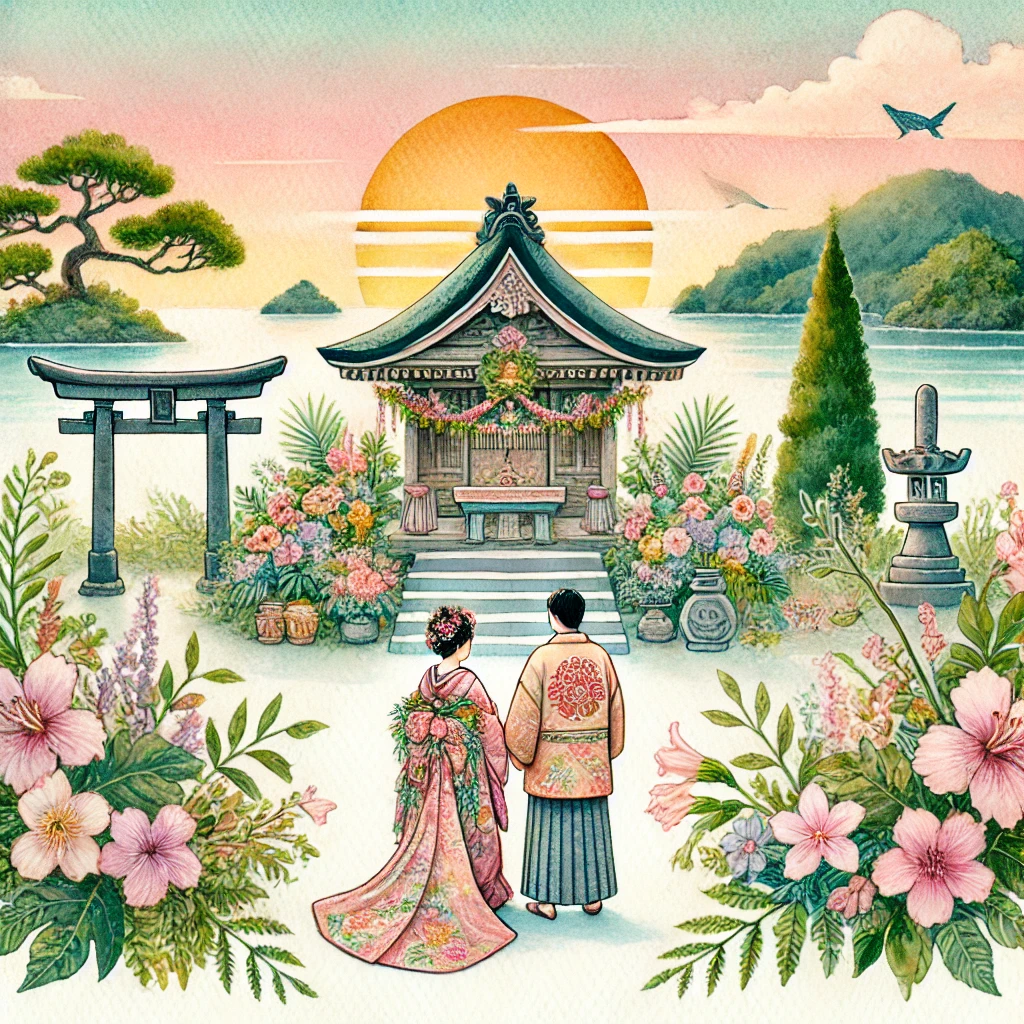
- Okinawan Weddings: Unique and Deeply Rooted Traditions
- Origins and Characteristics of Okinawan Weddings
- Pre-Wedding Preparations and Rituals
- Wedding Day Rituals and Flow
- Post-Wedding Rituals and Celebratory Events
- The Spiritual World Reflected in Okinawan Weddings
- Modern Changes in Traditional Weddings
- Folklore and Legends Related to Weddings
- Lessons Learned from Okinawan Weddings
- Q&A
- Summary
Okinawan Weddings: Unique and Deeply Rooted Traditions
Okinawan weddings possess a unique charm found nowhere else. This allure stems from the deep roots of Okinawan culture and spirituality, which have been nurtured over centuries and are intricately woven into the wedding rituals and customs.
Connecting with Gods, Ancestors, and Nature
Traditional Okinawan weddings are rich with rituals that emphasize the connection to gods, ancestors, and nature. For instance, in the ritual known as “Niibichi,” the bride and groom pull up a taro leaf together. This act symbolizes the establishment of a new household and the couple’s commitment to take root and grow in their new life. Additionally, scenes of gratitude and prayers offered to the gods at sacred places like “Ugansho” and “Utaki” are quintessential elements of Okinawan weddings.
More Than Mere Formalities
These rituals are far from mere formalities; they embody the values and spirit cherished by the Okinawan people. Gratitude for nature’s blessings, respect for ancestors, and the wish for divine protection are all deeply ingrained in these ceremonies. These sentiments are expressed in various ways during the wedding, a significant life milestone.
Strengthening Family and Community Bonds
Okinawan weddings also place great importance on deepening family and community ties. The preparation and management of the wedding involve the cooperative spirit known as “Yuimaaru,” where relatives and community members come together to support the event. This spirit of mutual assistance not only enhances the wedding but also serves as a strong support system for the newlyweds as they embark on their married life.
Modern Trends and Traditional Values
In contemporary Okinawa, new styles such as resort weddings and hybrid ceremonies that blend Japanese and Western elements have gained popularity. However, even as the styles evolve, the underlying spirit of Okinawan weddings remains unchanged. In fact, it may be even more crucial in today’s society to engage with these traditions and reaffirm the values they represent.
Universal Lessons from Okinawan Weddings
The lessons we can learn from Okinawan weddings are universally relevant: the harmony between tradition and modernity, the importance of family and community bonds, and the appreciation of gods and nature. These are values that should be cherished not only in weddings but also in our daily lives.
Exploring the Spiritual Depth of Okinawan Weddings
In this article, we will delve into the charm of traditional Okinawan weddings and the valuable lessons they offer. By exploring the spirit of Okinawan weddings, we hope readers will reflect on their own approach to weddings and the important values in life.
Origins and Characteristics of Okinawan Weddings
Historical Background and Influence of Chinese Culture
Ancient Exchanges and Cultural Fusion
Okinawan weddings have been significantly influenced by Chinese culture since ancient times. During the Ryukyu Kingdom era, frequent exchanges with China brought Confucianism, Taoism, and other philosophical thoughts to Okinawa. These ideas greatly influenced Okinawan wedding rituals and customs. The concept of “kankonsosai,” which refers to the four major ceremonies in life—coming of age, marriage, funeral, and ancestor worship—was also introduced from China and deeply embedded in Okinawan weddings.
The fusion with Chinese culture gives Okinawan weddings a unique atmosphere. For example, “ryuho-kake,” a decorative item used in weddings, is influenced by Chinese traditions. The dragon and phoenix, symbols of good fortune in China, are indispensable in these decorations. Okinawan weddings also use ryuho-kake to symbolize the couple’s happiness.
Through this cultural exchange, Okinawan weddings developed their distinct form and significance, preserving the flow of ancient traditions while creating something uniquely Okinawan.
The Role of Sapposhi and Evolution of Rituals
Discussing the relationship between Okinawan weddings and Chinese culture requires mentioning the “sapposhi.” These envoys sent by the Chinese emperor conducted ceremonies to recognize the kings of the Ryukyu Kingdom, significantly influencing Okinawan wedding rituals and tools.
For instance, the “Sanken no Gi,” a ritual involving the offering of sake, originated from interactions with sapposhi. During this ceremony, the bride and groom offer sake to their parents, seeking their blessing for the marriage. Additionally, white porcelain sake vessels, considered valuable items brought by the sapposhi, are used in weddings.
The interaction with sapposhi led to gradual changes in Okinawan wedding rituals over time, incorporating new cultural elements while preserving unique Okinawan customs.
Today, elements brought by the sapposhi remain in Okinawan weddings, reflecting the deep historical and cultural ties between Okinawa and China. Understanding this relationship reveals the depth and uniqueness of Okinawan weddings.
Relationship Between Agriculture and Weddings
Timing of Weddings and Agricultural Cycles
Okinawan weddings are closely tied to agricultural cycles. Historically, Okinawa has been an agricultural society where people’s lives revolved around farming activities, and wedding dates were chosen to align with agricultural schedules.
Traditionally, Okinawan weddings were held on auspicious days known as “Yuukui” during the agricultural off-season, typically from October to November in the lunar calendar. This period, following the rice harvest, allowed families to focus on wedding preparations without disrupting agricultural work. Additionally, weddings were often timed with the full moon, symbolizing abundance and fertility.
By aligning weddings with agricultural cycles, Okinawan families ensured a smooth transition into new family roles while celebrating the abundance and blessings of the land.
Prayers for Harvest and Progeny
Okinawan weddings embody prayers for a bountiful harvest and prosperous progeny, reflecting the essential values of an agricultural society. For instance, the “Amamik” ritual involves the bride and groom pouring water over themselves and performing a rain dance, symbolizing their prayers for rain and a good harvest. Traditional songs like “Tinsagu nu Hana” are sung, wishing for the flourishing of future generations.
These prayers, deeply rooted in the agricultural heritage of Okinawa, are expressed through wedding rituals, reinforcing the connection between family prosperity and the blessings of nature.
The Role of Gods and Ancestors in Weddings
Rituals at Sacred Sites and Prayers to Gods
Prayers to gods are an integral part of Okinawan weddings, particularly those performed at sacred sites known as “Ugandjo” (altars) within homes. The bride and groom offer prayers and special offerings, such as “Ugami Mochi,” to the gods, seeking their blessings for a harmonious marriage.
Additionally, prayers at “Utaki,” sacred sites believed to house deities, are conducted to ensure the couple’s future happiness. These rituals reflect the deep-seated belief in the gods’ involvement in daily life, especially during significant life events like weddings.
Gratitude to Ancestors and Continuation of Family Lineage
Gratitude to ancestors and the continuation of family lineage are central themes in Okinawan weddings. Rituals such as “Bunkawari,” where the bride and groom pledge to uphold family traditions in front of ancestral tablets, and “Shijitadashi,” where they reaffirm their family line, express respect and commitment to preserving family heritage.
These rituals emphasize the strong family bonds and the importance of honoring ancestors in Okinawan culture, reinforcing the new couple’s ties to their family lineage.
Pre-Wedding Preparations and Rituals
The Meaning and Procedures of Engagement (Yuukui)
Types and Symbolism of Engagement Gifts
An essential pre-wedding ritual in Okinawan weddings is the “Yuukui” (engagement ceremony). During this ceremony, the groom’s family presents engagement gifts, symbolizing their commitment and gratitude. The “Junininjin” (Twelve Items) are traditional engagement gifts, each carrying symbolic meanings such as “Inaguwa” (rice ears) for abundance, “Wakame” (seaweed) for fertility, and “Mochi” (rice cakes) for marital harmony.
These gifts reflect Okinawa’s rich natural and cultural heritage, symbolizing the groom’s family’s respect and good wishes for the bride’s family.
Procedures of Engagement and Roles of Both Families
The engagement process begins with the groom’s family preparing and presenting engagement gifts to the bride’s family, usually accompanied by close relatives. On an auspicious day known as “Yuukuiuchi,” the bride’s family hosts the groom’s family, expressing gratitude and verifying the engagement gifts. An intermediary known as the “nakodo” plays a crucial role in ensuring smooth communication and facilitating the engagement process.
These procedures emphasize the strong family ties and mutual respect between the groom’s and bride’s families, reflecting Okinawan values of cooperation and community.
The Miakuu (Eyebrow Raising) Ritual and the Bride’s Preparations
Origins and Significance of Miakuu
The “Miakuu” (eyebrow raising) ritual is
a pre-wedding ceremony where the bride’s eyebrows are carefully shaped, enhancing her beauty and symbolizing her readiness for marriage. This ritual, rooted in traditional Okinawan beauty practices, also signifies the bride’s determination and preparedness for her new role.
Ritual Procedures and the Bride’s Preparations
Conducted a few days before the wedding, Miakuu involves the bride sitting quietly while a chosen female relative, known as the “Miakuu-shi” (eyebrow artist), shapes her eyebrows. The bride’s makeup, including traditional “Bingata” (a type of resist dyeing), is applied, highlighting her beauty and preparing her for the wedding.
Through Miakuu, the bride not only enhances her physical appearance but also mentally prepares herself for the upcoming marriage, reflecting her commitment and gratitude towards her family.
The Tradition of Surimunu (Gift Exchange) and Regional Differences
Origins and Purpose of Surimunu
“Surimunu” (gift exchange) is a pre-wedding tradition where the groom’s family sends gifts to the bride’s family, symbolizing gratitude and celebration. This custom, evolving from the older practice of “Munuiri” (sending household items), reflects the deep family ties and mutual respect in Okinawan weddings.
Regional Variations and Modern Changes in Surimunu
Surimunu varies by region, reflecting local cultural and traditional differences. For example, in Nago City, gifts include traditional clothing, while in Itoman City, seafood and vegetables are common, highlighting the region’s fishing and farming heritage. Modern Surimunu practices have adapted to contemporary lifestyles, yet the core values of family and community support remain unchanged.
Wedding Day Rituals and Flow
Traditional Attire of the Bride and Groom
Features and Origins of the Bride’s Attire
The bride’s traditional attire, known as “Ryuso,” is a beautiful representation of Okinawan culture, characterized by vibrant colors and intricate patterns. Made from “Bingata” fabric, a traditional Okinawan dyeing technique, Ryuso symbolizes the bride’s beauty and purity. The colors red and white in the attire represent protection from evil and purity, respectively, and the design showcases Okinawa’s unique aesthetic and historical influences from China.
Features and Origins of the Groom’s Attire
The groom’s traditional attire, “Kariyushi Wear,” is a formal Okinawan garment made from light materials like hemp, suited for the warm climate. Featuring designs inspired by Okinawan nature, Kariyushi Wear reflects the island’s natural beauty and historical influences. Originally worn by Okinawan aristocracy, it has evolved into a symbol of formal wear for significant occasions like weddings.
The Role of Sanshin Players and Kachaashii Dancers
The Importance of Sanshin Players and Their Repertoire
Sanshin players are essential in Okinawan weddings, providing musical accompaniment that enhances the ceremony’s atmosphere. They perform traditional songs like “Kagiyadefu” for the couple’s entrance and “Omoro” during the ceremony, adding depth and cultural richness to the event. The ability to improvise and adapt to the wedding’s mood makes Sanshin players invaluable.
The Role and Significance of Kachaashii Dancers
Kachaashii dancers, often close relatives or friends, perform traditional Okinawan folk dances at weddings, symbolizing joy and celebration. Their graceful movements represent the bond between the couple and their future happiness, and their participation energizes and unites the wedding guests.
The Involvement of Relatives and the Community
Roles and Cooperation Among Relatives
Relatives play crucial roles in Okinawan weddings, from preparation to execution. Parents oversee the overall arrangements, while siblings assist the couple and handle specific tasks. This collaborative effort reflects the strong family bonds and communal values in Okinawan culture.
Support and Blessings from the Community
The community’s involvement is integral to Okinawan weddings, providing support and blessings from the preparation stages to the wedding day. Neighbors help with decorations, and local elders offer advice. The community’s participation, including traditional performances during the ceremony, highlights Okinawa’s collective spirit and enhances the wedding’s atmosphere.
Okinawan weddings are a testament to the enduring values of family, community, and respect for tradition. The active involvement of relatives and the community exemplifies Okinawa’s cultural richness and collective support, making these weddings uniquely beautiful and meaningful.
Post-Wedding Rituals and Celebratory Events
The Meaning and Origin of Niibichi (Root Pulling)
The Origin and Purpose of Niibichi
One of the post-wedding rituals in Okinawan weddings is “Niibichi” (root pulling). Niibichi is a ceremony celebrating the establishment of a new household by the bride and groom. The origin and purpose of Niibichi reflect Okinawan views on family and marriage.
The origins of Niibichi can be traced back to agricultural society practices. In an agricultural society, the harvest of crops was the foundation of life, and it was crucial to handle the roots of crops with care during harvest.
Niibichi incorporates this agricultural tradition into wedding ceremonies. During Niibichi, the bride and groom pull up a taro leaf in their garden. This act symbolizes the establishment of a new household.
The purpose of Niibichi is to celebrate the new beginning of the bride and groom. By performing Niibichi, the couple starts their new life under the watchful eyes of their family and community. Additionally, Niibichi reaffirms the bonds between the couple and their family and community.
The Procedure of the Ritual and the Roles of Participants
Niibichi is usually performed the day after the wedding. The ritual takes place in the garden of the newlyweds’ home, where a taro leaf is planted.
The ritual begins with the bride and groom pulling up the taro leaf together, symbolizing their joint effort in building a new household. Family, relatives, and community members gather to witness this act.
After the leaf is pulled, the parents of the bride and groom offer words of blessing, wishing happiness and success in the establishment of the new household.
Family, relatives, and community members participate in Niibichi, celebrating and supporting the couple. Following the ritual, a celebratory feast is held, where participants enjoy food, songs, and dances to mark the couple’s new journey.
Niibichi is a vital ritual celebrating the couple’s new beginning, conducted under the protection and support of their family and community.
The Upushaumachi (Coming of Age) Ceremony
The Significance and History of Upushaumachi
Upushaumachi is a post-wedding ceremony in Okinawa celebrating the bride and groom’s coming of age, marking their transition into adulthood. This ceremony holds a significant place in Okinawan life rituals.
The significance of Upushaumachi lies in recognizing the bride and groom’s transition from childhood to adults who bear responsibilities. In Okinawa, marriage is not just the union of two individuals but also the union of two families. Upushaumachi celebrates the couple’s new role as the heads of a new household.
The history of Upushaumachi dates back to ancient coming-of-age ceremonies. In Okinawa, children were formally recognized as adults through a coming-of-age ceremony. Upushaumachi adapted this tradition to the context of weddings.
The Content of the Ceremony and the Mindset of the Couple
Upushaumachi typically occurs a few days after the wedding at the couple’s home, with relatives and community elders in attendance.
The ceremony begins with the bride and groom, dressed in formal attire, entering the room to greet and receive blessings from their relatives and elders. They pledge to fulfill their responsibilities as adults.
Next, the couple serves sake to the relatives and elders, symbolizing their role as responsible adults. The attendees receive the sake and offer their blessings for the couple’s future.
The mindset of the bride and groom is crucial in Upushaumachi. They must act with a sense of responsibility to meet the expectations of their family and community. They must also commit to respecting and supporting each other in building their new household.
Upushaumachi is a vital ceremony for the couple to embrace their new role as adults, recognized and supported by their family and community.
The Custom and Modern Changes of Nanatsuguraumachi (Seven-Day Celebration)
The Origin and Purpose of Nanatsuguraumachi
Nanatsuguraumachi is a celebratory event held seven days after the wedding, wishing happiness for the bride and groom. The origin and purpose of Nanatsuguraumachi reflect Okinawan beliefs in the significance of the number seven and views on marriage.
The origin of Nanatsuguraumachi lies in the belief that the number “7” is auspicious in Okinawa, symbolizing “seven happinesses.”
The purpose of Nanatsuguraumachi is to wish happiness for the bride and groom. Family, relatives, and community members gather to pray for the couple’s happiness and present gifts to them.
Nanatsuguraumachi also marks a significant milestone in the couple’s new life, celebrating their transition into married life.
Changes and Continuity of Nanatsuguraumachi in Modern Society
In modern society, the form of Nanatsuguraumachi has changed due to nuclear family structures and urbanization, making large-scale celebrations difficult. Additionally, lifestyle changes make it challenging to find time for such events.
However, the significance and purpose of Nanatsuguraumachi remain unchanged. It is still a vital event to wish happiness for the bride and groom and celebrate their new life. Modern adaptations include holding smaller family gatherings or celebratory meals at restaurants, maintaining the essence of Nanatsuguraumachi.
Using social media to share the event with distant relatives and friends is another modern approach, expanding the celebratory circle.
Nanatsuguraumachi continues to evolve while preserving its significance, ensuring the couple’s happiness and reaffirming family and community bonds.
The Spiritual World Reflected in Okinawan Weddings
Respect and Gratitude Toward Gods and Nature
The Presence and Role of Gods in Weddings
Okinawan weddings embody deep respect and gratitude towards gods. Okinawans believe that gods are intimately involved in daily life, and their presence is felt during weddings.
Rituals like “Ugan” (prayer) are performed, where the bride, groom, and parents express their gratitude to the gods and seek blessings.
Additionally, sacred sites called “Utaki” play a crucial role. Before the wedding, the couple may visit Utaki to report their marriage to the gods, seeking their blessings.
The gods are believed to protect and guide the couple, making respect towards gods an essential aspect of a happy marriage.
Living in Harmony with Nature and Gratitude for Its Blessings
Okinawan weddings also express gratitude towards nature. Okinawans recognize the importance of living in harmony with nature and appreciating its blessings.
Rituals like Niibichi, where the couple pulls up a taro leaf, symbolize gratitude for the earth’s blessings and the wish for a harmonious household.
Wedding decorations often incorporate natural elements, like flowers and plants, showing respect for nature.
Gratitude towards nature is integral to Okinawan weddings, symbolizing the wish for a harmonious and blessed married life.
Ancestral Worship and Family Lineage
The Importance of Gratitude and Offerings to Ancestors
Gratitude and offerings to ancestors are vital in Okinawan weddings. Okinawans believe in the importance of respecting and being grateful to their ancestors.
Before the wedding, the couple may visit their ancestors’ graves to report their marriage and seek their blessings. Rituals to honor ancestors during the wedding also take place, expressing gratitude.
Gratitude towards ancestors is deeply connected to Okinawan family values, strengthening family bonds.
Continuation of Family Lineage and Wishes for Prosperity
Okinawan weddings emphasize the continuation of family lineage and wishes for prosperity. Weddings are seen as significant events for family lineage continuation.
Rituals like Upushaumachi, where the couple pledges their commitment to uphold the family lineage, reflect this importance.
Wishes for prosperity and descendants’ well-being are also included in ceremonies like Nanatsuguraumachi, ensuring the family’s future.
The continuation of family lineage and wishes for prosperity highlight Okinawan family values, making weddings essential ceremonies for these beliefs.
The Importance of Bonds with the Community
The Community’s Unity in Weddings
Community bonds are crucial in Okinawan weddings. The strong community spirit in Okinawa plays a vital role in supporting weddings.
The community celebrates the couple’s new beginning, contributing to the wedding’s joyous atmosphere. Community members also assist in wedding preparations and management.
The unity of the community reflects Okinawa’s spirit of mutual assistance, known as “Yuimaaru.” Weddings are a manifestation of this spirit, where the community supports the couple.
The Spirit of Mutual Assistance and Cooperative Efforts
Mutual assistance and cooperative efforts are key elements in Okinawan weddings. The culture of helping each other is deeply rooted in Okinawa.
During wedding preparations, relatives and community members work together on tasks like cooking and decorating the venue. This cooperation is an embodiment of the spirit of mutual assistance.
The spirit of mutual assistance and cooperative efforts are indispensable elements of Okinawan weddings, reflecting the cultural values of Okinawa.
Modern Changes in Traditional Weddings
The Introduction and Fusion of Western-Style Weddings
The Spread of Western-Style Weddings and Their Background
In modern Okinawa, Western-style weddings are becoming widespread alongside traditional ones. Several factors contribute to the popularity of Western-style weddings.
First, globalization plays a role. Historically, Okinawa has been open to international influences, easily adopting foreign cultures. Globalization has facilitated the acceptance of Western-style weddings.
Additionally, the convenience and economic factors of Western-style weddings contribute to their popularity. Specialized venues and planners make
preparations easier, and rental services for dresses and decorations reduce financial burdens.
Furthermore, changes in the values of younger generations, who value individuality and freedom, align with the nature of Western-style weddings.
The Fusion of Traditional Rituals and the Search for New Forms
In Okinawa, there is a trend to blend Western-style weddings with traditional rituals, creating new wedding styles.
For example, a wedding may combine a church ceremony with a traditional Niibichi ritual. After exchanging vows in the church, the couple might pull up a taro leaf in the garden, symbolizing the union of tradition and modernity.
Adapting traditional rituals to fit a Western-style wedding is another approach, such as incorporating Niibichi into the cake-cutting ceremony. This creativity reinterprets traditions to suit contemporary contexts.
The fusion of traditional rituals and new wedding forms enriches the diversity of Okinawan weddings, preserving cultural identity while embracing modern elements.
The Popularity and Background of Resort Weddings
The Development of Okinawa as a Resort Destination
Resort weddings are gaining popularity in Okinawa, with the region’s development as a resort destination driving this trend.
Okinawa’s beautiful beaches, lush nature, and year-round warm climate make it an ideal location for weddings. The growing popularity of Okinawa as a tourist destination has led to the construction of numerous resort hotels and wedding venues, enhancing its appeal for resort weddings.
These well-equipped environments make Okinawa a prime location for memorable weddings.
The Appeal and Challenges of Resort Weddings
Resort weddings offer many attractions, such as the opportunity to hold ceremonies amidst stunning natural scenery. For guests, attending a resort wedding can also be a delightful vacation experience, combining the celebration with a getaway.
However, resort weddings come with challenges, including higher costs for venues and accommodations, which can be a financial burden for the couple and their guests. Additionally, there are concerns that resort weddings might overlook local culture and customs, necessitating efforts to honor Okinawan traditions while embracing the resort wedding format.
Resort weddings are becoming a staple of Okinawan wedding styles. Balancing their appeal with the preservation of cultural integrity is essential for the future of resort weddings.
Simplification of Traditional Rituals and Challenges of Inheritance
Simplification of Traditional Rituals in Modern Society
In modern society, traditional wedding rituals are being simplified due to nuclear family structures and urbanization. It is becoming increasingly difficult to conduct large-scale traditional ceremonies.
For example, the Niibichi ritual, once performed in the garden of the bride and groom’s family home, is now often held in the garden of the wedding venue. The Upushaumachi ceremony, once attended by extended family and community elders, is now frequently conducted with only immediate family members.
The simplification of traditional rituals is influenced by lifestyle changes, making it harder to gather extended family and find traditional settings.
Preserving the essence of traditional rituals within simplified forms is a challenge, requiring innovative approaches to maintain their significance.
The Importance of Preserving Traditions and Educating the Next Generation
As traditional rituals are simplified, preserving and passing on these traditions to the next generation is crucial. Traditional rituals embody the wisdom and values of the ancestors, essential for maintaining Okinawan culture.
Families and communities play significant roles in preserving traditions. Parents must educate their children about the meaning of traditional rituals, and communities can teach children the importance of traditions through local events.
Schools also play a vital role in tradition preservation, offering opportunities for students to learn about their cultural heritage, deepening their understanding and appreciation of Okinawan culture.
Preserving traditions and educating the next generation are vital for safeguarding Okinawan culture. Despite modern societal changes, maintaining the significance of traditions and passing them on is essential.
Folklore and Legends Related to Weddings
The Custom of “Holding a Wedding on the Roof Tiles”
The Origin and Meaning of Weddings on Roof Tiles
In Okinawa, there is a unique custom of holding weddings on roof tiles, with various theories explaining its origin and meaning.
One theory suggests this custom originated from the weddings of aristocrats. Aristocrats, holding high status, conducted weddings on rooftops to signify their elevated social standing.
Another belief is that holding weddings on a high place, like the roof, symbolized the couple’s future prosperity. Roof tiles, essential for protecting homes, represent stability, and holding a wedding on them might have been a wish for a stable married life.
Additionally, the roof is closer to the sun, considered a life-giving and sacred entity. Holding weddings on the roof may have been a way to receive the blessings of the sun.
While the custom is rare, it embodies the wishes and wisdom of the Okinawan people.
The Implementation of Roof Tile Weddings in Modern Times
Today, weddings on roof tiles are almost nonexistent due to safety concerns and the impracticality of modern wedding venues.
However, the meaning behind the custom is still cherished. Some wedding venues recreate the essence of this tradition by holding ceremonies on the top floors of buildings.
Photo weddings featuring the couple standing on roof tiles are also popular, allowing couples to capture the symbolic meaning of the tradition in photographs.
Although the practice of roof tile weddings is no longer feasible, its significance remains. Modern adaptations help keep the tradition’s spirit alive.
Ancient Wisdom on “Secrets to a Harmonious Marriage”
Okinawan Wisdom on Maintaining Marital Harmony
Okinawa has passed down numerous pieces of wisdom for maintaining a harmonious marriage, stemming from years of experience and still relevant today.
For instance, the saying “husband and wife are like a three-legged race” emphasizes the importance of cooperation and mutual support. Working together, couples can overcome challenges that might be insurmountable alone.
Another saying, “even dogs won’t eat husband and wife quarrels,” advises keeping marital disputes private and resolving issues within the relationship.
The concept of “good wife, wise mother” highlights the ideal of a supportive wife and nurturing mother, reflecting the belief that mutual respect and support are key to a harmonious marriage.
These pieces of wisdom from Okinawan ancestors offer timeless guidance for marital harmony.
Modern Perspectives on Marital Harmony
Modern society sees changes in the perspectives on marital harmony. Unlike the past, where roles were clearly divided, contemporary marriages emphasize equality and mutual support.
With more dual-income households, sharing household and childcare responsibilities is crucial. Communication is also essential for deepening the marital bond.
Modern values are more diverse, and the concept of marital harmony varies for each couple. Respecting each other’s values and supporting each other is vital for building a harmonious marriage.
While ancient wisdom remains relevant, adapting it to fit modern marital dynamics is necessary. Cherishing traditional insights while exploring contemporary marital roles is crucial.
Superstitions and Scientific Basis Regarding “Wedding Dates and Directions”
Traditional Superstitions about Wedding Dates and Directions
Okinawa has various superstitions about wedding dates and directions, passed down through generations and still widely believed.
For example, certain days like “Tiger Day” or “Snake Day” are considered auspicious for weddings, believed to bring good fortune due to their favorable zodiac associations.
There are also beliefs about wedding directions, such as avoiding “north-facing pillows,” as the north is associated with death.
While these superstitions lack scientific basis, they reflect the wisdom and wishes of the ancestors, embodying their experiences and beliefs.
Scientific Examination and Interpretation of Superstitions
Modern efforts to examine wedding superstitions through scientific lenses can provide new insights into their meanings.
For instance, the association of certain zodiac days with weddings might be explored through astronomical studies, linking sun movements to traditional beliefs.
The avoidance of north-facing pillows could have health reasons, as some believe it affects circulation. Ancestors might have conveyed health-related observations through these superstitions.
Scientific examination of superstitions can bridge traditional wisdom and modern understanding, helping preserve the essence of ancestral knowledge while adapting it to contemporary contexts.
Wedding superstitions are rooted in the experiences and wisdom of the ancestors. Modern interpretations can help integrate this knowledge into current practices, maintaining its relevance.
Lessons Learned from Okinawan Weddings
The Importance of Harmonizing Tradition and Modernity
The Need to Respect Tradition While Embracing Change
One of the key lessons from Okinawan weddings is the importance of harmonizing tradition with modernity. Okinawan weddings often blend traditional rituals with contemporary styles, highlighting the need to respect traditions while adapting to the times.
Traditional rituals encapsulate the wisdom and values of our ancestors, preserving cultural heritage. However, it’s also a reality that performing these rituals in their original form can be challenging in today’s society.
The crucial aspect is to retain the essence of these traditions. While the forms may change, the meanings and values should be passed down. Respecting traditions while finding ways to adapt them to contemporary society is essential.
Achieving a Richer Wedding Experience Through Harmony of Tradition and Modernity
The harmony between tradition and modernity leads to a richer wedding experience. By blending traditional rituals with modern styles, couples can create meaningful ceremonies that resonate deeply with them and their guests.
For example, combining traditional rituals with Western-style wedding dresses allows couples to express their individuality while honoring tradition. Similarly, integrating modern performances with traditional music can offer guests a more profound emotional experience.
This harmony is not just significant for the couple but also for the guests, who can experience Okinawan culture and values through traditional rituals while finding the wedding relatable with modern touches.
Balancing tradition and modernity doesn’t merely create a new style. It enriches weddings by preserving the essence of traditions in a contemporary form.
The Value of Family and Community Bonds
Strengthening Family Bonds Through Weddings
Another lesson from Okinawan weddings is the importance of family bonds. These weddings are seen as vital occasions to reaffirm and strengthen family ties.
The preparation and execution of weddings involve the entire family. Fathers might oversee the ceremony while mothers prepare the food, showcasing the unity and cooperation within the family, thereby strengthening these bonds.
Additionally, weddings bring together extended family members who may live far apart, providing a rare opportunity to reconnect and celebrate together.
In modern society, where nuclear families and weakened family bonds are common, weddings can serve as a reminder of the importance of family. They are precious opportunities to reinforce family unity and connections.
Fostering Community Solidarity Through Weddings
Okinawan weddings also foster a sense of community solidarity. These events emphasize the importance of connections within the community, with weddings serving as platforms to reinforce these ties.
Community members often assist with wedding preparations and management, from setting up venues to preparing food. This cooperation strengthens community bonds.
Moreover, community elders often attend weddings, offering blessings and integrating the couple into the community. The wedding thus symbolizes the couple’s acceptance into the community.
In modern times, where community ties are often weaker, weddings can reaffirm and strengthen these bonds, emphasizing the importance of mutual support and community solidarity.
Never Forgetting Gratitude Toward Gods and Nature
The Importance of Gratitude and Prayer in Weddings
A significant lesson from Okinawan weddings is the importance of gratitude and prayer toward gods. These weddings include essential rituals expressing gratitude and seeking blessings from the gods.
Ceremonies often take place at sacred sites like Ugansho (altars) and Utaki (sacred groves), where the bride and groom offer prayers and thanks to the gods, seeking blessings for a happy married life.
Gratitude and prayer reflect the couple’s wish for a blessed life, with divine protection guiding their future.
In today’s society, where such spiritual practices are often overlooked, weddings can serve as reminders of the importance of gratitude and prayer, offering valuable moments to express and reaffirm these sentiments.
Fostering Gratitude for Nature’s Blessings and Coexistence
Another lesson from Okinawan weddings is the importance of appreciating nature’s blessings and fostering a sense of coexistence. These weddings include rituals that express gratitude for nature and the desire to live harmoniously with it.
For instance, the Niibichi ceremony involves thanking the earth for its blessings and expressing the wish to coexist with nature. Additionally, weddings held amidst natural beauty, like beaches and mountains, emphasize the appreciation of nature’s splendor.
Gratitude for nature and coexistence are crucial for building a sustainable society. By fostering these values, we can protect the environment and ensure that future generations inherit a beautiful earth.
Weddings offer essential opportunities to appreciate nature and cultivate a sense of coexistence, reinforcing the importance of these values in our lives.
The lessons from Okinawan weddings provide insightful guidance for modern life. Harmonizing tradition with modernity, valuing family and community bonds, and fostering gratitude toward gods and nature are universal values that resonate across generations.
By embracing these lessons, we can create meaningful weddings that honor traditions while adapting to contemporary contexts. We can strengthen family and community bonds and nurture gratitude for the divine and natural worlds.
These insights from Okinawan weddings guide us in creating our unique wedding celebrations, preserving the spirit of Okinawan traditions while forging new paths. Embracing these lessons, we can build a new wedding culture that respects the past and adapts to the present, ensuring rich and meaningful celebrations for the future.
Q&A
What is the ritual in Okinawan weddings where the bride and groom wish for happiness?
In Okinawan weddings, the “Niibichi” (root pulling) ceremony is performed. The bride and groom pull up a taro leaf together, symbolizing the establishment of a new household and taking root in their new life.
Where are gratitude and prayers offered to the gods in Okinawan weddings?
In Okinawan weddings, gratitude and prayers are offered at sacred sites called “Ugansho” (altars) and “Utaki” (sacred groves). The bride and groom report their marriage to the gods and seek their blessings.
What is a popular wedding style in modern Okinawa?
Resort weddings are popular in modern Okinawa. These weddings take place amidst beautiful beaches and lush nature, offering a unique and memorable experience. Additionally, weddings that combine traditional rituals with Western styles are also popular.
What does “Yuimaaru” mean in the context of Okinawan weddings?
“Yuimaaru” means “mutual assistance” in Okinawan. It signifies the cooperative spirit of relatives and community members who assist with wedding preparations and management, a crucial element supporting Okinawan weddings.
What are universal values from Okinawan weddings relevant to modern society?
Universal values from Okinawan weddings include the harmony of tradition and modernity, the importance of family and community bonds, and gratitude toward gods and nature. These are timeless values that modern society can cherish and uphold through wedding celebrations.
Summary
This blog post explores the unique and captivating rituals of traditional Okinawan weddings, reflecting the island’s rich culture and history. From the origins of wedding traditions to pre-wedding preparations, ceremonies, and post-wedding events, the post provides a comprehensive guide to Okinawan weddings.
Okinawan weddings are deeply intertwined with the island’s culture, emphasizing connections with gods, ancestors, and nature. Rituals like Niibichi and ceremonies at Ugansho showcase this spirituality. Additionally, these weddings highlight the importance of family and community bonds, with the spirit of mutual assistance, or Yuimaaru, playing a significant role.
While modern trends like resort weddings and hybrid styles combining traditional and Western elements are gaining popularity, the significance of traditional rituals remains undiminished. These traditions are essential for reaffirming values in today’s society, ensuring they are cherished and preserved.
The lessons from Okinawan weddings—harmonizing tradition with modernity, valuing family and community, and fostering gratitude toward gods and nature—are universal. They are not only vital for weddings but also for daily life.
By embracing the spirit of Okinawan weddings, we can create meaningful celebrations that honor traditions while adapting to contemporary contexts. This approach allows us to strengthen bonds and nurture gratitude, ensuring that the rich heritage of Okinawan weddings continues to inspire future generations.


コメント