
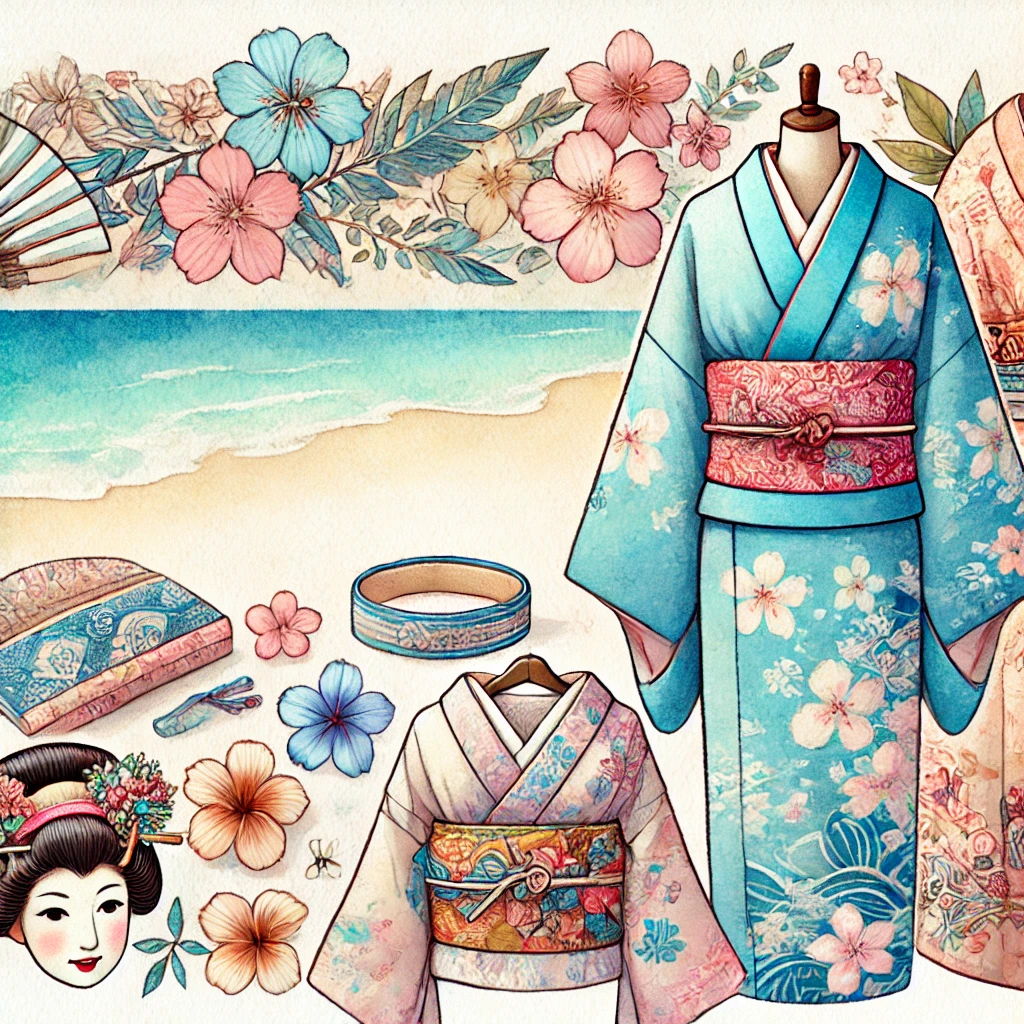
When you think of Okinawa, many people picture the blue ocean, white sandy beaches, and delicious food. However, Okinawa is not only about these attractive tourist spots but also boasts a rich culture nurtured through its long history. Among the most striking aspects of this culture are the traditional costumes of Okinawa, which reflect the history and spirituality of the region, embodying the very essence of Okinawa.
From the Bingata-dyed kimonos passed down since the Ryukyu Kingdom era to the light and beautiful Miyako Jofu, and the Kariyushi wear that represents modern Okinawa, the traditional clothing of Okinawa is incredibly diverse. By unraveling the meanings and sentiments embedded in each piece of clothing, we can gain insight into the lives, values, and rich spiritual world of the Okinawan people.
For instance, the patterns of waves, flowers, and birds depicted on Bingata-dyed kimonos are not merely decorative. They express the respect and gratitude the islanders have for nature and their ancestors. Additionally, the vibrant colors seen in Kumiodori costumes and Eisa dance costumes symbolize the significance of these garments in festivals and rituals.
However, the environment surrounding Okinawa’s traditional clothing is far from optimistic. There are various challenges, such as the shortage of successors to inherit the traditional garment-making techniques and the changes in lifestyle leading to a decline in the use of traditional clothing.
Therefore, it might be necessary for us to reconsider the value of Okinawa’s traditional clothing. Protecting the beautiful garments passed down from our ancestors and passing them on to the next generation is an effort to connect Okinawa’s history, culture, and spirit to the future.
In this blog post, we will introduce the profound world of Okinawa’s traditional clothing. We will delve into the features and history of various garments such as Bingata-dyed kimonos, Miyako Jofu, and Bashofu, and the efforts to preserve these traditions in the modern era. We hope that through Okinawa’s traditional clothing, you will feel the charm of the land and the sentiments of its people.
- An Overview of Okinawa’s Traditional Clothing
- Women’s Clothing
- Men’s Clothing
- Clothing for Festivals and Rituals
- Preservation of Traditional Clothing in the Modern Era
- Okinawa’s Spiritual World and Traditional Clothing
- Traditional Clothing as a Mirror Reflecting Okinawa’s Unique Culture
- Q&A
- Conclusion
An Overview of Okinawa’s Traditional Clothing
Traditions from the Ryukyu Kingdom Era
Historical Background
Okinawa’s traditional clothing is a part of the cultural heritage passed down since the Ryukyu Kingdom era. The Ryukyu Kingdom, which ruled the Okinawan islands from the 15th to the 19th century, cultivated a unique culture and tradition. During this time, Okinawa developed its distinctive culture while interacting with China, Japan, and Southeast Asian countries through trade.
It is said that Okinawa’s traditional clothing was established during this Ryukyu Kingdom period. To demonstrate the kingdom’s prestige, royalty and nobility wore luxurious garments that featured distinctive colors, patterns, and materials. These garments have been passed down through generations and continue to symbolize Okinawa’s traditional culture to this day.
Influences from China and Mainland Japan
Okinawa’s traditional clothing has been heavily influenced by its interactions with China and mainland Japan. During the Ryukyu Kingdom era, Okinawa was under the Chinese tributary system, receiving titles for its kings from the Chinese emperor. Consequently, Okinawan culture was strongly influenced by Chinese culture, and clothing was no exception.
For example, Bingata dyeing, used in women’s kimonos, is said to have originated from China. Additionally, the hakama
worn by men as formal attire reflects the influence of samurai culture from mainland Japan. The use of colors and motifs in these garments also shows the impact of Chinese and Japanese culture.
Thus, Okinawa’s traditional clothing has uniquely evolved by incorporating various cultural elements through its exchanges with China and mainland Japan.
Characteristics and Materials of the Clothing
Symbolism of Colors
Okinawan traditional clothing is known for its vibrant colors. Red, yellow, blue, and green are commonly used, each carrying symbolic meanings.
For example, red symbolizes the sun and vitality, yellow represents nobility and wealth, blue stands for the sea and sky, and green signifies nature and fertility. These colors are deeply connected to Okinawan nature, beliefs, and values, making the colors used in the clothing not just decorative but also spiritually significant.
Materials and Dyeing Techniques
The materials used in Okinawan traditional clothing are mainly natural fibers such as hemp, cotton, and silk. These materials are well-suited to Okinawa’s climate, offering excellent moisture absorption and breathability.
Various dyeing techniques are employed to enhance the beauty of the garments. Among the most famous are Bingata dyeing and indigo dyeing. Bingata dyeing involves using stencils to create intricate patterns, producing delicate and beautiful designs. Indigo dyeing uses dye extracted from indigo leaves, resulting in a rich blue color.
These dyeing techniques are traditional methods passed down through generations, preserved by skilled artisans. The meticulously dyed fabrics are essential in highlighting the beauty of Okinawa’s traditional clothing.
Women’s Clothing
Bingata-Patterned Kimonos
History and Techniques of Bingata
Bingata is one of Okinawa’s representative dyeing techniques, often used in women’s kimonos. Its history dates back to the 15th century. Bingata developed uniquely in Okinawa based on dyeing techniques that were introduced from China.
Bingata is characterized by using stencils to dye patterns onto fabric. These stencils, intricately cut with designs, are placed on the fabric and dye is applied to create the patterns. Repeating this process multiple times produces complex and beautiful motifs.
The dyes used in Bingata are mainly plant-based. Notable examples are Ryukyu indigo, extracted from indigo plants cultivated in Okinawa, known for its deep blue color, and Fukugi, a yellow dye that, when combined with indigo, produces green.
Representative Patterns and Their Meanings
Bingata kimonos feature various patterns, many of which are inspired by nature.
For example, wave and spiral patterns represent the sea. As Okinawa is surrounded by the ocean, the sea is indispensable to the lives of the people. These patterns express gratitude for the ocean’s blessings and coexistence with nature.
Additionally, motifs of flowers, butterflies, and birds are commonly seen, representing the beauty and vitality of nature. Patterns like hibiscus and banana fiber (bashofu) are particularly popular, symbolizing representative plants of Okinawa.
Geometric patterns are also used, such as arrow feather designs representing the arrows of warriors, symbolizing strength and courage, and hexagonal patterns representing longevity and good fortune.
Thus, the motifs in Bingata reflect Okinawa’s nature, beliefs, and values, allowing one to feel the culture of Okinawa through the kimonos.
Hanagasa and Tekko
The Role of Accessories in Enhancing Clothing
Okinawan women’s traditional attire is complemented by various accessories, most notably the hanagasa and tekko.
The hanagasa is a hat worn on the head, serving as an important accessory that enhances the kimono. It is decorated with artificial flowers, Bingata-dyed cloth, and metal ornaments, creating a festive appearance. The hanagasa also serves a practical purpose by providing shade from the sun, combining functionality and decoration.
The tekko are cloth covers for the back of the hands, typically designed to match the kimono’s patterns. Embroidered or Bingata-dyed, tekko enhance the elegance of the outfit with their gentle movement as the hands move.
Types and Materials of Hanagasa
Hanagasa vary in type and material.
The most common is the kuba hat, made from the bark of the kuba tree. It is lightweight and durable, decorated with Bingata cloth and artificial flowers. The kuba hat is essential for ceremonial occasions such as weddings and coming-of-age ceremonies.
Another type is the birou hat, made from birou leaves. It is lighter than the kuba hat and is often used in everyday settings, prioritizing practicality.
In recent years, metal hanagasa have also appeared, known for their durability and high decorative value. Modern designs are sometimes incorporated, making these hats a fusion of tradition and innovation.
Thus, hanagasa come in various types and are chosen according to用途 and occasions, playing an important role in enhancing Okinawan women’s traditional attire.
Miyako Jofu and Bashofu
Characteristics and Production Process of Miyako Jofu
Miyako Jofu, produced on Miyako Island in Okinawa, is highly regarded for its quality, earning the title “phantom fabric.” Miyako Jofu is woven using fibers from the choma plant.
The process begins by extracting fibers from the inner bark of the choma stalks, which are then spun into threads by hand. These threads are used to weave the fabric on traditional handlooms, with skilled artisans meticulously creating the fine fabric.
Miyako Jofu is known for its lightness and luster. The smooth, silk-like texture and fine weave give it a beautiful sheen.
Miyako Jofu is highly valued as material for kimonos, especially summer kimonos. Its smooth texture and excellent breathability make it perfect for Okinawa’s hot climate.
History and Modern Preservation of Bashofu
Bashofu is a fabric made from the fibers of the banana plant, representing one of Okinawa’s traditional crafts. Its history dates back to the 15th century.
The process begins with cutting and stripping the bark from the banana stalk. The fibers are soaked in water to soften them and then extracted by hand. These fibers are spun into threads, which are then woven into fabric on traditional handlooms.
Bashofu fabric is known for its softness and unique sheen. It is used not only for kimonos but also for obi (sashes) and traditional accessories. In recent years, bashofu has been used to create modern products such as bags, wallets, and home decor items.
Efforts to preserve traditional bashofu techniques and adapt them to modern lifestyles have brought new appeal to this fabric. Initiatives to pass on these skills to future generations help maintain the value of bashofu as a traditional Okinawan craft.
Men’s Clothing
Kariyushi Wear
The Origins of Kariyushi Wear
Kariyushi wear is one of the modern traditional clothing items representing Okinawan men. Its origins trace back to the 1970s when Okinawa needed lightweight attire suitable for the summer heat.
The term “kariyushi” means “stylish” in the Okinawan dialect. Kariyushi wear features colorful and vibrant designs that adapt traditional Bingata patterns.
Initially designed for tourists, kariyushi wear soon became beloved by locals as well. Today, it is widely accepted in business settings and everyday fashion, becoming a staple in Okinawan men’s wardrobes.
Design Characteristics and Wearing Occasions
Kariyushi wear often features motifs inspired by Okinawan nature and culture, such as wave patterns representing the sea and designs adapted from the crests of the Ryukyu Kingdom era.
The color palette is bright and vivid, with shades of red, yellow, blue, and green reflecting Okinawa’s beautiful nature. The asymmetrical design is a common characteristic, adding a modern touch to the traditional motifs.
Kariyushi wear is versatile, suitable for both business and casual settings. It is commonly worn in offices, similar to aloha shirts, and is popular for weddings, parties, summer festivals, and fireworks displays.
Kariyushi wear’s modern adaptations of traditional patterns make it a cherished garment that allows people to feel connected to Okinawan culture.
Bingata Obi and Woven Hakama
The Importance of Obi and Hakama in Formal Wear
Okinawan men’s formal wear includes the Bingata obi and woven hakama. The obi is a sash worn around the waist over the kimono, not only securing the kimono but also serving a decorative purpose. The hakama, also known as momohiki, is a loose-fitting garment covering the legs from the waist to the ankles.
Formal kimonos are typically plain black or navy. The bright and vibrant obi and hakama add a touch of elegance and vibrancy to the formal attire, making them indispensable items in traditional Okinawan men’s fashion.
Patterns and Colors of Bingata Obi
The obi used in formal wear is often finished with Bingata dyeing. Bingata obi feature various patterns, including waves and geometric designs.
Wave patterns symbolize the surrounding sea, an essential part of Okinawan life. Geometric patterns often adapt the crests from the Ryukyu Kingdom era, evoking a sense of history and tradition.
The colors are vivid, with red being particularly popular for celebratory occasions. The unique blending and layering of colors characteristic of Bingata dyeing add a distinct charm to the obi, making it an essential element in formal wear.
Clothing for Festivals and Rituals
Kumiod ori Costumes
History and Role of Costumes in Kumiodori
Kumiodori, a traditional Okinawan performing art developed during the Ryukyu Kingdom era, is a comprehensive stage art combining music, dance, and acting. Its history dates back to the early 18th century.
Costumes in Kumiodori play a crucial role in expressing the characters’ status, personality, and the atmosphere of the scenes. They include kimonos, hakama, obi, and headpieces, adorned with vibrant colors and luxurious decorations.
Costumes are integral to the visual storytelling of Kumiodori, enhancing the narrative and the performers’ movements, making them indispensable to the performance’s allure.
Costume Characteristics for Different Characters
Kumiodori characters are broadly categorized into nobility, warriors, and commoners, each with distinct costume characteristics.
Nobility costumes are the most luxurious and flamboyant, featuring fabrics woven with gold and silver threads and adorned with vibrant Bingata dyeing. Crowns and hairpieces with gold and silver decorations are also used.
Warrior costumes are less extravagant but still feature Bingata-dyed kimonos paired with hakama and obis. The colors are usually more subdued to convey the warrior’s stoic nature.
Commoner costumes are simpler, typically plain kimonos with minimal decoration. However, higher-ranking merchants among commoners may wear Bingata-dyed kimonos.
Thus, Kumiodori costumes are essential in portraying the characters’ status and personality, adding depth to the performance.
Eisa Costumes
Origins and Significance of Eisa
Eisa is a traditional Okinawan dance performed during the Obon season in the lunar calendar, serving as an important event for ancestor worship. Its origins are said to trace back to the Bon dances brought from China.
Eisa features dynamic drumbeats, lively shouts, and spirited dancing, with the central figure playing the sanshin, a traditional Okinawan instrument, to keep the rhythm. Eisa is an essential ritual for honoring ancestors and praying for a good harvest.
Design and Regional Variations of Costumes
Eisa costumes vary by region. Generally, men wear red waistcloths with bare upper bodies, while women wear red kimonos with white collars and belts.
Headwear includes headbands or kachashii, featuring various patterns like “Hama Chidori” and “Wakamatsu,” differing by region.
For example, Naha City’s Eisa costumes are characterized by red and white checkered kimonos with black belts, while Nago City in northern Okinawa features purple-red kimonos with gold belts.
Thus, Eisa costumes reflect regional traditions and customs, maintaining diverse forms through local variations.
Preservation of Traditional Clothing in the Modern Era
Technical Succession in Clothing Production
The Role of Traditional Craftspersons
The traditional clothing of Okinawa is supported by skilled artisans known as traditional craftspersons. These artisans, with their extensive experience, create beautiful garments using sophisticated techniques.
For instance, Bingata dyeing artisans possess advanced skills in using stencils to create patterns, conducting all processes by hand. Similarly, artisans of Bashofu and Miyako Jofu uphold handweaving techniques to produce traditional fabrics.
Traditional craftspersons not only create garments but also serve as custodians of the techniques, passing them on to apprentices and future generations. Their mission is to ensure the survival of these traditional skills.
Passing Techniques to the Younger Generation
Recently, the shortage of successors in Okinawan traditional crafts has become a concern. Many young people are not pursuing traditional craft paths, making it challenging to pass on the skills.
In response, various initiatives have been undertaken by Okinawa Prefecture. For example, workshops where traditional craftspersons visit schools to let children experience the techniques firsthand, and events to promote the charm of traditional crafts are organized.
Additionally, traditional craftspersons themselves are using social media for information dissemination and conducting workshops to appeal to the younger generation.
These efforts gradually increase young people’s interest in traditional crafts, making the succession of techniques an indispensable activity for connecting Okinawa’s traditional clothing to the future.
Utilizing Traditional Clothing as a Tourism Resource
Expansion of Experiential Tourism
In recent years, experiential menus utilizing traditional clothing have gained popularity in Okinawa tourism. Tourists can wear traditional clothing and experience Okinawan culture firsthand, adding to the attraction.
For example, in dressing experiences, visitors can try on Bingata-dyed kimonos and hanagasa, enjoying the traditional attire of Okinawa. Additionally, photo tours in traditional clothing amid Okinawa’s beautiful nature are popular, creating memorable experiences.
Such experiential tourism provides an excellent opportunity to deepen understanding of Okinawan culture and history, leading to repeat visitors through the appeal of traditional clothing.
Rental Services for Traditional Clothing
Rental services for traditional clothing have also been expanding within Okinawan tourism. Rental shops offer various traditional garments, including Bingata-dyed kimonos, hanagasa, and kariyushi wear.
Rental clothing is popular among tourists for its convenience in experiencing traditional Okinawan attire. It is often used for special memories such as pre-wedding photoshoots and family vacation pictures.
These rental services not only meet tourists’ needs but also provide work for garment-making artisans. By creating rental garments, traditional craftspersons find new opportunities to apply their skills.
Thus, traditional clothing plays an essential role as a tourism resource. Continuously promoting the charm of Okinawa’s culture through experiential tourism and rental services is key to preserving traditional clothing for the future.
Okinawa’s Spiritual World and Traditional Clothing
Harmony with Nature
Natural Motifs in Traditional Clothing
Okinawan traditional clothing often features designs inspired by nature, reflecting the deep connection between the people of Okinawa and the natural world around them.
For example, Bingata-dyed kimonos showcase patterns of waves, flowers, and birds, representing elements of nature. Miyako Jofu and Bashofu fabrics also incorporate plant motifs. These designs are not just decorative; they express reverence and gratitude towards nature.
Similarly, Kariyushi wear frequently features designs inspired by the sea, sky, and flowers, representing the beautiful natural environment of Okinawa. Through these garments, the importance of living in harmony with nature is conveyed.
Relationship between Clothing and Natural Materials
Okinawan traditional clothing is often made using natural materials. For instance, Bashofu is woven from fibers extracted from the bark of banana plants, and Miyako Jofu uses fibers from the choma plant.
These natural materials are cultivated within the local environment of Okinawa. Utilizing these natural resources to create clothing reflects the wisdom of the Okinawan people in coexisting with nature.
Moreover, the dyes used in Bingata dyeing often come from natural sources such as plants and shells. By using natural colors instead of chemical dyes, the beauty of Okinawa’s natural environment is expressed.
The relationship between clothing and natural materials highlights the deep connection between the people of Okinawa and nature. The spirit of living in harmony with nature is expressed and passed down through traditional clothing.
Ancestor Worship and Rituals
The Symbolism of Clothing in Festivals
Ancestor worship is a deeply rooted belief in Okinawa, and various festivals are held throughout the year. Traditional clothing plays a significant role in these festivals.
During the Obon festival in the lunar calendar month of July, families dress in traditional clothing to welcome the spirits of their ancestors. Women wear Bingata-dyed kimonos and hanagasa, while men don Kariyushi wear. Wearing traditional clothing expresses respect for ancestors and strengthens family bonds.
The Ryukyu Kingdom Festival at Shuri features processions of people in luxurious costumes, recreating ceremonies from the kingdom era. The vibrant clothing symbolizes the dignity and prosperity of the kingdom, as well as the weight of tradition passed down from ancestors.
In these ways, traditional clothing in festivals is not merely decorative but holds significant meaning as a symbol of respect for ancestors and tradition.
Sentiments toward Ancestors in Clothing
Okinawan traditional clothing embodies sentiments toward ancestors. For example, some Bingata patterns are adapted from family crests. Family crests symbolize familial ties and heritage passed down through generations. By incorporating crests into clothing, the connection with ancestors is honored and family bonds are strengthened.
Traditional clothing-making techniques, such as Bingata dyeing and weaving, are skills inherited from ancestors. Creating garments using these traditional methods is an expression of gratitude toward the ancestors.
Additionally, taking care of and preserving traditional clothing reflects respect for ancestors. These garments are not just items but treasures filled with family history and memories. Passing these garments on to future generations is an act of connecting the baton of heritage from ancestors to the future.
Okinawan traditional clothing deeply reflects the idea of ancestor worship. Through these garments, connections with ancestors are felt and family bonds are deepened. This is an invaluable cultural spirit for the people of Okinawa.
Traditional Clothing as a Mirror Reflecting Okinawa’s Unique Culture
Traditional Clothing Narrates Okinawa’s History and Culture
Okinawan traditional clothing is not just attire but a mirror reflecting the history and culture of Okinawa. The meanings and sentiments embedded in various garments, such as Bingata-dyed kimonos, woven fabrics, and Kariyushi wear, are deeply connected to the lives and values of the Okinawan people.
For instance, Bingata-dyed kimonos convey the splendor and aesthetic sense of the Ryukyu Kingdom era. Miyako Jofu and Bashofu are the crystallization of the wisdom and techniques developed by the Okinawan people in a harsh natural environment. Kariyushi wear expresses the open atmosphere and love for nature inherent in Okinawa.
These garments reflect the characteristics of different eras and regions, narrating the diversity and depth of Okinawan culture. Through traditional clothing, one can reflect on Okinawa’s history and connect with the endeavors of past generations.
The Future and Preservation of Traditional Clothing
Okinawan traditional clothing is a cultural heritage nurtured and passed down through a long history. However, with the changes in modern society, traditional garment-making techniques are at risk of being lost.
To ensure the future of traditional clothing, it is essential to pass down techniques and broadly communicate the value of clothing culture. This requires training artisans, expanding markets for traditional crafts, and various other measures.
Utilizing traditional clothing as a tourism resource is also a crucial effort for preservation. Experiential tourism and rental services help increase awareness and interest in traditional clothing among many people.
Traditional clothing is not merely a tourist attraction but a cornerstone of the Okinawan people’s identity and spirit. Recognizing its value and carefully preserving and passing it down to future generations is our collective responsibility.
Okinawan traditional clothing is an invaluable treasure woven from history, culture, nature, and the lives of people. Protecting and connecting these garments passed down from ancestors to the future ensures that the spirit of Okinawa shines eternally.
This blog post provides an in-depth exploration of the diversity of Okinawan traditional clothing and the historical and cultural significance embedded in each garment. By touching on the symbolic meanings and the spirituality of the Okinawan people behind the clothing, the article goes beyond mere introduction, offering a profound insight into the subject.
Additionally, the article addresses modern challenges in the preservation of traditional clothing and its utilization as a tourism resource, emphasizing the importance of passing down this heritage to future generations. This highlights that Okinawan traditional clothing is not just a relic of the past but an essential aspect of our present lives.
Finally, the article reaffirms the intrinsic value of Okinawan traditional clothing and emphasizes the importance of its preservation and transmission. Traditional clothing embodies the spirit of Okinawa, and by connecting it to the future, we ensure the perpetuation of Okinawa’s soul.
I hope this blog post serves as a gateway for many to discover the profound world of Okinawan traditional clothing and contributes to a deeper understanding and appreciation of Okinawan culture.
Q&A
What is the representative traditional clothing for women in Okinawa?
The representative traditional clothing for women in Okinawa is the Bingata-patterned kimono. Known for its vivid colors and intricate designs, it utilizes the Bingata dyeing technique.
What is Kariyushi wear?
Kariyushi wear is a modern traditional garment representing Okinawan men. It features colorful and vibrant designs that adapt traditional Bingata patterns, suitable for various occasions from business to casual settings.
What are the representative woven fabrics used in Okinawan traditional clothing?
The representative woven fabrics used in Okinawan traditional clothing are Miyako Jofu and Bashofu. Miyako Jofu is a light and durable fabric made from choma plant fibers, while Bashofu is a delicate and glossy fabric made from banana plant fibers.
What are the characteristics of Kumiodori costumes?
Kumiodori costumes are designed to reflect the status and personality of the characters, featuring vivid colors and luxurious decorations. Noble characters wear the most extravagant costumes woven with gold and silver threads, while warrior costumes typically include Bingata-dyed kimonos paired with hakama.
What is necessary to pass down Okinawan traditional clothing to the future?
To pass down Okinawan traditional clothing to the future, it is crucial to preserve traditional garment-making techniques and communicate the value of clothing culture widely. Flexible approaches, such as utilizing traditional clothing as a tourism resource and designing new garments suited to modern lifestyles, are also needed.
Conclusion
In this blog post titled “Okinawa’s Traditional Clothing and Its Varieties,” we have detailed the history, characteristics, and modern preservation efforts of Okinawan traditional clothing.
Okinawan traditional clothing, passed down since the Ryukyu Kingdom era, has evolved uniquely while incorporating influences from China and mainland Japan. The Bingata-patterned kimono for women is renowned for its vivid colors and intricate patterns. For men, Kariyushi wear is a popular modern garment representing Okinawa.
We also introduced traditional woven fabrics like Miyako Jofu and Bashofu, as well as special attire for festivals and rituals, such as Kumiodori and Eisa costumes. These garments reflect Okinawa’s nature, beliefs, and history, embodying profound meanings beyond mere attire.
In modern times, various efforts are being made to preserve traditional clothing techniques and utilize them as tourism resources. However, challenges such as the shortage of successors highlight the need for continued efforts.
Okinawan traditional clothing is an invaluable treasure woven from history, culture, nature, and beliefs. Recognizing its value and carefully preserving and passing it down to future generations is our responsibility.
I hope this blog post helps many people discover the charm and depth of Okinawan traditional clothing and deepens understanding and interest in Okinawan culture.


コメント