
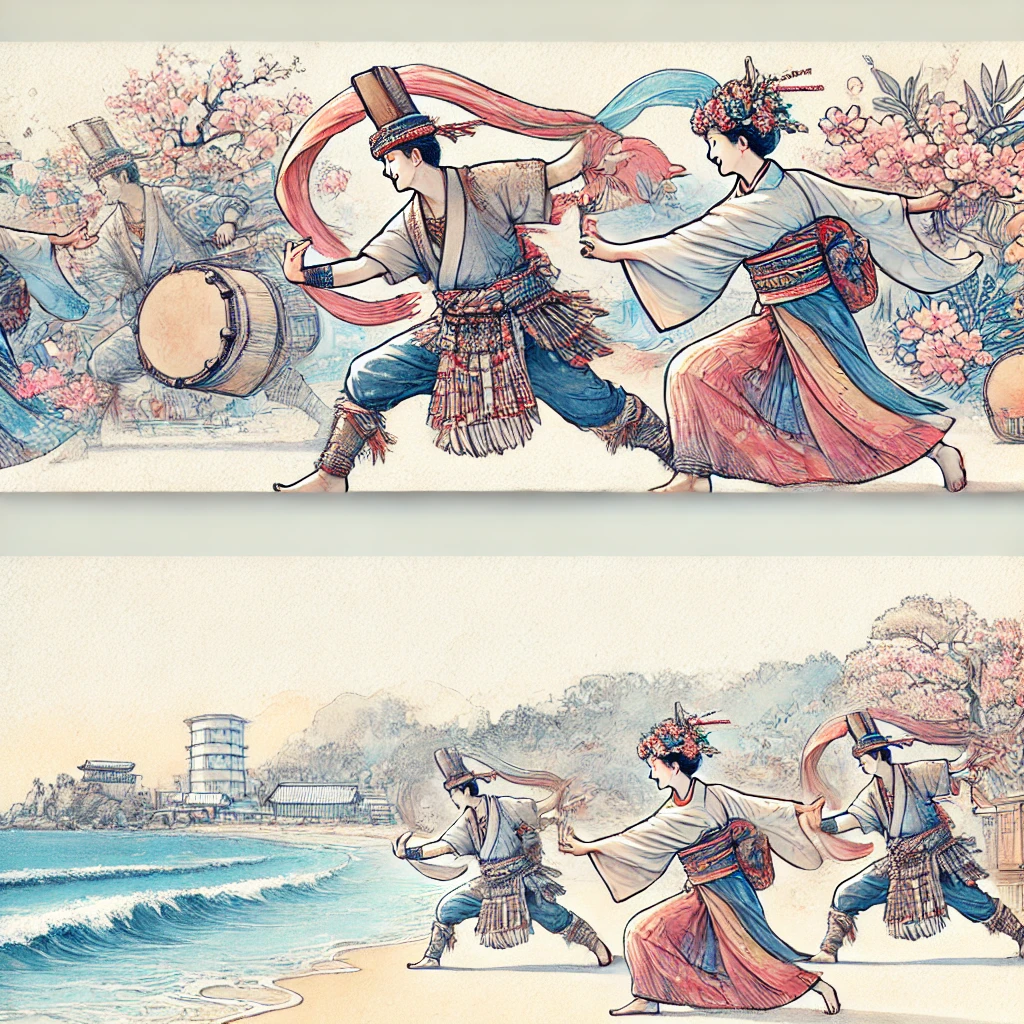
When you hear the word “Okinawa,” what comes to mind? Beautiful beaches, blue seas, and islands rich with natural beauty. It’s a region where unique culture and traditions thrive. Among these, Okinawa’s traditional dances captivate many as an art form that embodies the soul and history of the land.
Kumiodori, Ryukyu dance, and Eisa are representative traditional dances of Okinawa. Kumiodori is a theatrical performance with themes of love and loyalty. Ryukyu dance originates from the court dances of the Ryukyu Kingdom era and is divided into male and female dances. Eisa is a dance developed as a Bon dance, characterized by the use of drums and paranku (a type of hand drum). Each of these dances holds its own unique history and charm.
However, these dances are not merely for entertainment. They carry spiritual significance, expressing prayers, celebrations, ancestor worship, and gratitude for bountiful harvests, while also strengthening communal bonds. Through dance, the people of Okinawa have expressed their connection to nature and their ancestors, deepening their community ties.
Even in modern society, Okinawa’s traditional dances hold great importance. Amidst globalization, it is crucial to preserve Okinawa’s unique culture and pass it down to future generations. Efforts are being made to utilize these traditions as tourism resources and to engage the younger generation’s interest in cultural heritage.
Understanding and respecting Okinawan traditional dance contributes to a society that embraces diversity. Connecting precious cultural heritage to the future is also our responsibility as individuals living in the present.
The ancient dances of Okinawa are imbued with beauty, strength, and profound spirituality. Wouldn’t you like to listen to the emotions embedded in each movement? Surely, you will find something that stirs your heart.
This time, we will explore the charm and modern significance of Okinawa’s traditional dances. Let us together savor the art that history and culture have woven.
- Introduction
- Ancient Okinawan Dances
- The Spirituality Embedded in Okinawan Dance
- Traditions Carried Forward in the Modern Era
- Conclusion
- Q&A
- Summary
Introduction
The Rich Culture and History of Okinawa
The Nature and Historical Background of the Islands
Okinawa Prefecture, located at the southernmost tip of Japan, is a collection of beautiful islands blessed with a warm climate and abundant nature. Since ancient times, Okinawa has nurtured its unique culture. During the Ryukyu Kingdom era, diverse cultures flowed into Okinawa through trade with China and Southeast Asia, forming Okinawa’s unique culture. The tragic history of intense battles during World War II, which claimed many lives, is also deeply etched into the hearts of the Okinawan people, fostering a strong desire for peace.
Unique Language and Customs
Okinawa has its own language, “Uchinaaguchi,” which features distinct pronunciation and grammar from standard Japanese, allowing for heartfelt expressions unique to the people of Okinawa. Additionally, customs and values unique to Okinawa, such as the spirit of mutual aid known as “Yui Maru” and the life philosophy of “Ichari-bachode,” are deeply rooted in the lives of Okinawan people, supporting their rich culture.
The Importance of Traditional Dances
The Roles Played by the Dances
Okinawan traditional dances are not merely for entertainment but are deeply connected to people’s lives. They are performed at occasions of prayer and celebration, expressing feelings of ancestor worship and gratitude for bountiful harvests. These dances also strengthen village and regional unity, being passed down through generations. For the people of Okinawa, dance is an essential and cherished part of life.
The Significance of Dance in Modern Society
In modern society, Okinawan traditional dances remain highly significant. As globalization progresses, it is crucial to preserve and pass down Okinawa’s unique culture to future generations. Furthermore, in today’s stressful society, these dances bring joy and healing, promoting mental and physical well-being. They are also essential in promoting Okinawa’s appeal domestically and internationally as a tourism resource. Traditional dances enrich the lives of Okinawan people even today.
Ancient Okinawan Dances
Kumiodori
The Origin and Development of Kumiodori
The Contributions of Dance Magistrate Tamaki Chokun
Kumiodori was founded in the early 18th century by Tamaki Chokun, a dance magistrate of the Ryukyu Kingdom. Under the order of King Sho Kei, Tamaki Chokun developed Ryukyu’s own theatrical performances, incorporating elements from Chinese theater. Kumiodori evolved as a comprehensive art form that integrates music, dance, and acting.
The Establishment and Development of Kumiodori
Established by Tamaki Chokun, Kumiodori was subsequently inherited and developed by many people. The emphasis on storytelling led to the creation of numerous works themed around love and loyalty. The unique gestures and expressions of Kumiodori were established, and it came to be recognized as a high-art theatrical performance. Today, Kumiodori remains a representative traditional performing art of Okinawa, beloved by many.
Representative Plays and Stories
The Story of “Shushin Kaneiri”
“Shushin Kaneiri” is one of Kumiodori’s representative plays, depicting the love story of a young couple, their deep love, and the obstacles they face, movingly portrayed. The passionate dances of the couple and the heartfelt music are the highlights. It is a work that makes one feel the greatness of love’s power, cherished by many.
The Story of “Temizu no En”
“Temizu no En” depicts the loyalty of a retainer and his love for his lord. The protagonist, Wakamatsu, is prepared to sacrifice his life to clear his lord’s name. Wakamatsu’s strong will and unwavering loyalty to his lord make this a touching work. The valiant dance of Wakamatsu and the poignant music are highlights of the play.
Ryukyu Dance
Court Dance of the Ryukyu Kingdom Era
Influence of Chinese Culture
Ryukyu dance originates from the court dances of the Ryukyu Kingdom era, heavily influenced by Chinese culture due to active exchanges with China at the time. Elements of Chinese dance were incorporated into Ryukyu dance, leading to its unique development. The elegant gestures and luxurious costumes reflect the influence of Chinese culture.
Relationship with Court Events
Ryukyu dance was closely tied to court events during the Ryukyu Kingdom era. Dances were performed at national celebrations and diplomatic ceremonies, enjoyed by the royalty and nobility, showcasing authority and dignity through dance. Additionally, the dances served to highlight the superior aspects of Ryukyu culture to domestic and international audiences.
Characteristics of Male and Female Dances
The Strength and Vigor of Male Dance
Male dance in Ryukyu dance is characterized by its strength and vigor. The powerful rhythms of the drums are matched by strong, masculine movements, incorporating dynamic gestures like leaps and spins, expressing male strength and bravery. The bold expressions and shouts are also part of the allure of male dance.
The Grace and Refined Gestures of Female Dance
In contrast, female dance is characterized by grace and refined gestures. Movements are elegant and synchronized with slow music. The use of fans and traditional bingata costumes highlights the feminine beauty. Expressions and eye movements are also carefully crafted, enabling delicate emotional expression. Female dance is highly valued as an art form that expresses the beauty and dignity of Okinawan women.
Eisa
The Origin of Eisa as a Bon Dance
Relation to Ancestor Worship
Eisa originally developed as a Bon dance. In Okinawa, the Bon season involves rituals to welcome and console the spirits of ancestors. Eisa evolved as part of these rituals. It is still closely related to ancestor worship, with Eisa being vigorously performed during the Bon season to console the spirits of ancestors.
Regional Characteristics
Eisa has uniquely developed in different regions of Okinawa, each area displaying distinct dance gestures, music, and costumes. For example, in northern Okinawa Island, powerful male dances are predominant, while in the southern regions, many women participate, exhibiting graceful dances. In the Yaeyama Islands, unique costumes and music are used, showcasing the rich regional diversity of Eisa.
The Use of Drums and Paranku
Types and Playing Methods of Drums
Drums play a crucial role in Eisa. Along with string instruments like the sanshin, drums support Eisa’s music. There are large and small drums, each played differently. Large drums are struck with sticks to produce powerful rhythms, while small drums are hand-beaten to create lively rhythms. The drum rhythms are intricately connected to the dance movements, significantly influencing the atmosphere of Eisa.
The Role and Features of Paranku
Paranku is a distinctive Okinawan percussion instrument. It is a small hand drum played with sticks, producing rhythmic beats. Alongside drums, paranku supports Eisa’s music. The lively rhythms it creates energize the dance. The act of playing paranku itself is a highlight of Eisa. Dancers, striking paranku while performing rhythmic dances, embody the essence of Eisa.
The Spirituality Embedded in Okinawan Dance
Expressions of Prayer and Celebration
Manifestations of Prayers for Good Harvest and Gratitude
Okinawan traditional dances often express prayers for good harvests and gratitude. D
ances related to agricultural activities, like “Tanemaki Odori” performed during seed planting, convey strong prayers for abundant crops. “Odori Nembutsu” performed during the harvest season expresses gratitude for the bountiful harvest. Through dance, the people of Okinawa have expressed their thanks for nature’s blessings and hoped for plentiful yields.
Dances Celebrating Life’s Milestones
Traditional Okinawan dances are also performed to celebrate life’s milestones, such as weddings, births, and longevity celebrations. For example, “Kagiyadefu” danced at weddings, wishes happiness for the newlyweds. “Kajimaya,” performed to celebrate longevity, includes dances that bless long life. Through these dances, people celebrate significant life events and express their hopes for happiness.
Ancestor Worship and Gratitude for Abundant Harvests
Dances to Console the Spirits of Ancestors
Ancestor worship is deeply rooted in Okinawa. Traditional dances often carry the meaning of consoling ancestral spirits. As mentioned earlier, Eisa is performed during the Bon season to welcome and console the spirits of ancestors, with the sound of drums soothing their spirits. “Noro Odori,” a dance performed by women, also serves to console ancestral spirits, reflecting the spiritual values of the Okinawan people through dance.
Dances Expressing Gratitude for Abundant Harvests
Traditional Okinawan dances express gratitude for abundant harvests in various forms. For example, “Odori Nembutsu,” performed during the Bon season, is a representative dance that expresses both the consolation of ancestral spirits and gratitude for plentiful harvests. “Yotsutake,” often performed during rice harvesting, celebrates the rich harvest with rhythmic dance movements. “Taue Odori,” performed during the rice planting season, also symbolizes prayers for good harvests, reflecting the deep connection between the people and nature.
Strengthening Community Bonds
Dances that Deepen Village and Regional Unity
Traditional Okinawan dances also play a role in strengthening village and regional unity. Many dances involve the participation of the entire community. For instance, in the Bon dance “Yamatogwa,” villagers form a circle to dance together, fostering intergenerational exchange and strengthening communal ties. “Bo-jutsu,” a martial arts dance performed by young men, enhances camaraderie and fosters a sense of unity within the community.
Dances Passed Down Through Generations
Okinawan traditional dances have been passed down through generations, with many people engaging in dance from childhood to adulthood. The transmission of dance fosters intergenerational connections and the preservation of tradition. For example, the women’s dance “Teinsagu no Hana” has been handed down from mothers to daughters, with each generation learning and preserving the graceful movements. This intergenerational transmission supports the continuity of Okinawa’s traditional dances.
Traditions Carried Forward in the Modern Era
Efforts to Preserve Dance
Initiatives by Local Cultural Organizations
To preserve and pass down Okinawa’s traditional dances to future generations, local cultural organizations are actively engaged in various efforts. Preservation societies and dance classes are held to educate younger generations about these dances. Additionally, public performances are conducted to share the charm of traditional dances with a wider audience. The diligent activities of these cultural organizations support the continuation of Okinawa’s traditional dances.
Incorporating Traditional Arts into School Education
In Okinawan school education, the integration of traditional arts is also progressing. Lessons incorporating traditional dances are conducted in elementary and junior high schools, providing children with opportunities to connect with Okinawan culture and history through dance. High schools and universities also offer learning and practical experiences related to traditional arts, playing a significant role in passing down these cultural traditions to the next generation.
Utilization as a Tourism Resource
Performances and Experience Programs for Tourists
Okinawa’s traditional dances are also highlighted as tourism resources. Performances for tourists are held in various locations, showcasing the charm of Okinawan culture. Programs allowing tourists to experience dances like Eisa and Ryukyu dance themselves help deepen their understanding of Okinawan culture. These experience programs play an essential role in promoting Okinawa’s appeal.
Promotion Activities Domestically and Internationally
Okinawan traditional dances are utilized in promotion activities both domestically and internationally. They are performed at international events and cultural exchange projects, providing opportunities for people worldwide to appreciate the charm of Okinawan culture. Additionally, Okinawan dances are increasingly featured in domestic events and media, broadening the recognition of their value through these promotional efforts.
The Importance of Passing Down Traditions to the Next Generation
Efforts to Engage Younger Generations
To ensure the continuity of Okinawa’s traditional dances, it is essential to engage younger generations. Incorporating modern elements into traditional dances has been effective in attracting young people. For instance, integrating contemporary music or altering costumes has made these dances more appealing to the youth. Additionally, utilizing social media and the internet for information dissemination has been successful in sharing the allure of traditional dances with younger audiences.
Balancing Tradition and Innovation
Maintaining a balance between preserving traditions and embracing innovation is crucial for passing down traditional dances to future generations. It is important to respect traditional gestures and music while finding ways to present them that resonate with contemporary society. By avoiding excessive changes and seeking ways to adapt expressions to the times, Okinawa’s traditional dances can continue to be cherished and passed down to future generations.
Conclusion
The Allure of Okinawa’s Traditional Dances
Artistic Value Woven by History and Culture
Okinawa’s traditional dances possess artistic value woven by long history and rich culture. The movements, music, and costumes inherited from ancestors create a beautifully harmonious stage art. Through dance, one can contemplate Okinawa’s history and culture. The artistic value that has been passed down through generations is one of the great attractions of Okinawa’s traditional dances.
The Power to Captivate Modern People
Okinawa’s traditional dances have the power to captivate people living in the present day. These dances, inherited from ancient times, continue to move many hearts in contemporary society. The universal beauty and powerful energy of traditional dances appeal to modern sensibilities. Additionally, the ability to find solace and escape from the hustle and bustle of modern life through these dances adds to their charm. Okinawa’s traditional dances continue to provide profound emotions to people living today.
The Need to Understand and Respect Okinawan Culture
Achieving a Society that Embraces Diversity
Understanding and respecting Okinawan traditional dances contribute to creating a society that embraces diversity. It is essential to cherish Okinawa’s unique culture and recognize its value. Similarly, recognizing the value of cultures from other regions is important. By respecting cultural diversity, a richer society can be realized. Okinawa’s traditional dances offer insights towards achieving a society that embraces diversity.
The Responsibility to Pass Down Traditional Culture to the Future
Passing down Okinawa’s traditional dances to the future is our responsibility. We must hand over the precious culture inherited from our ancestors to the next generation. Preserving traditional culture requires time and effort. However, this effort is indispensable for leaving Okinawa’s rich culture to the future. Each individual must recognize the importance of traditional culture and take actions towards its preservation. Okinawan traditional dances remind us of the responsibility to connect traditional culture to the future.
Okinawa’s traditional dances possess the artistic value of history and culture and continue to captivate people today. Understanding and respecting their significance is required of us. For realizing a society that embraces diversity and for connecting traditional culture to the future, we must reconsider the meaning of Okinawa’s traditional dances. It is our responsibility to hand over the precious culture inherited from our ancestors to the next generation.
Q&A
What are some traditional Okinawan dances?
Representative traditional dances of Okinawa include Kumiodori, Ryukyu dance, and Eisa. Kumiodori, established in the early 18th century, is a comprehensive art form integrating music, dance, and acting. Ryukyu dance, originating from the court dances of the Ryukyu Kingdom era, is divided into male and female dances. Eisa is a Bon dance performed to console ancestral spirits and pray for bountiful harvests.
What spiritual significance is embedded in Okinawan traditional dances?
Okinawan traditional dances embody various spiritual significances such as expressions of prayers and celebrations, ancestor worship, and gratitude for abundant harvests, and the strengthening of community bonds. For instance, there are dances to console ancestral spirits and express gratitude for good harvests. They also play a role in deepening village and regional unity.
What roles do Okinawan traditional dances play in modern society?
In modern society, Okinawan traditional dances play roles in cultural preservation, utilization as tourism resources, and strengthening regional unity. Cultural organizations conduct preservation activities, and traditional arts are incorporated into school education. Tourist performances and experience programs are also important in promoting Okinawa’s appeal.
What efforts are being made to pass down Okinawan traditional dances to the next generation?
Efforts to pass down Okinawan traditional dances include engaging younger generations through incorporating modern elements, and balancing the preservation of traditions with innovation. Modern music and costume adaptations, along with information dissemination through social media, have made these dances more appealing to young people.
What is the significance of understanding and respecting Okinawan traditional dances?
Understanding and respecting Okinawan traditional dances contribute to achieving a society that embraces diversity and fulfilling the responsibility to pass down traditional culture to the future. Cherishing Okinawa’s unique culture and recognizing its value are essential. Passing down the precious culture inherited from our ancestors to the next generation is our responsibility.
Summary
In this article on “Okinawan Traditional Dances and Their Origins,” we introduced Kumiodori, Ryukyu dance, and Eisa, which are representative traditional dances of Okinawa. These dances embody various spiritual significances such as expressions of prayers and celebrations, ancestor worship, and gratitude for abundant harvests, and the strengthening of community bonds. In modern society, traditional dances play important roles in cultural preservation, utilization as tourism resources, and strengthening regional unity.
Efforts to engage younger generations and balance tradition with innovation are being made for the continuation of these dances. Understanding and respecting Okinawan traditional dances contribute to achieving a society that embraces diversity and fulfilling the responsibility to pass down traditional culture to the future.
Okinawa’s traditional dances, woven with the artistic value of history and culture, continue to captivate people today. We are responsible for handing over this precious culture to the next generation. It is important to reconsider the significance of Okinawa’s traditional dances and respect them to connect them to the future.


コメント