
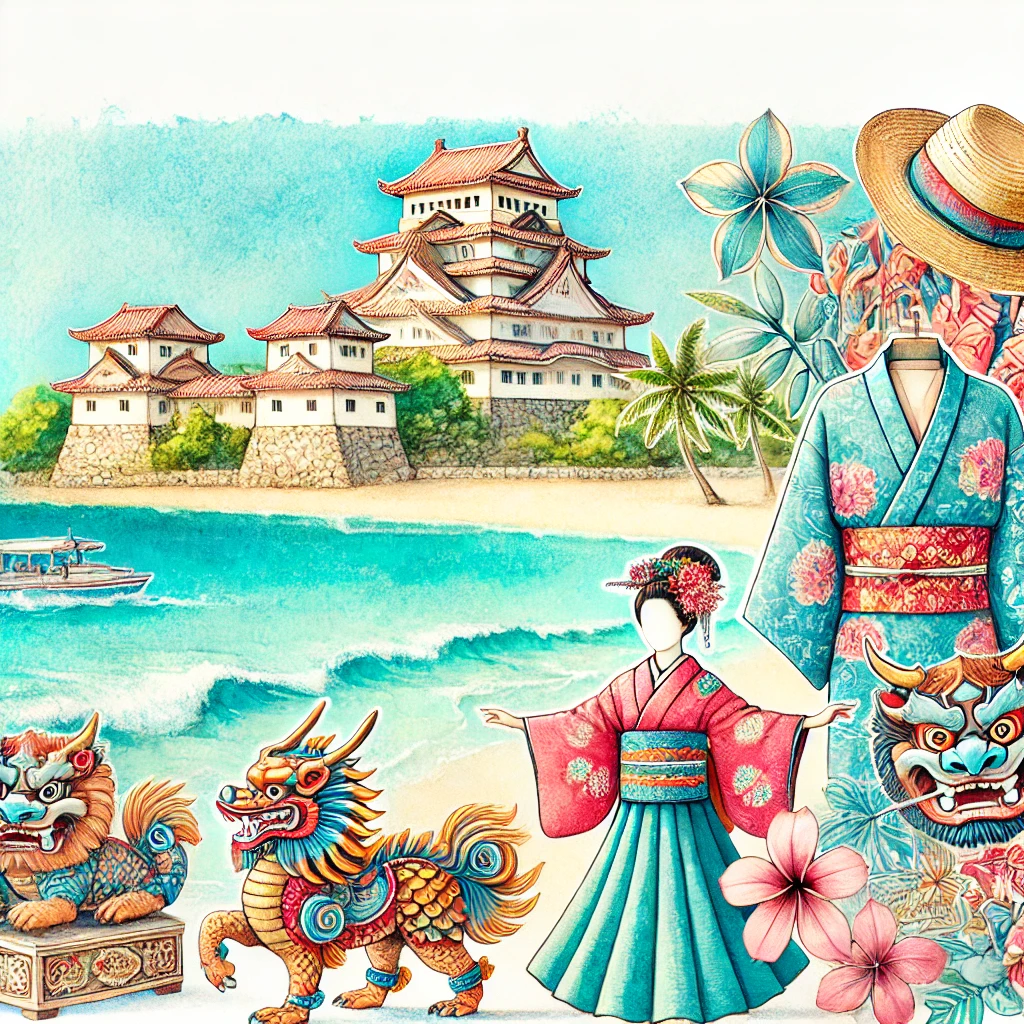
Okinawa, located at the southernmost tip of Japan, is known as a tourist destination for its stunning beaches and rich natural beauty. However, it is also a land filled with unique history and culture that sets it apart from other regions.
Okinawa has experienced various historical events, from the prosperity and decline of the Ryukyu Kingdom, the invasion by the Satsuma Domain, to its incorporation into Japan. Among these, the Battle of Okinawa during World War II left deep scars on the people of Okinawa. Many civilians were sacrificed, and through this tragic experience, the people of Okinawa came to deeply understand the value of life and the importance of peace.
Okinawan culture, nurtured through this history, has developed uniquely in many aspects such as language, religion, festivals, and crafts. The distinctive Okinawan language known as Uchinaguchi, unique beliefs such as Utaki worship and the presence of Shisa statues, traditional events like Eisa, Hounen Festival, and Tanetori Festival—all these are invaluable cultural heritages deeply connected to the lives of Okinawan people.
Additionally, Okinawan crafts such as Bingata, Yachimun, and Ryukyu lacquerware are highly regarded worldwide for their beauty and unique techniques. These crafts reflect Okinawa’s history, culture, and aesthetic sense, and the wisdom and skills of ancestors have been passed down through generations.
Moreover, the spirit of the Okinawan people is encapsulated in phrases like “Ichariba Chode” and “Yuimaru.” “Ichariba Chode” means “once we meet, we are all brothers,” symbolizing an open-hearted acceptance of others. “Yuimaru” represents mutual assistance and the importance of helping each other. The messages embedded in these phrases are valuable lessons for us living in modern society.
Learning about Okinawa’s history and culture is essential for understanding Japan’s diversity and reacknowledging the value of peace. By touching on the spirit of “Ichariba Chode” and reflecting on the values cherished by the Okinawan people, each of us can gain insights to lead a richer life.
In this blog, we will explore the charm of Okinawa from various angles, including its history, culture, and spirituality. Let’s experience together the heart of Okinawa, which has been handed down through generations.
- Introduction
- History of Okinawa
- Unique Culture and Traditions of Okinawa
- The Spiritual World of Okinawan People
- Recommended Books to Understand Okinawan Culture
- Conclusion
- Q&A
- Summary
Introduction
Overview of Okinawa’s History and Culture
Geographical Characteristics and Climate
Okinawa Prefecture, located at the southernmost tip of Japan, forms the Ryukyu Archipelago, consisting of about 160 islands. It belongs to the subtropical oceanic climate zone, characterized by warm and humid weather throughout the year. These geographical characteristics and climate have greatly influenced the formation of Okinawa’s unique culture and traditions.
Okinawa’s main island serves as the center of the prefecture, with major cities such as Naha. The central part of the island houses the ruins of Shuri Castle, a symbol of the Ryukyu Kingdom, now a World Heritage site. The northern part of the main island features the Yambaru region, a national park rich in subtropical nature.
On the other hand, the outlying islands, including Ishigaki, Iriomote, and Miyako, each have their distinct cultures and natural environments. These islands have thrived as trade intermediaries and have developed unique languages and cultures over time.
Okinawa’s climate, characterized by high temperatures and humidity, and frequent typhoons in summer, remains mild even in winter. This climate fosters the growth of coral reefs and subtropical plants, enriching Okinawa’s natural environment. It also supports the cultivation of agricultural products such as sugar cane, pineapples, and mangoes, which are among Okinawa’s specialties.
Historical Background and Cultural Formation
Okinawa’s history dates back to the prehistoric Shell Mound Period. Subsequently, during the Gusuku period, the Ryukyu Kingdom was established in the early 15th century. The kingdom engaged in intermediary trade between China and Japan, developing its unique culture.
In the early 17th century, the Satsuma Domain invaded, and the Ryukyu Kingdom came under its control, although it maintained its form as a kingdom. In 1879, the Meiji government incorporated the Ryukyu Kingdom into Japan as Okinawa Prefecture. During World War II, the Battle of Okinawa resulted in immense civilian casualties, leaving a lasting impact on the local people. Post-war, Okinawa was under American administration until its reversion to Japan in 1972, during which it faced challenges related to military bases and economic development.
This complex historical background has significantly influenced the formation of Okinawa’s unique culture and traditions. During the Ryukyu Kingdom era, influenced by China and Japan, Okinawa developed its distinct language, religion, festivals, performing arts, and crafts, which blossomed in various fields.
Purpose and Structure of This Article
Understanding Okinawa’s Unique Traditions and Events
This article delves into Okinawa’s history and culture, focusing particularly on its unique traditions and events. Understanding these unique aspects is crucial for appreciating the diversity within Japan.
In terms of language, we will explore the characteristics of the Okinawan language known as “Uchinaguchi” and the diversity of dialects across different regions. Regarding religion, we will explain the Utaki worship, sacred sites, and guardian deities like Shisa. In terms of festivals and events, we will cover traditional events such as the lunar calendar celebrations, Eisa, Hounen Festival, and Tanetori Festival. For performing arts, we will discuss the history and features of traditional dances like Kumiodori and Ryukyu dance, and for crafts, we will introduce traditional crafts such as Bingata, lacquerware, and pottery.
These traditions and events are deeply rooted in the daily lives of Okinawan people, and understanding the historical and spiritual background behind them is essential. This article aims to provide clear explanations with specific examples for each tradition and event.
Exploring the Spiritual World of Okinawan People
To understand Okinawan traditions and events, it is essential to explore the spiritual world of Okinawan people. This article will explain the unique spirituality of Okinawa, represented by phrases like “Ichariba Chode” and “Yuimaru.”
“Ichariba Chode,” meaning “once we meet, we are all brothers,” embodies the Okinawan perspective on life, emphasizing acceptance and mutual aid. “Yuimaru” refers to the custom of mutual assistance, highlighting the importance of community spirit.
Moreover, the tragic experiences of the Battle of Okinawa have strengthened the Okinawan people’s desire for peace. Passing on the lessons of war to future generations and fostering a heart that longs for peace is a significant theme for the Okinawan people.
This article will explore how this spirituality connects with Okinawan traditions and events. Understanding the spiritual world of the Okinawan people will deepen the meaning of these traditions and events.
History of Okinawa
History of the Okinawa Kingdom from Ancient to Early Modern Times
From Prehistoric Times to the Three Kingdoms Period
The Shell Mound Period and the Beginning of Agriculture
Okinawa’s history begins with the Shell Mound Period in prehistoric times. Shell mounds, dating back approximately 6,500 years, are found across Okinawa, revealing the lifestyle of ancient people. Artifacts such as shells, bones, and stone tools indicate a life centered on hunting and gathering.
Around 2,500 years ago, agriculture began, with the cultivation of crops like sugar cane and taro. This period saw the start of settled life, as evidenced by artifacts such as pottery and stone axes found in archaeological sites.
The Gusuku Period and the Unification of the Three Kingdoms
From the 12th century, fortified settlements known as “gusuku” were built across Okinawa. These were the residences of local rulers and also served as ritual sites. Famous gusuku sites include Nakijin Castle and Zakimi Castle.
In the 14th century, the Three Kingdoms period began, with the northern, central, and southern kingdoms vying for power. Gradually, the central kingdom, led by the king of Chuzan, emerged as the dominant power.
The Prosperity of the Ryukyu Kingdom and Relations with China
Development Under Chuzan Kingship
In 1429, King Sho Hashi unified the three kingdoms, founding the Ryukyu Kingdom. The kingdom flourished under the rule of the Chuzan kings, establishing tributary relations with China and becoming a hub in East Asian trade networks.
Shuri Castle, the political, economic, and cultural center of the kingdom, thrived during this period. The castle and the surrounding aristocratic residences showcased the kingdom’s grandeur. The current Shuri Castle, reconstructed after its destruction in World War II, continues to reflect its historical significance.
Tributary Relations with China and Envoys
From the 15th to the 17th centuries, the Ryukyu Kingdom maintained tributary relations with China. By offering tributes to the Chinese emperor and receiving investiture, the kingdom affirmed its legitimacy. This relationship elevated the kingdom’s status and facilitated advantageous trade.
Chinese envoys, dispatched for investiture ceremonies, participated in significant kingdom events, transmitting imperial edicts. These visits were grand events, celebrated with large-scale festivities. The envoys visited Shuri Castle and various gusuku, experiencing the kingdom’s culture.
Relations with China were not merely political but also cultural. Many students were sent to China to study its sciences and technologies. Confucianism, introduced from China, profoundly influenced the
kingdom’s politics and society.
Incorporation into Japan and Modern History
Invasion and Control by the Satsuma Domain
The Satsuma Invasion of Ryukyu
In the early 17th century, the Satsuma Domain, led by the Shimazu clan, invaded the Ryukyu Kingdom. In 1609, the Satsuma forces landed in Ryukyu and captured Shuri Castle. Unable to resist militarily, the kingdom came under Satsuma’s control.
This event, known as the “Satsuma Invasion,” had a profound impact on the kingdom’s history. Satsuma imposed indirect rule, significantly influencing the kingdom’s governance.
Indirect Rule by the Satsuma Domain
Under Satsuma’s indirect rule, the Ryukyu Kingdom retained its nominal independence, with the king and Shuri Castle remaining intact. However, real power lay in Satsuma’s hands.
Satsuma conducted trade with China through the kingdom, reaping substantial profits. Conversely, the kingdom faced heavy tribute burdens, straining its economy. Satsuma officials resided in Ryukyu, interfering in its politics and economy.
Despite the indirect rule, the kingdom’s traditional culture persisted, though it incorporated influences from Satsuma. This period saw changes in language, customs, and attire, reflecting Satsuma’s cultural impact.
The Establishment of Okinawa Prefecture by the Meiji Government
Abolition of Domains and the Ryukyu Disposition
In 1871, the Meiji government implemented the abolition of domains and established prefectures nationwide. The Ryukyu Kingdom’s status became a contentious issue during this process. Although part of Japan, the kingdom maintained a semblance of independence, prompting debates on its position.
In 1879, the Meiji government abolished the Ryukyu Kingdom, establishing Okinawa Prefecture. This “Ryukyu Disposition” formally incorporated Ryukyu into Japan, severing its tributary ties with China.
The Birth of Okinawa Prefecture and Modernization
Following its establishment, the Japanese government promoted Okinawa’s modernization. Shuri Castle became the prefectural office, and modern schools, roads, and ports were developed. Japanese language education spread, and Japanese legal and administrative systems were introduced.
However, maintaining traditional culture became challenging. Resistance movements emerged, but they were ultimately suppressed. Okinawan people were urged to embrace their identity as Japanese citizens, facing issues of identity and assimilation.
During modernization, Okinawa’s economy underwent significant changes. The sugar industry developed, becoming a cornerstone of the Okinawan economy. Emigration flourished, with many Okinawans moving abroad.
World War II and Postwar Okinawa
The Battle of Okinawa and Civilian Sacrifices
Fierce Ground Battles and Civilian Impact
In April 1945, towards the end of World War II, American forces landed on Okinawa, initiating intense battles with Japanese forces. The Battle of Okinawa, a last-ditch defense for Japan, was marked by devastating combat.
Japanese forces established strongholds in Shuri Castle and southern mountain regions, using caves and bunkers for prolonged defense. American forces advanced through naval bombardments and airstrikes, engaging in fierce ground battles. The conflict resulted in widespread destruction and significant civilian casualties.
Forced Mass Suicides of Civilians
To avoid civilian casualties, Japanese forces relocated civilians to the southern mountains. However, food and medical supplies were scarce, leading to dire conditions and increasing civilian deaths.
Moreover, fearing capture by American forces, Japanese soldiers coerced civilians into mass suicides. Many civilians, forced to take their own lives using grenades or cyanide, faced tragic deaths. This harrowing event remains a poignant symbol of the Battle of Okinawa.
The Battle of Okinawa claimed the lives of not only Japanese and civilians but also many American soldiers. Over 200,000 people lost their lives in the three-month conflict. Post-war, the people of Okinawa have strived to convey the horrors of war and foster a desire for peace.
American Administration and Reversion to Japan
Construction of U.S. Bases and Land Seizures
After the Battle of Okinawa, the island came under American administration. During the Cold War, the U.S. built large military bases in Okinawa, seizing vast amounts of land and displacing residents.
The presence of U.S. bases has supported Okinawa’s economy while causing various problems such as incidents, accidents, and noise pollution. The bases’ existence has intertwined complexly with Okinawan identity and the desire for peace.
The Reversion Movement and 1972 Reversion
From the 1950s, a movement emerged among Okinawans to return to Japan. Dissatisfaction grew over the lack of rights under American rule, as the Japanese constitution did not apply to Okinawa.
In the 1960s, the reversion movement gained momentum, with large-scale demonstrations and rallies held across the island. The Japanese government also negotiated with the U.S. for the reversion of administrative rights.
On May 15, 1972, Okinawa reverted to Japan. Post-reversion, the Japanese constitution was applied, and Okinawan citizens regained their rights as Japanese nationals. However, U.S. bases remained, and the base issue continues to be a critical challenge for Okinawa.
The tragic experiences of the Battle of Okinawa, American administration, and reversion have led Okinawans to confront issues of peace, human rights, and identity. This history provides essential perspectives for understanding contemporary Okinawa.
Unique Culture and Traditions of Okinawa
Language and Dialects
Characteristics of Uchinaguchi (Okinawan Language)
Differences from Japanese and Unique Grammar
The language spoken in Okinawa is called “Uchinaguchi” or Okinawan language. Uchinaguchi is a unique language distinct from Japanese, with its own grammar and pronunciation.
The grammar of Uchinaguchi is simpler compared to Japanese, with different usage of particles and word order. For example, “I am a student” in Japanese is “私は学生です” (Watashi wa gakusei desu), whereas in Uchinaguchi, it is “ワン ヤ ガクセー ヤイビーン” (Wan ya gakusei yaibiin). “ワン” (Wan) means “I,” “ヤ” (Ya) is a particle indicating the subject, and “ヤイビーン” (Yaibiin) corresponds to “am.”
Additionally, Uchinaguchi has unique particles and expressions not found in Japanese. For instance, the particle “〜さ” emphasizes, as in “クヮッチー さ” (Kwachii sa) meaning “very delicious.”
Phonetic Features and Pronunciation
Uchinaguchi has distinct phonetic features compared to Japanese. In addition to the five vowels found in Japanese, Uchinaguchi includes “ï” (a central vowel in the “i” range). In terms of consonants, there is no distinction between “t” and “d” or “k” and “g,” and “チ” (chi) and “ツ” (tsu) as well as “ジ” (ji) and “ズ” (zu) are not differentiated.
The accent in Uchinaguchi follows different rules from Japanese, typically placing emphasis on the second syllable. Examples include “カジマヤー” (kajimayaa) for “well” and “イラブ” (Irabu) for “Irabu Island.”
The differences in pronunciation can make Uchinaguchi difficult for Japanese speakers to understand. However, understanding Uchinaguchi is crucial for deeply appreciating Okinawa’s culture and spirit.
Diversity of Regional Dialects
Mainland Dialects and Sakishima Dialects
Okinawa has various dialects depending on the region. Broadly, these can be divided into “Mainland Dialects,” spoken on Okinawa’s main island, and “Sakishima Dialects,” spoken in the Miyako and Yaeyama Islands.
The Mainland Dialects, centered around Naha City, are considered the standard form of Uchinaguchi. The Naha Dialect, also known as the Shuri Dialect, developed around Shuri, the former royal capital.
The Sakishima Dialects include the Miyako Dialect of the Miyako Islands and the Yaeyama Dialect of the Yaeyama Islands. These dialects have unique vocabulary and grammar, sometimes making them mutually unintelligible with Mainland Dialects.
Differences in Dialects by Island
Each island in Okinawa has its own distinct dialect. Examples include the Kunigami Dialect in northern Okinawa Island, the Kume Island Dialect, and the Yonaguni Island Dialect.
These dialects reflect the history, culture, and lifestyle of their respective islands. For instance, the Yonaguni Dialect incorporates many words from Taiwanese due to historical interactions. The Kume Island Dialect is noted for its distinctive accent.
Okinawa’s linguistic diversity showcases the unique heritage of each region. These dialects are important cultural assets that reflect the islands’ histories and ways of life. Preserving and passing them on to future generations is essential for maintaining Okinawa’s cultural identity.
Religion and Beliefs
Utaki Worship and Sacred Sites
Types and Roles of Utaki
At the heart of Okinawan traditional belief is “Utaki,” sacred sites where village guardian deities are worshipped.
Utaki can be broadly classified into two types: “Chimura Utaki” located within villages for everyday prayers and ceremonies, and “Toomura Utaki” located on the outskirts of villages for larger rituals.
Utaki are places where people pray for village safety, bountiful harvests, and the health of the residents. They also host life milestone ceremonies such as births, coming-of-age rituals, and weddings.
Gods Worshipped at Utaki
Various deities are worshipped at Utaki, with the central figure often being “Amamikiyo,” a goddess who is considered the guardian of the village, bringing fertility and prosperity.
Another important deity is “Shinugu God,” a family guardian deity who protects the household and ensures health and prosperity.
Other deities include natural gods and ancestral spirits. Sea gods, mountain gods, and fire gods reflect the deep respect Okinawans have for nature. Ancestors are revered as family protectors, with special ceremonies held during festivals like Bon and New Year.
Utaki worship is deeply rooted in Okinawan life, with a focus on gratitude towards nature and ancestors and prayers for family and village well-being.
Shisa: Guardians of the Home
Origins and Meaning of Shisa
Shisa, lion-like statues found on rooftops and at gates of Okinawan homes, serve as protective guardians. The origin of Shisa is believed to trace back to the Chinese belief in “lions” as sacred creatures with the power to ward off evil.
There are two types of Shisa: male with an open mouth to ward off evil and female with a closed mouth to keep good spirits in. This represents the balance of protecting the home and nurturing the family.
Role as Household Guardians
Shisa are believed to protect homes from evil spirits and misfortune. Positioned on roofs or by gates, they are thought to absorb bad energy and expel it.
Shisa also symbolize prosperity and family continuity. They are popular gifts for new homes or weddings, representing wishes for family happiness and safety.
Shisa are an essential part of Okinawan homes and culture, symbolizing the protection and prosperity of the household. They are also popular souvenirs, with various designs and sizes made by local craftsmen.
Festivals and Events
Lunar Calendar Festivals and Eisa
Importance of the Lunar Calendar and Major Festivals
In Okinawa, the lunar calendar remains significant, and many traditional festivals and events follow it. The lunar calendar, based on the moon’s phases and seasonal changes, suits the agricultural and fishing lifestyle of Okinawans.
Major lunar calendar festivals include “New Year (Sogwachi),” “Qingming Festival (Shimi),” “Tug-of-War (Tsunahiki),” and “Bon (Ukui).” These festivals are deeply rooted in Okinawan life and faith, strengthening community bonds.
Origins and Characteristics of Eisa Dance
“Eisa” is a traditional Okinawan Bon dance held in the seventh month of the lunar calendar. Young men and women perform dynamic drum dances with spirited chants.
Originating from the Chinese “Nembutsu Odori” (Buddhist chant dance) to comfort ancestral spirits, Eisa evolved uniquely in Okinawa.
Eisa features vigorous drum rhythms and energetic movements. Men play large drums with powerful motions, while women dance gracefully with vibrant costumes. Spirited chants like “Haiya!” and “Hoisa!” enhance the dance’s vigor and call ancestral spirits.
Eisa is now a summer highlight in Okinawa, celebrated with regional variations. It symbolizes Okinawan vitality, unity, and gratitude towards ancestors.
Hounen Festival and Tanetori Festival
Significance of Hounen Festival and Sea God Festival
Hounen Festival, held between August and September in the lunar calendar, prays for a bountiful harvest and village prosperity.
Central to the Hounen Festival is the “Sea God Festival (Unjami),” a ceremony venerating sea deities for abundant catches and safe voyages. Offerings of rice, sake, and fish are made to the sea gods at coastal altars.
Following the Sea God Festival, “Haarii” (boat races) often take place. Young men compete in rowing races, praying for a good fishing season and demonstrating their strength.
Hounen Festival expresses gratitude for nature’s bounty and hopes for future prosperity, reflecting Okinawan views on nature and the world.
Origins and Rituals of Tanetori Festival
“Tanetori Festival (Kuzuntui)” is a traditional agricultural ritual held in September of the lunar calendar, focusing on selecting seeds for the next year.
Originating from a millet seed selection ceremony, the Tanetori Festival involves rituals led by village priests (Kannushi). Offerings are made to deities, and selected seeds are presented for divine blessing.
The “Naabaru” procession, carrying seed boxes around the village, is part of the festival. Residents contribute seeds to the boxes, praying for a good harvest.
Tanetori Festival showcases Okinawan respect for seeds and the divine protection of agriculture, highlighting the people’s reverence for nature.
Performing Arts and Crafts
Kumiodori and Ryukyu Dance
History and Characteristics of Kumiodori
“Kumiodori” is a traditional Okinawan performing art combining song, dance, and acting, created in the early 18th century by playwright Tamagusuku Chokun.
Kumiodori’s themes include historical
tales, legends, and love stories from the Ryukyu Kingdom era. Notable plays include “Shushin Kaneiri” and “Temizu no En.”
Kumiodori features traditional instruments like the sanshin (three-stringed instrument), drums, and flutes. The dance is characterized by graceful, refined movements and skillful use of props such as fans and flower hats. The acting conveys stories through dialogue and gestures.
Kumiodori, a key traditional Okinawan art, is designated as an Important Intangible Cultural Property of Japan.
Types and Transmission of Ryukyu Dance
“Ryukyu Dance” comprises “Classical Dance” and “Folk Dance.” Classical Dance, performed at the royal court, is elegant and refined, with performances like “Kagiyade-fuu” and “Nubui Kuduchi.” It has been passed down by court dancers.
Folk Dance, vibrant and dynamic, includes performances like “Kachashi” and “Jindami Nasabu.” These dances, performed at community festivals, have been preserved by locals.
Ryukyu Dance is transmitted through “Iemuchi,” an apprenticeship system where disciples learn by imitating their masters. This system emphasizes long-term training to acquire skills.
Today, Ryukyu Dance is highly regarded both domestically and internationally, showcasing Okinawan history, culture, and aesthetics.
Crafts from the Ryukyu Kingdom Era
Bingata and Dyeing Techniques
“Bingata” is a traditional Okinawan dyeing technique using stencils to create patterns. Originating from China in the 16th century, it flourished during the Ryukyu Kingdom era.
Bingata features vivid colors and intricate designs, using natural dyes from plants and minerals. Common motifs include flowers, birds, and geometric patterns symbolizing nature and good fortune.
The process involves applying resist paste with stencils, removing the stencils, and then coloring the fabric. This is repeated for complex patterns.
Bingata was used for royal and aristocratic garments during the Ryukyu Kingdom era. Today, it is a vital traditional craft, designated as an Important Intangible Cultural Property of Japan.
“Binagata,” a simplified form of Bingata, became popular among commoners, featuring simpler designs and fewer colors. Used for clothing, bags, and home decor, it remains a cherished part of everyday life and a popular souvenir.
Lacquerware and Pottery
Okinawan lacquerware and pottery are significant traditional crafts.
“Lacquerware” involves coating wooden items with lacquer. Okinawan lacquerware, influenced by Chinese and Japanese styles, developed its unique aesthetic.
Red and black colors predominate, with decorative techniques like “Raden” (inlaid shell) and “Maki-e” (sprinkled picture). Raden involves embedding shell pieces for patterns, while Maki-e uses gold or silver powder on lacquer.
During the Ryukyu Kingdom era, lacquerware was prized by royalty and aristocracy. Today, it is also appreciated as everyday items like trays, bowls, and boxes.
“Pottery,” known as “Yachimun,” features rustic and warm textures. Originating around the 15th century, Yachimun uses local clay, resulting in unique colors and textures.
Yachimun products range from jars and urns to plates and teapots, valued both for utility and artistic merit. Yachimun is celebrated for its connection to Okinawan history and culture.
Okinawan lacquerware and pottery, deeply embedded in daily life, also represent high artistry. Preserving and passing these crafts to future generations is vital for maintaining Okinawa’s cultural heritage.
The Spiritual World of Okinawan People
The Spirit of Ichariba Chode
Meaning and Origin of the Phrase
“Ichariba Chode,” meaning “once we meet, we are all brothers,” reflects the Okinawan worldview and philosophy.
The phrase’s origin is rooted in Okinawa’s historical background. As a crossroads of cultural exchange with China and Southeast Asia, and during the Ryukyu Kingdom’s active maritime trade, Okinawans cultivated a spirit of accepting and helping others regardless of background.
Ichariba Chode embodies this spirit, symbolizing the inclusive and cooperative nature of Okinawan people.
Okinawan Life Philosophy
The spirit of Ichariba Chode deeply influences Okinawan life philosophy, intertwined with the concept of “Yuimaaru” (mutual assistance). Yuimaaru emphasizes collaboration and community effort in various activities, from farming to festivals.
The phrase “命どぅ宝” (Nuchi du Takara), meaning “life is a treasure,” reflects the Okinawan recognition of life’s preciousness, shaped by the tragic experiences of war.
Ichariba Chode, Yuimaaru, and Nuchi du Takara together form the foundation of Okinawan values, prioritizing human connections and heartful richness over material wealth.
The Spirit of Yuimaaru
Mutual Assistance Customs
“Yuimaaru” represents the custom of mutual assistance in Okinawa. It involves pooling labor and resources for communal tasks like farming or building houses.
Yuimaaru developed in response to Okinawa’s harsh natural environment and historical circumstances. Frequent typhoons necessitated cooperation for survival. During the Ryukyu Kingdom era, a system of labor exchange for royal protection also supported Yuimaaru.
Today, Yuimaaru persists in preparing for community events, repairing homes, and more, strengthening communal bonds and fostering a spirit of cooperation.
Importance of Community Spirit
Yuimaaru highlights the importance of community spirit in Okinawa, where the collective well-being often takes precedence over individual interests. This community-focused mindset influences values and behaviors, fostering strong support networks.
While prioritizing community can sometimes suppress individual opinions, it also creates a robust support system for overcoming challenges.
Maintaining community spirit is crucial in modern society, where urbanization and nuclear families erode traditional ties. In Okinawa, community bonds remain vital, preserving cultural and spiritual heritage for future generations.
Experience of the Battle of Okinawa and Desire for Peace
Horrors of War and Lessons Learned
During World War II, the Battle of Okinawa inflicted immense suffering on the local population. Intense battles between Japanese and American forces led to numerous civilian casualties, with many forced into tragic mass suicides by the Japanese military.
The Battle of Okinawa deeply imprinted the horrors of war on the Okinawan people, leaving lasting emotional scars from the loss of family and friends.
This experience also reinforced the value of peace, instilling a strong resolve to prevent future conflicts.
Longing for Peace
The Okinawan people have cultivated a profound longing for peace from their wartime experiences. Post-war, Okinawa faced challenges under American administration, including issues related to military bases. Despite this, Okinawans have upheld non-violent principles and consistently advocated for peace.
Peace education in Okinawa starts from a young age, with school curriculums teaching about the Battle of Okinawa and the importance of peace. Numerous events and activities also promote peace awareness, fostering a shared commitment to peace.
Okinawa’s dedication to peace has garnered international recognition. In 1995, Okinawan poet Shun Medoruma received the Akutagawa Prize for his works reflecting war experiences and peace aspirations.
The spirit of Ichariba Chode, Yuimaaru, and a deep-seated desire for peace are integral to Okinawan culture and values, offering profound insights into the significance of peace.
Recommended Books to Understand Okinawan Culture
History-related Books
“History of Okinawa” by Takara Kurayoshi
Comprehensive History from Ancient to Modern Times
This book provides a comprehensive history of Okinawa from ancient to modern times. Author Takara Kurayoshi, president of Okinawa Prefectural University of Arts, is a leading Okinawan history researcher.
The book covers Okinawa’s history from prehistoric times through the modern era, detailing pivotal events like the Gusuku period, Ryukyu Kingdom era, Satsuma control, Battle of Okinawa, and post-war history.
Key Events and Characteristics of Each Era
The book details key events and characteristics of each era, such as the political system and cultural development during the Ryukyu Kingdom, and the tragic civilian experiences during the Battle of Okinawa. Understanding these features is essential for grasping the flow of Okinawan history.
“History of Okinawa” is published by Genshobo and remains a long-standing bestseller since its first edition in 2000.
“Ryukyu Kingdom” by Kamimura Takashi
Politics and Diplomacy of the Kingdom Era
This book focuses on the politics and diplomacy of the Ryukyu Kingdom. Author Kamimura Takashi, director of the Okinawa Prefectural Museum and Art Museum, is a leading Ryukyu Kingdom researcher.
The book explains the political structure, royal authority, and diplomatic relations with China and Japan. It details the kingdom’s prosperity through intermediary trade and the impact of Satsuma control.
Cultural and Social Development
The book also explores cultural and social development during the Ryukyu Kingdom era, including royal cultural policies, urban development centered around Shuri Castle, and the flourishing of performing arts and crafts. Social structures, lifestyles, and rituals are vividly depicted.
“Ryukyu Kingdom” is published by Chikuma Gakugei Bunko and remains a popular and frequently reprinted book since its first edition in
1993.
Culture-related Books
“Festivals and Beliefs of Okinawa” by Miyagi Eisho
Festivals and Events in Various Regions
This book details Okinawa’s festivals and beliefs, covering regional examples. Author Miyagi Eisho, a professor at Okinawa International University, is a leading folklorist.
The book introduces major festivals such as lunar calendar events, Hounen Festival, and Eisa, explaining their history, significance, and current practices. It also explores regional beliefs, including Utaki worship, sacred sites, and Shisa beliefs.
Objects of Worship and Ritual Methods
The book explains the deities and sacred places worshipped by Okinawans, such as sun and sea deities, and ancestor veneration. It details ritual methods, offerings, prayers, dances, and music, vividly illustrating the ceremonies.
“Festivals and Beliefs of Okinawa” is published by Nirai-sha and is a must-read for understanding Okinawan festivals and beliefs since its first edition in 2007.
“Okinawan Crafts” by Kudeken Kenyu
Techniques of Weaving and Dyeing
This book explains Okinawan crafts, focusing on weaving and dyeing techniques. Author Kudeken Kenyu, a professor at Okinawa Prefectural University of Arts, is a leading craft researcher.
The book introduces techniques like Bingata and explains their history, characteristics, and production processes with ample photos and illustrations. It also covers various types of woven fabrics, their techniques, patterns, and uses.
History and Features of Pottery and Lacquerware
The book also discusses Okinawan pottery (Yachimun) and lacquerware, detailing their history, features, and production methods. It includes examples from royal luxury items to everyday objects.
“Okinawan Crafts” is published by Naha Shuppansha and is essential for understanding Okinawan crafts since its first edition in 2000. It provides insights into the rich world of Okinawan textiles, pottery, and lacquerware.
Conclusion
The Charm and Uniqueness of Okinawan Culture
Inheritance of History and Tradition
A major attraction of Okinawan culture is the preservation of its long history and traditions to the present day. From the unique culture, performing arts, and crafts that have continued since the Ryukyu Kingdom era, the people of Okinawa have safeguarded cultural heritage passed down from their ancestors and transmitted it to the next generation.
Traditional agricultural events, such as the Hōnen Festival and the Tane-tori Festival, are still held across various regions. Traditional performing arts like Eisa are also cherished and preserved by local communities. Crafts like Bingata and Bingata have been passed down through the hands of skilled artisans.
The inheritance of such history and traditions is an essential element supporting the identity of the people of Okinawa. Passing down the wisdom and skills of our ancestors to the next generation is indispensable for preserving the uniqueness of Okinawan culture.
Value in Modern Society
The charm of Okinawan culture also holds significant value in contemporary society. The spirit of Ichariba Chode and the Yuimaru spirit teach us the importance of human connections and mutual assistance. In today’s society, individualism and selfishness are rampant, and the weakening of human relationships has become a problem, but Okinawan culture reminds us of the importance of human bonds.
Moreover, Okinawa’s nature worship and festivals teach the importance of coexistence between nature and humans. In today’s society, environmental issues are becoming serious, and harmony with nature is being lost, but Okinawan culture shows us the importance of respecting nature and living in harmony with it.
Furthermore, the experience of the Battle of Okinawa and the longing for peace provide significant insights for us living in today’s society. The thoughts of the Okinawan people, who know the horrors of war and the preciousness of peace, resonate with the global trend of seeking peace. Okinawa’s experience will be a great encouragement to people around the world who yearn for peace.
The Significance of Learning Okinawan History and Culture
Understanding and Respecting Diversity
Learning about Okinawan history and culture leads to understanding and respecting diversity. By knowing the history of Okinawa, which has nurtured its unique culture within Japan, we can recognize the diversity of Japanese culture. Moreover, understanding Okinawan culture and values is essential for fostering a mindset of respecting different cultures.
In today’s globalized society, it is required for people with diverse cultural backgrounds to coexist. Learning about Okinawan history and culture is the first step toward realizing a multicultural society.
The Preciousness of Peace and the Value of Life
Learning about Okinawan history and culture is an opportunity to reaffirm the preciousness of peace and the value of life. The tragic experiences of the Battle of Okinawa teach us about the inhumanity of war and the value of peace. Additionally, the spirit of “Nuchi du Takara,” cherished by the people of Okinawa, provides important insights into recognizing the dignity of all life.
In contemporary society, problems that threaten the dignity of life, such as violence, discrimination, and poverty, are numerous. Learning about Okinawan history and culture should provide us with the tools to face these issues and work toward building a peaceful and just society.
We have explained Okinawa’s history, culture, and spirituality. The unique charm of Okinawa’s culture continues to hold great value in today’s society. The values cherished by the people of Okinawa, such as the spirit of Ichariba Chode, Yuimaru, and the desire for peace, suggest the kind of society we should strive for.
Learning about Okinawa’s history and culture will be the first step for each of us to respect diversity and realize a peaceful and just society. Utilizing Okinawa’s experiences and wisdom for the future is our mission.
To understand Okinawa’s history and culture, it is essential to visit the region and experience the lives of its people. Using the books introduced in this article as a guide, why not feel the charm of Okinawa firsthand? Surely, new discoveries and emotions await you.
Q&A
What are the particularly important events in Okinawan history?
The particularly important events in Okinawan history include the establishment of the Ryukyu Kingdom in the early 15th century, the invasion by the Satsuma Domain in the early 17th century, the incorporation into Japan in 1879, the Battle of Okinawa in World War II, and the return to Japanese sovereignty in 1972.
What are some famous traditional events in Okinawa?
Famous traditional events in Okinawa include Eisa, a lunar calendar event, the Hōnen Festival, and the Tane-tori Festival. Particularly, Eisa is known as a representative Bon dance of Okinawa, characterized by its vigorous dancing with drum beats.
What kinds of crafts are there in Okinawa?
Okinawan crafts include dyeing and weaving products like Bingata and Bingata, pottery called Yachimun, and Ryukyu lacquerware. These crafts are known for their unique colors, patterns, and techniques, reflecting Okinawa’s history and culture in beautiful works.
What are some words that express the spirituality of the people of Okinawa?
Words that express the spirituality of the people of Okinawa include “Ichariba Chode” and “Yuimaru.” Ichariba Chode means “once we meet, we are all brothers,” expressing a tolerant heart that accepts others. Yuimaru represents the spirit of mutual assistance, showing the importance of helping each other.
What impact did the experience of the Battle of Okinawa have on the people of Okinawa?
The experience of the Battle of Okinawa left deep scars on the people of Okinawa. Many civilians were sacrificed, and they experienced the horrors of war firsthand. From this experience, the people of Okinawa strongly recognized the preciousness of life and the importance of peace, developing a strong resolve never to repeat the tragedy of war.
Summary
Okinawa’s history and culture possess a unique charm different from other regions. Over a long history, it has experienced various events, such as the prosperity of the Ryukyu Kingdom, the invasion by the Satsuma Domain, and incorporation into Japan. Particularly, the Battle of Okinawa in World War II left deep scars on the people of Okinawa.
In such history, the people of Okinawa have nurtured their unique culture. In language, they speak Okinawan (Uchinaaguchi), a unique dialect. In religion, they have indigenous beliefs such as Utaki worship, altars, and Shisa. In festivals and events, traditions such as Eisa, the Hōnen Festival, and the Tane-tori Festival have been passed down.
Moreover, Okinawan crafts have produced numerous beautiful works, including Bingata, Bingata, Yachimun pottery, and Ryukyu lacquerware. These crafts reflect Okinawa’s history, culture, and aesthetic sense vividly.
The spirituality of the people of Okinawa also has unique characteristics. The spirit of Ichariba Chode and Yuimaru reflects a tolerant heart that accepts others and the importance of mutual help. From the experience of the Battle of Okinawa, they learned the preciousness of life and the importance of peace, developing a strong resolve never to repeat the tragedy of war.
Learning about Okinawa’s history and culture is indispensable for understanding Japan’s diversity. It also teaches us diverse values, ways of life, and the preciousness of peace. Reaffirming and utilizing the charm and value of Okinawa’s history and culture in modern society is what each of us is required to do.

コメント