
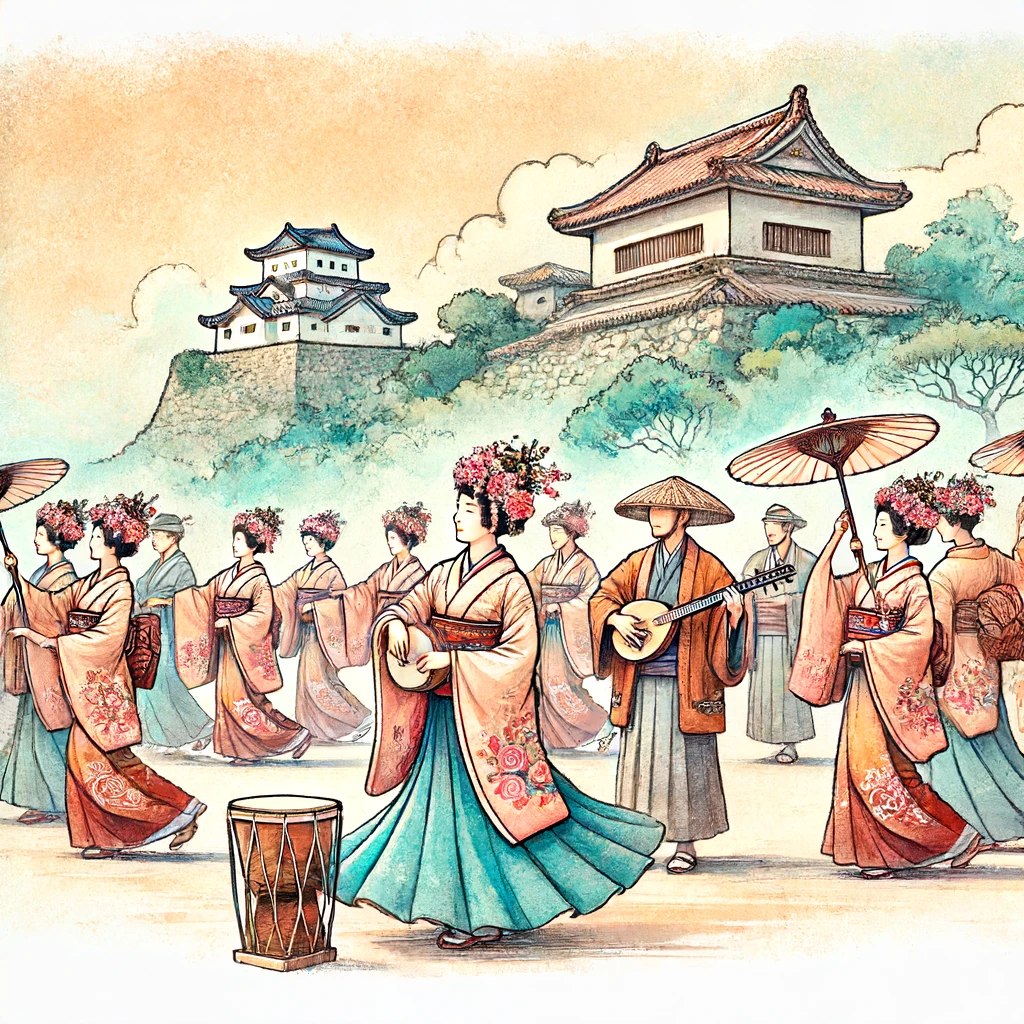
Among the traditional performing arts of Okinawa, “Kumi Odori” holds a particularly significant position. Kumi Odori is a unique Okinawan composite art that encompasses distinctive storytelling, music, and dance. Its history dates back to around the 17th century.
Kumi Odori has produced numerous masterpieces, such as “Shushin Kaneiri,” “Temizu no En,” and “Onna Monogurui.” These stories explore universal themes like love, human relationships, and social issues. They also deeply reflect Okinawan values and spirit, such as the pride and duty of samurai and the strength of women.
The true charm of Kumi Odori lies in its high level of artistry. It is a composite art that blends dialogue, song, music from the sanshin and drums, and graceful dance. This expressive form can be both intense and elegant, deeply moving the hearts of the audience. The unique aesthetic sense refined over its long history continues to leave a significant impact on modern audiences.
The history of Kumi Odori has not been without challenges. The art form faced a decline due to modernization but experienced a revival movement after World War II. Efforts to preserve traditions while engaging in new creations have been vital to the resilience of Kumi Odori, balancing classical and innovative approaches.
Every element of Kumi Odori, from the music and dance to the stories and costumes, breathes the history and culture of Okinawa. It weaves the thoughts of predecessors, passing them on to those living today. Kumi Odori truly is a crystallization of Okinawan identity.
- What is Kumi Odori?
- History of Kumi Odori
- Elements of Kumi Odori
- Famous Kumi Odori Works
- Okinawan Spirit Reflected in Kumi Odori
- Preservation and Transmission of Kumi Odori
- The Appeal of Kumi Odori
- Experiencing Kumi Odori
- Conclusion
- Kumi Odori, Forever
- Q&A
What is Kumi Odori?
Definition and Characteristics of Kumi Odori
Etymology and Meaning of Kumi Odori
The term “Kumi Odori” is composed of two words: “Kumi,” meaning “story” or “script,” and “Odori,” meaning “dance” or “drama.” Therefore, Kumi Odori refers to a performing art that expresses stories through dance and drama. This unique traditional Okinawan performing art traces its origins back to around the 17th century. It developed during the Ryukyu Kingdom period and played a significant role in the court’s ceremonies and banquets, serving as an important aspect of the education of the samurai class.
The defining characteristic of Kumi Odori is the integration of music, dance, and drama to express a narrative. The stories unfold with the accompaniment of traditional instruments like the sanshin and drums, with beautiful movements and singing. The characters convey their emotions through dialogue and monologues, drawing the audience into the story.
Additionally, Kumi Odori emphasizes specific forms and styles, with set rules for the progression of the story and the movements of the characters. These elements represent a culmination of aesthetic sense and expressive techniques passed down through a long history.
Performance Format and Structure of Kumi Odori
Kumi Odori performances are typically held on stage, featuring screens and props to depict the world of the story. The characters progress the narrative through gestures, dialogue, and song. The structure of Kumi Odori is based on a three-part composition known as “Jo-Ha-Kyu.” “Jo” introduces the story, setting up the characters and the situation. “Ha” develops the story, illustrating the emotions and conflicts of the characters. “Kyu” presents the climax and resolution, delivering the story’s peak and conclusion.
This three-part structure is also seen in other traditional Japanese performing arts such as Noh and Kabuki, but Kumi Odori builds its narratives with unique interpretations and expressive methods. The performance duration varies depending on the piece but typically lasts around 2 to 3 hours, during which the audience immerses in the story and empathizes with the characters’ emotions and thoughts.
The unity between the stage and the audience is also a crucial aspect of Kumi Odori performances. The actors and the audience share a single space, creating the world of the story together. This sense of unity is one of Kumi Odori’s appeals.
Differences from Other Traditional Performing Arts
Comparison with Noh and Kyogen
Kumi Odori and Noh/Kyogen are both traditional Japanese performing arts but differ in several aspects. Noh, mainly loved by the aristocracy and samurai class, pursues the beauty of yugen (subtlety and profundity). Noh stories often draw from mythology, legends, and historical figures, utilizing symbolic expressions. The Noh stage is characterized by its simple and abstract construction.
In contrast, Kumi Odori, closer to the common people, emphasizes comprehensible storytelling. The themes of Kumi Odori center around relatable human dramas, with realistic emotional expressions. The Kumi Odori stage features specific backgrounds and props, characterized by realistic expressions.
Kyogen, a comical performance art often presented between Noh plays, depicts humor in everyday life. Kyogen stories focus on the lives of common people, using humor to satirize society.
Both Kumi Odori and Kyogen are rooted in the lives of common people. However, Kumi Odori emphasizes dramatic and emotional stories, whereas Kyogen focuses on humor and satire.
Comparison with Kabuki and Bunraku
Kumi Odori and Kabuki/Bunraku are traditional Japanese performing arts that developed during the Edo period, each with distinct characteristics. Kabuki is a popular art form known for its elaborate stage sets, costumes, and exaggerated acting. Kabuki stories are often accessible and relatable, with the famous “onnagata” (male actors playing female roles).
On the other hand, Kumi Odori uses simpler stage sets and more restrained, realistic acting. The stories of Kumi Odori often reflect Okinawan history and culture, with many didactic themes.
Bunraku, also known as puppet theater, progresses its narratives with the accompaniment of shamisen music. Bunraku puppets are characterized by their delicate expressions and movements, operated by highly skilled puppeteers.
While both Kumi Odori and Bunraku use shamisen music to advance their narratives, Kumi Odori involves human actors, whereas Bunraku involves puppets. Moreover, Kumi Odori is uniquely Okinawan, whereas Kabuki and Bunraku developed in mainland Japan.
Understanding the differences between Kumi Odori and other traditional performing arts can deepen the appreciation of Kumi Odori’s uniqueness and appeal. Kumi Odori reflects Okinawa’s unique culture and history, making it a significant and cherished art form.
History of Kumi Odori
Origins and Development of Kumi Odori
Performing Arts of the Ancient Ryukyu Era
To explore the origins of Kumi Odori, one must first understand the performing arts of the ancient Ryukyu era. This period, spanning from the 12th to the 17th century, saw the existence of three kingdoms in Okinawa: Hokuzan, Chuzan, and Nanzan.
One notable performing art from this era is “Gosamaru Dance.” It centers around Gosamaru, a hero from Ryukyu creation myths, and was performed at court banquets. Gosamaru Dance, with its narrative nature, is considered a prototype of Kumi Odori.
Additionally, the “Kayo” music genre flourished during this period. Kayo featured songs accompanied by instruments like the sanshin, with lyrics about love, nature, and life. Kayo is believed to have influenced the music of later Kumi Odori.
The performing arts of the ancient Ryukyu era provided foundational elements for Kumi Odori. The narrative dance and musical traditions of this period were passed down and evolved into the Kumi Odori we know today.
Birth of Kumi Odori in the Early Modern Period
Kumi Odori is believed to have emerged in the early 18th century during the reign of King Sho Ho of the Ryukyu Kingdom. King Sho Ho, who valued the arts, promoted various forms of entertainment at court banquets.
The earliest known Kumi Odori performance was “Kukan no Tora” in 1719. This piece, based on a Chinese tale, was presented as a comprehensive art form integrating music, dance, and drama. The success of “Kukan no Tora” led to Kumi Odori being recognized as an official court entertainment, with numerous works created subsequently.
The birth of Kumi Odori coincided with the cultural flourishing of the Ryukyu Kingdom, which thrived on trade with China, Japan, and Southeast Asia. Kumi Odori evolved as a unique Ryukyuan art form, influenced by Chinese theater while maintaining distinct local elements.
Moreover, Kumi Odori played an essential role in the education of the samurai class. Through Kumi Odori, they learned literature, history, and ethics, thereby acquiring a well-rounded education.
Emerging in the early modern period, Kumi Odori became a significant cultural asset of the Ryukyu Kingdom, shaped by its cultural development and the intellectual pursuits of the samurai class. The history of Kumi Odori, beginning with “Kukan no Tora,” represents a precious legacy that conveys Okinawa’s culture and spirit.
Growth of Kumi Odori in the Modern Period
Prosperity of Kumi Odori in the 18th Century
The 18th century marked the height of Kumi Odori’s popularity. Numerous outstanding works were created during this period, establishing Kumi Odori as a representative performing art of the Ryukyu Kingdom.
One prominent author from this era is Tamaki Chokun. Known for works like “Shushin Kaneiri” and “Temizu no En,” Tamaki Chokun’s creations are noted for their deep psychological portrayal of human emotions and elegant language.
During the 18th century, the performance style of Kumi Odori also became more refined. The three-part structure of the narrative, the harmony between music and dance, and the realistic acting became the standard, elements that are still retained in modern Kumi Odori performances.
The prosperity of Kumi Odori was supported by the stable political and economic conditions of the Ryukyu Kingdom. The royal court’s generous support allowed Kumi Odori to pursue artistic excellence. Additionally, it was valued as an essential part of the samurai’s cultural education, endearing it to many people.
The flourishing Kumi Odori of the 18th century also served as a symbol of the Ryukyu Kingdom’s cultural identity. Developing a unique art form amidst cultural exchanges with China and Japan was a source of pride for the kingdom.
The 18th century was the golden age of Kumi Odori, with many masterpieces created by authors like Tamaki Chokun. These works remain essential to Kumi Odori’s repertoire, continuing to convey Okinawa’s culture to this day.
Changes in Kumi Odori during the 19th Century
Entering the 19th century, Kumi Odori began to see new developments. While earlier works often drew from Chinese tales and Ryukyuan legends, 19th-century pieces started focusing more on relatable human dramas.
For example, “Hanabushi no En” depicts a romance between individuals of different social statuses, highlighting the lives and emotions of common people. “Onna Monogurui” portrays the struggles of women in feudal society, bringing social issues to the forefront.
These new works reflect the political and social changes in the Ryukyu Kingdom. In 1879, the kingdom was annexed by Japan, becoming Okinawa Prefecture. This transition significantly impacted Kumi Odori, as it lost royal patronage and faced competition from Western culture.
Despite these challenges, Kumi Odori persisted as a cherished cultural tradition. It remained a vital part of Okinawan life, offering solace and connection to the past.
The 19th-century Kumi Odori introduced socially relevant themes, marking a significant evolution in its content. However, the annexation of the Ryukyu Kingdom and the influx of Western culture posed existential threats to its survival. This period of transition highlights the deep ties between Kumi Odori and Okinawan history.
Modern Era of Kumi Odori
Decline and Revival of Kumi Odori in the 20th Century
The 20th century brought significant challenges to Kumi Odori. Following the annexation of the Ryukyu Kingdom in 1879, Okinawa experienced cultural marginalization under Japanese rule. World War II further devastated the region, destroying much of its cultural heritage.
In the post-war period, Okinawa fell under U.S. military occupation, making the revival of traditional culture difficult. Kumi Odori faced the risk of extinction.
However, the 1950s saw the beginnings of a cultural revival movement. Key figures like Takeda Nobukata and Tamaki Morishige played pivotal roles in this resurgence. They had dedicated themselves to preserving Kumi Odori even amid wartime chaos.
Takeda Nobukata and his peers organized performances and focused on passing on their knowledge to the younger generation. They also documented scripts and music to restore lost works.
Their efforts bore fruit, and Kumi Odori gradually regained prominence by the 1960s. The reversion of Okinawa to Japan in 1972 further boosted interest in traditional culture, bringing Kumi Odori back into the spotlight.
Today, Kumi Odori performances are regularly held at the National Theatre Okinawa, and it is integrated into school curricula, ensuring its transmission to future generations.
The history of Kumi Odori in the 20th century is one of decline and revival. Despite the disruptions caused by war and occupation, dedicated individuals like Takeda Nobukata ensured its survival. The flourishing state of Kumi Odori today is a testament to their efforts.
New Developments in Kumi Odori in the 21st Century
In the 21st century, Kumi Odori continues to evolve. Efforts are made to preserve its traditions while introducing innovations that reflect contemporary society.
One significant trend is the production of new Kumi Odori works. These pieces incorporate modern themes, resonating with today’s audience. For instance, “Kaze no Michi,” set in post-war Okinawa, delivers a powerful message relevant to contemporary viewers.
Experimental approaches are also being explored, such as outdoor performances and the use of modern stage technology. These initiatives expand the possibilities of Kumi Odori, making it more accessible and engaging.
Kumi Odori’s international presence is growing. Performances and workshops abroad aim to share Okinawan culture with the world. This global outreach is crucial in promoting Kumi Odori beyond Japan.
Educational and outreach activities play a vital role in ensuring Kumi Odori’s future. School programs and public workshops provide opportunities for people of all ages to experience Kumi Odori. This grassroots engagement is essential for fostering the next generation of performers and enthusiasts.
In the 21st century, Kumi Odori seeks to balance tradition and innovation. New works, experimental performances, and international outreach highlight its dynamic nature. Educational initiatives ensure that Kumi Odori remains a living art form, continuously evolving while preserving its rich heritage.
Kumi Odori, with its 400-year history, is a treasure of Okinawa. As we carry forward this legacy, we have the responsibility to honor and sustain it, enriching it for future generations. The story of Kumi Odori is far from over; we are part of its continuing narrative.
Elements of Kumi Odori
Stories and Scripts
Themes and Narrative Structure of Kumi Odori
Kumi Odori encompasses a wide range of themes, broadly categorized into three types: classical Chinese tales, Ryukyuan legends, and stories depicting common people’s lives.
Early Kumi Odori works often drew on classical Chinese stories. Pieces like “Peacock Dance” and “Egret Maiden” incorporated Chinese legends into the world of Kumi Odori, reflecting the strong influence of Chinese culture on the Ryukyu Kingdom at the time.
Many works also adapted Ryukyuan legends. Stories like “Shushin Kaneiri” and “Nidou Tekiuchi,” based on Okin
awan folklore, remain popular today.
From the 18th century onwards, stories depicting the lives of common people became more prevalent. “Hanabushi no En” and “Onna Monogurui,” which explore themes like romance between different social classes and women’s lives, reflect the social realities of the time.
The narrative structure of Kumi Odori typically follows the three-part composition known as “Jo-Ha-Kyu.” “Jo” introduces the story, “Ha” develops it, and “Kyu” presents the climax and resolution. This clear structure helps draw the audience into the world of the narrative.
Kumi Odori stories often include “Utaki,” songs that express the characters’ emotions. Utaki plays a crucial role in helping the audience understand the story.
The themes and narrative structure of Kumi Odori reflect Okinawa’s history and culture. While influenced by China and Japan, Kumi Odori has developed its unique narrative world, mirroring the hearts of the Okinawan people.
Characteristics of Kumi Odori Scripts and Language
Kumi Odori scripts, known as “Kumi Odori scripts,” feature a unique literary style. They consist of two main elements: “Kotoba” and “Utaki.”
“Kotoba” refers to the characters’ dialogue and narration. Kumi Odori’s “Kotoba” is written in “Shuri dialect,” used by the upper class. This dialect, distinct from everyday speech, conveys the characters’ status and emotions.
“Utaki,” on the other hand, refers to the sung lyrics accompanied by music. Utaki uses even more refined language, rich with metaphors and wordplay. It is crucial for expressing the characters’ feelings and aiding the audience’s understanding of the story.
The scripts combine “Kotoba” and “Utaki” to create a distinctive literary style. They also include detailed instructions on the characters’ movements, emotions, and stage settings, guiding the actors’ performances and stagecraft.
Kumi Odori scripts have been refined and handed down through history. While classical scripts are treasured and performed, new scripts continue to be created. These scripts are the foundation of Kumi Odori, supporting the art form.
Kumi Odori scripts reflect the linguistic culture of Okinawa. Stories woven in the special language of Shuri dialect mirror the hearts of the Okinawan people. Understanding Kumi Odori scripts helps deepen one’s appreciation of the art form.
Music and Dance
Instruments Used in Kumi Odori
The music of Kumi Odori is characterized by three main instruments: sanshin (a three-stringed instrument), kuju (a type of fiddle), and taiko (drums). These instruments play crucial roles in coloring the narratives of Kumi Odori.
The sanshin, with its three silk strings and distinct timbre, is central to Kumi Odori’s melodies. The sanshin player skillfully synchronizes with the “Kotoba” and “Utaki,” producing delicate sounds.
The kuju, a string instrument played with a bow made from horsehair, contrasts with the sanshin with its deeper tones. It expresses scene changes and emotional shifts in the characters.
The taiko, responsible for the rhythm, creates powerful beats that enhance the story’s intensity, resonating deeply with the audience. The taiko player produces various rhythms to match the “Kotoba” and “Utaki.”
These instruments work together harmoniously to weave the music of Kumi Odori. The sanshin’s delicate sounds, the kuju’s deep tones, and the taiko’s powerful rhythms create the unique musical experience of Kumi Odori.
Additionally, Kumi Odori music includes a special improvisational format called “Otodori,” a call-and-response between the sanshin and taiko. Otodori showcases the performers’ skill, heightening the performance’s tension.
The music of Kumi Odori fully brings out the charm of Okinawan traditional instruments. The sounds of the sanshin, kuju, and taiko color the stories, drawing the audience into the narrative world.
Dance and Movements in Kumi Odori
The dance of Kumi Odori is composed of a series of gestures known as “kata.” These “kata” are stylized forms of expression, refined over a long history.
Kumi Odori dances can be categorized into “male dances” and “female dances.” Male dances feature powerful, heroic gestures, often portraying samurai characters. Female dances, on the other hand, are characterized by graceful, delicate movements, often depicting noblewomen.
The basic posture in Kumi Odori dance is called “Kamae.” “Kamae” involves standing with feet shoulder-width apart and knees slightly bent. It is a fundamental stance that combines stability and beauty.
In Kumi Odori dance, gestures are performed in sync with “Utaki.” The movements of the hands and feet change with the lyrics of “Utaki,” integrating gestures and songs to express the characters’ emotions.
Various props are also used in Kumi Odori dance. Fans, swords, and umbrellas are essential for expressing the characters’ status and feelings. Actors skillfully manipulate these props to vividly depict the story world.
Mastering Kumi Odori dance requires long practice. Actors must not only perfect the “kata” but also understand the meaning behind each gesture. Through “kata,” actors express the characters’ emotions, conveying them to the audience.
Kumi Odori dance is the epitome of Okinawan physical culture. The beauty and expressiveness of “kata” reflect the spiritual depth of the Okinawan people. Appreciating Kumi Odori dance offers a profound understanding of Okinawan culture.
Costumes and Props
Costumes of the Characters
Costumes in Kumi Odori play a crucial role in expressing the characters’ status and personality. Traditional costumes known as “Kariyushi” are commonly used.
The main male character’s costume is called “Kariyushi Kamishimo.” The upper garment, “Chura Kimono,” has long sleeves, and the lower garment is either “White Pants” or “Striped Pants.” This attire, used as formal wear by samurai, exudes dignity and grace.
The main female character’s costume, “Kariyushi Kamishimo” or “Nibusiki,” includes an upper garment similar to “Chura Kimono” and a long skirt called “Mossou.” This attire, worn by noblewomen, embodies elegance and refinement.
Villains or antagonists often wear different designs. For example, a black upper garment paired with red pants is a typical antagonist costume. The colors and patterns of the costumes are vital in expressing the characters’ personality.
Some Kumi Odori costumes feature “Bingata,” an Okinawan dyeing technique. Bingata, known for its vibrant colors and intricate patterns, enhances the visual appeal of Kumi Odori performances.
Costumes in Kumi Odori visually express the characters’ status and personality. The design and colors help the audience understand the story and immerse them in the narrative world.
Props Used in Kumi Odori and Their Significance
Various props are used in Kumi Odori to express the characters’ status and emotions and to assist the story’s progression.
The fan is one of the most frequently used props in Kumi Odori. It not only enhances the beauty of the gestures but also expresses emotions such as anger, sadness, and joy. For instance, opening a fan vigorously can signify anger, while covering the face with a fan can express sorrow.
The sword symbolizes the samurai and is used in battle scenes and to express the warrior’s emotions. For example, drawing a sword can signify a samurai’s resolve or determination.
The umbrella symbolizes noblewomen and is used to create graceful gestures and express emotions such as love and longing. For instance, resting an umbrella on the shoulder can signify romantic feelings.
Kumi Odori also uses large cloths called “Hikimaku” to depict scene changes and the passage of time. Opening a “Hikimaku” signals the start of a new scene.
Other props include hats, lanterns, and pipes, each playing an essential role in enriching the story and expressing the characters’ emotions.
Props enhance the expressiveness of Kumi Odori performances. Actors skillfully manipulate these props to convey the characters’ emotions to the audience. The use of props is a testament to the actors’ skills and is mastered through extensive practice.
Props in Kumi Odori reflect Okinawan culture and aesthetics. While some props are common in other Japanese traditional arts, such as fans and swords, others like Bingata costumes and Hikimaku are unique to Okinawa. The way props are used embodies the Okinawan people’s sensibility and aesthetic sense.
Costumes and props are essential elements in visually expressing the world of Kumi Odori. Costumes depict the characters’ status and personality, while props convey their emotions. Together, they enrich and deepen the expression of Kumi Odori’s narrative world.
Famous Kumi Odori Works
Shushin Kaneiri
Overview of the Story
“Shushin Kaneiri” is one of the representative works of Kumi Odori, believed to be written by Tamaki Chokun. The story revolves around the protagonist, Wakamatsu, and his lover, Mewarabi.
Wakamatsu, a retainer of the king, accidentally rings a bell stored in the royal treasury and is exiled as punishment. Mewarabi, demonstrating her unwavering love, decides to accompany Wakamatsu on his difficult journey to the remote island.
The harsh conditions on the island take their toll, and Wakamatsu eventually succumbs to illness. Mewarabi, determined to stay true to her love, decides to end her life and
join Wakamatsu in the afterlife.
Features and Appeal of the Work
“Shushin Kaneiri” is a tragic love story that portrays the unwavering bond between lovers. The strong connection between Wakamatsu and Mewarabi, despite their challenging circumstances, deeply moves the audience.
A significant feature of this work is Mewarabi’s strong will and determination. Her courageous actions to stay true to her love leave a profound impact on the audience.
The dance scene known as “Nibuta,” where an old couple possessed by spirits perform a dance for Wakamatsu and Mewarabi, is particularly famous and popular among Kumi Odori performances.
The appeal of “Shushin Kaneiri” lies in the pure love and strong will of the characters. The portrayal of their unwavering love deeply resonates with the audience, while the dance scenes highlight the high artistry of Kumi Odori.
“Shushin Kaneiri” remains a beloved work, symbolizing the deep-rooted connection between lovers and the enduring spirit of Okinawa.
Temizu no En
Overview of the Story
“Temizu no En,” written by Tonaki Hirakei, is a representative Kumi Odori work. The story follows the protagonist, Aharen, and his lover, Kuniko.
Aharen, a retainer of the king, is forbidden from pursuing his love for Kuniko due to a royal decree. Unable to suppress their feelings, Aharen and Kuniko decide to flee together. However, during their escape, Kuniko falls into a river.
Despite Aharen’s efforts to save her, Kuniko is swept away. Aharen, holding onto Kuniko’s memory, returns to the capital and cherishes a water basin that once belonged to her. Eventually, overwhelmed by his longing, Aharen ends his life to reunite with Kuniko in the afterlife.
Features and Appeal of the Work
“Temizu no En” is a tragic love story depicting the separation and subsequent longing of the lovers. The heartfelt emotions of Aharen and Kuniko deeply touch the audience.
A notable feature of this work is Aharen’s deep longing for Kuniko. His actions, cherishing the water basin as a memento, leave a strong impression on the audience.
The famous “Shian no Dan” scene, where Aharen reminisces about Kuniko, beautifully expresses his emotions through poetic language, making it a highly popular part of the performance.
The appeal of “Temizu no En” lies in Aharen’s profound longing and the beautiful language used to express it. The portrayal of his unwavering love for Kuniko resonates deeply with the audience, while the poetic scenes highlight the high artistry of Kumi Odori.
“Temizu no En” remains a beloved work, symbolizing the enduring love and longing between lovers in Okinawa.
Onna Monogurui
Overview of the Story
“Onna Monogurui,” believed to be written by Tamaki Chokun, is one of the representative works of Kumi Odori. The story revolves around the protagonist, Koyakoya, her husband, Kaneko, and Kaneko’s mistress, Kohagi.
Koyakoya suffers from jealousy and torment due to Kaneko’s relationship with Kohagi. One day, Koyakoya witnesses Kaneko and Kohagi meeting secretly.
Driven by jealousy, Koyakoya decides to take revenge on Kaneko. She kills his beloved horse and serves its meat to him.
Upon realizing what he has eaten, Kaneko is furious and drives Koyakoya out of the house. Koyakoya, with nowhere to go, wanders aimlessly and eventually falls into madness, dancing frenetically in her delirium.
Features and Appeal of the Work
“Onna Monogurui” depicts the suffering of a woman in a troubled marriage. Koyakoya’s intense emotional turmoil and eventual madness leave a strong impression on the audience.
A significant feature of this work is Koyakoya’s intense emotional shifts. Her struggle between love for her husband and jealousy towards the mistress is portrayed with realistic psychological depth. The nuanced acting that captures Koyakoya’s emotional complexities draws the audience in.
The famous “Kyoran no Dan” scene, where Koyakoya dances in a frenzy, is particularly popular. The dynamic dance expressing intense emotions showcases the high artistry of Kumi Odori.
The appeal of “Onna Monogurui” lies in the portrayal of Koyakoya’s emotional turmoil and the compelling performances. The intense depiction of her emotions resonates deeply with the audience, while the dance scenes highlight the high artistry of Kumi Odori.
“Onna Monogurui” remains a beloved work, depicting the struggles of women in Okinawa and addressing universal themes that resonate with contemporary audiences.
The representative works of Kumi Odori, such as “Shushin Kaneiri,” “Temizu no En,” and “Onna Monogurui,” all depict deep human emotions. Themes of love, loss, and emotional struggle are timeless, resonating with many.
The common thread in these works is the expression of characters’ emotions through beautiful language and compelling performances. The strong will of Mewarabi in “Shushin Kaneiri,” the deep longing of Aharen in “Temizu no En,” and the intense emotional turmoil of Koyakoya in “Onna Monogurui” all deeply resonate with the audience, offering profound emotional experiences.
These works also feature famous dance scenes, such as the “Nibuta” in “Shushin Kaneiri,” the “Shian no Dan” in “Temizu no En,” and the “Kyoran no Dan” in “Onna Monogurui,” showcasing the high artistry of Kumi Odori.
These representative works are deeply ingrained in the hearts of Okinawan people. Through relatable themes and uniquely Okinawan aesthetics, Kumi Odori continues to be loved and cherished by many.
Okinawan Spirit Reflected in Kumi Odori
Samurai Culture During the Royal Court Era
Relationship Between Kumi Odori and Samurai
Kumi Odori is deeply intertwined with the samurai culture of the Ryukyu Kingdom era. The samurai, known as the Shuri samurai, formed the ruling class of the Ryukyu Kingdom, serving as officials and warriors with a high level of education.
Kumi Odori developed as an entertainment for the samurai. They not only enjoyed watching Kumi Odori but also created and performed their own works. Tamaki Chokun, the author of “Shushin Kaneiri,” was a samurai himself.
Through Kumi Odori, the samurai expressed their aesthetic sense and values. The stories often reflect themes of loyalty, duty, and love, which were highly regarded by the samurai.
Kumi Odori also served as a measure of the samurai’s cultural education. Understanding, creating, and performing Kumi Odori were seen as indicators of the samurai’s intellectual depth and refinement.
Samurai Values Reflected in Kumi Odori
Kumi Odori embodies the values cherished by the samurai. One such value is loyalty.
In “Shushin Kaneiri,” Wakamatsu accepts his punishment of exile to demonstrate his loyalty to the king. His unwavering loyalty represents the ideal behavior of the samurai.
Similarly, in “Temizu no En,” Aharen complies with the king’s decree forbidding his romance with Kuniko. His actions reflect the prioritization of duty and loyalty over personal desires, a core samurai value.
Love is another theme where samurai values are evident. Mewarabi in “Shushin Kaneiri” and Kuniko in “Temizu no En” show deep devotion to their lovers, even when faced with societal and personal challenges. Their actions illustrate the samurai perspective on love and duty.
Thus, Kumi Odori serves as a window into the values and aesthetics of the samurai culture. It reveals the depth of their intellectual pursuits and their dedication to duty and honor, offering modern audiences a glimpse into the past.
Kumi Odori is a performing art closely connected to samurai culture. The samurai used Kumi Odori to express their values and demonstrate their cultural sophistication. Themes of loyalty and love in Kumi Odori reflect universal ideals, resonating even today.
Understanding samurai culture is crucial to comprehending the history and culture of the Ryukyu Kingdom. Through Kumi Odori, one can gain insights into the spiritual essence of Okinawa.
Reflection of Ryukyu Kingdom’s History and Culture
Kumi Odori and the Politics and Economy of the Ryukyu Kingdom
Kumi Odori is also deeply connected to the political and economic conditions of the Ryukyu Kingdom. The 18th century, a period of great prosperity for the kingdom, saw significant development in Kumi Odori.
During this time, the Ryukyu Kingdom thrived through trade with China, Japan, and Southeast Asia. The royal court, benefiting from this economic prosperity, also invested in cultural and artistic endeavors.
Kumi Odori flourished under the patronage of the royal court, which encouraged performances and honored distinguished works and performers. Kumi Odori was often featured at court events and celebrations.
Thus, Kumi Odori’s development is closely linked to the economic and political stability of the Ryukyu Kingdom. The golden age of Kumi Odori coincided with the kingdom’s cultural and economic peak.
Diplomacy and Cultural Exchange Reflected in Kumi Odori
Kumi Odori also reflects the diplomacy and cultural exchanges of the Ryukyu Kingdom.
For instance, “Shushin Kaneiri” features the celestial maidens of the Thirty-Three Heavens, a concept from Buddhist cosmology introduced from China. This inclusion indicates the cultural influence of China on the Ryukyu Kingdom.
Similarly, in “Temizu no En,” Aharen returns from China, reflecting the importance of the kingdom’s diplomatic relations with China.
Kumi Odori thus serves as a lens through which we can view the Ryukyu Kingdom’s international relationships. It reveals the kingdom’s cultural diversity and its diplomatic emphasis.
Kumi Odori developed amid the political, economic, and diplomatic contexts of the Ryukyu Kingdom. Its flourishing represents the kingdom’s cultural zenith.
Moreover, Kumi Odori reflects the influence of Chinese culture and the kingdom’s international exchanges. Through Kumi Odori, one can understand the rich cultural heritage and the diplomatic efforts of the Ryukyu Kingdom.
Kumi Odori acts as a mirror, reflecting the history and culture of the Ryukyu Kingdom. Understanding Kumi Odori helps us delve into the spiritual essence of Okinawa.
Okinawan Values Depicted in Kumi Odori
Emphasis on Loyalty and Duty
Kumi Odori embodies the values cherished by the Okinawan people, one of which is the emphasis on loyalty and duty.
In “Shushin Kaneiri,” Wakamatsu’s acceptance of his punishment shows his loyalty to the king. Similarly, Mewarabi’s choice to follow Wakamatsu demonstrates a strong sense of duty and loyalty to her lover.
In “Temizu no En,” Aharen’s adherence to the king’s decree highlights the prioritization of duty over personal desires, reflecting the Okinawan value of loyalty and duty.
These stories exemplify the importance of loyalty and duty in Okinawan culture, values that continue to be cherished in modern Okinawan society.
Depiction of Love and Human Relationships
Kumi Odori also reflects the Okinawan perspectives on love and human relationships.
“Shushin Kaneiri” and “Temizu no En” depict deep bonds between lovers, showing that love remains steadfast despite hardships. These stories highlight the emotional depth and the importance of romantic love in Okinawan culture.
In contrast, “Onna Monogurui” depicts the complexities of marital relationships, reflecting the struggles and emotional turbulence within human connections. This realistic portrayal showcases the nuanced understanding of human emotions in Okinawan culture.
Kumi Odori’s depiction of love and human relationships resonates with the Okinawan people’s values and emotional depth. The narratives reflect a culture that deeply values emotional connections and resilience.
Kumi Odori captures the values and perspectives of the Okinawan people. The emphasis on loyalty and duty, as well as the intricate depiction of love and human relationships, offers profound insights into Okinawan culture.
Kumi Odori serves as a mirror, reflecting the values and sensibilities of the Okinawan people. It provides a deeper understanding of their spirit and culture, resonating with audiences even today.
Preservation and Transmission of Kumi Odori
Decline of Kumi Odori Before the War
Influence of Modernization and Western Culture
From the late 19th century to the early 20th century, Okinawa experienced significant transformations. The Ryukyu Kingdom was annexed by Japan in 1879, and modernization began to take hold.
During this modernization process, traditional Okinawan culture began to decline. Japanese culture and values were emphasized in education, leading to the marginalization of Okinawan traditions.
The influx of Western culture further accelerated the decline of traditional arts. New forms of entertainment like movies and music captivated the younger generation, reducing interest in traditional arts like Kumi Odori.
Kumi Odori struggled to survive in this changing cultural landscape, facing challenges in its preservation and transmission.
Reduction in Performance Opportunities
Modernization also led to a significant decrease in performance opportunities for Kumi Odori.
Traditionally, Kumi Odori was performed at royal court events and celebrations. However, the abolition of the Ryukyu Kingdom ended these opportunities.
Additionally, Kumi Odori was an integral part of samurai culture. With the dissolution of the samurai class, Kumi Odori lost its primary audience and supporters.
Economic changes also impacted Kumi Odori. The shift in industrial structure during modernization meant less financial support for traditional arts.
These factors combined to drastically reduce performance opportunities for Kumi Odori, making its preservation increasingly difficult.
In pre-war Okinawa, Kumi Odori faced a steady decline due to modernization, Western cultural influences, and reduced performance opportunities. The art form encountered significant challenges in maintaining its tradition.
However, efforts to preserve Kumi Odori persisted even in difficult times. The following section will explore the revival of Kumi Odori after the war.
Revival Movement of Kumi Odori Post-War
Resumption of Cultural Activities and Re-evaluation of Kumi Odori
Okinawa suffered significant damage during World War II. In the aftermath, the U.S. military occupied the island, complicating the revival of traditional culture.
However, by the 1950s, cultural activities began to resume. Efforts to revive traditional arts, including Kumi Odori, gained momentum.
Kumi Odori was re-evaluated during this period, recognized as a cultural treasure of Okinawa. This re-evaluation was part of a broader movement to reclaim Okinawan identity after the war.
Reviving Okinawan culture held profound significance for the people, serving as a way to heal and rebuild their community.
Establishment and Activities of Kumi Odori Preservation Society
Central to the revival of Kumi Odori was the establishment of the Kumi Odori Preservation Society in 1955. Members, including those who had dedicated themselves to preserving Kumi Odori before the war, played a crucial role in its restoration.
Leading figures like Takeda Nobukata and Tamaki Morishige
were instrumental in this effort. They spearheaded initiatives such as performances, training young artists, and documenting scripts and music.
Takeda focused on performing and publicizing Kumi Odori, showcasing its beauty to a wider audience. He also worked on creating new works alongside traditional ones.
Tamaki concentrated on transmitting skills, training new generations of performers. His efforts ensured the continued legacy of Kumi Odori’s techniques and traditions.
The activities of the Kumi Odori Preservation Society significantly contributed to the revival of the art. Their dedication brought Kumi Odori back into the spotlight, enabling its resurgence.
The Preservation Society’s work laid the foundation for the current flourishing state of Kumi Odori. Their efforts ensured the survival and transmission of this cultural treasure.
Modern Transmission and Development of Kumi Odori
Education and Training in Kumi Odori
Today, Kumi Odori is actively transmitted to the next generation through education and training.
The Okinawa Prefectural University of Arts offers a Kumi Odori course, where students learn the art form’s techniques, history, and theory. This education is crucial in nurturing future Kumi Odori performers.
The National Theatre Okinawa also has a training program for young artists, where they receive direct instruction from experienced performers. This apprenticeship is vital for preserving Kumi Odori’s traditions.
Various community centers and cultural institutions also offer Kumi Odori classes and workshops, making the art accessible to a broader audience. These initiatives play an essential role in the dissemination and appreciation of Kumi Odori.
Education and training are fundamental to the preservation and development of Kumi Odori. These efforts ensure that the art form continues to thrive in future generations.
Creation and Performance of New Kumi Odori Works
Modern Kumi Odori is not limited to traditional performances but also embraces the creation of new works. These new creations explore contemporary themes and expand the possibilities of Kumi Odori.
One notable new work is “Kimutaka no Amawari,” which premiered in 2012. Set during the post-war period in Okinawa, it conveys powerful messages to modern audiences.
Another innovative piece, “Okuma no Boka,” introduced in 2017, incorporates elements of traditional Okinawan martial arts. This work exemplifies the expansion of Kumi Odori’s expressive range.
New works bring fresh perspectives to Kumi Odori, attracting new audiences and revitalizing the tradition. They demonstrate the art form’s adaptability and relevance in contemporary society.
Today’s Kumi Odori thrives on the balance between tradition and innovation. Education and training ensure the transmission of traditional skills, while new creations keep the art vibrant and dynamic.
Kumi Odori continues to evolve, driven by the dual forces of preserving tradition and embracing innovation. This approach ensures its enduring vitality and relevance for future generations.
Kumi Odori is a rich and multifaceted art form that reflects Okinawa’s cultural heritage. Understanding its history, values, and ongoing development deepens our appreciation of this remarkable tradition.
The Appeal of Kumi Odori
Unique Okinawan Artistic Expression
Aesthetics and Techniques of Kumi Odori
Kumi Odori possesses unique Okinawan aesthetics and techniques, distinguishing it from other traditional Japanese performing arts.
The aesthetics of Kumi Odori differ from the traditional Japanese concepts of “yugen” (mysterious beauty) and “yojo” (lingering beauty). Instead, Kumi Odori’s aesthetics are more direct and powerful.
For example, the dance in Kumi Odori features vigorous movements, loud vocal expressions, and intense facial expressions. These elements reflect the aesthetics of Kumi Odori, aiming to directly convey human emotions.
The music of Kumi Odori, characterized by the bold melodies of the sanshin and drums, plays a crucial role in heightening the emotions of the characters and enhancing the drama.
The performance techniques of Kumi Odori are based on “kata” (forms), which have been refined over centuries. These forms encapsulate the beauty and discipline of Kumi Odori, making it a distinctive art form.
Kumi Odori’s aesthetics and techniques are deeply rooted in Okinawa’s nature, history, and culture. The rich natural environment, historical turbulence, and cultural diversity of Okinawa have given rise to the powerful and expressive art of Kumi Odori.
The Performances and Actors of Kumi Odori
The appeal of Kumi Odori lies significantly in its performances and the actors’ skills. The performances are not merely physical movements and lines but acts that embody the characters’ emotions.
Kumi Odori actors undergo extensive training to master the art form’s complex techniques. They precisely follow traditional forms while infusing their performances with their own sensibilities to portray various characters.
Exceptional actors can vividly express the subtle nuances of their characters’ emotions. Their dynamic performances, which convey joy, anger, sorrow, and pleasure, captivate the audience.
Kumi Odori performances also depend on the seamless coordination between actors. The interactions and harmony among multiple actors on stage create a sense of unity and enhance the overall impact.
Actors hone their skills through rigorous practice, not only perfecting their techniques but also deepening their human qualities. The beauty of their performances reflects their inner growth and dedication.
The performances and actors of Kumi Odori highlight the high level of artistry in Okinawa. Their refined skills and expressive power make Kumi Odori a treasured cultural heritage.
The unique Okinawan artistic expression, along with the skilled performances and actors, forms the core of Kumi Odori’s appeal. It is an art form that encapsulates the richness and beauty of Okinawan culture.
Embodiment of History and Culture
Okinawan History Imprinted in Kumi Odori
Kumi Odori deeply reflects Okinawan history, embedding it within its stories and performances.
For instance, “Shushin Kaneiri” is set during the Ryukyu Kingdom period, highlighting the era’s social and cultural structures. “Temizu no En” portrays the political dynamics between the royal court and local regions.
Kumi Odori also captures the hardships experienced by Okinawans. “Kimutaka no Amawari” addresses the tragedies of the Battle of Okinawa, and “Onna Monogurui” illustrates the challenges faced by women under the patriarchal system.
Through Kumi Odori, audiences can explore various periods of Okinawan history, gaining insight into the lives and experiences of its people.
Okinawan Culture and Spirit Conveyed Through Kumi Odori
Kumi Odori also conveys the essence of Okinawan culture and spirit. The stories are infused with values and aesthetics cherished by the Okinawan people.
“Shushin Kaneiri” and “Temizu no En” emphasize the importance of loyalty and love, reflecting Okinawan ideals. The strong bonds between characters resonate with the deep sense of emotional connection valued in Okinawan culture.
“Onna Monogurui” portrays the strength of women, highlighting their resilience and determination. This depiction aligns with the historical struggles and strengths of Okinawan women.
Kumi Odori also emphasizes the significance of human relationships. The stories of Wakamatsu and Mewarabi, and Aharen and Kuniko, highlight the value of connections and mutual support in Okinawan culture.
Through Kumi Odori, audiences can appreciate the deep cultural values and spiritual essence of Okinawa. The art form serves as a bridge connecting the past and present, conveying timeless values and emotions.
Kumi Odori embodies Okinawan history and culture. The art form allows audiences to experience the historical and cultural depth of Okinawa through its compelling narratives and performances.
Timeless Themes and Universality in Kumi Odori
Human Dramas Depicted in Kumi Odori
The appeal of Kumi Odori extends beyond its historical and cultural reflection. It encapsulates timeless themes that resonate with modern audiences.
Many Kumi Odori stories revolve around human dramas. Characters navigate love, family, duty, and emotions, universal themes that transcend time and place.
“Shushin Kaneiri” deals with the universal theme of forbidden love. The poignant love story of Wakamatsu and Mewarabi deeply moves modern audiences.
“Onna Monogurui” explores the complexities of marital relationships, depicting struggles and emotional conflicts. The realistic portrayal of human emotions resonates with contemporary viewers.
These timeless themes in Kumi Odori make it relatable and impactful for modern audiences. The universal portrayal of human emotions and conflicts continues to captivate viewers.
Messages from Kumi Odori for Modern Society
Kumi Odori also conveys significant messages for modern society, addressing contemporary issues through its traditional narratives.
“Kimutaka no Amawari” underscores the horrors of war and the value of peace. The tragic experiences of the characters highlight the senselessness of conflict.
“Onna Monogurui” brings attention to the issues of gender roles and the oppression of women, echoing ongoing societal discussions on gender equality and women’s rights.
Through these stories, Kumi Odori offers insights and reflections on current societal challenges. It encourages audiences to contemplate and engage with these issues.
Kumi Odori’s enduring appeal lies in its portrayal of universal human experiences and its relevance to modern societal concerns. The art form continues to inspire and provoke thought across generations.
Kumi Odori is a profound artistic tradition that encapsulates the essence of Okinawan culture. Its timeless themes and contemporary relevance make it a valuable cultural heritage.
Experiencing Kumi Odori
Kumi Odori Performances
Regular and Special Performances
Experiencing Kumi Odori through live performances is the best way to appreciate its beauty and depth. Regular performances are held throughout the year.
The National Theatre Okinawa hosts the “Kumi Odori Regular Performances” from October to December, featuring a variety of classic and new Kumi Odori works.
Other venues, such as the Nanjo Culture Center and the Urasoe Performing Arts Hall, also host Kumi Odori performances, providing ample opportunities to witness this traditional art.
Special performances, such as anniversary events or prestigious actors’ succession ceremonies, offer unique experiences with distinctive programs and productions.
These performances are not to be missed by Kumi Odori enthusiasts, offering unique insights into the art form.
Points and Etiquette for Viewing Kumi Odori
To fully enjoy Kumi Odori, understanding some key points and following proper etiquette can enhance the experience.
First, familiarize yourself with the story synopsis beforehand. Knowing the basic plot helps in understanding the characters’ relationships and the narrative flow.
Pay attention to the specific expressions in Kumi Odori, such as the rhythm of the lines, the beauty of the dance forms, and the emotional impact of the music. These elements showcase the artistry and cultural richness of Kumi Odori.
While viewing, it’s important to observe proper etiquette. Refrain from talking or taking photos during the performance to avoid disturbing others.
Applaud at appropriate moments, such as after significant dialogues or scene transitions, to show appreciation for the performers’ efforts.
Understanding the story and observing proper etiquette can significantly enhance the enjoyment of Kumi Odori, allowing for a deeper appreciation of its artistry.
Learning Kumi Odori
Training and Instruction in Kumi Odori
Learning Kumi Odori requires years of dedicated practice under a master. The art form is traditionally transmitted from master to apprentice.
Training in Kumi Odori involves mastering forms, vocal techniques, and sanshin playing. Apprentices start by imitating their master’s examples and gradually develop their skills.
The training is rigorous, demanding physical endurance and mental resilience. Apprentices repeatedly practice forms and receive strict guidance from their masters.
Through this demanding training, apprentices not only acquire technical skills but also learn the mindset and discipline required for performing Kumi Odori. Observing their master’s dedication, they develop the resolve to pursue the art form.
Beginner Kumi Odori Classes
Recently, beginner Kumi Odori classes have become more accessible, allowing newcomers to explore the basics of the art form.
The “Palette Civic Theater” in Naha City offers “Kumi Odori Beginner Classes” intermittently, teaching basic forms and vocal techniques in an easy-to-understand manner.
The National Theatre Okinawa also offers “Kumi Odori Public Workshops,” where participants can learn about the history and styles of Kumi Odori while experiencing the forms and techniques firsthand.
These beginner classes provide an entry point for those interested in Kumi Odori. Participating in these classes can spark a deeper interest and appreciation for the art.
Learning Kumi Odori requires dedication and extensive training, but the process enriches one’s understanding of Okin
awan culture and artistic expression. Beginner classes play a crucial role in introducing and cultivating new enthusiasts for Kumi Odori.
Kumi Odori Museums and Exhibitions
Museums Displaying Kumi Odori History and Artifacts
Visiting museums and exhibitions dedicated to Kumi Odori is an excellent way to deepen one’s understanding of the art form. These institutions display the history, styles, and artifacts of Kumi Odori.
For instance, the “Ryukyu Dance Museum” in Naha City has permanent exhibits on the history and techniques of Kumi Odori. Visitors can view costumes, props, and sanshin used in performances, gaining a deeper appreciation for the art.
The National Theatre Okinawa also houses an “Exhibit Room” displaying Kumi Odori scripts, photographs, and costumes, offering insights into the art’s rich history.
Exploring these museums and exhibitions can enhance one’s interest and understanding of Kumi Odori, providing a tangible connection to its history and culture.
Special Exhibitions and Lectures on Kumi Odori
Museums often host special exhibitions and lectures focused on specific aspects of Kumi Odori, providing in-depth knowledge and unique insights.
For example, the National Theatre Okinawa held the “Treasures of Kumi Odori Exhibition” in 2020, featuring the famous work “Shushin Kaneiri.” The exhibition showcased scripts, costumes, and props, offering a comprehensive view of the work’s appeal.
Museums also host lectures by Kumi Odori scholars and performers, discussing the history and beauty of the art form. These events provide rare opportunities to hear valuable insights directly from experts.
Lectures and special exhibitions offer a deeper understanding and appreciation of Kumi Odori, making them valuable experiences for enthusiasts.
Kumi Odori museums and exhibitions serve as gateways to the art form, allowing visitors to connect with the history and essence of Kumi Odori. These experiences deepen appreciation and inspire further exploration of Okinawan culture.
Conclusion
Historical Significance of Kumi Odori
Kumi Odori, established in the early 18th century, is a traditional performing art representing Okinawa. It has developed unique aesthetics and techniques, cherished by people over the centuries.
The history of Kumi Odori is intrinsically linked to the history of Okinawa. It has reflected the glory of the Ryukyu Kingdom, endured the challenges of modernization, and thrived in the present day. Kumi Odori has always been a source of comfort and inspiration for Okinawan people.
The dialogues in Kumi Odori capture the richness of Okinawan language, the melodies reflect the beauty of Okinawan music, and the dances embody the spirit of Okinawa.
Kumi Odori is indeed the crystallization of Okinawan identity, passing down the cultural wealth accumulated by the ancestors.
Importance of Kumi Odori for Understanding Okinawan Culture
Kumi Odori is indispensable for understanding Okinawan culture. It encapsulates the essence of Okinawan language, music, and dance.
Experiencing Kumi Odori is akin to delving into Okinawan history, as the stories mirror the social and cultural contexts of their times.
The characters’ actions and emotions reveal the values and aesthetics of the Okinawan people. The emphasis on love, loyalty, and resilience reflects the core of Okinawan spirit.
Moreover, the artistic expressions in Kumi Odori, such as the beautiful forms, witty dialogues, and poignant sanshin melodies, showcase the height of Okinawan artistry.
Through Kumi Odori, one can gain a profound understanding of the Okinawan way of life, their emotions, and their worldview.
Kumi Odori is not merely a source of knowledge but an experiential journey into Okinawan culture. It offers a holistic understanding of the Okinawan spirit and values.
The Future and Potential of Kumi Odori
Kumi Odori, with its rich history, continues to evolve and holds great potential for the future.
Balancing tradition and innovation is key to its vitality. Creating new works and collaborating with other art forms expand the possibilities of Kumi Odori.
Promoting Kumi Odori globally is also crucial. Multilingual performances and international tours can help share its beauty and depth with a wider audience.
Ensuring the transmission of Kumi Odori to future generations is another important task. Educational programs, performances for children, and beginner classes are essential for cultivating new Kumi Odori enthusiasts.
Kumi Odori’s strength lies in its ability to preserve tradition while embracing change. This dual approach ensures its continued growth and relevance.
Understanding and appreciating the depth of Kumi Odori enriches our cultural experience. It reflects the richness of Okinawan culture and the enduring human spirit.
Kumi Odori, with over 400 years of history, continues to shine brightly. It is a cultural treasure of Okinawa and a heritage that resonates with humanity.
Preserving and enhancing Kumi Odori, and passing it on to future generations, is our responsibility. The journey of Kumi Odori has only just begun, and it is our task to carry it forward.
By sharing the beauty and depth of Kumi Odori with others, we ensure that it remains a beloved art form, continuing to inspire and touch hearts.
Kumi Odori’s history continues to unfold. Together, let us create the next chapter in its rich and storied legacy.
Kumi Odori, Forever
In this article, we have explored Okinawa’s traditional performing art, Kumi Odori, from various angles.
We detailed the history, forms, narrative characteristics, music, dance, costumes, and props that make up Kumi Odori.
We also discussed the artistic beauty, deep connection with Okinawan history and culture, and spiritual essence embodied in Kumi Odori. It is indeed the crystallization of Okinawan identity.
Moreover, we introduced the efforts to preserve and develop Kumi Odori and ways to experience its appeal. Balancing tradition and innovation is crucial for the future of Kumi Odori.
Kumi Odori is not something that can be understood overnight. It is a complex and profound art form woven with intricate layers.
However, the deeper one delves into Kumi Odori, the more one is captivated by its richness and beauty. It is a supreme art that encapsulates Okinawa’s essence.
We hope this article sparks interest in Kumi Odori for many readers.
We encourage you to watch Kumi Odori performances and visit museums to experience its charm firsthand. Discovering the beauty of Kumi Odori will surely be an enlightening and emotional journey.
Welcome to the world of Kumi Odori.
Q&A
What are the main features of Kumi Odori’s narrative structure?
Kumi Odori narratives are typically structured in three parts: “jo” (introduction), “ha” (development), and “kyu” (climax and conclusion). This clear structure draws the audience into the story.
What are the primary instruments used in Kumi Odori music?
The music of Kumi Odori is characterized by three main instruments: the sanshin, the kuju (a type of fiddle), and the taiko (drum).
What is the story of “Shushin Kaneiri”?
“Shushin Kaneiri” is a poignant love story about young lovers who reunite in old age after a long separation, beautifully portraying their enduring emotions.
Can you explain the decline and revival history of Kumi Odori?
Kumi Odori faced a decline due to modernization and Western influences before the war but was revived post-war through the efforts of dedicated artists like Takeda Nobukata and Tamaki Morishige. The Kumi Odori Preservation Society continues to play a crucial role in its preservation and development.
What should one keep in mind when watching Kumi Odori performances?
When watching Kumi Odori, familiarize yourself with the story beforehand, appreciate the beauty of the forms, dialogues, and music, and observe proper viewing etiquette, including appropriate applause timings.


コメント