
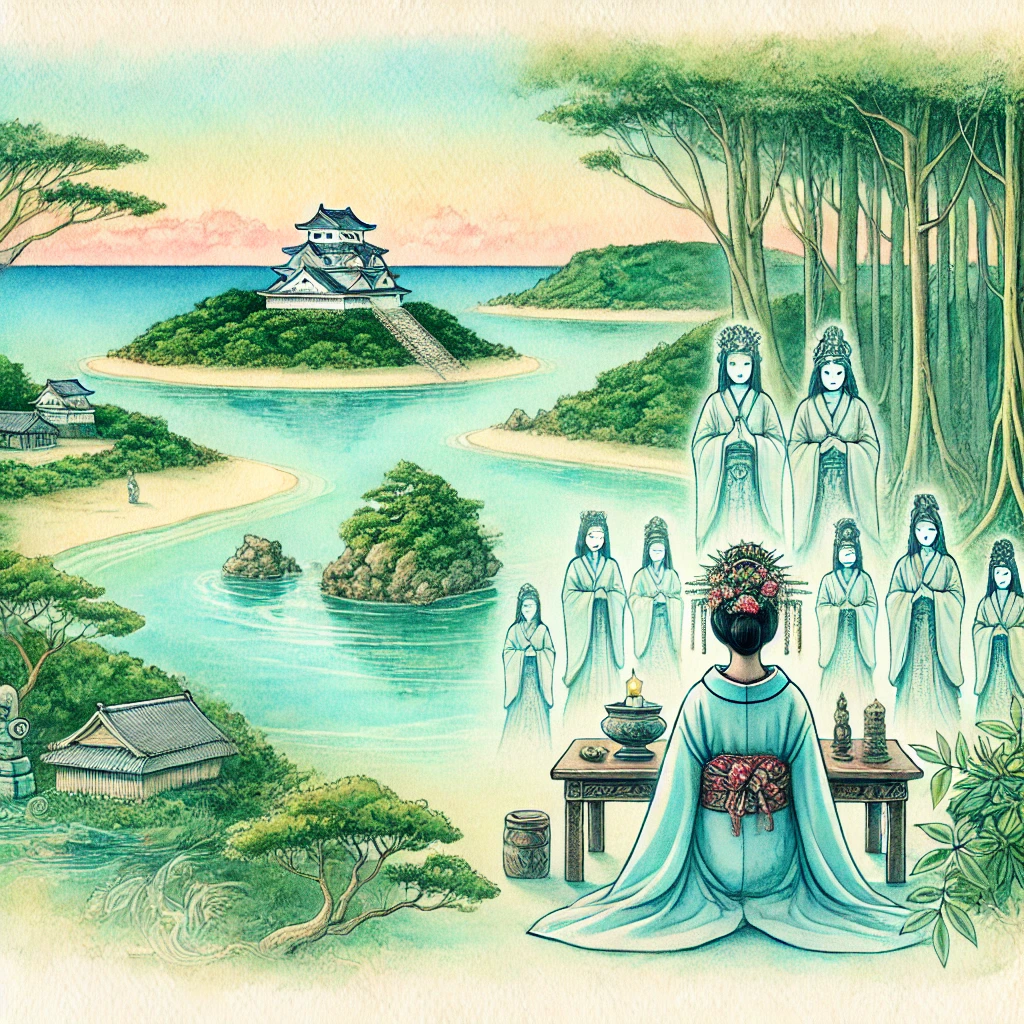
Have you ever been captivated by the breathtaking seas, lush forests, and unique culture of Okinawa? At the heart of this distinctive culture lies an ancient belief system known as “Noro Faith,” which has long accompanied the lives of the people of Okinawa.
Noro Faith is a mystical belief system centered around female priests called Noro. It deeply values nature worship and ancestor worship. The Noro serve a crucial role as intermediaries between gods and humans, ensuring the peace and prosperity of their villages.
Noro Faith is also intricately linked with many traditional Okinawan festivals, and its influence remains strong today. Sacred ceremonies such as “Niitoze” to celebrate the lunar New Year and “Uukui” for bountiful harvest prayers are led by the Noro, providing spiritual solace to the people of Okinawa.
However, in modern society, various challenges to the succession and development of Noro Faith have become apparent. Issues such as the lack of successors and difficulties in transmitting traditional knowledge have created a harsh environment for the continuation of Noro Faith.
Nonetheless, Noro Faith still encompasses many values that are relevant to contemporary society. It offers insights into living harmoniously with nature, the social roles of women, and the balance of strength and kindness in society—values that can help navigate the complexities of modern life.
What can we learn from this “spiritual heritage” of Noro Faith, and how can we pass it on to the future? By exploring the roots of the spirituality that Okinawans have cherished and preserved, we can find wisdom to overcome the challenges of today’s world. This blog aims to take you on such a journey.
From ancient times to the present day, Noro Faith has continued to be a companion to the hearts of the people of Okinawa. Let’s step together into this world shrouded in the mystic veil.
- What is Noro Faith?
- Characteristics of Noro Faith
- Noro Faith and Traditional Okinawan Events
- Reasons Why Noro Faith Has Rooted in Okinawan Culture
- Legends and Incidents Related to Noro Faith
- Conclusion
- Q&A
- Summary
What is Noro Faith?
The Definition and Role of the Noro
The Origin and Meaning of the Term “Noro”
Noro Faith is one of Okinawa’s traditional belief systems, with the Noro at its center. A Noro is a female priest who serves as a mediator between gods and humans, playing a vital role in the village community. The origin of the term “Noro” is debated, but it is generally believed to mean “a person who prays” or “a person who serves the gods.”
Noro convey the will of the gods and ancestors to the people and deliver the people’s prayers to the gods. They pray and perform rituals to ensure the village’s safety, bountiful harvests, and healing from illnesses. Thus, the Noro maintain harmony between the divine and the human realms.
Each region in Okinawa has its own Noro, forming unique belief systems. Through their interactions with the gods, Noro have used their acquired knowledge and power to guide and protect the lives of villagers.
Duties and Responsibilities of the Noro
The primary duties of the Noro include conducting rituals and offering prayers. Rituals are performed at various times, such as the changing of seasons or during critical agricultural activities, with the Noro playing a central role. They also listen to villagers’ wishes and convey them to the gods.
Noro also engage in prophecies and divine revelations through their communion with the gods. They foresee crises like natural disasters, epidemics, or wars and advise on appropriate measures. Moreover, Noro are responsible for maintaining village order, guiding villagers morally, and sometimes mediating disputes.
The role of the Noro extends beyond mere ritual performance to encompass critical responsibilities for the village’s peace and prosperity.
The Selection and Succession of Noro
The method of selecting a Noro varies by region. Often, women born into a Noro family learn the ways of rituals and prayers from a young age and officially assume the role upon reaching adulthood. The position of Noro is passed down from mother to daughter or sister to sister.
In some cases, women are chosen as Noro through divine revelation or dreams, indicating they possess special qualities or abilities for the role. The succession of Noro is vital for preserving and passing down Okinawan traditional culture. The knowledge and skills of the Noro have been honed over many years, ensuring an unbroken lineage to the present day, reflecting the depth of Okinawan faith.
The Origins and History of Noro Faith
The Origins and Ancient Development of Noro Faith
The origins of Noro Faith trace back to ancient Okinawa. Archaeological evidence shows that people began living in Okinawa around 2000 BCE. These early inhabitants developed a belief system that revered nature and worshipped ancestors.
Women with special powers started playing roles as intermediaries between gods and humans, performing prayers and rituals to thank nature for its blessings and to wish for village safety and prosperity. This practice became the foundation of Noro Faith.
As time progressed, Noro Faith became more sophisticated and systematized. With the development of village communities, the role of the Noro became increasingly significant.
Noro Faith During the Ryukyu Kingdom Era
In the late 14th century, the Ryukyu Kingdom was established, and Noro Faith held a significant position. A hierarchical system of priests was organized, with the highest priestess, Kikoe-Okimi, at the top, guiding the Noro throughout the land.
The royalty and nobility of the Ryukyu Kingdom highly valued the power of the Noro, involving them in important ceremonies and venerating them as protectors of the royal family. During this period, elements of Buddhism also began to integrate with Noro Faith, leading to the development of a unique syncretic belief system.
The Evolution of Noro Faith in Modern Times
The annexation of the Ryukyu Kingdom by Japan in 1879 brought significant changes to Noro Faith. As part of Japan’s modernization policies, Noro Faith was condemned as superstition and subjected to suppression.
Nevertheless, the people of Okinawa continued to preserve Noro Faith discreetly, practicing rituals and prayers behind the scenes while publicly attending Shinto shrines. After World War II, under US occupation, Noro Faith became a source of solace and hope for the war-torn population.
Since Okinawa’s reversion to Japan in 1972, Noro Faith has regained prominence, being recognized for its cultural significance and as a tourist attraction. Today, Noro Faith remains deeply embedded in the lives of Okinawans, with its rich history and traditions continuously upheld.
Characteristics of Noro Faith
A Female-Centered Belief System
The Role of Noro as Female Priests
A notable characteristic of Noro Faith is its female-centered structure, with Noro serving as the primary religious figures. Historically, women in Okinawa have been revered as intermediaries between the divine and the human realms.
Noro communicate the will of the gods through their spiritual interactions, praying for village welfare, good harvests, and healing from illnesses. The experience of childbirth and child-rearing, associated with the cycle of life, is believed to endow women with a sacred power, making them suitable for communion with the divine.
The Relationship Between Matriarchal Society and Noro Faith
Traditionally, Okinawa had a matriarchal society where lineage and property were passed down through the maternal line. This matriarchal influence is reflected in Noro Faith.
The position of Noro is often inherited from mother to daughter. Girls born into Noro families are trained in rituals and prayers from a young age and officially become Noro upon adulthood. In matriarchal societies, women were central figures in family and community life, which naturally extended to the religious sphere, embodied by the Noro.
The Status and Role of Women in Noro Faith
In Noro Faith, women hold a very significant status. The Noro are not only religious figures but also act as village elders.
In important village decisions, the Noro’s opinions are highly respected as they convey the will of the gods. Noro also serve as advisors to village women on matters like love, marriage, and childbirth, providing guidance and support.
Noro Faith has cultivated a culture that elevates and celebrates the power of women. To this day, Okinawan women take pride in the presence of Noro and continue to uphold this tradition.
Noro as Intermediaries Between Gods and Humans
The Transmission of Divine Will by Noro
The primary role of the Noro is to act as intermediaries, conveying the will of the gods to the people. Through their spiritual practices, Noro discern the intentions of the gods and relay them to the villagers.
In times of crises, such as natural disasters or epidemics, Noro pray to the gods to understand the causes and receive guidance on how to address them. They then convey this divine will to the villagers, providing directions on how to overcome these challenges.
Noro also listen to the villagers’ prayers and convey them to the gods, whether for healing illnesses or wishing for children. By acting as a bridge between the divine and human worlds, Noro offer spiritual support and solace to the villagers.
Noro’s Rituals and Prayers
Noro deepen the connection between gods and humans through various rituals and prayers. Important rituals are conducted during significant village events, such as seasonal changes or key agricultural activities.
For instance, during the lunar New Year, the “Niitoze” ceremony is led by the Noro, who offer greetings to the gods and pray for the village’s safety and bountiful harvests. Agricultural rituals such as “Tohachi,” marking the start of rice planting, and “Fuchibare,” thanking
for the harvest, are also significant.
Through these rituals, Noro foster a close relationship with the gods and convey divine will to the villagers. They also perform special prayers in response to individual needs, such as healing illnesses or ensuring safe childbirth.
Noro’s rituals and prayers are essential ceremonies that heal villagers’ hearts and provide hope.
The Relationship Between Noro and Believers
The relationship between the Noro and the villagers goes beyond that of a mere religious leader and followers. Noro are deeply involved in the daily lives of villagers, offering spiritual support and guidance.
Villagers hold deep trust and respect for the Noro, whose words are regarded as the will of the gods and followed accordingly. In turn, Noro care deeply for the villagers, listening to their concerns and wishes.
The relationship between Noro and the villagers is built on a long-standing foundation of mutual trust. It is not just a religious bond but a strong communal tie.
The Role of Noro Faith in Village Communities
The Role of Noro in Village Communities
Noro Faith is closely intertwined with village communities, with Noro playing a crucial role in ensuring the community’s peace and prosperity.
In making important village decisions, the Noro’s opinions are highly valued, as they convey the divine will. Noro also help maintain order within the village, providing moral guidance and mediating disputes.
Noro serve as the spiritual center of the village, uniting and leading the villagers.
Noro Faith and Village Cohesion
Noro Faith also plays a significant role in strengthening village cohesion. Villagers come together under the leadership of the Noro, cooperating for the village’s development.
For example, agricultural work, fishing, and festival preparations are communal efforts, with Noro encouraging the villagers and praying for divine blessings. The presence of Noro fosters a sense of unity and solidarity among the villagers.
Noro Faith is also crucial for preserving and passing down village traditions to future generations. Through rituals and ceremonies, Noro impart the village’s history and culture to the villagers, especially the children, who learn valuable stories and wisdom from the Noro.
Noro Faith has spiritually connected the villagers, strengthening the bonds of the community. It is a cherished cultural heritage of the Okinawan people.
Noro Faith and Community Decision-Making
Noro Faith has significantly influenced community decision-making. Important decisions are made by respecting the Noro’s opinions and seeking divine guidance.
For instance, when starting new projects or determining village policies, the Noro consult the gods and convey their will to the villagers, who then make decisions based on this divine guidance.
During crises like natural disasters or epidemics, the Noro’s advice is crucial. They convey the divine will and provide guidance on overcoming the challenges.
Noro Faith has helped integrate the villagers’ will, aiding in collective decision-making within the community. This wisdom, cultivated over many years, is a testament to the enduring strength of Okinawan culture.
Noro Faith and Traditional Okinawan Events
Prayers and Ceremonies Conducted by the Noro
Annual Events and Prayers by the Noro
Noro play a crucial role in Okinawa’s annual events. Celebrations such as “Niitoze” for the lunar New Year and “Tohachi” marking the start of rice planting always feature prayers conducted by the Noro during these seasonal milestones.
During these prayers, the Noro offer thanks to the gods and wish for the village’s safety and a bountiful harvest. They also comfort the spirits of ancestors and pray for the prosperity of their descendants.
Prayers by the Noro unite the villagers’ hearts and nurture gratitude for nature’s blessings, reflecting a tradition that the people of Okinawa have cherished for generations.
Types of Rituals and Ceremonies Conducted by the Noro
The rituals and ceremonies conducted by the Noro are varied and numerous.
“Otakabee” is a significant ceremony praying for the village’s safety and a good harvest. The Noro visit sacred sites to offer prayers to the gods.
“Uukui” is a ceremony to comfort the spirits of ancestors. The Noro invite ancestral spirits to their homes, offering them food and expressing gratitude.
“Mifo-rashi” is a ceremony for purifying the village, where the Noro drive away evil spirits and invite pure energy into the community.
These ceremonies are supported by the deep prayers and heartfelt gratitude of the Noro towards the gods.
The Significance of Noro Prayers and Ceremonies
Prayers and ceremonies conducted by the Noro are vital events that heal the hearts of villagers and give them hope.
In times of natural disasters, epidemics, or wars, the prayers of the Noro provided spiritual support to the people. By delivering the villagers’ wishes to the gods for good harvests or descendants’ prosperity, the Noro instilled courage and hope in the community.
The prayers and ceremonies of the Noro nurture the spirituality of the Okinawan people, ensuring the continuation of respect for nature and ancestor worship.
This tradition forms the foundation of Okinawan culture and values, carefully preserved to this day.
The Relationship Between Noro Faith and Agricultural Rituals
The Role of Noro in Agricultural Rituals
In Okinawan farming villages, Noro Faith and agricultural rituals are deeply interconnected. The Noro play a significant role at various stages of farming activities.
For instance, during “Tohachi,” which signals the beginning of rice planting, the Noro visit the fields to pray for a good harvest. During harvest time, the Noro offer the first rice to the gods, expressing gratitude.
The Noro oversee the growth of crops and teach villagers to appreciate nature’s blessings.
Prayers for a Good Harvest and Gratitude Ceremonies by the Noro
Prayers for a good harvest and gratitude ceremonies by the Noro are essential events for rural communities.
During the harvest prayer ceremony, the Noro wish for abundant crops and pray for the safe planting and sowing. Villagers celebrate the beginning of the agricultural year with heartfelt prayers led by the Noro.
In the gratitude ceremony, the Noro offer newly harvested rice to the gods, thanking them for the year’s blessings. Villagers renew their gratitude to the gods alongside the Noro.
These ceremonies symbolize the deep connection between nature and humanity, forming the core of Okinawan agricultural culture.
The Relationship Between Noro Faith and Agriculture
Noro Faith is closely related to Okinawan agriculture. The Noro oversee crop growth and instill in the villagers a sense of gratitude for nature’s blessings.
Additionally, the Noro have historically served as leaders in agricultural tasks. During planting and harvesting seasons, they guide villagers and teach them proper techniques.
Noro Faith provides a spiritual foundation that supports the coexistence of Okinawan people and nature. This belief system is deeply entwined with Okinawa’s traditional lifestyle centered around agriculture.
Even today, Noro Faith remains a crucial element supporting Okinawan rural culture.
The Relationship Between Noro Faith and Life Rituals
Birth Rituals and Noro Faith
In Okinawa, the birth of a child is celebrated as a great joy, with the Noro playing a vital role.
In the birth ritual known as “Tanadui,” the Noro prays for the newborn’s protection by the gods, wishing for the child’s healthy growth and happiness and bestowing blessings.
In the “Junihi” ceremony, the Noro gives the child a name imbued with hopes for their future.
The Noro celebrate the birth of children and play an essential role in watching over their growth.
Coming-of-Age Rituals and Noro Faith
In Okinawa, the coming-of-age ceremony “Sutuva” involves significant participation from the Noro.
During “Sutuva,” young people are welcomed into adulthood. The Noro pray for the gods’ protection over the young adults, explaining the responsibilities and expectations of adulthood.
Young people learn about village history, traditions, and moral teachings from the Noro, making this a crucial ceremony for passing cultural heritage to the next generation.
The Noro oversee the growth of young adults and play an essential role in integrating them into the community.
Funeral Rituals and Noro Faith
In Okinawa, funeral rituals also involve significant roles for the Noro.
In the funeral ceremony known as “Nabi,” the Noro guides the deceased’s spirit to the afterlife, easing the bereavement of the family and praying for the deceased’s peace.
In the “Shiji” ceremony, the Noro enshrines the deceased’s spirit alongside the ancestors, ensuring the deceased becomes a guardian spirit for their descendants.
The Noro accompany life’s milestones, acting as a bridge between the gods and the people, underpinning the spirituality of the Okinawan people.
Reasons Why Noro Faith Has Rooted in Okinawan Culture
The Relationship Between Okinawa’s Natural Environment and Noro Faith
The Geographic Characteristics of Okinawa and Noro Faith
Okinawa is a region comprising islands at Japan’s southernmost tip, characterized by a subtropical climate with hot, humid summers and mild winters.
Okinawa is also prone to frequent typhoons, often causing significant damage.
Living in such an environment, Okinawans have come to deeply appreciate and respect the power of nature.
Noro Faith is closely connected to this view of nature. The Noro interact with nature’s gods and have historically played roles in controlling these forces. For Okinawans living in a harsh natural environment, the presence of the Noro has been indispensable.
The Connection Between Nature Worship and Noro Faith
The people of Okinawa have long revered nature as sacred, believing that gods reside in mountains, forests, rivers, and seas.
This nature worship is reflected in Noro Faith. The Noro use their communion with nature’s gods to benefit the villagers.
For instance, when praying for a good harvest, the Noro offers prayers to the field gods. When praying for safety at sea, they offer sacrifices to the sea gods.
Noro Faith is a belief system deeply tied to the Okinawan view of nature.
The Relationship Between Okinawa’s Climate and Noro Faith
Okinawa’s subtropical climate, characterized by high temperatures and humidity, has influenced its unique lifestyle.
Noro Faith is also closely linked to this climate. For example, rain-making ceremonies were crucial during the dry season to address water shortages. The Noro prayed to rain gods for rain.
Preparing for typhoons also involved significant rituals. The Noro offered sacrifices to typhoon gods and prayed for the village’s safety.
Thus, Noro Faith has developed as a belief system adapted to Okinawa’s climate.
Historical Background and Development of Noro Faith
The Continuation of Ancient Beliefs and the Development of Noro Faith
The origins of Noro Faith date back to ancient Okinawa. Archaeological evidence indicates that people began inhabiting Okinawa as early as 2000 BCE.
These early inhabitants developed beliefs that revered nature and worshipped ancestors, which eventually evolved into Noro Faith.
Noro Faith has inherited and uniquely developed these ancient beliefs, reflecting Okinawan history and culture.
The Development of Noro Faith During the Ryukyu Kingdom Era
Noro Faith significantly developed during the Ryukyu Kingdom era.
The Ryukyu Kingdom, established in the early 15th century and lasting until the late 19th century, officially recognized Noro Faith, assigning it a crucial role.
A hierarchical system with the highest priestess, Kikoe-Okimi, was established, with Noro across regions conducting ceremonies under her guidance.
Women from the royal family also served as Noro, worshipping the family’s guardian gods.
Thus, Noro Faith was institutionally established and flourished during the Ryukyu Kingdom era.
Changes and Adaptations of Noro Faith in Modern Times
The annexation of the Ryukyu Kingdom by Japan in 1879 brought significant changes to Noro Faith.
Under the Meiji government’s policy of nationalizing Shinto, Noro Faith faced persecution. Many Noro were forced to convert to Shinto, making it challenging to practice traditional rituals.
However, Okinawans continued to preserve Noro Faith. While publicly worshiping at Shinto shrines, Noro continued their prayers and rituals clandestinely.
After World War II, Noro Faith began to revive, providing solace and hope for war-torn people.
Today, Noro Faith is
re-evaluated as an essential part of Okinawan cultural heritage, with efforts underway for its preservation and development.
Noro Faith has adapted to changing times while remaining a spiritual pillar for the people of Okinawa.
The Impact of Noro Faith on the Spiritual World of Okinawans
Noro Faith and the Okinawan Worldview
Noro Faith has profoundly influenced the worldview of Okinawans.
In the Okinawan worldview, it is believed that gods reside in all aspects of nature, including mountains, forests, rivers, seas, the sun, and the moon.
Humans are also considered part of nature, living in harmony with the gods.
This worldview is deeply connected to Noro Faith. The Noro have played roles in maintaining harmony between humans and the gods of nature.
Noro Faith has taught Okinawans the importance of living in harmony with nature and the humility of humans.
Noro Faith and Okinawan Values
Noro Faith has also significantly influenced Okinawan values.
The spirit of “Wa” (harmony) is highly valued among Okinawans, emphasizing mutual assistance and cooperation within the community.
These values are closely linked to Noro Faith, with the Noro fostering a sense of harmony and mutual help among villagers.
Additionally, Okinawans have always valued respect for ancestors, viewing them as protective figures for descendants.
Through ancestor worship ceremonies, the Noro instilled a sense of respect for ancestors in the villagers.
Thus, Noro Faith has played a crucial role in shaping Okinawan values.
The Unique Spirituality Fostered by Noro Faith
Noro Faith has nurtured a unique spirituality in Okinawa.
Okinawans have cherished the idea of living in harmony with nature, gods, and ancestors. This spirituality has been cultivated by Noro Faith.
Noro Faith has taught people to revere nature, foster gratitude towards the gods, and respect ancestors, wishing for the happiness of descendants.
This spirituality has been a driving force for Okinawans to overcome the harsh natural environment and historical challenges.
Even in modern times, the spirituality nurtured by Noro Faith remains a cornerstone of Okinawan culture and values, serving as a vital asset for the people.
Legends and Incidents Related to Noro Faith
Legends and Folktales About Noro
Legends of Noro’s Mystical Powers
Okinawa has various legends about the mystical powers of the Noro.
One legend suggests that the Noro could heal illnesses and prevent natural disasters through their prayers.
It is also said that the Noro had the power to foresee the future, predicting events in the village and individual fates.
These legends reflect the deep faith in the Noro’s mystical powers and the high expectations people had of them.
Legends of Noro’s Interactions with the Gods
Okinawa has numerous legends about the interactions between the Noro and the gods.
According to one legend, the Noro could visit the world of the gods and directly communicate with them, gaining wisdom and power to benefit the villagers.
Another legend tells of gods appearing in the Noro’s dreams to deliver messages, which the Noro would then convey to the villagers.
These legends illustrate the special relationship between the Noro and the gods, underscoring the sacredness of the Noro.
Folktales About Noro’s Prophecies and Oracles
Okinawa also has many folktales about the prophecies and oracles of the Noro.
One tale tells of a Noro predicting disasters or events in the village, warning the villagers in advance. Those who followed the Noro’s prophecies were able to avoid harm.
There are also tales of Noro predicting individual fates, guiding people through their lives. Those who adhered to the Noro’s oracles reportedly lived happy lives.
These folktales reflect the deep faith in the Noro’s prophecies and oracles and the significant trust people placed in their words.
Historical Incidents Involving Noro Faith
The Relationship Between Noro Faith and Authorities
Historically, Noro Faith has played an important role in relations with authorities.
During the Ryukyu Kingdom era, the relationship between the royal family and the Noro was highly significant. Women from the royal family served as Noro, worshipping the family’s guardian gods.
The Noro also participated in important royal ceremonies, playing a role in sanctifying the monarchy.
However, Noro Faith sometimes conflicted with authorities. From the modern era onwards, Noro Faith faced persecution under the nationalization of Shinto policies.
Thus, Noro Faith has a history of both cooperation and conflict with authorities.
The History of Suppression and Resistance Against Noro Faith
Noro Faith has also been subject to suppression and resistance throughout history.
Particularly under the Meiji government’s nationalization of Shinto policies, Noro Faith faced persecution, with many Noro forced to convert to Shinto, making it difficult to practice traditional rituals.
However, Okinawans continued to protect Noro Faith, performing prayers and rituals clandestinely while publicly worshipping at Shinto shrines.
This history of suppression and resistance highlights the significance of Noro Faith to the Okinawan people.
Social Incidents and Controversies Surrounding Noro Faith
In recent years, various social incidents and controversies have arisen around Noro Faith.
Disputes over the succession of Noro have occurred in various places, reflecting the friction between traditional succession methods and modern values.
There are also debates about the rituals of Noro Faith, with concerns about their simplification and commercialization, as well as efforts to reinterpret the rituals’ significance for modern society.
These social incidents and controversies reflect the ongoing relevance of Noro Faith in contemporary society. Balancing tradition and modernity remains a critical issue.
The Succession and Transformation of Noro Faith in Modern Times
The Current State and Succession Efforts of Noro Faith
Today, Noro Faith continues to be practiced in various parts of Okinawa.
Each region has faith groups centered around the Noro, continuing traditional rituals and prayers.
Efforts to preserve Noro Faith include training successors, documenting and preserving rituals, and transmitting traditional knowledge.
However, the succession of Noro Faith faces challenges in modern society due to youth migration to urban areas and changes in traditional lifestyles.
The succession of Noro Faith is crucial for preserving Okinawan culture and values and passing them to future generations.
Adaptation and Transformation of Noro Faith in Contemporary Society
In contemporary society, Noro Faith faces the need for adaptation and transformation.
In urban areas, maintaining the traditional village-based structure of Noro Faith is challenging, leading to the formation of new types of faith groups and the simplification of rituals.
There are also efforts to explore the modern significance of Noro Faith, linking its values to contemporary issues such as environmental protection and peace movements.
These adaptations and transformations are necessary for Noro Faith to continue thriving in modern society. Balancing tradition with creating new values is essential.
Challenges and Prospects for the Succession of Noro Faith
The succession of Noro Faith faces several challenges, including a shortage of successors, difficulties in transmitting traditional knowledge, and the simplification of rituals.
Balancing the values of modern society with those of Noro Faith is another critical issue.
However, the succession of Noro Faith is essential for preserving Okinawan culture and spirituality and passing it to future generations.
Reinterpreting the values of Noro Faith to align with modern society and ensuring its continuation in new forms is necessary.
Balancing tradition and modernity while working towards the succession and development of Noro Faith will be key to building Okinawa’s future.
Conclusion
The Influence of Noro Faith on Okinawan Culture
The Relationship Between Noro Faith and Traditional Okinawan Culture
Noro Faith is deeply intertwined with Okinawa’s traditional culture. Its influence can be seen in various aspects of Okinawan tradition, including festivals, rituals, and performing arts. For example, the famous Okinawan festival “Eisa” is closely linked to Noro Faith, originating from rituals led by Noro to pray for a bountiful harvest. Additionally, the traditional performing art “Kumiodori” often features stories where Noro play significant roles.
Thus, Noro Faith has significantly shaped and developed Okinawa’s traditional culture. Understanding Okinawan culture is incomplete without acknowledging the profound impact of Noro Faith.
The Unique Values and Worldview Cultivated by Noro Faith
Noro Faith has fostered unique values and a worldview specific to Okinawa. Values such as living in harmony with nature, gratitude to the gods, and reverence for ancestors are deeply rooted in Noro Faith. Moreover, the Okinawan worldview, which sees gods residing in all elements of nature, originates from Noro Faith. These values and worldviews are reflected in Okinawan culture, arts, and lifestyle, forming a crucial part of Okinawa’s distinctive charm.
The Importance of Noro Faith in Okinawan Culture
Noro Faith is an indispensable element of Okinawan culture. It holds the key to understanding Okinawa’s history and traditions. Knowing the history of Noro Faith, which has long been a spiritual pillar for Okinawans, is essential for comprehending Okinawan culture. Even in contemporary times, Noro Faith plays a vital role in preserving traditional culture and providing spiritual support, deeply embedded in the lives of Okinawans. A true understanding of Okinawan culture necessitates an understanding of Noro Faith, as it forms the core of Okinawa’s cultural essence.
The Spirituality of the Okinawan People Learned from Noro Faith
Harmony Between Nature and Humans as Seen in Noro Faith
Noro Faith teaches the importance of harmony between nature and humans. It posits that gods reside in all aspects of nature, and humans are part of this natural world, coexisting with the gods. This perspective emphasizes the importance of valuing and living in harmony with nature, providing valuable insights for addressing contemporary environmental issues. Learning from Noro Faith allows us to explore sustainable ways of creating a society where nature and humans coexist.
The Social Role of Women as Learned from Noro Faith
Noro Faith highlights the significant social role of women. In Noro Faith, women have served as crucial mediators between the gods and humans, with their spirituality and intuition highly valued, granting them high social status. This perspective offers important insights for considering women’s social roles in modern society. There is much to learn from Noro Faith about creating a society where women can fully utilize their abilities. The respect for women seen in Noro Faith is a key element in realizing true gender equality in society.
The Spiritual Strength and Kindness of the Okinawan People as Seen in Noro Faith
Noro Faith exemplifies the spiritual strength and kindness of the Okinawan people. The people of Okinawa have endured harsh natural environments and historical hardships, drawing spiritual strength from Noro Faith. It has provided them with hope and courage to face challenges. Simultaneously, Noro Faith has nurtured kindness and compassion in people. The gratitude towards nature, gods, and ancestors, and the mutual help spirit of “Yui-Maru,” are deeply connected to Noro Faith. The spirituality of the Okinawan people seen in Noro Faith offers valuable lessons for living in the present day. Learning from the resilience and kindness of the Okinawan spirit can enrich our own lives.
The Significance and Challenges of Noro Faith in Modern Society
The Contemporary Significance and Value of Noro Faith
Noro Faith holds important significance and value in modern society. Its principles of living in harmony with nature, preserving traditional culture, and serving as a spiritual refuge are especially relevant today. Noro Faith provides valuable insights into contemporary issues such as environmental problems and the crisis of spirituality. Exploring the modern significance of Noro Faith and applying its values to today’s society is a crucial task not only for Okinawa but for the world.
The Challenges in Preserving and Developing Noro Faith
However, there are various challenges in preserving and developing Noro Faith. Issues such as a shortage of successors, difficulties in transmitting traditional knowledge, and the simplification of rituals threaten the foundation of Noro Faith. Balancing modern societal values with those of Noro Faith is another critical challenge. Overcoming these challenges requires concerted efforts from the entire community, including government, educational institutions, and local communities, to preserve and develop Noro Faith for future generations.
Messages from Noro Faith to Modern Society
Noro Faith conveys important messages to those living in modern society. It teaches us to coexist with nature, value traditions while creating new values, trust in the power of women, help each other, and build a society that combines strength and kindness. It encourages us to maintain hope and courage to face challenging times. The heart of Okinawa nurtured by Noro Faith provides valuable guidance for navigating the complexities of contemporary society. Learning from Noro Faith and applying its wisdom in the present is essential. This practice is vital not only for Okinawa but for the future of the world. Passing on the “spiritual heritage” of Noro Faith to the next generation and utilizing it in the new era may be a mission for each of us living today.
Q&A
What is the role of women in Noro Faith?
In Noro Faith, women play a crucial role as mediators between the gods and humans. Female priests, known as Noro, convey the will of the gods and deliver people’s prayers to the divine. They also protect the peace and prosperity of their villages. In a society deeply rooted in matriarchal traditions, the spirituality and intuition of women are highly valued, granting them high social status.
How is Noro Faith related to traditional Okinawan events?
Noro Faith is closely connected to many traditional Okinawan events. For example, in celebrations like the lunar New Year “Niitoze” and the harvest prayer ceremony “Uukui,” Noro play a central role. Noro also have significant roles in agricultural and life rituals, deeply embedded in people’s lives. Okinawan traditional events are strongly influenced by Noro Faith.
What is the significance of Noro Faith in modern society?
Noro Faith holds significant contemporary value, emphasizing harmony with nature, preserving traditional culture, and providing spiritual refuge. It offers valuable insights into environmental issues and the crisis of spirituality in modern society. Additionally, Noro Faith provides important lessons on the social roles of women and the balance of strength and kindness in society.
What are the challenges in preserving and developing Noro Faith?
There are several challenges in preserving and developing Noro Faith, including a shortage of successors, difficulties in transmitting traditional knowledge, and the simplification of rituals. Balancing modern societal values with those of Noro Faith is another critical challenge. Overcoming these issues requires collective efforts from government, educational institutions, and local communities.
What can modern society learn from Noro Faith?
Noro Faith teaches us to live in harmony with nature, value traditions while creating new values, trust in the power of women, help each other, and build a society that combines strength and kindness. It encourages maintaining hope and courage in challenging times. Learning from the spirit of Okinawa nurtured by Noro Faith provides valuable guidance for navigating contemporary society.
Summary
This blog, titled “The History and Characteristics of Okinawa’s Traditional Belief, Noro Faith,” delves into the origins and historical background of Noro Faith, its female-centered belief system, and its significance and challenges in modern society. Noro Faith has deeply rooted itself in the lives of Okinawans, fostering values such as nature worship, ancestor reverence, and respect for female spirituality. It is closely connected to traditional Okinawan events like agricultural and life rituals, with its influence still evident today.
In modern society, Noro Faith faces various challenges in its preservation and development, such as a shortage of successors and the simplification of rituals. However, it also encompasses many values relevant to contemporary issues, such as harmony with nature, the social roles of women, and a balanced society of strength and kindness. We are called to learn from the “spiritual heritage” of Noro Faith and apply its wisdom to modern society. Preserving the heart of Noro Faith nurtured by Okinawans over a long history and passing it to the next generation may be our mission in the present day.


コメント