
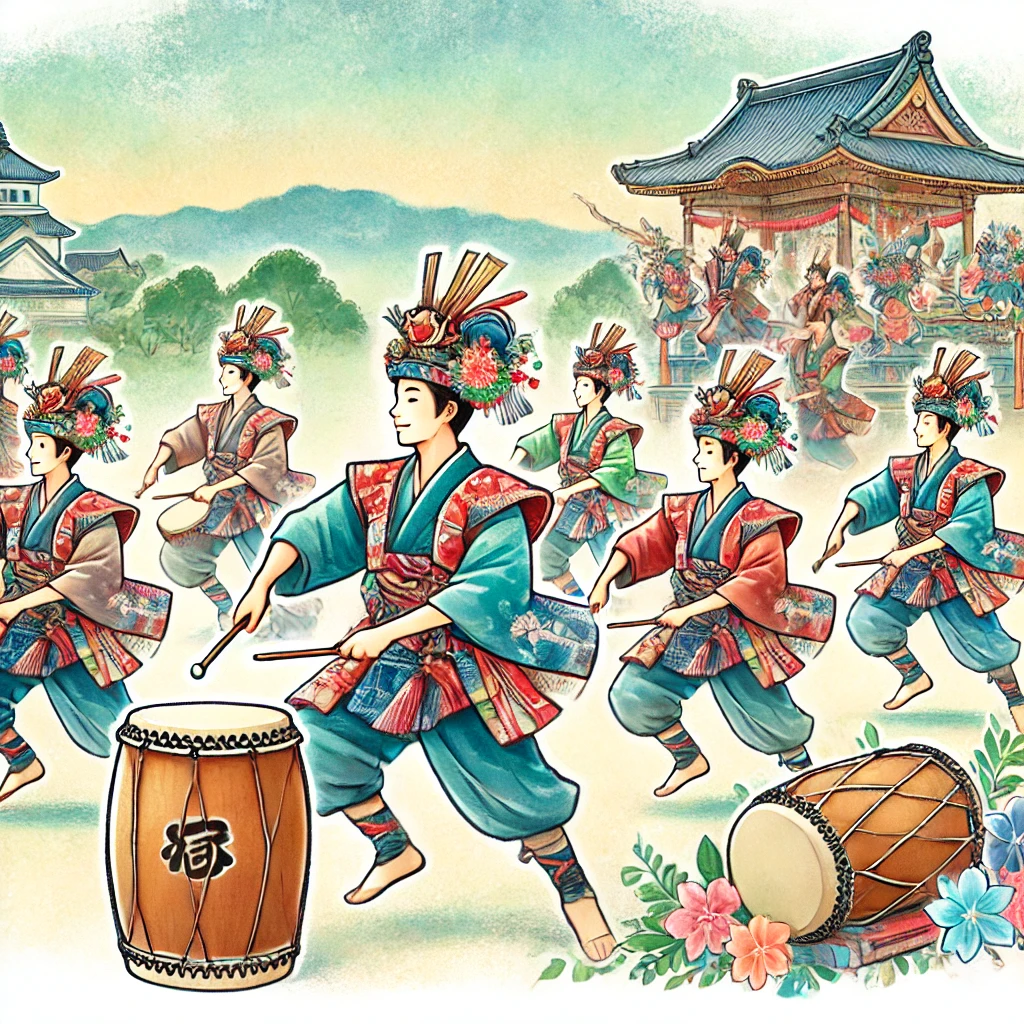
Eisa is one of the traditional performing arts that represents Okinawa. The powerful beats of the drums, combined with the graceful and energetic movements of the dancers in their vibrant costumes, create a spectacle that leaves the audience in awe. However, the appeal of Eisa extends beyond its dynamic performances.
The origins of Eisa are surrounded by various theories, suggesting that it developed uniquely in Okinawa while being influenced by China and mainland Japan. Each element of Eisa, from the drum performances and unique costumes and makeup to the mixed-gender dances and the emphasis on exuberant performance, reflects the rich history and culture of Okinawa.
Moreover, Eisa is deeply intertwined with the spiritual world of Okinawa. The beliefs and wishes of the Okinawan people, such as ancestor worship and prayers for a good harvest, are manifested in various aspects of Eisa. Through Eisa, we might be able to touch upon the very soul of the Okinawan people.
Looking into the history of Eisa, we find that it has faced numerous challenges, such as the “Eisa Ban” during the Meiji era. Despite these difficulties, the people of Okinawa have persevered, protecting and preserving Eisa. It can be said that Eisa has become ingrained in Okinawan culture because of its deep connection to the spirit of the Okinawan people.
This article will delve into the origins, characteristics, historical background, and the relationship between Eisa and Okinawan spirituality, providing a comprehensive look at the many facets of Eisa’s charm. By exploring Eisa, we invite you to immerse yourself in the rich cultural world of Okinawa. You are sure to become captivated by Eisa.
- What is Eisa?
- Origins of Eisa
- Characteristics of Eisa
- Eisa and the Spiritual World of Okinawa
- Legends and Historical Events Related to Eisa
- Reasons Why Eisa Became an Integral Part of Okinawan Culture
- Conclusion
- Q&A
- Summary
What is Eisa?
Definition of Eisa
The Etymology of Eisa
The word “Eisa” is said to originate from the Okinawan term “Eesaa,” which means “to meet” or “to come together.” This name was given because Eisa serves as a means for people to gather and deepen their interactions. Additionally, Eisa can be written as “英彩,” meaning “heroic dance,” emphasizing its valorous aspect.
Eisa holds a special significance for the people of Okinawa. It is not just a dance but also an important ritual expressing gratitude to ancestors and prayers for a good harvest. Through Eisa, people come together as one, strengthening community bonds.
While there are various theories about the origins of Eisa, it is clear that this art form is deeply connected to the spirituality of the Okinawan people. As its etymology suggests, Eisa symbolizes the cultural value that Okinawa places on human connections and interactions.
Components of Eisa
Eisa consists of three main elements: drums, sanshin, and dance. The drums, in particular, are the heart of Eisa. The beat of the drums, akin to a heartbeat, ignites the dancers’ spirits, leading to energetic and lively performances.
The sanshin, a traditional Okinawan string instrument, plays a crucial role in coloring Eisa’s music. Its melodious yet sometimes melancholic tones have the power to evoke emotions and soothe the soul.
The dance, which is the essence of Eisa, showcases both male and female dancers performing together. The dynamic movements are mesmerizing, and the contrast between the elegant gestures of the women and the vigorous steps of the men is particularly captivating.
These components of Eisa interact with each other to create a unified performance. The rhythm of the drums, the melodies of the sanshin, and the vibrant dance movements come together to form the essence of Eisa.
Historical Background of Eisa
Various Theories on the Origins of Eisa
There are several theories about the origins of Eisa. Some suggest it came from China, others from mainland Japan, while another theory proposes that it developed independently in Okinawa.
The Chinese origin theory points to the many similarities between Eisa and traditional Chinese performing arts. For instance, both feature drum-based dances, but Eisa also has unique elements not found in Chinese arts.
The Japanese mainland origin theory notes the connections between Eisa and traditional Japanese arts like Bon Odori and Nenbutsu Odori, which also involve dancing to drum rhythms. However, Eisa’s unique development sets it apart from mainland Japanese arts.
Currently, the most widely accepted theory is that Eisa evolved uniquely in Okinawa, influenced by both China and Japan. This theory emphasizes that while Eisa was influenced by external cultures, it was distinctly shaped by Okinawan people, reflecting the island’s history and spirituality.
While the exact origins of Eisa remain a mystery, it is clear that it has been nurtured over many years as a cornerstone of Okinawan culture. The wisdom and passion of our ancestors have created the Eisa we know today.
The Development of Eisa
Eisa has evolved alongside Okinawa’s history. While it has been performed in various regions for centuries, its character has changed over time.
A significant turning point was the Eisa Ban during the Meiji era, when authorities deemed Eisa a vulgar and barbaric art form and issued a ban. This led to a temporary decline, but Eisa continued to be passed down secretly among the people.
In the Showa era, a movement to revive Eisa began. As the value of traditional arts was re-evaluated, Eisa also gained renewed appreciation. Today, Eisa is widely recognized both domestically and internationally as a representative traditional art of Okinawa.
The development of Eisa highlights its deep roots in the hearts of Okinawans. Despite historical changes and challenges, Eisa has survived and thrived, showcasing the strong will and dedication of the Okinawan people.
Eisa will continue to walk alongside Okinawa’s history and culture. It is our responsibility to preserve and pass on this precious heritage to future generations. Through Eisa, we aim to connect the spirit of Okinawa to the future.
Eisa remains one of the most popular traditional arts in Okinawa, thanks to its unique appeal.
The charm of Eisa lies in its dynamic nature. The powerful drum rhythms and the lively movements of the dancers captivate the audience, creating a sense of freedom as if the dancers are one with the music.
Eisa not only entertains the audience but also brings joy to the performers. It provides a space for self-expression, and the joy of mastering its complex movements is unparalleled.
Moreover, Eisa fosters connections among people. It is an art form where people of all ages and genders dance together, creating intergenerational bonds through shared practice and performance.
These aspects of Eisa’s charm continue to attract many people. Recently, its appeal has been rediscovered both in Japan and abroad, leading to a surge in its popularity.
We have the responsibility to cherish and pass on this invaluable treasure of Okinawa. By promoting the beauty of Okinawan culture through Eisa, we can harness its power to connect people in our modern society.
Eisa truly symbolizes the heart of Okinawa. We hope that Eisa will continue to resonate with the spirit of Okinawan people and enrich their culture for years to come.
Origins of Eisa
Theory of Chinese Origin
Similarities with Chinese Traditional Performing Arts
In exploring the origins of Eisa, we must first consider the influence of China. Eisa shares many similarities with traditional Chinese performing arts.
Notably, the use of drums in dance is common in Chinese arts such as Nuo dance and Kunqu opera. These art forms also involve dancing to drum rhythms, similar to Eisa.
The costumes used in Eisa also show Chinese influence. The vibrant colors and auspicious patterns like dragons and phoenixes are common in traditional Chinese attire.
These similarities have led to the theory that Eisa originated from China. During the Ryukyu Kingdom era, Okinawa had active exchanges with China, and many cultural elements are believed to have been introduced. Eisa might have been one of them.
However, it’s premature to conclude that Eisa was directly brought from China based on these similarities. Eisa also has many unique developments not found in Chinese arts.
Cultural Influence from China
Considering the origins of Eisa, we cannot overlook the cultural influence from China. Okinawa has had active exchanges with China for centuries, with various cultural elements being introduced.
During the Ming dynasty, many Chinese people settled in Okinawa, bringing their culture with them. This influence is evident in Okinawan language, customs, and performing arts.
Given this background, it is natural to think that Chinese culture influenced Eisa. In fact, some instruments used in Eisa have Chinese origins.
However, the influence from China is just one factor in the development of Eisa. Okinawan people adapted and interpreted these influences uniquely, creating their own performing arts.
It is the creativity of the Okinawan people, who incorporated external influences while developing their unique expressions, that should be highlighted.
Theory of Japanese Mainland Origin
Connections with Mainland Traditional Arts
Another important aspect to consider is the influence from mainland Japan. Eisa shares several connections with traditional Japanese arts.
For example, similar forms of performing arts in mainland Japan include Bon Odori and Nenbutsu Odori, which also involve dancing to drum rhythms, similar to Eisa.
The movements in Eisa also show influences from mainland arts like Noh and Kabuki. The graceful gestures of women in Eisa, for instance, resemble those seen in Noh.
These connections have led to the theory that Eisa originated from mainland Japan. Okinawa has had exchanges with mainland Japan for centuries, and these influences might have contributed to the development of Eisa.
However, while acknowledging mainland influences, it is hard to believe that Eisa was directly introduced from there. Eisa has evolved uniquely, showcasing distinct developments
not seen in mainland arts.
Cultural Influence from Mainland Japan
Despite being geographically distant from mainland Japan, Okinawa has had cultural exchanges with it for centuries. Particularly during the Edo period under Satsuma Domain’s rule, mainland culture was actively introduced to Okinawa.
For instance, the Satsuma Domain encouraged Okinawan samurai to learn mainland performing arts like Noh and Kabuki. These policies helped mainland arts take root in Okinawa.
Additionally, many students were sent from Okinawa to mainland Japan during the Ryukyu Kingdom era, bringing back knowledge and skills that contributed to cultural development.
This constant influx of mainland culture undoubtedly influenced Eisa’s development. However, Eisa is not a mere imitation of mainland arts. Okinawan people adapted and reinterpreted these influences, creating their unique art form.
The essence of Eisa lies in the creativity of Okinawan people who blended external influences with their own culture.
Theory of Unique Development in Okinawa
Historical and Geographical Characteristics of Okinawa
Understanding the origins of Eisa requires appreciating Okinawa’s historical and geographical characteristics. Okinawa has cultivated a unique culture while being influenced by both China and mainland Japan.
Okinawa’s geographical position between China and Japan made it a cultural crossroads. During the Ryukyu Kingdom era, Okinawa thrived as a center of East Asian trade, absorbing various cultural influences.
These historical and geographical characteristics provided fertile ground for Okinawa’s unique cultural development. Okinawan people have absorbed external influences and created new cultural expressions.
Eisa exemplifies this unique development. While influenced by China and mainland Japan, Okinawan people have added their interpretations, evolving Eisa into a distinctive art form.
Eisa is a performing art born from Okinawa’s history and environment. Exploring its origins helps us understand the essence of Okinawan culture.
Fusion with Other Cultures
Considering the origins of Eisa, we cannot overlook its fusion with other cultures. Eisa has developed uniquely in Okinawa while being influenced by China and mainland Japan.
For example, some instruments used in Eisa have Chinese origins, while others come from mainland Japan. The costumes and dance movements also show various cultural influences.
However, Eisa is not just a collection of different cultural elements. Okinawan people have creatively interpreted these influences, creating new expressions.
For instance, they have incorporated Chinese instruments with Okinawan rhythms and mainland gestures into Eisa’s dance.
This fusion of cultures has enriched and diversified Eisa. Eisa symbolizes the fusion of Okinawan culture with other influences.
Exploring Eisa’s origins helps us understand the process of cultural formation in Okinawa. Through interactions with various cultures, Okinawan people have built their unique culture, epitomized by Eisa.
Although Eisa’s origins are still partly shrouded in mystery, it is clear that it has been nurtured as a spiritual cornerstone of Okinawan people over many years.
Eisa has developed uniquely in Okinawa, influenced by external cultures but shaped by Okinawan people’s creativity. It is a cultural heritage created by Okinawa’s history and environment.
Understanding Eisa’s origins is not just an academic pursuit. It is also about appreciating the spirituality and aesthetic sense of Okinawan people.
Eisa features powerful drum rhythms and dynamic dance movements, but at its core, it expresses gratitude to ancestors and reverence for nature. Through Eisa, Okinawan people connect with the unseen world.
Eisa also plays a role in strengthening community bonds. Practicing Eisa together unites people, fostering a sense of community.
Exploring Eisa’s origins allows us to touch upon the essence of Okinawan people’s spirit. Eisa is not just an art form but a way of life for Okinawan people.
Future research will further clarify Eisa’s origins, revealing more details about its development.
However, we must remember that Eisa has survived until today because of the passion and creativity of Okinawan people. We have the responsibility to cherish and pass on this precious cultural heritage to future generations.
Understanding Eisa’s origins might also make us reflect on our own ways of living. Valuing tradition while creating new culture embodies the spirit of Okinawan people.
Characteristics of Eisa
Drum-Centric Performances
Types of Drums Used
Drums play a central role in Eisa performances, and three main types of drums are used.
Firstly, there is the “Paranku,” a large drum with a diameter of about 60 cm. It is strapped around the waist with a cord and produces a powerful sound, forming the backbone of Eisa’s musical ensemble.
Next is the “Shisa Daiko,” a medium-sized drum. Slightly smaller than the Paranku, with a diameter of about 30 cm, it is held with one hand while the other hand strikes it with a stick.
Lastly, there is the “Hand Daiko,” a small hand-held drum used to maintain rhythm.
The rich, layered sounds of these drums create the dynamic and compelling soundscape of Eisa.
Drum Techniques and Unique Rhythms
The drum techniques in Eisa are incredibly dynamic, particularly the Paranku’s performance.
The performer, with the Paranku strapped to their waist, stands poised with the drum in front, striking it with powerful, sweeping motions that involve the entire body. This movement gives the impression of the performer becoming one with the drum, with their intense energy resonating through each beat.
Eisa’s drum rhythms are also distinctive. The basic rhythm pattern follows a “Don-Don-Doko-Doko” four-beat cycle, forming the foundation upon which various rhythmic variations are built.
The rhythms can include complex syncopations, sudden silences followed by synchronized strikes, and an ever-changing tempo, making the drum not just an accompaniment but the essence of the music itself.
Unique Costumes and Makeup
Details and Symbolic Meaning of Costumes
Eisa costumes are vivid and striking. Dancers wear brightly colored kimonos and adorn their heads with floral hats.
Women’s costumes are particularly elaborate, featuring kimonos in vibrant hues like red, blue, and yellow, embellished with gold and silver decorations, creating a blossoming floral appearance.
Men’s costumes, while not as flashy, are still colorful and often include a cord around the waist for the drum.
These costumes carry symbolic meanings. The bright colors symbolize wishes for prosperity and abundance.
The floral hats are said to represent the sun, symbolizing gratitude for its blessings and prayers for a bountiful harvest.
Characteristics and Role of Makeup
Eisa dancers wear distinctive makeup, typically a white base with red and black highlights around the eyes and mouth.
This makeup style, called “Suupaa,” is meant to convey a divine or majestic presence.
Through this makeup, dancers transform, embodying a different persona, which adds to the sacred atmosphere of Eisa.
The Suupaa makeup also emphasizes facial expressions, allowing dancers to vividly convey emotions such as joy, anger, sorrow, and delight, enhancing the audience’s experience.
Makeup is not merely decorative but an essential element that amplifies the expressive power of Eisa.
Mixed-Gender Dancing
Role Distribution Between Men and Women
Eisa is characterized by mixed-gender dancing, with distinct roles for men and women.
Men usually play the drums while dancing vigorously, contributing to the dynamic aspect of Eisa.
Women perform graceful dances, often using fans or sanshin, showcasing fluid and elegant movements.
This division of roles highlights the contrasting elements of strength and grace, adding depth to the performance.
Unique Atmosphere Created by Mixed-Gender Dancing
The combination of male and female dancers creates a unique atmosphere in Eisa.
The interplay of the powerful male dances and the elegant female dances creates a dynamic performance. Sometimes, it even evokes the feeling of a romantic exchange between partners.
Furthermore, Eisa involves people of all ages, from children to the elderly, dancing together. This communal aspect symbolizes the unity and cohesion of the community.
Eisa is not just a performing art but also a platform for strengthening community bonds. By dancing together, the bonds within the community become even stronger.
Emphasis on Excitement and Audience Engagement
Sense of Unity with the Audience
Eisa emphasizes creating a sense of unity with the audience. Dancers perform facing the audience, inviting them to join in the dance.
The chants known as “Kachashi” play a crucial role in this interaction. Dancers shout calls like “Haiya!” and “Hoi!” while dancing, engaging the audience to clap and dance along.
This interaction through chants fosters a sense of unity between the performers and the audience, enhancing the excitement of Eisa.
Improvisation and High Degree of Freedom
Eisa performances are characterized by improvisation and a high degree of freedom.
While there are basic dance forms, there is room for variation. Dancers adapt the dance to their own sensibilities, adding personal flair to their movements.
At the peak of excitement, the dance can become almost entirely improvised. Dancers move freely to the music, and this spontaneity adds to the appeal of Eisa.
Moreover, the formations in Eisa are flexible, changing from lines to circles to groups, adding variety to the dance.
This improvisation and freedom give Eisa a unique vibrancy. It is an unbounded, living art form, embodying the essence of Eisa.
Examining the features of Eisa reveals how its elements intertwine to create this vibrant art form.
The powerful drum rhythms, the colorful costumes, the gender-specific roles, and the unity with the audience all combine to express the prayers and joy of the Okinawan people.
Eisa is not just an art form but an expression of the Okinawan spirit. Dancers channel their emotions through the dance, and the audience receives and resonates with these feelings.
This creates a bond between people, transcending age and class. Everyone dances to the same rhythm, creating a sense of unity.
Eisa symbolizes the essence of Okinawan communities, bringing people together to share joy. This is why Eisa is an irreplaceable part of Okinawan culture.
Understanding Eisa’s features is also a way to learn about Okinawa’s culture and history. By listening to the drumbeats and watching the dancers, one can feel the spirit of the Okinawan people.
When we can truly appreciate these feelings, we can grasp the true allure of Eisa. Through music and dance, we touch the heart of Okinawa, which is the ultimate charm of Eisa.
Eisa and the Spiritual World of Okinawa
Connection with Ancestor Worship
Expressing Gratitude to Ancestors through Eisa
Eisa is not merely a performing art; it is deeply intertwined with the spiritual world of the Okinawan people. Among these spiritual connections, the relationship with ancestor worship is particularly significant.
In Okinawa, the tradition of respecting and giving thanks to ancestors has been long established. People believe that their lives are supported by the blessings of their ancestors.
Eisa serves as a way to express this gratitude to ancestors. Dancing Eisa is an act of offering thanks and consoling the spirits of ancestors.
Historically, the origins of Eisa are said to be rooted in the purpose of comforting the spirits of ancestors. Eisa was traditionally performed during harvest festivals and Bon Odori, reflecting this intention.
Calling upon and honoring the spirits of ancestors, and expressing gratitude for their blessings, are deeply embedded in the spirit of Eisa.
Methods of Expressing Ancestor Worship
Ancestor worship in Eisa is expressed in various forms.
For instance, the costumes in Eisa sometimes feature the crests of ancestors. This symbolizes that the dancers are embodying the spirits of their ancestors, drawing upon their power to dance.
Additionally, the gestures in Eisa dances have meanings related to welcoming and entertaining ancestors. The graceful movements of the hands are said to symbolize the act of hosting ancestors.
Furthermore, the music of Eisa also expresses ancestor worship. The sound of the sanshin, a traditional Okinawan instrument, is believed to play a role in summoning the spirits of ancestors.
In this way, every element of Eisa incorporates the philosophy of ancestor worship. Through Eisa, the people of Okinawa connect with their ancestors and express their gratitude for their blessings.
For those of us living in the modern world, the concept of ancestor worship might be somewhat unfamiliar. However, holding a sense of gratitude towards our predecessors is incredibly important.
Eisa acts as a mechanism to awaken such feelings. It provides a way to communicate with the spirits of ancestors and offer thanks. Through Eisa, we might experience such a profound connection.
Significance of Praying for a Good Harvest
The Connection Between Agricultural Culture and Eisa
Discussing Eisa and the spiritual world of Okinawa would be incomplete without mentioning its significance in praying for a good harvest. Okinawa, deeply rooted in agricultural traditions, has long relied on the blessings of agricultural produce for its people’s livelihoods.
Thus, customs praying for bountiful harvests are prevalent across Okinawa. Yūkar, for instance, is a notable example.
Eisa is also deeply linked to prayers for a good harvest. The period when Eisa is most actively performed, from August to September in the old lunar calendar, coincides with the harvest season.
Before the harvest, people danced Eisa to pray for abundance. The powerful rhythms of Eisa were believed to invoke the blessings of the earth.
Moreover, the lyrics of Eisa songs often contain prayers for a good harvest. A verse from the “Honen Festival Song” goes:
“Haishai Haishai, Five Grains Abundant, Haishai Haishai, Peace in the Land.”
This is a song that directly wishes for a bountiful harvest and national prosperity.
Ritualistic Aspects of Praying for a Good Harvest
The prayers for a good harvest in Eisa are not just wishes; they are also ritualistic acts.
In ancient times, prayers were offered before dancing Eisa, a ceremony known as kogigi. In kogigi, prayers were offered at sacred places to wish for the success of Eisa and a bountiful harvest.
Even during Eisa, certain gestures are believed to invoke a good harvest. For example, the vigorous stomping of the dancers’ feet is said to awaken the power of the earth.
Furthermore, at the end of Eisa performances, a ritual called “Ukwī” might be performed, where dancers form a circle and dance, expressing gratitude for the harvest.
In this manner, Eisa has a ritualistic aspect of praying for a good harvest. It is not merely a wish but a physical act of invoking abundance. Each gesture is imbued with the prayers of the Okinawan people.
In modern times, the connection between Eisa and prayers for a good harvest may have weakened. However, the spirit of gratitude for nature’s blessings and the wish for abundance remains crucial.
Through Eisa, we can touch upon the prayers of the Okinawan people. Stomping on the ground, dancing with sweat—each act is filled with the wish for a bountiful harvest. With this perspective, Eisa dances take on a new, profound meaning.
Strengthening Community Bonds
Intergenerational Exchange Through Eisa
Eisa not only expresses the spiritual world of Okinawa but also plays a significant role in strengthening community bonds, particularly through intergenerational exchange.
Eisa is a performing art where people of all ages, from children to the elderly, dance together. The gathering of community members for dance performances fosters interactions between generations who might otherwise seldom engage with one another.
Through dancing, children learn the art from adults, receiving tips and occasional praise. These interactions contribute to the growth of the children.
For adults, dancing with children brings joy and vitality. The pure smiles of the children provide encouragement, creating an emotional connection across generations.
Eisa practices also serve as venues for intergenerational exchange. Seniors teach juniors the techniques, sometimes strictly, sometimes kindly. These interactions instill not only the skills of the art but also the values of human conduct.
Eisa acts as a bridge connecting generations, fostering community bonds through shared activities and goals.
Formation of Regional Identity
Eisa also plays a crucial role in forming regional identity.
Each region in Okinawa has its unique style of Eisa, reflecting local characteristics in the dance styles, lyrics, and costumes.
For example, the Eisa of Shuri in Naha City, influenced by royal culture, is characterized by elegant and refined dances. In contrast, the northern regions showcase robust and wild dances, reflecting agricultural influences.
Thus, Eisa serves as a means of expressing regional individuality. Through Eisa, community members reaffirm their roots and take pride in their culture.
Moreover, Eisa enhances the sense of unity within the region. The practice and performance of Eisa bring the community together, fostering strong bonds through shared goals and efforts.
Eisa also creates connections beyond the local community. Festivals featuring Eisa attract visitors from other regions, fostering exchanges and promoting the region’s charm.
Eisa truly symbolizes regional identity. It allows people to reflect on their culture with pride and share it with the wider world. Eisa draws out the strength of the community, fostering both internal unity and external connections.
In modern society, where regional ties are weakening, Eisa continues to play a vital role in strengthening community bonds.
Generations gather to dance together, expressing regional individuality and sharing pride. Eisa holds the power to foster such connections.
We can learn much from Eisa: the importance of intergenerational exchange and regional pride. Eisa provides valuable insights into living with a sense of community.
Eisa is deeply connected to the spiritual world of Okinawa, encompassing ancestor worship, prayers for a good harvest, and community cohesion. It embodies the heartfelt wishes of the Okinawan people.
Ancestor worship, in particular, underpins Eisa. Expressing gratitude to ancestors and consoling their spirits, the Okinawan people have connected with their forebears through Eisa.
The significance of praying for a good harvest is also crucial. The powerful dances of Eisa are believed to invoke the blessings of the earth, with people praying for abundance through their entire bodies.
Additionally, Eisa has always played a role in strengthening community bonds. It fosters intergenerational exchanges and expresses regional individuality, symbolizing community unity.
These elements intertwine to form the art of Eisa. It is not just a dance; it is a profound expression of the Okinawan spirit.
When we watch Eisa, we should reflect on the wishes embedded within it: gratitude to ancestors, prayers for abundance, and love for the community. Understanding these wishes allows us to grasp the true charm of Eisa.
And the lessons learned from Eisa can be applied to our own lives. Valuing our ancestors, appreciating nature’s blessings, and cherishing community connections—Eisa suggests such ways of living.
Eisa embodies the spiritual world of Okinawa. Sharing its profound charm with more people and experiencing Okinawa’s heart through Eisa would be truly wonderful.
Eisa is a treasure of Okinawa and the world. It is our mission to pass on its value to the next generation, preserving its essence while adapting it to the future. This continuous effort will carry Eisa into the future.
Legends and Historical Events Related to Eisa
Origins of Eisa Recorded in “Kyuuyo Gaiden”
Contents and Credibility of “Kyuuyo Gaiden”
To explore the origins of Eisa, the historical text “Kyuuyo Gaiden” is indispensable. Compiled in the late 18th century, this record of Ryukyu’s history mentions the origins of Eisa.
According to “Kyuuyo Gaiden,” Eisa was introduced in 1392 (the 25th year of the Hongwu era in Ming China). It is said that Eisa originated from a dance performed during a banquet to welcome an envoy from Ming China to Ryukyu.
This account supports the theory that Eisa’s origins lie in China. Many researchers have pointed out similarities between Eisa and traditional Chinese performing arts.
However, we cannot take the descriptions in “Kyuuyo Gaiden”
at face value. This text records events several hundred years after they occurred, raising questions about its accuracy.
Moreover, while “Kyuuyo Gaiden” mentions the origins of Eisa, it does not detail the specifics of the dance. How Eisa was transmitted and spread remains largely unknown.
Nonetheless, the account in “Kyuuyo Gaiden” provides crucial clues for considering Eisa’s history. It has prompted further research into the origins and transmission process of Eisa.
Impact of the Legend
The origin legend of Eisa recorded in “Kyuuyo Gaiden” has significantly influenced people’s perception of Eisa.
This legend has led to the widespread recognition of Eisa as a venerable performing art with ancient roots. The notion that “Eisa has over 400 years of history” is based on this legend.
Additionally, the legend has framed Eisa as an “imported culture.” It suggests that Eisa is a performing art introduced from China.
This perspective is essential for understanding the development of Eisa. The history of Eisa can be seen as one of cultural exchange and creation, incorporating and transforming external influences.
The legend in “Kyuuyo Gaiden” highlights the dual nature of Eisa as both an “ancient tradition” and an “imported culture.”
However, the emphasis on this legend has sometimes overshadowed other perspectives essential for understanding Eisa’s origins and development.
For instance, the relationship between Eisa and Okinawa’s agricultural culture, and the role of Eisa within local communities, are crucial aspects not directly addressed in the legend.
While the legend in “Kyuuyo Gaiden” is a vital starting point for considering Eisa, it is merely the beginning. We must take insights from the legend while exploring the broader history and significance of Eisa.
The allure of Eisa lies not only in the mystery of its origins. The legend prompts us to shed light on the various facets of Eisa, bringing us closer to its essence.
The “Eisa Ban” of the Meiji Era
Background and Content of the Ban
A crucial chapter in the history of Eisa is the “Eisa Ban” of the Meiji era, which had a significant impact on its development.
In 1879, Okinawa Prefecture was established, and the Ryukyu Kingdom was dissolved, bringing Okinawa under Japanese rule.
The Meiji government, promoting national prosperity and military strength, pursued modernization, viewing traditional cultures and customs as “old-fashioned” and negative.
Eisa was not exempt from this view. The authorities saw Eisa as a “barbaric” and “non-productive” activity.
In 1900, Okinawa Prefecture enacted the “Regulations for the Improvement of Customs,” banning traditional performing arts, including Eisa. This decree, known as the “Eisa Ban,” was issued.
This ban severely threatened the existence of Eisa, prohibiting public performances and causing Eisa to face the risk of decline.
Impact of the Ban on Eisa
The “Eisa Ban” cast a long shadow over the development of Eisa. However, its impact was not solely negative.
While the ban forced Eisa off public stages, it continued to be secretly passed down among the people.
Under the ban, Eisa took on the character of a “culture of resistance,” serving as a refuge for the people against the repression of the authorities.
Additionally, the ban paradoxically heightened the value of Eisa, making it recognized as something to be “protected” and “cherished.”
The ban also influenced the regional spread of Eisa. Unable to perform publicly, Eisa continued quietly in small, scattered settlements, strengthening its regional diversity.
As a result, Eisa became more localized, with unique dance styles and lyrics emerging in various areas, enriching its diversity.
The “Eisa Ban” was a period of great trial for Eisa. However, overcoming this trial allowed Eisa to flourish and develop into its current rich form.
The ban led to a renewed recognition of Eisa’s value and strengthened its identity as a regional art. Through adversity, Eisa gathered new strength.
The experience of the “Eisa Ban” likely taught the people of Okinawa the importance of their culture. The frustration and sorrow of having their cherished culture suppressed fostered a determination to protect Eisa.
When we watch Eisa, we should remember the immense efforts of our predecessors. Behind the power of Eisa lies the history of overcoming such trials.
The Revival and Development of Eisa in the Modern Era
Preservation and Transmission Activities
Despite the crisis brought by the “Eisa Ban,” Eisa has remarkably revived and is now widely celebrated as a representative art of Okinawa.
This revival has been driven by efforts to preserve and pass on Eisa. After World War II, the value of Eisa was re-evaluated, and its revival began across various regions.
Youth groups and children’s associations took the lead in practicing Eisa, learning the dances and songs from the elders, ensuring that the almost lost skills were preserved.
Activities to disseminate the history and significance of Eisa also became active, including publishing books on Eisa and holding lectures, promoting Eisa’s charm to the broader society.
These persistent efforts have fueled the revival of Eisa, bringing it back into the spotlight.
Today, preservation societies have been established in various regions, organizing activities to pass on Eisa systematically. Eisa is cherished and preserved as a regional treasure.
Modern Adaptations and Popularization of Eisa
Modern Eisa, while maintaining its traditions, has also embraced new developments, adapting to contemporary contexts.
In recent years, Eisa has been modernized in various ways, such as incorporating contemporary rhythms into traditional music and adopting modern designs in costumes, exploring new forms of expression.
Eisa has also been integrated into education, with schools including Eisa in their curriculum and extracurricular activities, increasing opportunities for children to engage with Eisa, thereby expanding its reach.
Additionally, Eisa has gained attention as a tourism asset, with Eisa shows being held for domestic and international tourists, promoting Eisa as a highlight of Okinawa’s appeal.
These modern adaptations and the popularization of Eisa significantly expand its potential. By preserving tradition while creating new values, Eisa continues to evolve.
Balancing tradition and innovation is not easy. Excessive modernization risks losing the essence of Eisa.
Therefore, it is crucial to value both tradition and innovation, finding a harmonious balance. This approach can pave the way for Eisa’s future.
The modern development of Eisa offers significant insights. Traditional culture is not merely a relic of the past but something that lives on and should develop into the future.
Reflecting on Eisa’s history reveals a continuous cycle of change and creativity. Transmitted from China, uniquely developed in Okinawa, and surviving suppression, Eisa’s history is one of resilience and vitality.
This history shows that Eisa is a vibrant culture, not just an old art form. This vitality ensures that Eisa continues to shine today.
We bear the responsibility of passing on this invaluable cultural heritage to the next generation, preserving traditions while creating new values. By cherishing both aspects, we can shape Eisa’s future.
The legends and historical events surrounding Eisa reveal its profound depth. From its mysterious origins and trials during the ban to its modern revival and development, Eisa’s journey is rich and multifaceted.
The legend in “Kyuuyo Gaiden” serves as a crucial record marking the beginning of Eisa’s history, suggesting its Chinese origins and prompting further exploration of Eisa’s diverse aspects.
The “Eisa Ban” of the Meiji era was a significant trial, but overcoming it allowed Eisa to gain new strength and fostered a deeper appreciation for culture among the Okinawan people.
Reflecting on these histories and continuing to adapt Eisa for the modern era ensures that its profound charm and cultural significance are preserved and passed on. Eisa is not just a relic of the past but a living, evolving cultural treasure.
Reasons Why Eisa Became an Integral Part of Okinawan Culture
Historical Background and Geographical Characteristics of Okinawa
Historical Development of Okinawa
To understand why Eisa became an integral part of Okinawan culture, we must first examine Okinawa’s historical background. Okinawa has a unique history that has profoundly influenced the integration of Eisa into its cultural fabric.
Okinawa was an independent nation known as the Ryukyu Kingdom from the 15th to the 19th century. During this period, the Ryukyu Kingdom thrived through trade with China, Japan, and Southeast Asian countries, serving as a central hub for East Asian commerce, known as “Bankoku Shinryo.”
During this time, Okinawa absorbed various cultural influences. Confucian philosophy and culture were introduced from China, while performing arts and crafts techniques were brought from Japan. The Ryukyu Kingdom, while embracing these foreign cultures, developed its own unique culture.
In the late 19th century, the Ryukyu Kingdom was annexed by Japan and became Okinawa Prefecture. However, during the Meiji government’s assimilation policies, traditional Okinawan culture, including Eisa, faced suppression and risked decline.
During World War II, Okinawa suffered extensive damage as it became a battleground. After the war, Okinawa was placed under American administration until its reversion to Japan in 1972, experiencing a different historical trajectory from mainland Japan.
Throughout these turbulent times, Okinawa continuously absorbed external influences while preserving and nurturing its unique culture. Eisa, a product of this history, developed uniquely through the integration of foreign elements and the creativity of the Okinawan people.
Geographical Features and Cultural Uniqueness
The geographical characteristics of Okinawa significantly contributed to Eisa’s establishment as a unique cultural tradition. Located on islands far from mainland Japan, Okinawa’s isolation fostered the development of distinctive cultural elements.
Okinawa’s subtropical maritime climate, characterized by high temperatures and humidity, favored the development of agricultural culture. Rice cultivation, in particular, has been a central part of Okinawan agriculture.
Eisa is closely linked to this agricultural culture, originally developing as a festival to pray for abundant harvests. It played a vital role in the agrarian-based society of Okinawa.
Additionally, Okinawa is frequently hit by typhoons, creating a harsh natural environment where people have cultivated a spirit of mutual assistance. Eisa has functioned as a means to strengthen communal bonds.
Moreover, Okinawa consists of numerous islands, each developing its own unique culture. Eisa, too, evolved differently in various regions, creating a rich diversity of styles.
Thus, Okinawa’s geographical characteristics provided a foundation for the development of its unique culture, including Eisa. Limited external interaction led Okinawans to develop a culture that values harmony with nature and strong community bonds.
Eisa is the embodiment of this culture, expressing the prayers and joys of people living in a harsh natural environment. Okinawa’s geography played a crucial role in making Eisa an integral part of its culture.
Connection Between Okinawan Spirituality and Eisa
Characteristics of Okinawan Spirituality
To understand why Eisa became an integral part of Okinawan culture, it is essential to consider the unique spirituality of the Okinawan people. Okinawans possess distinctive values and worldviews deeply reflected in Eisa.
One characteristic of Okinawan spirituality is the concept of living in harmony with nature. Okinawans revere nature and have always cherished a way of life that harmonizes with natural surroundings, expressing gratitude for nature’s blessings.
Additionally, ancestor worship is a significant aspect of Okinawan spirituality. Respecting and comforting the spirits of ancestors is a deeply rooted custom, with ancestors seen as protective and guiding forces for their descendants.
Furthermore, Okinawans value human connections, symbolized by the phrase “Ichari-bachode,” meaning “once we meet, we are brothers.” This spirit of helping even strangers highlights the importance of human bonds in Okinawan culture.
These values, shaped by Okinawa’s harsh natural environment and historical challenges, form the foundation of Okinawan spirituality.
Eisa as an Expression of Okinawan Spirituality
Eisa vividly reflects the spirituality of the Okinawan people. Various elements of Eisa embody the values and worldviews of Okinawan spirituality.
Firstly, Eisa exemplifies the concept of harmony with nature. Originally a festival to pray for abundant harvests, Eisa incorporates agricultural movements in its dance gestures. This expresses gratitude for nature’s blessings and a wish for prosperity, reflecting the Okinawan way of living in harmony with nature.
Eisa is also deeply connected to ancestor worship. Performing Eisa is an act of comforting ancestors’ spirits and seeking their protection. The dances include gestures to summon and entertain ancestral spirits, highlighting this connection.
Moreover, Eisa symbolizes the importance of human connections. It is a communal dance where people of all ages come together to perform, embodying the spirit of “Ichari-bachode.” This unity across generations fosters strong community bonds.
Thus, Eisa is a performing art that embodies Okinawan spirituality, encompassing values such as harmony with nature, ancestor worship, and human connections. These elements are woven into the fabric of Eisa, making it an indispensable part of Okinawan culture.
For the Okinawan people, Eisa is a cherished tradition because it resonates with their spiritual core. Dancing Eisa is an act that stirs the soul, connecting individuals with nature, ancestors, and community.
Intergenerational Exchange and Tradition Through Eisa
Strengthening Intergenerational Bonds Through Eisa
One reason Eisa has become an integral part of Okinawan culture is its role in promoting intergenerational exchange. Eisa connects people across generations, fostering strong communal ties.
Eisa is a performing art where people of all ages, from children to the elderly, dance together. This creates opportunities for intergenerational exchange, bridging gaps between generations that might not otherwise interact.
The practice sessions for Eisa are especially significant for fostering intergenerational bonds. During these sessions, experienced dancers teach the younger generation, passing on not only the techniques but also the spirit of Eisa.
During actual performances, a strong sense of unity emerges, with young and old dancing to the same rhythm. This fosters a powerful bond that transcends generational boundaries.
Through Eisa, intergenerational exchange strengthens community ties, embodying the spirit of “Ichari-bachode.” This principle of mutual assistance is passed down through Eisa, ensuring that these values endure.
Eisa’s role in intergenerational exchange is crucial for the transmission of Okinawan culture. The younger generation learns directly from their elders, perpetuating Okinawan traditions and values across generations.
Preservation and Development of Tradition
Eisa has endured as a unique cultural tradition in Okinawa because it has been passed down through generations. Eisa is a symbol of Okinawa’s heritage, continuously preserved and developed by its people.
Okinawans have always strived to protect and pass on Eisa. Despite facing the risk of decline amid historical changes, Eisa has survived through the efforts of the community.
After World War II, the revival of Eisa began, led by youth groups who resurrected the tradition nearly lost to wartime devastation. This effort reflected a strong will to preserve their heritage.
Additionally, preservation societies across regions have played a significant role in passing on Eisa. These societies actively engage in activities to transmit the techniques and spirit of Eisa to future generations.
Through these efforts, Eisa has been continuously handed down, embodying the spirit of the Okinawan people and serving as an invaluable cultural heritage.
However, preserving tradition is not merely about replicating the past. It is essential to protect tradition while fostering new creations.
Indeed, Eisa has always evolved and developed over time, incorporating new expressions and interpretations with each era. Modern Eisa blends traditional and contemporary elements.
Eisa, thus, is a dynamic performing art that embraces both tradition and innovation. Valuing inherited traditions while adapting to new times has kept Eisa vibrant and alive.
The essence of Eisa’s establishment as a unique cultural tradition in Okinawa lies in this balance between preservation and development. Through Eisa, Okinawans have safeguarded and nurtured their identity.
Eisa is a cornerstone of Okinawan culture, its value enduring over time. By inheriting traditions and fostering innovation, Okinawan culture continues to thrive alongside Eisa.
In exploring why Eisa became an integral part of Okinawan culture, we have seen the influence of historical background, geographical characteristics, and the spirituality of the Okinawan people. These factors have intricately intertwined to shape the culture of Eisa.
Notably, the connection between Okinawan spirituality and Eisa is profoundly significant. Eisa reflects the values of harmony with nature, ancestor worship, and human connections, embodying the essence of Okinawan spirituality.
Moreover, Eisa has facilitated intergenerational exchange and the transmission of tradition. Despite historical challenges, Eisa has endured, continuously evolving while preserving its core values.
Preservation and development are fundamental to Eisa’s essence. Embracing both tradition and innovation has kept Eisa vibrant and relevant, embodying Okinawa’s cultural identity.
When we appreciate Eisa, we should remember that it encapsulates Okinawa’s history and spirit. By listening to the drumbeats and watching the dancers, we can feel the prayers and joys of the Okinawan people.
We can apply the lessons learned from Eisa to our own lives, cherishing nature, respecting ancestors, and valuing human connections. Eisa embodies a way of life that is essential even in modern times.
Eisa is a treasure of Okinawa and the world. Our mission is to ensure that its value is widely recognized and passed on to future generations. By preserving
traditions and fostering new creations, we can ensure that Eisa continues to thrive.
Eisa reflects the rich history and culture of Okinawa, offering valuable insights. By looking at Okinawa through the mirror of Eisa, we can also reflect on our own lives, gaining deeper understanding and appreciation.
Conclusion
Summary of Eisa’s Origins and Characteristics
We have explored the origins and characteristics of Eisa in detail. To summarize:
The origins of Eisa are subject to various theories, but it is widely believed that Eisa developed uniquely in Okinawa while being influenced by both China and mainland Japan. The origin legend recorded in “Kyuuyo Gaiden” is a crucial clue for understanding Eisa’s history.
The characteristics of Eisa include drum-centered performances, distinctive costumes and makeup, mixed-gender dancing, and performances emphasizing excitement and audience engagement. These elements intricately combine to create the unique appeal of Eisa.
Eisa is also deeply connected to the spiritual world of Okinawa. Elements of ancestor worship and prayers for a good harvest are reflected in various aspects of Eisa. Eisa can be seen as an expression of the soul of the Okinawan people.
Furthermore, Eisa has played a significant role in strengthening community bonds. It has fostered intergenerational exchanges and the transmission of traditions. Eisa embodies the preservation and development of Okinawan culture.
The Impact of Eisa on Okinawan Culture
Eisa has profoundly influenced Okinawan culture.
First, Eisa has become a symbol of Okinawan identity. Through Eisa, the people of Okinawa express their history, culture, and spirituality. Eisa truly embodies the essence of Okinawa.
Eisa has also contributed to the development of Okinawan performing arts. Many other performing arts have branched out from Eisa, forming the foundation of contemporary Okinawan entertainment.
Moreover, Eisa has significantly impacted Okinawan tourism culture. As a representative cultural content, Eisa attracts many tourists to Okinawa.
In these ways, Eisa has influenced various aspects of Okinawan culture. It is no exaggeration to say that contemporary Okinawan culture cannot be discussed without mentioning Eisa.
The Future of Eisa and the Importance of Its Transmission
Eisa will continue to be a central part of Okinawan culture. However, ensuring this requires ongoing efforts to pass Eisa on to future generations.
In modern society, the transmission of traditional culture is increasingly challenging. However, looking back at the history of Eisa, we see that it has survived difficult times, including war and suppression.
We have a responsibility to pass this precious cultural heritage to the next generation. This involves teaching children the techniques and spirit of Eisa and broadly communicating its value to society. These are the missions entrusted to each of us.
At the same time, we must remember that the transmission of Eisa is not merely about replicating the past. It is crucial to protect tradition while incorporating new creativity. Adapting Eisa to contemporary expressions will ensure its future. Continuous efforts in this regard will help Eisa thrive into the future.
The future of Eisa is in our hands. How we cherish and pass on this invaluable treasure is the question we must answer.
May the sound of Eisa continue to resonate in the land of Okinawa and in the hearts of its people. We hope that, alongside Eisa, Okinawan culture will continue to flourish forever.
Q&A
What is the most credible theory regarding the origin of Eisa?
The most credible theory is that Eisa uniquely developed in Okinawa while being influenced by both China and mainland Japan.
What are the characteristic elements of Eisa?
The characteristic elements of Eisa include drum-centered performances, distinctive costumes and makeup, mixed-gender dancing, and performances that emphasize excitement and audience engagement. These elements combine to create Eisa’s unique charm.
How is Eisa connected to the spiritual world of Okinawa?
Eisa is deeply connected to the spiritual world of Okinawa. It reflects ideas of ancestor worship and prayers for a good harvest. Eisa is an expression of the soul of the Okinawan people.
How did the “Eisa Ban” during the Meiji era affect Eisa?
The “Eisa Ban” during the Meiji era placed Eisa at risk of decline. However, overcoming this challenge led to the re-recognition of Eisa as something to be protected. The ban also contributed to Eisa’s regional diversification.
What is the most important reason why Eisa became an integral part of Okinawan culture?
The most important reason is that Eisa is deeply connected to the spirituality of the Okinawan people. Eisa reflects values such as harmony with nature, ancestor worship, and the importance of human connections, embodying the essence of Okinawan culture.
Summary
This article has detailed the origins and characteristics of Eisa, a traditional performing art of Okinawa. The most credible theory about Eisa’s origins is that it developed uniquely in Okinawa while being influenced by China and mainland Japan. Key characteristics of Eisa include drum performances, distinctive costumes and makeup, mixed-gender dancing, and performances that emphasize excitement.
Eisa is deeply connected to the spiritual world of Okinawa, reflecting ancestor worship and prayers for a good harvest. The “Eisa Ban” during the Meiji era significantly impacted Eisa, but overcoming this challenge reinforced its importance as something to be protected.
Eisa became an integral part of Okinawan culture because it is closely linked to the spirituality of the Okinawan people. Values such as harmony with nature, ancestor worship, and human connections are reflected in Eisa. Eisa is an expression of the Okinawan spirit and has significantly influenced Okinawan culture. It is our responsibility to ensure the future transmission of Eisa, preserving its traditions while fostering new creativity.


コメント