
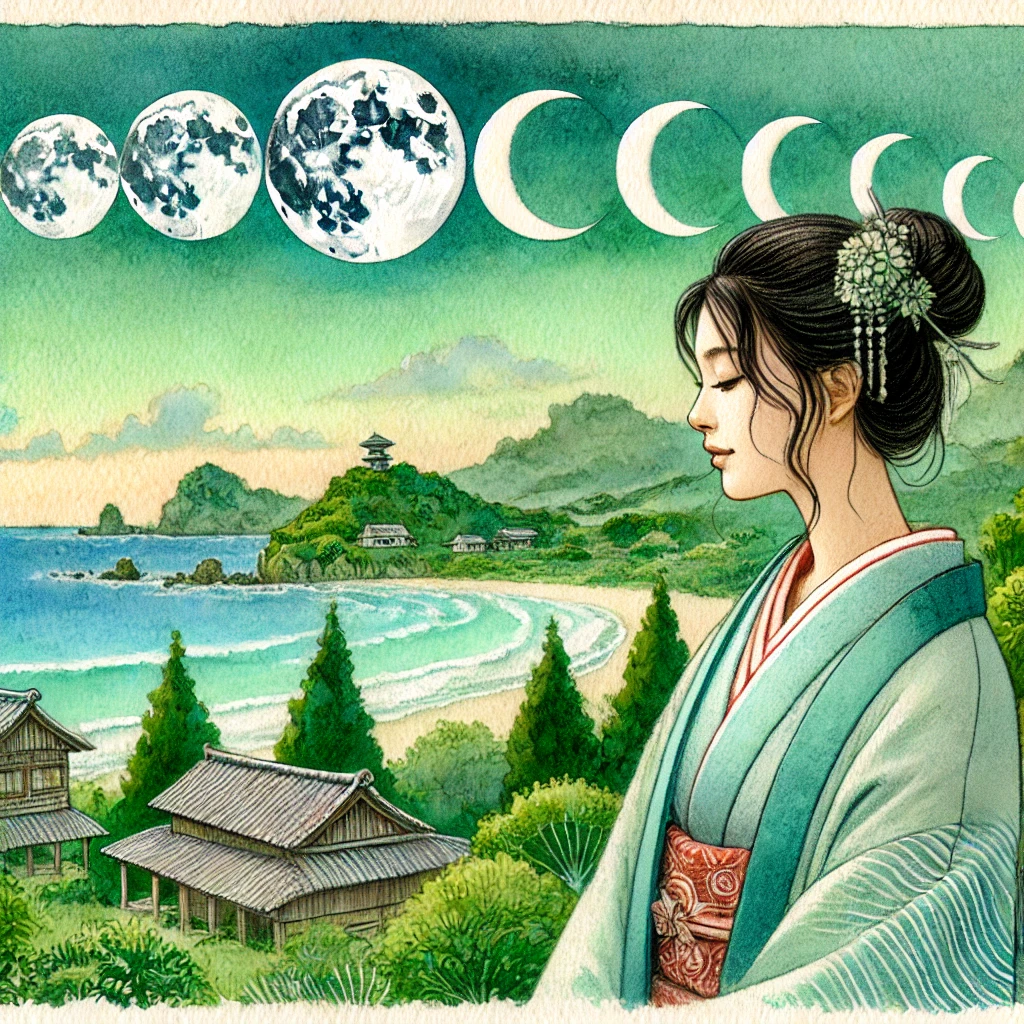
Okinawa’s beautiful seas and skies, along with its rich natural surroundings, have long been complemented by a deep and enduring cultural heritage. Among the many facets of this heritage is the mysterious figure known as the “Tsukiyomi no Kannagi.” But did you know about this intriguing aspect of Okinawan tradition?
The Tsukiyomi no Kannagi are women endowed with the special ability to interpret the phases of the moon. These women have played a crucial role in maintaining the peace and safety of their villages, acting as intermediaries between nature and humans, and significantly influencing people’s lives.
From the stories of the Tsukiyomi no Kannagi, we can discern the distinctive spiritual world that the people of Okinawa have cherished. This includes a deep connection with nature, reverence for mystical entities, a belief in the principle of cause and effect, and a respect for the spiritual power of women. These values are essential, yet they are gradually being lost in modern society.
When we listen to the tales of the Tsukiyomi no Kannagi, we are reminded of the importance of living in harmony with nature and the need to preserve and reassess traditional cultures. In a rapidly changing modern world, where environmental issues and community challenges are prevalent, these ancient wisdoms offer valuable insights.
To harness the wisdom of the Tsukiyomi no Kannagi in today’s world, each of us must rediscover the value of traditional culture and strive to pass it on to the next generation. The wisdom embedded in Okinawa’s traditional culture holds the key to achieving a sustainable society.
In this blog, we will delve into the spiritual world and the profound traditional culture of Okinawa through the stories of the Tsukiyomi no Kannagi. We will uncover the insights these tales offer for overcoming the challenges faced by modern society.
Let’s embark on a journey to listen to ancient wisdom and explore a way of life that is in harmony with nature. May the stories of the Tsukiyomi no Kannagi bring new realizations to your heart.
- Tsukiyomi no Kannagi – The Mystical Women Who Interpret the Phases of the Moon
- The Close Relationship Between Nature and Humans
- Awe and Reverence for Mystical Beings
- The Concept of Cause and Effect in Folklore
- The Role of Women in Okinawan Culture
- The Significance of Tsukiyomi no Kannagi in Modern Times
- Q&A
- Summary
Tsukiyomi no Kannagi – The Mystical Women Who Interpret the Phases of the Moon
Since ancient times, the people of Okinawa have been deeply connected to nature, nurturing a unique culture within this harmonious relationship. One such cultural element is the mystical figure known as the “Tsukiyomi no Kannagi.”
The Tsukiyomi no Kannagi refers to women who possess the special ability to interpret the phases of the moon. These women are believed to observe the moon’s movements and predict fortunes based on its changes.
It is said that Tsukiyomi no Kannagi existed throughout Okinawa. Chosen by village elders or priests, they underwent rigorous training before assuming their roles.
Every night, the Tsukiyomi no Kannagi would gaze at the moon, meticulously observing its shape, color, and the positions of the surrounding stars. From these observations, they would predict the month’s fortune. A favorable month promised abundant harvests and safety, while an unfavorable month warned of disasters and illnesses.
Villagers relied on the Tsukiyomi no Kannagi’s predictions for various aspects of life, including agriculture, fishing, and significant ceremonies. Additionally, these women conducted rituals to pray for the village’s peace and safety.
However, with the passage of time and the advancement of modernization, the role of the Tsukiyomi no Kannagi has diminished, and they are now rarely seen.
Nevertheless, the respect and awe for the Tsukiyomi no Kannagi remain deeply ingrained in the hearts of the Okinawan people. They are still spoken of as mystical figures who mediate between nature and humanity.
In one village, there is a legend where villagers ignored a Tsukiyomi no Kannagi’s warning of an unfavorable month and set out to fish, only to encounter a severe storm that claimed many lives. Conversely, in another village, following the Tsukiyomi no Kannagi’s advice led to a bountiful harvest.
These stories highlight the reverence the Okinawan people have for the Tsukiyomi no Kannagi, who are seen as influential figures capable of determining their fate. The existence of these women reflects an important aspect of Okinawa’s culture, showcasing the close relationship between nature and humanity.
The Close Relationship Between Nature and Humans
The people of Okinawa have always been closely connected to nature, nurturing a unique culture within this harmonious relationship. The story of the Tsukiyomi no Kannagi symbolically represents this close relationship.
The Connection Between the Phases of the Moon and People’s Lives
The phases of the moon have a deep connection with the lives of the Okinawan people. The Tsukiyomi no Kannagi, by observing the moon’s movements and predicting fortunes, significantly influenced people’s lives.
The Relationship Between Agriculture and the Moon
Okinawan agriculture is closely linked with the phases of the moon. The Tsukiyomi no Kannagi would predict the best times for agricultural activities by interpreting the moon’s movements. For instance, the new moon was considered ideal for sowing seeds, while the full moon was deemed suitable for harvesting. This wisdom, derived from years of observation and experience, has been crucial in supporting Okinawan agriculture.
The Relationship Between Fishing and the Moon
The phases of the moon also greatly impact Okinawan fishing. The Tsukiyomi no Kannagi would interpret the moon’s movements to determine the best fishing spots and times. The full moon, with its fast currents and active fish, was considered ideal for fishing, whereas the new moon, with its calm waters, was less favorable. This knowledge has been passed down among Okinawan fishermen, ensuring abundant catches.
The Relationship Between Ceremonial Events and the Moon
Okinawan ceremonial events, such as weddings and funerals, are deeply tied to the phases of the moon. The Tsukiyomi no Kannagi would select auspicious dates for these events based on the moon’s movements. Weddings were often held during the full moon, believed to strengthen marital bonds, while funerals were commonly conducted during the new moon, thought to ensure the deceased’s peaceful journey. Thus, the phases of the moon are intricately woven into the significant milestones of Okinawan lives.
The Importance of Wisdom in Interpreting Natural Phenomena
The story of the Tsukiyomi no Kannagi highlights the importance of wisdom in interpreting natural phenomena. The people of Okinawa meticulously observed natural movements to glean various insights necessary for coexisting with nature.
Observation Methods and the Transmission of Techniques
The Tsukiyomi no Kannagi developed unique methods and techniques to observe the moon’s movements. They meticulously examined the moon’s shape, color, and the positions of the surrounding stars to predict fortunes. These observation methods, honed through years of experience and wisdom, have been passed down through generations. This traditional wisdom remains crucial for leading a harmonious life with nature in modern society.
The Wisdom of Coexisting with Nature
The story of the Tsukiyomi no Kannagi exemplifies the wisdom of coexisting with nature. The people of Okinawa built a sustainable society by respecting nature and living in accordance with its rhythms. For instance, aligning agricultural activities with the moon’s phases helps maintain healthy soil and ensures abundant harvests. Similarly, timing fishing activities according to the moon’s movements preserves marine resources. This wisdom of coexisting with nature is a valuable guide for addressing the environmental challenges faced by modern society.
The Modern Relevance of Traditional Knowledge
The traditional knowledge embodied in the stories of the Tsukiyomi no Kannagi holds significant relevance for contemporary society. As globalization and urbanization progress, traditional wisdom and techniques are at risk of being lost. However, this wisdom, based on years of experience and observation, provides crucial insights for addressing modern challenges. For instance, the knowledge of the Tsukiyomi no Kannagi can inform disaster preparedness and sustainable agricultural and fishing practices. By integrating traditional knowledge into modern society, we can build a richer, more sustainable future.
Awe and Reverence for Mystical Beings
The Tsukiyomi no Kannagi have been regarded with awe and reverence by the people of Okinawa. These women, possessing the special ability to interpret the phases of the moon, played a vital role in ensuring the village’s peace and safety.
The Villagers’ Faith in the Tsukiyomi no Kannagi
The villagers held a strong faith in the Tsukiyomi no Kannagi, viewing them as divinely chosen beings. Their predictions were regarded as absolute, and they were revered accordingly.
The Rituals and Processes of Choosing the Kannagi
The Tsukiyomi no Kannagi were selected by village elders or priests. The chosen women underwent rigorous training to acquire the skills to interpret the phases of the moon. These selection rituals and processes were considered sacred, and the villagers showed profound respect for them. The rituals of choosing the Kannagi were significant events, with the entire village praying for their success.
The Reverence and Awe for the Kannagi
The Tsukiyomi no Kannagi were viewed with reverence and awe by the villagers. They were seen as special beings chosen by the gods, and their words were considered absolute. The villagers bowed their heads before the Kannagi and listened attentively to their words. They also feared the Kannagi’s power and dreaded incurring their wrath, believing that defying the Kannagi would jeopardize the village’s peace and safety.
The Social Status and Role of the Kannagi
The Tsukiyomi no Kannagi held high social status within the village. They were involved in crucial decision-making processes and influenced the villagers’ fates. Additionally, the Kannagi were responsible for safeguarding the village’s peace and safety by predicting natural disasters and illnesses. Thus
, the Kannagi were indispensable figures, providing vital support to the villagers.
The Importance of Adhering to the Predictions
The Tsukiyomi no Kannagi’s predictions significantly impacted the villagers’ lives. The villagers believed that adhering to these predictions was essential for maintaining the village’s peace and safety.
The Content of Predictions and Criteria for Judging Fortunes
The Tsukiyomi no Kannagi observed the moon’s shape, color, and the positions of surrounding stars to predict fortunes. A favorable month indicated abundant harvests and safety, while an unfavorable month warned of disasters and illnesses. The Kannagi provided advice based on these observations, and the villagers believed that following this advice was crucial for safeguarding the village’s peace and safety.
The Comfort Gained from Following Predictions
The villagers derived great comfort from following the Tsukiyomi no Kannagi’s predictions. They felt relieved from the anxieties of natural disasters and illnesses, and could look forward to bountiful harvests. Additionally, adhering to the predictions fostered a sense of unity within the village, encouraging cooperation in the face of difficulties. Following the predictions was a vital source of spiritual support for the villagers.
The Risks of Ignoring Predictions
Conversely, ignoring the Tsukiyomi no Kannagi’s predictions posed significant risks. Villagers who disregarded the predictions often faced severe natural disasters and illnesses, suffering considerable losses. Ignoring the predictions undermined the Kannagi’s authority and threatened the village’s peace and safety. The villagers recognized the importance of heeding the Kannagi’s words and understood the dangers of ignoring them.
The Concept of Cause and Effect in Folklore
The stories of the Tsukiyomi no Kannagi strongly reflect the concept of cause and effect. The disasters that befell those who ignored the predictions and the benefits gained by those who followed them underscore the teachings of cause and effect.
The Disasters That Resulted from Ignoring Predictions
Villagers who ignored the Tsukiyomi no Kannagi’s predictions often encountered significant disasters. Numerous stories of such cause-and-effect scenarios have been passed down.
Specific Examples from Folklore
In one village, despite a Tsukiyomi no Kannagi predicting an unfavorable month, villagers ignored the warning and set out to fish, only to encounter a severe storm that claimed many lives. In another village, disregarding the Kannagi’s prediction during agricultural activities led to a devastating drought and crop failure. These examples vividly illustrate the dangers of ignoring the predictions.
The Nature of Disasters and Villagers’ Reactions
The disasters in these stories, such as storms, droughts, and illnesses, severely threatened the villagers’ lives. The villagers experienced immense suffering, losing many lives and their livelihoods. Realizing that ignoring the predictions caused these disasters, the villagers deeply regretted their actions and vowed never to disregard the predictions again.
The Lessons of Cause and Effect
These stories instilled the lessons of cause and effect deeply in the villagers’ minds. Ignoring the predictions was seen as defying the natural order, inevitably leading to disasters. The stories emphasized the importance of heeding the Kannagi’s words and living in harmony with nature. These lessons became guiding principles for the villagers, passed down through generations.
The Benefits of Adhering to Predictions
On the other hand, villagers who followed the Tsukiyomi no Kannagi’s predictions enjoyed significant benefits. Abundant harvests and safe living conditions were seen as evidence of the effectiveness of adhering to the predictions.
Specific Examples from Folklore
In one village, following the Tsukiyomi no Kannagi’s advice in agricultural activities led to a bountiful harvest. In another village, refraining from fishing during an unfavorable month predicted by the Kannagi allowed villagers to avoid a severe storm. These examples highlight the importance of adhering to the predictions.
The Nature of Benefits and Villagers’ Reactions
The benefits in these stories, such as abundant harvests and safe living conditions, were crucial for the villagers’ livelihoods. The villagers felt immense joy and gratitude for these benefits, reaffirming the importance of following the predictions and renewing their faith in the Kannagi.
The Proof of the Effectiveness of Predictions
These stories were seen as proof of the Tsukiyomi no Kannagi’s effectiveness, reinforcing the villagers’ belief in following the predictions. Adhering to the natural order and listening to the Kannagi’s words were believed to ensure a prosperous and safe life. These stories also strengthened the unity within the village and contributed to the Kannagi’s authority.
The Role of Women in Okinawan Culture
The stories of the Tsukiyomi no Kannagi highlight the significant role of women in Okinawan culture. The existence of women with mystical powers was indispensable in traditional Okinawan society.
The Existence of Women with Mystical Powers
In addition to the Tsukiyomi no Kannagi, Okinawan traditional society featured many women with mystical powers. These women played vital roles as intermediaries between nature and humans.
Other Female Mystical Figures
Okinawa had numerous female mystical figures, such as Yuta (female shamans) and Noro (female priests). Each played essential roles in supporting the villagers’ lives in their respective communities. Yuta listened to people’s troubles and offered solutions, while Noro conducted rituals for the village’s safety and prosperity, supporting the villagers’ faith. These female mystical figures were indispensable in traditional Okinawan society.
The Strong Connection Between Women and Nature
In traditional Okinawan society, women were seen as closely connected to nature. They were viewed as bearers of life and recipients of nature’s blessings. Additionally, women were believed to synchronize with the phases of the moon through menstruation. This deep connection to nature made women revered figures with mystical powers.
The Faith in Women’s Spiritual Powers
The people of Okinawa believed in and relied on women’s spiritual powers. Women were considered to have sharp spiritual sensitivity, capable of communicating with gods and ancestors. Their predictions and prayers were believed to be vital for the village’s peace and safety. This faith in women’s spiritual powers was a crucial element supporting traditional Okinawan society.
The Significant Social Responsibility of Women
Female mystical figures, including the Tsukiyomi no Kannagi, bore significant social responsibilities in traditional Okinawan society. They played vital roles in ensuring the village’s peace and safety.
The Responsibilities and Expectations as a Kannagi
The Tsukiyomi no Kannagi had the critical responsibility of safeguarding the village’s peace and safety. The villagers believed that adhering to the Kannagi’s predictions would help them avoid natural disasters and illnesses. Therefore, the Kannagi was expected to provide accurate predictions. Additionally, the Kannagi was required to listen to the villagers’ troubles and offer solutions. Fulfilling these responsibilities earned the Kannagi the villagers’ trust.
The Role and Influence as Female Leaders
Female mystical figures like the Tsukiyomi no Kannagi, Yuta, and Noro were also female leaders involved in the village’s crucial decision-making processes. They consulted with village elders and influential figures to determine the village’s policies. Their words significantly influenced the villagers, who viewed the Kannagi’s predictions and advice as absolute. Thus, female leadership and influence were vital elements supporting traditional Okinawan society.
The Status and Respect for Women in Traditional Society
In traditional Okinawan society, women were respected and valued. Especially those with mystical powers were revered as village protectors. Women were also seen as guardians of the household and child-rearers, recognizing the importance of their roles. Moreover, women were central figures in village festivals and events, essential to village life. Thus, the status and respect for women were high in traditional Okinawan society.
The Significance of Tsukiyomi no Kannagi in Modern Times
The stories of the Tsukiyomi no Kannagi hold significant relevance in modern society. They emphasize the importance of preserving and reassessing traditional culture, living in harmony with nature, and addressing contemporary challenges.
The Need for the Preservation and Reassessment of Traditional Culture
The stories of the Tsukiyomi no Kannagi are part of Okinawa’s traditional culture but are gradually being lost. Preserving and reassessing traditional culture is an important task for modern society.
The Current State and Crisis of the Tsukiyomi no Kannagi
Today, the Tsukiyomi no Kannagi are rarely seen. Traditional wisdom and techniques have been passed down through generations but are now difficult to maintain in modern society. As urbanization and globalization progress, traditional culture is being lost. The succession of the Tsukiyomi no Kannagi is no exception, with a shortage of candidates and the risk of this knowledge and skills disappearing.
Rediscovering and Protecting the Value of Traditional Culture
Traditional culture is a repository of wisdom accumulated over a long history, containing crucial insights for building a sustainable society. The stories of the Tsukiyomi no Kannagi highlight the importance of coexisting with nature, the social role of women, and other lessons relevant to modern challenges. Rediscovering and protecting the value of traditional culture holds significant importance for contemporary society.
The Importance of Transmitting Traditional Knowledge to Future Generations
Transmitting traditional knowledge to future generations is essential for preserving traditional culture. The wisdom and techniques of the Tsukiyomi no Kannagi must be passed down to avoid being lost. Education and awareness activities are crucial for conveying the importance of traditional culture to children and encouraging its succession. Establishing social systems to
support and protect traditional culture is also necessary. Transmitting traditional knowledge to future generations is a responsibility of modern society.
Reacknowledging the Importance of Living in Harmony with Nature
The stories of the Tsukiyomi no Kannagi emphasize the importance of living in harmony with nature. Modern society has become increasingly detached from nature, but learning from traditional wisdom can help build a sustainable society.
The Disconnect from Nature in Modern Society
Modern society, in its pursuit of convenience and efficiency, has become increasingly detached from nature. Urbanization has reduced opportunities to feel connected to nature. Additionally, the mass production and consumption system imposes a significant burden on the natural environment, leading to serious issues such as global warming and environmental pollution.
Learning to Coexist with Nature from Traditional Wisdom
The traditional wisdom embedded in the stories of the Tsukiyomi no Kannagi teaches the importance of living in harmony with nature. By following nature’s rhythms and receiving its blessings, we can build a sustainable society. Traditional agricultural and fishing practices, for example, allow for abundant harvests without overburdening the environment. Moreover, respecting and fearing nature fosters environmental conservation. Learning from traditional wisdom offers insights for addressing modern environmental issues.
Insights for Achieving a Sustainable Society
The stories of the Tsukiyomi no Kannagi provide valuable insights for achieving a sustainable society. Living in harmony with nature and utilizing its blessings can reduce environmental burdens and build a sustainable society. Moreover, preserving and reassessing traditional culture fosters local pride and strengthens community bonds. By integrating traditional wisdom into modern society, we can achieve economic development and environmental protection, as well as community revitalization, moving closer to a sustainable society.
The stories of the Tsukiyomi no Kannagi are part of Okinawa’s traditional culture, but their significance extends to modern society. They highlight the importance of living in harmony with nature and the need for preserving and reassessing traditional culture. By learning from traditional wisdom, we can address contemporary challenges and build a sustainable society. Rediscovering and passing on traditional knowledge is a responsibility we all share.
Q&A
Who are the Tsukiyomi no Kannagi?
The Tsukiyomi no Kannagi are mystical women in Okinawa’s traditional culture who interpret the phases of the moon to predict fortunes. They played a vital role in maintaining the peace and safety of their villages as intermediaries between nature and humans.
How did the Tsukiyomi no Kannagi’s predictions impact villagers’ lives?
The predictions of the Tsukiyomi no Kannagi significantly influenced villagers’ lives, guiding agricultural activities, fishing, and ceremonies. Adhering to the predictions was believed to ensure abundant harvests and safe living conditions.
What do the stories of the Tsukiyomi no Kannagi reveal about Okinawa’s spiritual world?
The stories of the Tsukiyomi no Kannagi reveal that the people of Okinawa deeply respected mystical entities, believed in the principle of cause and effect, and valued the spiritual power of women. These stories reflect the Okinawan worldview and its strong connection with nature.
What is the significance of the Tsukiyomi no Kannagi’s stories in modern society?
The stories of the Tsukiyomi no Kannagi emphasize the importance of living in harmony with nature and the need for preserving and reassessing traditional culture. They offer valuable lessons for addressing contemporary environmental and community challenges.
What is needed to harness the wisdom of the Tsukiyomi no Kannagi in modern society?
To harness the wisdom of the Tsukiyomi no Kannagi in modern society, it is essential to rediscover the value of traditional culture and ensure its transmission to future generations. Education and awareness activities are crucial for conveying the importance of traditional wisdom and promoting efforts toward building a sustainable society.
Summary
In this blog titled “Tsukiyomi no Kannagi – The Mystical Women Who Interpret the Phases of the Moon,” we explored the stories of the Tsukiyomi no Kannagi, who played a crucial role in Okinawan traditional culture. These women, acting as intermediaries between nature and humans, significantly influenced villagers’ lives through their moon phase interpretations.
The stories of the Tsukiyomi no Kannagi highlight the distinctive spiritual world of Okinawa, emphasizing the deep connection with nature, reverence for mystical entities, belief in the principle of cause and effect, and respect for the spiritual power of women. These values are crucial and increasingly rare in modern society.
The stories also emphasize the importance of living in harmony with nature and the need for preserving and reassessing traditional culture. By learning from traditional wisdom, we can address contemporary environmental and community challenges.
To harness the wisdom of the Tsukiyomi no Kannagi in modern society, we must rediscover the value of traditional culture and ensure its transmission to future generations. Each of us should recognize the importance of traditional wisdom and take action toward building a sustainable society. The wisdom embedded in Okinawa’s traditional culture holds the key to solving modern societal challenges.


コメント