
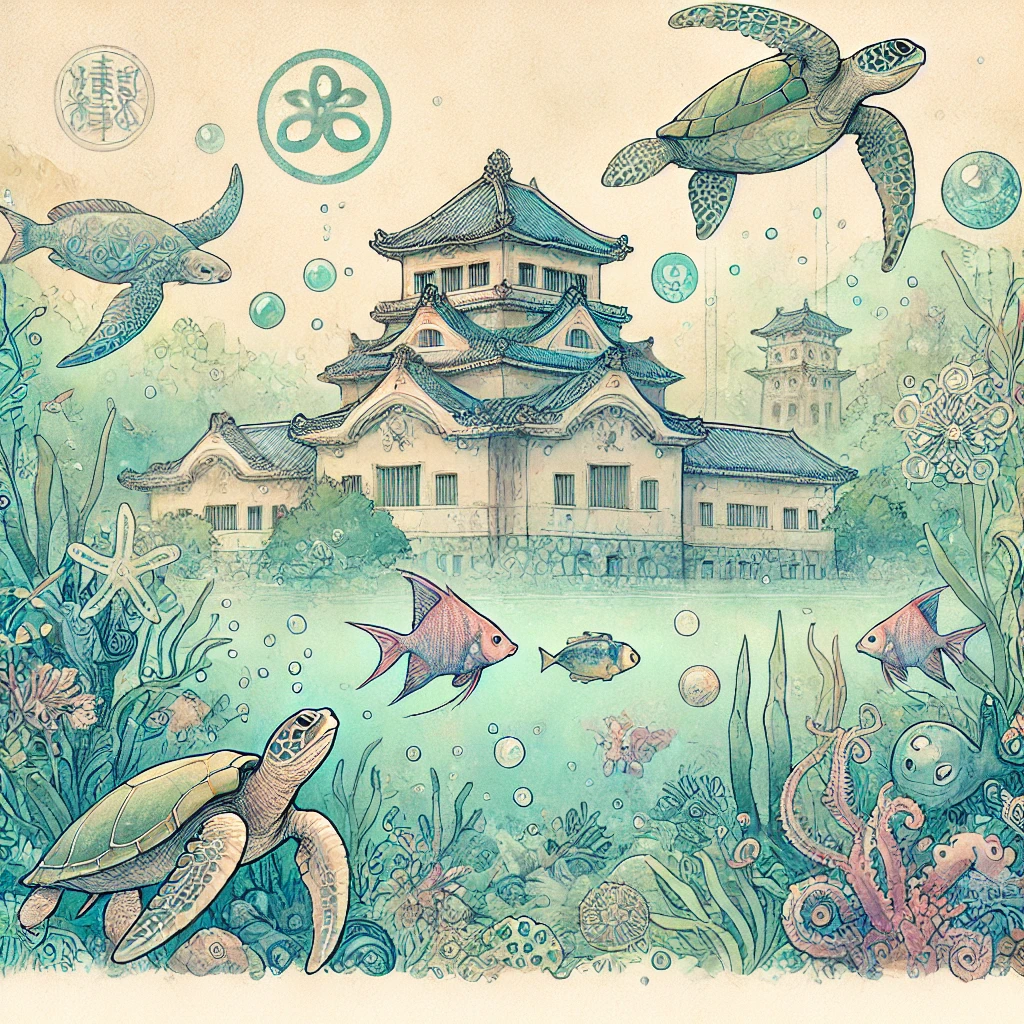
Long ago, on the island of Hateruma in Okinawa, there was a young man. He spent his days in the mystical realm of Ryugu, so blissful that he lost track of time. However, upon returning to the present world, he found that everything he once knew had drastically changed.
This “Legend of Ryugu” is not just an old tale. It weaves together Okinawa’s rich culture and worldview, delivering profound messages about life and death, time and eternity, and the relationship between nature and humanity.
In the legend, the protagonist opens a forbidden box, despite being warned not to, and instantly transforms into an old man. This story challenges us to reflect on the fleeting nature of life and the importance of cherishing every moment.
Furthermore, the Ryugu legend reflects Okinawa’s unique perspective on nature and mortality. The people of Okinawa have long viewed nature as a companion to humanity and life as part of an endless cycle. The tale of the young man who becomes a turtle in the “Legend of the Turtle of Senaga Island” embodies this worldview perfectly.
In our modern society, we are often rushed and preoccupied with immediate concerns. Yet, the Ryugu legend encourages us to pause and ponder the meaning of life and our harmony with nature.
This age-old legend carries universal lessons that resonate even today. Let’s dive into the world of the Ryugu legend and explore the depths of Okinawan culture. You might just discover insights that prompt you to reevaluate your own life.
- The Legend of Ryugu from Hateruma Island – A Fascinating Tale of the Undersea Palace
- The Perception of Time
- Taboos and Fate
- Lingering Attachments to the Present World and Rebirth
- The Existence of a Mystical Otherworld
- Lessons from the Legend
- Okinawa’s Unique Worldview
- Similar Stories Passed Down
- Q&A
- Summary of This Blog
The Legend of Ryugu from Hateruma Island – A Fascinating Tale of the Undersea Palace
Hateruma Island is a small island located at the southernmost tip of the Yaeyama Islands in Okinawa Prefecture. This island is home to the mysterious tale known as the Ryugu legend.
Once upon a time, there was a young man on Hateruma Island who worked as a fisherman. One day, while out at sea, he was suddenly swallowed by a massive wave. When he came to, he found himself in a beautiful underwater world. There stood a magnificent palace inhabited by a beautiful princess.
The princess welcomed the young man warmly and invited him into her palace. They fell in love, and he spent many happy days with her. However, he began to worry about the family he had left behind on the island and asked the princess to let him return to the surface.
Understanding his wish, the princess gave him a box with strict instructions not to open it. She then sent him back to the shore of Hateruma Island.
When the young man returned, he discovered that he had spent centuries in Ryugu. His family and friends were long gone, and the island had changed greatly. Overcome with curiosity, he opened the box given to him by the princess. Instantly, white smoke emerged, and he turned into a wrinkled old man.
This legend illustrates the difference in the flow of time between the mystical world of Ryugu and the real world. It also serves as a moral lesson about the consequences of giving in to forbidden temptations and the loss of eternal youth.
The Perception of Time
The Different Flows of Time in the Real World and the Mystical Realm
The Fast Pace of Real-World Time vs. The Slow Flow of Mystical Time
In the Ryugu legend from Hateruma Island, the differing flows of time between the real world and the mystical realm are highlighted. The young man spends what feels like a brief period in Ryugu, but in the real world, centuries have passed. This discrepancy illustrates the fast pace of time in our world compared to the slow, near-eternal flow of time in the mystical realm.
In our daily lives, we are often rushed, living at a fast pace. In contrast, in the mystical world represented by Ryugu, time flows slowly, almost eternally. This difference in time flow invites us to reflect on the meaning and value of life.
The Relativity and Subjectivity of Time
The Ryugu legend also suggests the relativity and subjectivity of time. For the young man, the time spent in Ryugu was blissful and fulfilling, yet upon returning to the real world, he found that a long time had passed. This difference in time perception shows that time is subjective, influenced by our circumstances and environment.
Additionally, this legend encourages us to ponder the relativity of time. Though the flow of time differs between the real world and the mystical realm, within each world, time flows at a consistent pace. This demonstrates that time is not absolute but relative.
The Contrast Between Eternity and a Moment
Ryugu: The Eternal World
Ryugu is depicted as an eternal world where time flows slowly, and there is no death or aging. The inhabitants of Ryugu, including the princess, possess eternal life and live in happiness. This eternal world symbolizes human longing and prompts us to contemplate the value of eternity.
However, Ryugu, as an eternal world, operates under different laws than the present world. The eternal life of Ryugu’s inhabitants is a dreamlike state, unattainable for humans living in the present world.
The Fleeting Moments of the Present World
In contrast, the time in the present world is portrayed as fleeting. When the young man returns from Ryugu, the world he knew has changed drastically. His family and friends have passed away, and his entire life seems to have vanished in an instant.
This fleetingness represents the impermanence of life. Our lives, compared to eternity, are merely a moment. Yet, it is precisely because of this that it is crucial to cherish every moment and live a meaningful life.
The Ryugu legend, through the contrast between eternity and a fleeting moment, invites us to reflect on the meaning and value of life.
Taboos and Fate
The Significance of Opening the Forbidden Box
The Dangers of Breaking Taboos
In the Ryugu legend, there is a taboo against opening the box given by the princess. This taboo symbolizes the rules and ethics that humans should follow. Breaking this taboo hints at the dangers of venturing into the unknown recklessly.
In modern society, we are surrounded by various taboos, such as laws, morals, and social norms. Breaking these taboos can lead to unforeseen consequences. The Ryugu legend makes us think about the significance of taboos and the risks associated with breaking them.
Human Curiosity and Desire
The young man’s act of opening the forbidden box also reflects human curiosity and desire. The interest in the unknown and the allure of the forbidden are intrinsic human desires. However, giving in to these desires can sometimes lead to significant consequences.
The Ryugu legend illustrates the dual nature of human curiosity and desire. While curiosity can lead to new discoveries and creations, succumbing to desire can cause the loss of important things.
Accepting and Transforming Fate
The Powerlessness of Humans Against Fate
When the young man opens the box, he is confronted with the powerlessness of humans against fate. Despite his intentions, he becomes an old man, demonstrating that humans cannot control their destiny.
We often believe we are living our lives according to our own will, but in reality, many aspects are influenced by chance and fate. The Ryugu legend makes us reflect on the power of fate and human powerlessness in the face of it.
Life Changes and Growth Through Fate
However, fate is not always tragic. Through his experiences in Ryugu, the young man learns about the meaning and value of life. He understands the importance of family and home, and the fleeting beauty of life.
Unforeseen events brought by fate can bring new insights and enrich our lives. The Ryugu legend teaches us the importance of accepting fate and growing through it.
Lingering Attachments to the Present World and Rebirth
家族や故郷への思い
現世に残した大切な人々への想い
The young man, the protagonist of the Ryugu legend, could not forget his family in the present world, even amidst the happiness he experienced in Ryugu. For him, his family was his emotional anchor and an indispensable part of his life.
In our lives, too, the presence of family and loved ones is crucial. They are the ones with whom we share joy and sorrow and who support us. The Ryugu legend teaches us about the importance of familial bonds and how these ties transcend time and distance.
Nostalgia for Home and a Sense of Belonging
When the young man returned from Ryugu to the present world, he found that his hometown, Hateruma Island, had changed significantly. However, he still felt a strong sense of nostalgia and belonging to his home.
Our hometown is our root and a part of our identity. No matter how far we go, we are always connected to our hometown in our hearts. The Ryugu legend highlights the special meaning of home and the importance of cherishing it.
Acceptance of Aging and Death
Acceptance of Aging and the Fulfillment of Life
When the young man opened the forbidden box, he instantly turned into an old man. This event symbolizes the unavoidable reality of aging. Everyone will face aging eventually.
However, accepting aging is a necessary process for completing one’s life. As we age, we accumulate wisdom and experience, finding the meaning of life. The Ryugu legend teaches us not to fear aging but to embrace it and learn from it.
The Inevitability of Death and the Possibility of Rebirth
Just like aging, death is an unavoidable reality. Upon returning from Ryugu, the young man finds that many of his loved ones have already passed away, illustrating the inevitability of death.
However, death is not the end but a new beginning. Many religions and philosophies have concepts of the afterlife or reincarnation. The Ryugu legend offers a perspective that views death not with fear but as a journey to a new world.
The Existence of a Mystical Otherworld
Ryugu: The Underwater World
A Mystical World Under the Sea
Ryugu, the setting of the legend, is a mystical world under the sea. Since ancient times, the sea has stimulated human imagination, regarded as an unknown world. Ryugu embodies this mystique, reminding us of the sea’s allure and mystery.
Modern science and technology have gradually unveiled the underwater world, yet much remains unknown, and the sea continues to fascinate us. The Ryugu legend plays an important role in preserving and conveying the mystery of the sea.
A Different World Governed by Different Laws
Ryugu is also a world governed by entirely different laws than the present world. In Ryugu, time flows differently, and there is no death or aging. It is inhabited by sacred beings like the princess.
The existence of another world stimulates our imagination and helps us relativize the real world. The Ryugu legend provides a new perspective, free from the common sense and values of the present world.
The Sacred Being: Princess Otohime
A Sacred Being Governing the Otherworld
Princess Otohime, the ruler of Ryugu, is depicted as a sacred being. She guides the inhabitants of Ryugu and warmly welcomes the young man. Her presence brings order to the mystical world and creates a connection with the present world.
In many cultures and religions, sacred beings play an essential role. They provide hope and comfort to people and maintain the order of the world. Princess Otohime in the Ryugu legend is one such expression of a sacred being, teaching us the importance of spirituality.
The Interaction and Romance Between Humans and Gods
The romance between Princess Otohime and the young man symbolizes the interaction between humans and gods. In myths and legends, romances between gods and humans are often depicted, representing human longing for the divine and the gods’ love for humanity.
The love story of Princess Otohime and the young man in the Ryugu legend illustrates the connection between the real world and the otherworld, between humans and gods. This connection teaches us the importance of believing in unseen worlds and greater beings.
Lessons from the Legend
The Consequences of Breaking Taboos
The Dangers of Challenging Taboos
In the Ryugu legend, breaking the taboo of opening the forbidden box marks a significant turning point. Challenging taboos involves venturing into the unknown, which can be highly dangerous.
In our lives, we also face various taboos. These are rules formed through long histories and serve to protect us. The Ryugu legend makes us consider the significance of taboos and the dangers of challenging them.
The Importance of Ethics and Morality
Breaking taboos is also an act against ethics and morality. Ethics and morality are essential for maintaining social order and ensuring people live peacefully.
The Ryugu legend, through the concept of taboos, emphasizes the importance of ethics and morality. Ignoring or disregarding them can have significant consequences not only for oneself but also for those around us.
The Ephemeral Nature and Beauty of Life
Pursuing Happiness in a Finite Life
The happy days in Ryugu seemed eternal to the young man. However, upon returning to the real world, he realized the transient nature of life. Our lives are not eternal; we must pursue happiness within a limited time.
The Ryugu legend prompts us to consider what we should value and how we should live in our finite lives. This might involve cherishing bonds with family and friends and living true to our hearts. Because time is limited, it is crucial to make every moment meaningful.
Appreciation of Impermanence and the Discovery of Beauty
The Ryugu legend also teaches us about the appreciation of life’s impermanence. Just as the young man turned into an old man, our lives are constantly changing and fleeting. However, within this impermanence lies beauty.
Cherry blossoms are beautiful because they are ephemeral and fleeting. Similarly, our lives have irreplaceable value because they are transient. The Ryugu legend teaches us the importance of accepting impermanence and finding beauty within it.
Okinawa’s Unique Worldview
A Worldview in Harmony with Nature
Coexistence and Harmony Between Nature and Humans
Okinawan culture values the coexistence and harmony between nature and humans. In the Ryugu legend, the connection between the underwater world and the human world reflects the deep bond between nature and humanity.
The people of Okinawa have long seen nature not only as an object of fear but as a companion to live with. They have cherished the blessings of nature and valued living in harmony with it.
Nature Worship and Animism
The Okinawan worldview is based on nature worship and animism. They believe that spirits inhabit natural objects and have revered and cherished them. The presence of Princess Otohime in the Ryugu legend reflects this nature worship.
For the people of Okinawa, nature is not just a material existence but one with spiritual power. They have looked at the essence of themselves and the world through dialogue with nature.
The Ambiguity of the Boundary Between the Present World and the Otherworld
Continuity Between the Present World and the Otherworld
In the Ryugu legend, the boundary between the present world and the otherworld is ambiguous, showing continuity between the two. The young man moves from the present world to Ryugu and then returns to the present world. This represents the continuity between the present world and the otherworld in Okinawan worldview.
For the people of Okinawa, the present world and the otherworld are not separated but are continuous and influence each other. They possess the imagination to freely traverse between the present world and the otherworld.
Belief and Expectations in the Afterlife
In the Okinawan worldview, there is a strong belief and expectation in the afterlife. In the Ryugu legend, Ryugu is depicted as an eternal world different from the present world, evoking thoughts of the afterlife.
The people of Okinawa view death not as an end but as a journey to a new world. They have long respected the spirits of their ancestors and valued communication with the deceased. The Ryugu legend reflects this view of life and death.
Similar Stories Passed Down
The Legend of the Young Man Who Became a Turtle of Senaga Island
Similarities and Differences with the Ryugu Legend
The legend of “The Young Man Who Became a Turtle of Senaga Island” shares similar motifs with the Ryugu legend. In both, a young man visits another world and returns to find significant changes in the present world.
However, in the legend of the young man who became a turtle, the young man turns into a turtle, which is different from the Ryugu legend. This transformation might symbolize the deep connection between humans and nature in the Okinawan worldview.
The Symbolic Meaning of Becoming a Turtle
The turtle holds special significance in Okinawan culture. It symbolizes longevity, wisdom, and patience. In the legend of the young man who became a turtle, becoming a turtle suggests that the young man has become one with nature and attained eternal life.
This legend indicates the possibility of transcending the boundaries between humans and nature. It reflects the deep connection between humans and nature in the Okinawan worldview.
The Cycle and Rebirth of Humans and Nature
Continuity of Life and the Concept of Reincarnation
The Ryugu legend and the legend of the young man who became a turtle both encompass the continuity of life and the concept of reincarnation. In these legends, death is not seen as an end but as a new beginning.
In the Okinawan worldview, life exists in an endless cycle, repeatedly undergoing death and rebirth. Humans are part of nature and are incorporated into this cycle.
Unification with Nature and Eternal Life
These legends suggest that by becoming one with nature, humans can attain eternal life. This does not imply physical immortality but living continuously within the cycle of life.
In the Okinawan worldview, humans can achieve true eternal life by harmonizing with nature and becoming part of it. The Ryugu legend and the legend of the young man who became a turtle reflect this Okinawan worldview.
The above analysis of the Ryugu legend provides a clear explanation from the perspective of an SEO-focused web writer. By conveying the rich culture and worldview of Okinawa, it can attract the interest of many people and lead to an increase in blog traffic.
Q&A
In the Ryugu legend, how did the flow of time in Ryugu differ from the flow of time in the present world for the young protagonist?
The time the young man spent in Ryugu felt like a brief period, but in the present world, centuries had passed. This highlights the difference in the flow of time between the present world and the otherworld.
What is the significance of opening the forbidden box in the Ryugu legend?
Opening the forbidden box signifies the dangers of breaking taboos and reflects human curiosity and desire. It involves stepping into the unknown, an act that carries significant consequences.
How is nature perceived in the Okinawan worldview?
In the Okinawan worldview, nature is seen as a presence that should coexist harmoniously with humans. Based on nature worship and animism, it is believed that spirits reside in natural objects.
What are the similarities and differences between the Ryugu legend and the legend of “The Young Man Who Became a Turtle of Senaga Island”?
Both legends involve a young man visiting another world and returning to find significant changes in the present world. However, the young man becomes a turtle in the Senaga Island legend, which is different from the Ryugu legend.
What can be inferred about life and death in the Okinawan worldview from the Ryugu legend and the legend of “The Young Man Who Became a Turtle of Senaga Island”?
These legends encompass the ideas of the continuity of life and reincarnation. In the Okinawan worldview, life exists in an endless cycle, and death is seen not as an end but as a new beginning.
Summary of This Blog
The “Legend of Ryugu from Hateruma Island” reflects Okinawa’s rich culture and worldview. Themes such as the difference in the flow of time between the present world and the otherworld, the dangers of breaking taboos, and the transient beauty of life are woven into the story. It also reveals Okinawa’s unique perspectives on nature and life, highlighting coexistence with nature, continuity between the present world and the otherworld, and the concept of reincarnation.
This legend shares similarities with the legend of “The Young Man Who Became a Turtle of Senaga Island,” providing important insights into understanding the Okinawan worldview. From these legends, we are prompted to think about the meaning of life, harmony with nature, and the continuity of life.
The Ryugu legend carries universal messages that resonate even in contemporary life. It challenges us to consider what we should value and how we should live within our finite lives. Through this story, we can delve into the depths of Okinawan culture and reflect on our own lives.


コメント