
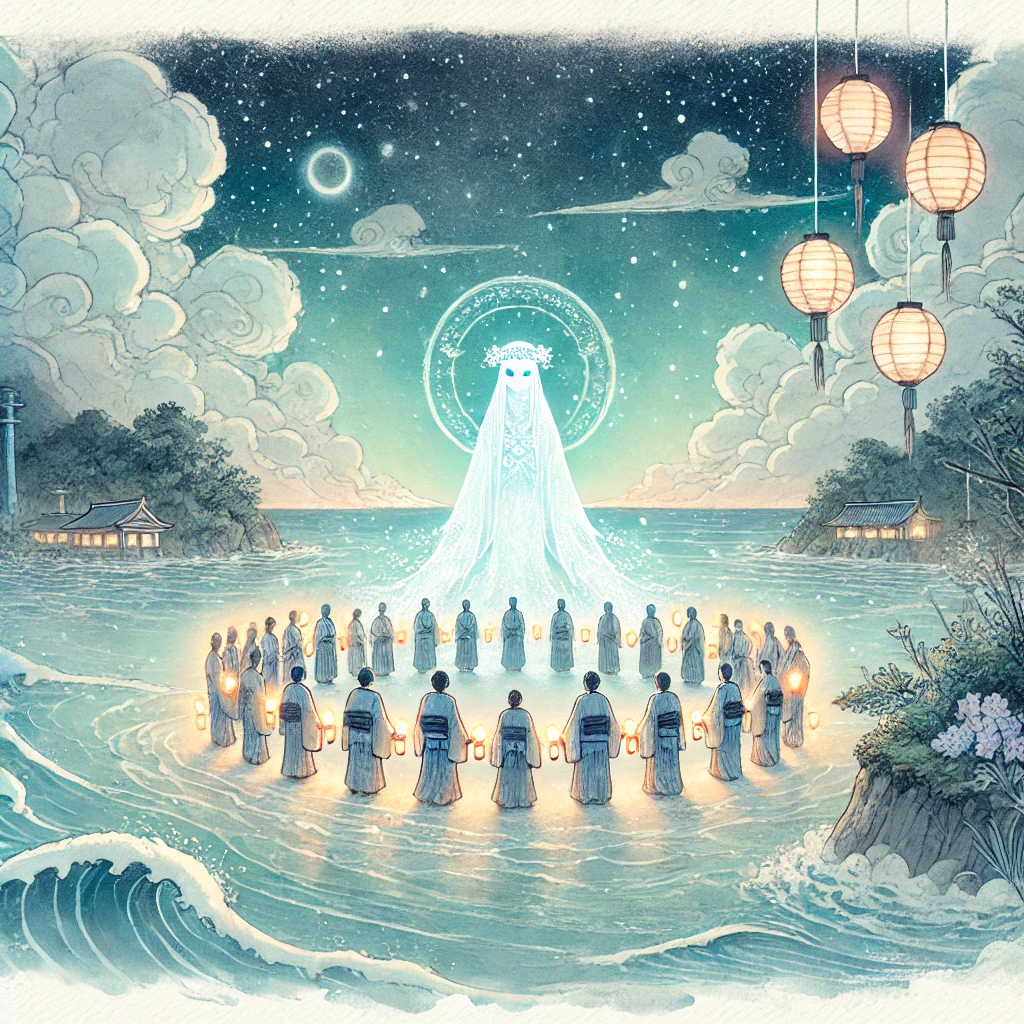
A small island in Okinawa, shrouded in the darkness of midsummer. The silence is broken only by the sound of waves and the rustling of trees in the wind. Amidst this tranquility, white shadows begin to move along the coastline—this is not a scene from a horror movie. It is the beginning of the mystical ritual known as “Shirumichu,” a tradition passed down on the island of Aka.
Have you ever experienced a connection to an invisible world? Heard the voices of ancestors, felt the power of nature, and discovered your inner strength? This ritual encompasses such profound spiritual experiences, which are gradually being lost in modern society.
Shirumichu is not merely an old custom. It is a precious cultural heritage that reminds us of important aspects that we modern people are beginning to forget.
For instance, the power of community. In Shirumichu, every islander, regardless of age or gender, plays a crucial role. This experience helps us rediscover the joy of mutual support, something that is fading in today’s individualistic society.
Furthermore, there is the coexistence with nature. During the ritual, participants directly feel the power of the sea, mountains, and starry skies. As environmental issues become more severe, this experience strongly reminds us of the fundamental fact that we are part of nature.
Moreover, the imagination for the unseen. In a modern society that tries to quantify everything through science and technology, Shirumichu teaches us the importance and existence of the invisible world. This imagination is essential for the development of both art and science.
Above all, the power to transform fear into hope. In the pitch darkness, there is the fear of facing ghosts (Yurei). However, beyond this fear lies a profound sense of relief and hope. In an increasingly uncertain modern society, this experience holds significant meaning.
“How does such an old ritual relate to me in modern times?” you might wonder. But consider this: daily stress, relationship troubles, anxiety about the future… Could it be that the root of many problems we face in modern society is the “something lost” that Shirumichu teaches us?
In this article, we delve into the full story of Shirumichu, shrouded in a veil of mystery. From the detailed flow of the ritual, the voices of the participants, to its significance in modern society, we will thoroughly unravel it.
This journey into ancient wisdom may bring new perspectives and courage to your life. Let’s embark on this journey of old yet new wisdom now.
- The Story of Shirumichu on Aka Island
- Key Perspectives for Understanding the Spiritual World of Okinawa
- Elements of Fear in Shirumichu
- Actual Incidents and Legends
- The Boundary Between Fear and Awe
- The Significance of Shirumichu in Modern Society
- Lessons from Shirumichu
- Conclusion
- Q&A
- Summary
The Story of Shirumichu on Aka Island
Aka Island is part of the Kerama Islands, located west of Okinawa’s main island. Surrounded by emerald green seas, this small island has a mysterious custom passed down from ancient times. This ritual is known as “Shirumichu.”
Shirumichu is held every year on the 15th day of the 7th lunar month. This day is also known as “Unke” in Okinawa, a day for ancestor worship. The islanders believe that on this day, the spirits of their ancestors visit the living world.
Preparation for the ritual begins several days in advance. The women of the island carefully wash pebbles collected from the beach, selecting only the white, shining stones. These stones, known as “Shiru,” play a crucial role in the ritual.
On the day of Shirumichu, as evening falls, all the lights on the island are turned off. In the darkness, the islanders quietly wait inside their homes. Then, at midnight, a mysterious spectacle unfolds.
Along the coastline, ghostly white figures appear. These are believed to be spiritual beings called “Yurei,” the spirits of the islanders’ ancestors. The Yurei slowly emerge from the sea and make their way onto the island.
At this moment, the island elders play a special role. They are sacred prayer masters known as “Yuta,” who act as a bridge between the spiritual and physical worlds. Holding the white stones prepared by the women, the Yuta welcome the Yurei.
The Yuta gently speak to the Yurei, saying, “Welcome home. We have been eagerly awaiting your return.” Then, they offer the white stones to the Yurei one by one.
Strangely enough, the Yurei seem to accept these stones. Carrying the stones, the Yurei head towards the sacred site in the center of the island, known as “Utaki.” Utaki is believed to be the dwelling place of the island’s guardian deities.
As the Yurei reach Utaki, a mystical atmosphere envelops the entire island. The Yuta begin to offer prayers in front of Utaki, wishing for the island’s safety, prosperity, and a bountiful harvest.
During these prayers, the islanders continue to wait quietly inside their homes. Looking outside is strictly prohibited. According to tradition, those who directly see the Yurei during the ritual are said to be cursed with misfortune or illness.
When the prayers conclude, the Yurei return to the sea. The Yuta watch over them as they head back. By dawn, the Yurei have completely disappeared, and the sea regains its tranquility.
In the morning, when the islanders step outside, they find white stones scattered along the beach. These are the “Shiru” that the Yurei did not take back. The islanders carefully collect these stones and store them until the next Shirumichu.
The day after Shirumichu, a grand festival is held on the island. People rejoice in their reunion with the spirits of their ancestors, dancing, singing, and sharing delicious food to wish for a prosperous and peaceful year.
This mystical ritual has been passed down on Aka Island for hundreds of years. However, in recent years, the outflow of young people and the waves of modernization have threatened its continuation. The island elders are making every effort to pass on this important tradition to the next generation.
For the people of Aka Island, Shirumichu is more than just a custom. It is an opportunity to reaffirm their bonds with their ancestors, recognize the existence of unseen forces in their lives, and live in harmony with nature. Through this ritual, the islanders rediscover their roots and find hope for the future.
Key Perspectives for Understanding the Spiritual World of Okinawa
The islands of Okinawa are home to a unique spiritual world that thrives amidst their natural beauty. Among these, the Shirumichu of Aka Island stands out as a mystical custom that vividly reflects the traditional beliefs and views of nature held by the people of Okinawa. Through this tradition, we delve into the profound spirituality that resides deep within the hearts of Okinawan people.
The Close Relationship Between Nature and the Spiritual World
For the people of Okinawa, nature and the spiritual world are inseparably intertwined. This relationship is particularly evident on small islands like Aka Island.
The Connection Between the Island’s Geographical Features and Spiritual Beliefs
Aka Island is a small island surrounded by emerald-green seas. Its geographical characteristics significantly influence the spiritual world of its inhabitants. The sea surrounding the island is perceived as a boundary that separates the living world from the afterlife.
The islanders believe in the existence of an ideal land called “Niraikanai” beyond the sea. Niraikanai is considered a source of abundance and happiness, and it is believed that gods and ancestral spirits visit from there. This belief is deeply reflected in the Shirumichu ritual.
The coastline is regarded as a sacred place where the living world and the afterlife intersect, and the Shirumichu ritual is conducted along this coastline. The concept of ghosts (Yurei) coming ashore from the sea is also based on this belief.
Moreover, a sacred site called “Utaki” located in the island’s center is believed to be the dwelling place of the island’s guardian deities. Utaki is usually situated within dense forests and is revered with a sense of awe. During the Shirumichu ritual, the Yurei are said to head towards this Utaki.
Thus, the geographical features of Aka Island are closely tied to the spiritual beliefs of its residents, forming the foundation for the unique custom of Shirumichu.
The Gods of the Sea and Mountains: Forms of Nature Worship
In Okinawan belief, the sea and mountains are revered as the abodes of different gods.
The sea god, known as “Ungami,” is believed to bring bountiful catches and ensure safe voyages. Fishermen pray to Ungami before setting out to sea, seeking safety and a good catch. In the Shirumichu ritual, the Yurei coming from the sea are sometimes perceived as messengers of Ungami.
Conversely, the mountain god, referred to as “Ugantu,” is revered as a source of abundant harvests and vitality. Mountains bring rain and provide pure water, essential for life. Even on a small island like Aka, there are places dedicated to Ugantu on elevated grounds.
In the Shirumichu ritual, there is a flow where the Yurei arriving from the sea head towards the mountain sacred site, Utaki. This symbolizes the harmony between the sea and mountain gods, bringing prosperity to the entire island.
Such forms of nature worship reflect how the people of Okinawa have lived in harmony with nature, appreciating its blessings. Shirumichu serves as an opportunity to reaffirm this deep connection with nature.
Weather Phenomena and Spiritual Interpretations: Typhoons and Prayers
Okinawa is frequently hit by typhoons, significantly impacting the lives of its residents. Consequently, a unique spiritual interpretation and prayer culture related to typhoons have developed.
The people of Okinawa tend to view typhoons not just as natural phenomena but also as expressions of the gods’ will. While typhoons bring destruction, they also provide beneficial rain, drive away pests, and purify seawater.
The Shirumichu ritual incorporates elements of prayer that express both awe and gratitude towards typhoons. During the ritual, the Yuta (prayer masters) pray for the island’s safety and a good harvest, which includes protection from typhoons and the blessing of adequate rainfall.
Interestingly, the date of Shirumichu, the 15th day of the 7th lunar month, coincides with the beginning of the typhoon season. Welcoming the spirits of ancestors and praying for the island’s safety at this time serves as preparation for the upcoming typhoon season.
In addition, special prayer rituals called “Kajimaya” are performed when a typhoon approaches, aiming to change its course or reduce its intensity. The spiritual power cultivated through Shirumichu is also applied in these emergency prayers.
This connection between weather phenomena and spiritual interpretations reflects the Okinawan people’s reverence for nature and their strong will to overcome its challenges. Shirumichu can be seen as a ritual that encapsulates this spirituality.
The Importance of Ancestral Worship
In Okinawan culture, ancestral worship holds a highly significant position. The Shirumichu ritual is deeply rooted in this spirit of ancestral reverence.
The Spirit of “Uyafaafuji”: Respecting Ancestors
“Uyafaafuji” is an Okinawan term meaning “to cherish ancestors.” This concept represents a core value that underpins the lives and thoughts of Okinawan people.
For the people of Okinawa, ancestors are not merely past entities. They are believed to watch over, guide, and sometimes assist the living. Therefore, it is crucial to honor and express gratitude to ancestors in daily life.
The Shirumichu ritual vividly embodies the spirit of Uyafaafuji. The act of respectfully welcoming and entertaining the spirits of ancestors coming from the sea as Yurei is a manifestation of this concept.
Interestingly, in Shirumichu, the spirits of ancestors are not treated as objects of fear but as beings of respect and affection. While the ritual has an eerie and mysterious atmosphere, its underlying essence is deep love and respect for ancestors.
The spirit of Uyafaafuji is also deeply ingrained in daily practices. For example, offering the first bite of a meal to the ancestors or visiting graves to seek their opinion before making important decisions are common practices.
Shirumichu can be seen as a large-scale ritual that embodies the daily practice of Uyafaafuji, performed once a year by the entire island. Through this ritual, the islanders reaffirm their connection with their ancestors and reflect on their roots.
Household Altars and Ancestral Tablets: Dialogues with Ancestors at Home
Many households in Okinawa have “ihai” (ancestral tablets) and “butsudan” (household altars), which are central to daily ancestral worship.
An ihai is a wooden tablet inscribed with the names of ancestors. Typically, individual ihai are made for each ancestor up to 33 years after death, after which they are consolidated into a single “general ihai.” During Shirumichu, special offerings are made to these ihai to prepare for welcoming the spirits of ancestors.
A butsudan is where the ihai are enshrined, and offerings are made to the ancestors. Okinawan butsudan, also known as “Tushinuyā” (Year House), is where daily meals, tea, sake, and other offerings are placed.
During Shirumichu, families engage in “dialogue” with their ancestors at the butsudan. This involves reporting on the events of the past year, seeking advice on family issues, and sometimes asking for guidance from the ancestors. This “dialogue” is not merely a formality but a sincere and heartfelt communication for many people.
An interesting practice during Shirumichu is keeping the doors of the butsudan open throughout the night. This is said to allow the spirits of the ancestors to come and go freely. Additionally, a bowl of water is often placed in front of the butsudan to quench the thirst of the spirits after their long journey.
Thus, ihai and butsudan play a vital role in daily ancestral worship and serve as key points of interaction with ancestors during the special occasion of Shirumichu. The practices conducted in the private space of the home, combined with the public rituals at the coastline and Utaki, form the complete picture of Shirumichu.
“Obon” and “Shimi”: Ancestral Worship in Annual Events
Besides Shirumichu, there are other significant annual events related to ancestral worship in Okinawa. The most prominent among these are “Obon” and “Shimi.”
Obon is an ancestral worship event held from the 13th to the 15th day of the 7th lunar month. Similar to the mainland’s Obon, this period is believed to be when the spirits of ancestors return to the living world. However, Okinawan Obon has distinct features.
For example, “Eisa,” a traditional dance, is vigorously performed. Eisa, characterized by its dynamic drum rhythms, is said to comfort the spirits of ancestors and send them off simultaneously. While Shirumichu is solemn and mysterious, Obon’s Eisa is lively and energetic.
On the other hand, Shimi is a spring festival held in the 3rd lunar month. Families and relatives gather to visit ancestral graves and hold feasts in front of them. This custom of feasting around graves is unique to Okinawa and symbolizes enjoying a meal with the ancestors.
Shirumichu is closely related to these events. While Obon welcomes the spirits of ancestors and Shimi celebrates the arrival of spring with them, Shirumichu sends the spirits off at the end of summer. Together, these events form a cycle of year-round interaction between the Okinawan people and their ancestors.
Each of these events involves unique offerings. Obon features “Shoryūma” (spirit horses) made of cucumbers and eggplants, while Shimi involves special sweets called “Uchikabi.” In Shirumichu, the aforementioned white stones “Shiru”
play a crucial role.
Through these annual events, the people of Okinawa continuously affirm and strengthen their bond with their ancestors. Shirumichu, while part of this cycle, stands out due to its mystical nature.
Reverence for Invisible Forces
In Okinawa’s spiritual world, the existence of invisible forces is of utmost importance. People are constantly aware of and respect these forces in their daily lives. Shirumichu offers one of the most direct experiences of interacting with these unseen forces.
The Concept of “Mabui”: The Existence and Importance of Souls
In Okinawan traditional belief, the concept of “Mabui” (soul) is central. Mabui is regarded as the source of a person’s life force and spirituality, existing separately from the physical body.
In Shirumichu, the concept of Mabui plays a crucial role. The ritual is seen as an opportunity for the Mabui of ancestors and the Mabui of the living to interact.
Mabui is believed to have the following characteristics:
- It can leave the body: Mabui can leave the body during moments of intense shock or fear, a phenomenon known as “Mabui-utushi” (soul loss), which can cause physical or mental distress.
- It can be called back: If Mabui leaves the body, it can be called back through a special ritual called “Mabui-gumi” (soul retrieval).
- It continues to exist after death: Mabui does not disappear after death but continues to exist in the afterlife. Shirumichu is an opportunity to interact with the Mabui of the deceased.
- It affects descendants: The Mabui of ancestors is believed to influence the happiness or misfortune of their descendants, making regular ancestral worship essential.
In Shirumichu, participants often feel that their Mabui is interacting with the Mabui of their ancestors. This is frequently expressed through intense emotional experiences or indescribable sensations such as trembling, uncontrollable tears, or a profound sense of peace.
Additionally, the concept of Mabui is closely related to the taboos of Shirumichu. The prohibition against looking outside during the ritual is to avoid exposing Mabui to potential danger. Seeing Yurei directly can cause one’s Mabui to leave the body.
Through the concept of Mabui, the people of Okinawa maintain a constant awareness of invisible forces and have found ways to coexist with them. Shirumichu provides a concentrated experience of these interactions.
“Kijimuna” and “Kaminchu”: Spirits in Folk Beliefs
Okinawan folk beliefs feature various spirits and supernatural beings, the most famous of which are “Kijimuna” and “Kaminchu.” These entities play crucial roles in understanding the spiritual world underlying Shirumichu.
Kijimuna:
Kijimuna is a small spirit featured in Okinawan folklore with the following characteristics:
- Appearance: Described as a small old man with red hair
- Habitat: Often resides in banyan trees
- Personality: Mischievous but generally friendly to humans
- Abilities: Can bring abundant catches or bestow supernatural powers on humans
Although Kijimuna does not directly appear in Shirumichu, the belief in this spirit symbolizes the Okinawan people’s recognition and reverence for the invisible forces in nature. Participants in Shirumichu are also mindful of such spirits as they engage in the ritual.
Kaminchu:
Kaminchu refers to people with divine power or those chosen by the gods, characterized by:
- Role: Functions as intermediaries between gods and humans
- Abilities: Possess spiritual powers such as prophecy, healing, and prayer
- Becoming: Some are born with the potential to be Kaminchu, while others receive a divine revelation
- Social Status: Play an important role within the village community
In Shirumichu, Kaminchu play a central role. Especially the “Yuta,” who are considered a type of Kaminchu, lead the ritual, communicate with the Yurei, and provide spiritual care to the participants.
The existence of Kaminchu embodies the belief that it is possible to interact with invisible forces and that these interactions hold significant social importance. Through Kaminchu, participants in Shirumichu believe they can connect with spiritual powers.
These spirits in folk beliefs are crucial elements that shape the worldview of Okinawan people, reinforcing the notion that invisible forces pervade nature and human society. Shirumichu offers a direct experience of these forces.
The Role of “Yuta”: Spiritual Intermediaries
Yuta, traditional prayer masters in Okinawa, play an extremely important role in Shirumichu. They function as intermediaries between humans and spiritual entities, guiding the entire ritual.
The main features and roles of Yuta are as follows:
- Spiritual Power: Yuta are believed to be born with special spiritual power, enabling them to communicate with spiritual entities and foresee the future.
- Ritual Progression: In Shirumichu, Yuta oversee the entire ritual, offering prayers at the right moments, welcoming and sending off the Yurei, and performing the core parts of the ceremony.
- Spiritual Interpreter: Yuta interpret messages from the Yurei and convey them to the participants, including warnings, advice from ancestors, and predictions about the coming year’s harvest or fishing prospects.
- Mental Care: If participants feel intense fear or anxiety during the ritual, Yuta provide spiritual care, calming those whose Mabui is at risk of leaving their bodies or comforting those who have had ominous experiences.
- Managing Taboos: Yuta supervise the adherence to various taboos during the ritual and prescribe appropriate actions if someone breaks the rules.
- Year-round Role: Beyond Shirumichu, Yuta are important figures in daily life, offering advice on health, family issues, business success, and more.
Yuta embody the reverence for invisible forces, believed to possess abilities beyond ordinary people’s reach, fostering both awe and comfort among the people.
The presence of Yuta provides reassurance to the community, knowing that there are individuals capable of interacting with and managing spiritual forces. Participants in Shirumichu closely observe the actions of Yuta, interpreting their movements and reactions as indications of spiritual phenomena.
Additionally, Yuta’s prophecies and warnings often leave lasting impressions, influencing people’s actions long after the ritual. Decisions may be based on Yuta’s guidance, reflecting their significant impact.
In conclusion, Yuta play a crucial role in maintaining and strengthening reverence for invisible forces, bridging the spiritual and physical worlds, and serving as the backbone of Okinawan spiritual culture.
Elements of Fear in Shirumichu
Shirumichu, a mystical custom passed down on Okinawa’s Aka Island, contains elements of fear that captivate many people. These fears are not merely for the thrill; they have deep spiritual and cultural significance. Let’s explore the elements of fear inherent in Shirumichu.
The Ritual Conducted in Darkness and Silence
One of the most distinctive features of Shirumichu is that the ritual is conducted at night, with all the lights on the island turned off. This setting itself leaves a powerful impression on participants and islanders.
The Nighttime Coastline: Symbolic Boundary
The nighttime coastline, where the Shirumichu ritual is performed, is perceived as the boundary between the living world and the afterlife. During the day, the serene and beautiful emerald-green sea turns into a menacing darkness at night.
In the pitch-black night, with only the sound of the waves, the coastline feels like an entrance to another world. Islanders greet the Yurei (ghosts) at this boundary. As one’s eyes adjust to the darkness, they may begin to see faint white shadows at the water’s edge… Many have reported such experiences.
Some participants of the ritual have testified to feeling something approaching from beyond the sea. Whether this is a product of imagination or an actual presence remains unknown. This uncertainty amplifies the fear inherent in Shirumichu.
Additionally, the unique soundscape of the nighttime coastline—waves, wind, and occasional nocturnal animal sounds—enhances the ritual’s mystical atmosphere. Especially the distant prayers of the Yuta (shaman) can feel like a call from another realm.
Extinguished Lights: Psychological Effects of Sensory Changes
In Shirumichu, all lights on the island are extinguished. This act not only prepares for welcoming the Yurei but also significantly impacts participants’ psychology.
With visual information severely limited, other senses become heightened. Hearing, smell, and touch start working more acutely, making participants sensitive to subtle changes they would normally overlook, such as the rustling of the wind, the texture of the sand, or the varying scent of the sea.
This heightened sensory awareness induces anxiety and tension, making participants acutely aware of the presence of the unseen. Thoughts like “Is something there?” or “Am I being watched?” naturally arise.
Darkness also stimulates imagination. The slightest sound or movement can be greatly magnified in one’s mind. For example, hearing the rustle of a nearby bush might lead one to imagine that a Yurei is passing by.
Interestingly, many participants report actually “seeing” something in this environment. This may not necessarily be a supernatural phenomenon but rather a characteristic of human vision in low light, where even the slightest changes in light and shadow can be exaggerated. This trait contributes to the mystical experiences of Shirumichu.
Sounds in Silence: Stimulating the Imagination
During the Shirumichu ritual, the entire island is enveloped in an eerie silence, which enhances the sacredness of the ceremony and stimulates participants’ imaginations.
In silence, small sounds that usually go unnoticed become prominent, such as:
- The distant sound of waves
- The rustling of trees and grass in the wind
- The calls of nocturnal animals
- The sound of one’s own heartbeat and breathing
These sounds intensify the mystical atmosphere of the ritual. Especially the distant prayers of the Yuta, which can feel like calls from another realm.
This silence also brings the experience of hearing “sounds without sound.” In complete silence, the human ear may perceive nonexistent sounds, a phenomenon known as “auditory hallucinations,” where the brain creates sounds in the absence of actual auditory input.
Some participants report hearing whispers or footsteps in this environment. Whether these sounds are real or hallucinations is ambiguous, adding to the fear and mystery of Shirumichu.
Silence also distorts the sense of time. In an environment with few auditory or visual changes, it becomes difficult to accurately perceive the passage of time. Many participants report feeling that “time passed slowly” or “night dawned in an instant,” experiencing conflicting perceptions of time.
Thus, the silence in Shirumichu is not merely the absence of sound. It sharpens participants’ senses, stimulates imagination, and sometimes blurs the boundary between reality and illusion, making it a crucial element of the ritual.
The Presence of Yurei (Ghosts)
At the heart of Shirumichu lies the presence of Yurei (ghosts). These spiritual entities form the core of the ritual, leaving a powerful impression on participants.
Description of Yurei: The Meaning of the White Figure
In Shirumichu, Yurei are typically depicted in white. This white appearance carries deep cultural and spiritual significance.
First, white is considered a sacred and pure color in Okinawan culture. Many ceremonial garments and tools are white, indicating their importance. The depiction of Yurei in white suggests that these spiritual beings are not mere ghosts but sacred entities.
Additionally, white symbolizes the boundary between the living world and the afterlife. White reflects all wavelengths of visible light, representing “the color that contains all colors.” This may symbolize that Yurei possess the characteristics of both the living and the afterlife.
Interestingly, many participants report seeing “white shadows” or “white lights” during the ritual. These sightings may not necessarily be supernatural. Human eyes, accustomed to darkness, are highly sensitive to even slight changes in light. The fleeting reflections of moonlight or starlight on the waves or clouds can be perceived as the white figure of a Yurei.
However, even if scientific explanations are possible, they do not diminish the mystery or awe of Shirumichu. Rather, the ambiguity between natural phenomena and spiritual experiences deepens the ritual’s spiritual significance.
The white figure of Yurei remains etched in the memories of participants. Many continue to ponder “What was that white shadow?” long after the ritual. This lingering question captures the essence of the fear and allure of Shirumichu.
Visitors from the Sea: Symbolism of the Afterlife
In Shirumichu, Yurei are believed to visit from the sea. This setting reflects Okinawa’s traditional view of the afterlife.
In Okinawan folklore, there exists an ideal land called “Niraikanai” beyond the sea. Niraikanai is a source of abundance and happiness, home to gods and ancestral spirits. The notion that Yurei visit from the sea in Shirumichu is closely tied to this concept of Niraikanai.
The arrival from the sea can also symbolize the cycle of life and death. The sea is both a source of life and a dangerous, unknown territory. The flow of Yurei emerging from the sea and returning to it represents the cycle of birth, death, and rebirth.
During the actual ritual, participants stand at the coastline, gazing towards the sea. The nighttime sea becomes a pitch-black void, its contents unimaginable. In this setting, many people report feeling as if “something is approaching from the sea.”
This sensation might not be purely imaginative. Subtle sounds from the sea, the scent of saltwater, and the moist air on the skin can unconsciously shape the impression of “something approaching.”
Furthermore, the setting of sea visitors heightens participants’ awareness of “boundaries.” Standing at the coastline, they feel as if they are at the boundary between the living world and the afterlife. This awareness enhances the tension and mystery of the ritual.
The Act of Receiving Shir: Interaction Between Spirit and Matter
One of the most mystical moments in Shirumichu is when the Yurei receive Shir (white stones). This act symbolizes the interaction between invisible spiritual entities and the material world, forming the core of the ritual.
Shir is meticulously prepared by the island’s women several days before the ritual. They collect pebbles from the beach, wash them, and select the whitest, most beautiful ones. This process itself is considered sacred.
On the night of the ritual, the Yuta (shaman) hold these Shir and offer them to the Yurei emerging from the sea. Interestingly, many participants report experiencing phenomena such as “the Shir floated in the air and disappeared” or “the Shir glowed.”
Interpretations of these phenomena vary depending on personal beliefs and worldviews. Some may view them as supernatural events, while others might consider them a form of collective hypnosis or illusion. However, what matters is not the interpretation but the powerful impression and spiritual impact these moments have on participants.
The act of receiving Shir creates a tangible point of contact between the invisible world and the visible world. It is a moment when participants recognize the presence of a spiritual dimension in a very concrete form. This experience brings deep awe and, paradoxically, a sense of peace to many people.
Moreover, the exchange of Shir carries respect and gratitude towards ancestors. Shir is not just a stone; it is a medium that conveys the thoughts of the living to the ancestors. Conversely, the Yurei accepting Shir signifies that the ancestors have received the descendants’ thoughts and acknowledged their wishes.
This mystical moment of exchange leaves participants deeply emotional. Many report trembling, uncontrollable tears, or an indescribable feeling of being enveloped. These reactions reflect a complex mix of fear, awe, and comfort.
Furthermore, some participants claim to have “seen” the Yurei receiving Shir. Descriptions vary from seeing a white shadow moving in the darkness to a brief appearance of a human-like figure of light. Whether these experiences are actual visual phenomena or illusions induced by strong expectations and suggestions is uncertain. However, for the experiencers, these moments are real and leave a lasting memory.
Thus, the act of receiving Shir is one of the most mystical and fear-inducing elements of Shirumichu. It is not merely a ritualistic gesture but a significant moment that provides participants with a profound spiritual experience.
Fear of Breaking Taboos
Shirumichu is governed by strict taboos that participants must adhere to. The fear of breaking these taboos adds tension to the entire ritual and strongly regulates participants’ behavior.
Prohibition of Peeking: Maintaining Mysticism
One of the most critical taboos in Shirumichu is the prohibition against peeking outside during the ritual. Islanders are required to stay quietly inside their homes while the ritual is in progress.
This taboo serves several important purposes. Firstly, it maintains the mysticism of the ritual. The appearance of Yurei is not to be directly witnessed. This is based on the belief that interaction with spiritual entities requires certain protocols and rules. Seeing forbidden things is thought to disrupt the spiritual balance, inviting misfortune and disaster.
Additionally, this taboo stimulates participants’ imagination. Not being able to see the ritual firsthand prompts people to imagine its proceedings, thereby amplifying its mysticism and significance in their minds. The psychology of “It’s more frightening because it’s unseen” enhances the mysterious atmosphere of Shirumichu.
Moreover, this taboo reinforces community discipline and unity. By adhering to the same rules, everyone fosters a common respect and awe towards the ritual.
However, human curiosity is strong, and there are always those who attempt to break this taboo. Their experiences become legendary across the island. Stories like “I peeked and saw a white shadow looking at me” or “I fell ill with an unknown disease afterward” emphasize the importance of the taboo and heighten people’s fear.
Consequences of Breaking Taboos: Social and Spiritual Repercussions
Breaking the taboos of Shirumichu is not merely a breach of ritual rules; it is believed to bring both social and spiritual repercussions.
Socially, those who break the taboos may face ostracism. Shirumichu is a vital ritual for the island’s peace and prosperity, and disrespecting it is unacceptable. In extreme cases, violators might even be banished from the island.
Spiritually, the consequences are depicted as more severe and eerie. Breaking the taboos is believed to bring various misfortunes, such as:
- Falling ill with unexplained diseases
- Failure in fishing or farming
- Persistent misfortunes in the family
- Being plagued by nightmares
- Encounters with ghosts or supernatural phenomena
These “punishments” do not always manifest immediately. Instead, any subsequent misfortune might be attributed to the broken taboo, leading to ongoing paranoia. This uncertainty sustains the fear over a long period.
Interestingly, many of these “punishments” could be psychologically induced. Strong guilt or stress can lower immune defenses, making one more susceptible to illness. Constant anxiety can turn minor setbacks into perceived major misfortunes.
Thus, the fear of breaking taboos is a complex phenomenon involving real social and psychological impacts. This explains why many islanders continue to seriously observe these taboos.
Strictness of the Ritual: Importance of Preserving Tradition
The Shirumichu ritual is performed with extreme strictness, reflecting not mere formalism but the importance of preserving tradition.
The preparation phase alone involves detailed rules, such as:
- The proper method of collecting Shir (white stones)
- Ways to purify the body before the ritual
- Choosing appropriate attire
- Preparing offerings
Each rule, though seemingly trivial, holds deep meaning for the islanders.
For example, there is a specific way to collect Shir: “pick with the left hand, wash with the right hand,” as the left hand is believed to receive spiritual power and the right hand purifies it. Participants purify themselves with seawater before the ritual, believed to cleanse worldly impurities and prepare for interaction with spiritual entities.
By adhering to these meticulous rules, participants experience the sacredness of the ritual, entering a special state of mind and body. This can alter brain activity patterns, leading to unique perceptions and emotions.
The ritual’s strictness also emphasizes the importance of preserving tradition across generations. Shirumichu has been practiced for hundreds of years, and maintaining its exact form allows the wisdom and teachings of ancestors to be passed down intact.
However, this strictness can clash with modern society. Some younger generations find these rules “outdated” or “unscientific,” and there are calls to open parts of the ritual to tourists.
In this context, maintaining the ritual’s strictness protects not only tradition but the island’s identity. It is an opportunity for islanders to connect with their roots and find spiritual grounding amidst rapid societal changes.
Simultaneously, this strictness brings a sense of tension to Shirumichu. The fear of “What if I make a mistake?” envelops the entire ritual with awe. This tension is what elevates Shirumichu from a mere custom to a soul-stirring experience.
Actual Incidents and Legends
Due to its mystical nature, Shirumichu has inspired numerous mysterious experiences and legends. These stories, passed down through generations, emphasize the ritual’s mystique and significance. Here, we will introduce some actual incidents and legends related to Shirumichu. These stories, gathered from oral traditions and old records of the island’s people, should be approached with careful consideration regarding their authenticity.
Testimonies of Seeing “What Should Not Be Seen”
One of the most important taboos in Shirumichu is not to peek outside during the ritual. However, human curiosity sometimes leads to breaking this taboo. Here are some testimonies of those who defied this rule.
The Experience of a Curious Young Man
In 1985, a 19-year-old young man named Mr. A shared an experience that shocked the entire island.
On the night of Shirumichu, Mr. A’s curiosity got the better of him, and he peered out of his house window to see what was happening. Initially, he saw nothing, but after a while, he noticed white shadows moving along the shoreline.
Mr. A described his experience:
“At first, I thought it was mist. But as I looked closer, I saw human shapes, dozens of them slowly walking along the beach. When I tried to look away in fear, one of them suddenly turned towards me. Its face was completely white, with only black eyes staring directly at me.”
After this experience, Mr. A fell ill with a high fever and was bedridden for a week. During this time, he continued to dream of the white face. Fortunately, he recovered, but he never broke the Shirumichu taboo again.
In 2003, another interesting testimony emerged from a woman in her 50s, Ms. B.
Ms. B stepped outside her house to use the restroom during the night of Shirumichu and saw a woman in a white kimono standing in her yard.
Ms. B’s testimony:
“At first, I thought it was my neighbor. But as I looked closer, I saw that her feet were floating slightly above the ground. When I tried to call out to her, she turned around, and her face was like a blank egg—no eyes, nose, or mouth. Terrified, I ran back into my house.”
After this encounter, Ms. B experienced recurring visions of the same faceless woman at night for several months. Ultimately, the phenomenon ceased after a purification ritual performed by a Yuta (shaman).
These testimonies highlight the dangers of breaking Shirumichu’s taboos and underscore the ritual’s mystique and spiritual power. While these experiences could be dismissed as hallucinations or illusions, their profound impact on the individuals involved is undeniable.
For instance, Mr. A’s experience led him to study traditional culture, and he now dedicates himself to preserving the island’s cultural heritage. Similarly, Ms. B’s encounter sparked her interest in her family’s history, leading her to research her genealogy.
Thus, the mysterious experiences related to Shirumichu hold significance beyond mere ghost stories. They serve as a catalyst for people to reconsider their culture, history, and connection with the unseen world.
Sudden Illness: Consequences of Breaking Taboos
Many stories recount sudden illnesses following the breaking of Shirumichu’s taboos. These tales emphasize the dangers of defying taboos and the presence of unseen forces.
In 1972, the case of a man in his 40s, Mr. C, became particularly famous.
Mr. C, intoxicated, ventured outside on the night of Shirumichu and attempted to observe the ritual at the beach. According to his testimony, a white mist enveloped the shore, and he saw vague human shapes within the mist.
Frightened, Mr. C ran back home, but the next day he was struck by an unexplained high fever. Despite medical treatment, his condition persisted for over a month.
Eventually, Mr. C confessed his actions to a Yuta, who performed a special prayer and advised him to apologize to his ancestors. Miraculously, Mr. C’s fever gradually subsided, and he fully recovered.
Since then, Mr. C has diligently participated in ancestor worship and the island’s traditional events.
In 2010, a young woman in her 20s, Ms. D, had a similar experience.
Ms. D secretly went outside to take photos of the Shirumichu ritual for social media. However, her photos only showed white mist.
Afterwards, she suffered severe headaches and recurring nightmares of a white shadow chasing her. This condition persisted for weeks, leading to significant physical and mental exhaustion.
Finally, Ms. D’s grandmother consulted a Yuta, revealing the situation. Following the Yuta’s instructions, Ms. D performed an apology ritual and disposed of the incriminating photos in the sea. Her symptoms gradually improved thereafter.
These cases suggest that breaking Shirumichu’s taboos can lead to significant physical and mental repercussions.
While these symptoms may not be purely supernatural, involving psychological factors like guilt and stress, the impact on the islanders reinforces the importance and mystique of Shirumichu.
These stories highlight the complex interplay of social, psychological, and spiritual elements surrounding the breaking of taboos. Even today, many islanders strictly adhere to these taboos, recognizing their cultural and spiritual significance.
Community Redemption: The Process of Forgiveness and Healing
Many stories also depict how individuals who break Shirumichu’s taboos are ultimately redeemed by the community. These narratives reflect Okinawa’s traditional values, where individual mistakes are addressed collectively, and solutions are sought together.
The case from 1998 is particularly memorable.
A man in his 30s, Mr. E, who had moved to the island from elsewhere, openly criticized Shirumichu as “old-fashioned superstition” and deliberately disrupted the ritual by shouting and throwing stones at the beach.
Shortly after, Mr. E experienced strange symptoms, hearing eerie voices from the sea at night and suffering from sudden dizziness and nausea during the day.
Initially, the islanders reacted with anger and condemnation. However, as Mr. E’s condition worsened, their attitude shifted.
The island elders convened and decided that saving Mr. E would benefit the entire community. They initiated the following redemption process:
- A special prayer by the Yuta, pleading with the ancestors and island gods to forgive Mr. E’s ignorance.
- A large-scale purification ritual involving the entire community, during which Mr. E was cleansed with seawater and received special blessings.
- Educational sessions where elders taught Mr. E about the island’s history and the significance of Shirumichu.
- Mr. E performed a heartfelt apology and ancestor worship, expressing sincere remorse and reflection.
Amazingly, Mr. E’s symptoms gradually improved through this process. The strange voices ceased, and his physical ailments subsided.
Mr. E’s values profoundly changed due to this experience. He developed deep respect for Shirumichu and now actively works to preserve the island’s cultural heritage.
This case not only highlighted individual redemption but also strengthened the community’s unity. The islanders reaffirmed the power of tradition and the importance of forgiveness and healing.
In 2015, a modern example of community redemption occurred.
A university student, Ms. F, secretly recorded the Shirumichu ritual and posted the video online, which quickly spread and attracted unwanted attention to the island.
Ms. F, plagued by guilt and unexplained illness, also faced severe criticism from the islanders.
Ultimately, the community collectively addressed the issue:
- Young islanders led efforts to remove the video from the internet and prevent further dissemination.
- The island’s public relations team explained Shirumichu’s sanctity and the problems of unauthorized recording and sharing through the media.
- The island’s education committee launched a cultural education program for the younger generation, inspired by this incident.
- Ms. F publicly apologized, acknowledging her mistake and promoting proper understanding and respect for Shirumichu.
As a result, the video was almost entirely removed from the internet. The incident unexpectedly boosted interest in traditional culture among younger generations, and Ms. F’s health improved as she took responsibility and received community support.
These cases illustrate the seriousness of breaking Shirumichu’s taboos and the effectiveness of communal and traditional wisdom in addressing such breaches. The approach of viewing individual mistakes as collective issues and resolving them together holds significant value even in modern society.
Furthermore, these redemption processes strengthen community bonds and reinforce the importance of cultural heritage. Through handling taboo breaches, islanders deepen their understanding of their culture and their commitment to its preservation.
These stories of community redemption highlight the mystique and power of Shirumichu and demonstrate the wisdom and tolerance of the Okinawan people. These narratives celebrate the power of human bonds and cultural strength, transcending mere tales of fear.
Mysterious Events Following the Ritual
Many stories recount mysterious events occurring throughout the island after the Shirumichu ritual. These events are often interpreted as the effects of the ritual or the influence of spiritual forces, further emphasizing the significance of Shirumichu.
Abundant Harvests and Failures: Impact of the Ritual’s Success or Failure
Shirumichu is a ritual that prays for the island’s peace and prosperity. Therefore, the outcome of agricultural yields and fishing catches after the ritual is often seen as an indicator of the ritual’s success or failure.
The events of 1965 are particularly noteworthy. That year’s Shirumichu was delayed by a week due to unusual weather conditions. During
the ritual, a sudden strong wind blew, and the Yuta’s (shaman’s) prayers were carried away by the wind.
An elder, Mr. G, recalled:
“The moment the wind blew, the sea surface glowed. It felt as if the Yurei (ghosts) were angry. Even after the ritual ended, everyone was filled with anxiety.”
That year, the island suffered a severe crop failure. The harvest of the main crop, sugarcane, was less than half of the average, and the fishing catch also drastically decreased. The islanders believed this failure was due to the ritual’s failure.
However, in 1966, the situation changed dramatically. That year, the islanders prepared with exceptional fervor, and the ritual was conducted with utmost solemnity. During the ritual, the sea surface shone calmly, and a gentle breeze blew.
Following the ritual, the island experienced an unprecedented bumper crop. The sugarcane harvest reached a record high, and the fishing catch significantly increased. Moreover, the island enjoyed continuous prosperity for several years.
The islanders attributed this abundance to the success of Shirumichu. Particularly memorable was the unusual gift washed ashore after the ritual: a large number of beautiful shells and rare driftwood. The islanders interpreted this as a gift from the Yurei.
Even today, the outcomes of agricultural yields and fishing catches after Shirumichu are of great interest to the islanders. The first harvest festival after the ritual holds special significance as an opportunity to assess that year’s crop.
While scientific explanations for these phenomena are possible, such as weather conditions and ocean currents affecting yields, the islanders perceive these natural events as part of Shirumichu’s influence.
This belief positively impacts the islanders’ actions. The sincere participation in the ritual, wishing for abundance, results in a dedicated approach to farming and fishing. Additionally, in years of poor harvests, the community’s solidarity strengthens as they support each other through difficult times.
Thus, the connection between Shirumichu and the island’s industries is more than mere superstition; it is a vital cultural element intertwined with the islanders’ lives.
Miraculous Events Across the Island
There are stories of miraculous events occurring throughout the island following Shirumichu. These events are often seen as evidence of the ritual’s spiritual power affecting the entire island.
The events of 1983 remain vivid in the islanders’ memories. That year’s Shirumichu was conducted with a particularly solemn atmosphere. During the ritual, the clouds covering the island suddenly cleared, revealing a star-filled sky.
The day after the ritual, islanders noticed that the water in their wells was clearer and sweeter than usual. Even more astonishing, an ancient well in the island’s center, which had been dry for over 30 years, began to flow again.
Ms. H, who was a teenager at the time, recalled:
“I remember my grandfather running to the well in tears, saying, ‘The Yurei have blessed us.’ I still remember the taste of that water.”
This event brought great hope and joy to the islanders. The revival of the dry well was celebrated as a restoration of the island’s historical and cultural heritage. Today, the well is preserved as the “Shirumichu Well.”
In 2008, another mysterious event was reported. After that year’s Shirumichu, a large amount of driftwood washed ashore. While driftwood is usually seen as a nuisance, this time it was extraordinarily beautiful.
A local sculptor, Mr. I, began creating artworks from the driftwood. Interestingly, each time a sculpture was completed, good things happened on the island. For instance, after creating a fish-shaped sculpture, an unusual large fish of the same shape was caught in abundance.
Mr. I shared his thoughts:
“At first, I thought it was just a coincidence. But with each completed sculpture, something good happened. Now, I believe the driftwood was a gift from the Yurei.”
These events, while difficult to explain scientifically, had a profound impact on the islanders.
These “miracles” fostered a strong sense of solidarity and hope among the islanders. The revival of the dry well provided an opportunity to revalue the island’s history and traditions. The driftwood sculptures contributed to the development of the island’s artistic culture.
Moreover, these events reinforced the significance of Shirumichu. The islanders’ attitudes towards the ritual became more earnest, and the awareness of preserving traditions increased.
Thus, the “miraculous events” following Shirumichu hold meaning beyond mere curious tales. They strengthen the island’s culture and community bonds, providing hope and pride to the people.
Averting Disasters: Prophetic Aspect of the Ritual
There are also traditions that Shirumichu has the power to foresee and avert impending disasters. These stories emphasize the mystical power of the ritual and the spiritual abilities of the Yuta (shamans).
The Shirumichu ritual before the typhoon season in 1992 is particularly memorable. During the ritual, the lead Yuta, Mr. J, suddenly began to shudder violently and proclaimed, “A great wind is coming to engulf the island.”
Following Mr. J’s warning, the islanders took unprecedented measures to prepare for the typhoon. They reinforced houses, stockpiled emergency supplies, and reviewed evacuation routes.
In September of that year, one of the largest typhoons on record approached Okinawa. While other islands suffered severe damage, Aka Island’s damage was minimal. The islanders attributed this to the warning from Shirumichu and the subsequent preparations.
Mr. K, a firefighter at the time, recalled:
“Without Mr. J’s warning, we wouldn’t have been prepared in time. Thanks to Shirumichu, our disaster awareness was heightened.”
In 2011, during the East Japan Earthquake, Shirumichu again played a crucial role. Six months before the earthquake, during the Shirumichu ritual, another Yuta predicted, “A great wave will come from the sea.”
This prediction led to increased tsunami preparedness on the island. When the earthquake occurred, the islanders quickly evacuated to higher ground, minimizing casualties.
These instances demonstrate that Shirumichu is not merely a traditional event but plays a vital role in safeguarding the island. Predictions and warnings during the ritual enhance disaster awareness and lead to concrete measures.
While explaining these predictions scientifically is challenging, their positive impact on the islanders’ behavior is undeniable. Trust in Shirumichu ultimately strengthens the island’s disaster preparedness.
Moreover, these experiences bridge Shirumichu with modern society. Traditional rituals complement and reinforce contemporary disaster response systems, exemplifying the coexistence and mutual influence of tradition and modernity.
Thus, the “prophetic aspect” of Shirumichu is not mere superstition or legend. It functions as a crucial cultural tool directly impacting the islanders’ lives and ensuring their safety and peace.
Supernatural Experiences of the Yuta
The Yuta (shamans), who play a central role in Shirumichu, are often said to experience supernatural phenomena. These experiences emphasize the Yuta’s spiritual abilities and the mystical power of Shirumichu.
Dialogue with Spirits: Yuta as Interpreters
Yuta are believed to have the ability to directly communicate with Yurei (ghosts) and ancestral spirits during the Shirumichu ritual. This “dialogue with spirits” is one of the most mystical aspects of the ritual.
In 2005, a veteran Yuta, Ms. L (then in her 70s), had a particularly memorable experience. During the ritual, Ms. L suddenly began speaking in the voice of a young man. The voice was identified as that of a young man, Mr. M, who had died in a maritime accident 30 years earlier.
Mr. M’s father, Mr. N, recalled the event:
“When I heard my son’s voice, I almost collapsed. Through Ms. L, my son said, ‘Please don’t be sad about me anymore.’ The way he spoke and his expressions were just like him.”
This event profoundly affected the island, offering great comfort to Mr. M’s grieving family and friends.
In 2017, a young Yuta, Ms. O (in her 30s), experienced an intriguing phenomenon. During the ritual, she suddenly began speaking in a foreign language later identified as ancient Greek. Ms. O did not speak any foreign languages.
Subsequent research revealed that her words meant “praying for the island’s peace and prosperity.” A local historian speculated that ancient Greek merchants, who once sailed these waters, might have been shipwrecked on the island.
These “dialogues with spirits” serve roles beyond spiritual phenomena, uncovering the island’s history, culture, and deep-seated emotions.
Through these experiences, Yuta fulfill significant roles:
- Reconnecting with the past: Communicating the voices of the deceased helps islanders reconnect with their roots and history.
- Emotional healing: Messages from the deceased bring great comfort and peace to grieving families and friends.
- Cultural preservation: Transmitting the words and experiences of past generations contributes to the preservation of the island’s culture and traditions.
- Strengthening community bonds: Sharing these mystical experiences fosters strong bonds among the islanders.
However, critically examining these phenomena is essential. Unconscious memories or collective expectations may contribute to these experiences.
Nevertheless, these experiences significantly impact the islanders, reinforcing the importance and mystique of Shirumichu. “Dialogue with spirits” bridges the unseen and the real worlds, deeply engrained in the islanders’ hearts.
Prophecies and Warnings: Foreseeing the Future
Yuta are believed to foresee future events and
issue warnings during the Shirumichu ritual. These prophecies significantly influence the islanders’ actions and sometimes determine the island’s fate.
In 2001, experienced Yuta, Mr. P (then in his 60s), began to shudder violently during the ritual and shouted, “The sea floor is shaking. The island will sink.” This prophecy caused great concern among the islanders.
Mr. Q, responsible for disaster management, shared:
“Honestly, we were skeptical at first. But Mr. P’s prophecies had been accurate before, so we decided to take precautions.”
Following Mr. P’s prophecy, the island reviewed tsunami measures, confirmed evacuation routes, conducted evacuation drills, and stockpiled emergency food.
A large earthquake struck later that year, causing minimal damage to the island. This event deeply impressed the islanders, who credited the prophecy and preparations.
In 2013, young Yuta, Ms. R (in her 40s), made an intriguing prophecy during the ritual, stating, “People will fall from the sky. A new wind will blow over the island.”
Initially, no one understood this prophecy. However, the following year, a skydiving facility opened on the island, attracting many tourists. This prophecy was interpreted as foreseeing the development of the island’s tourism industry.
These prophecies serve significant roles:
- Enhancing disaster awareness: Disaster-related prophecies heighten disaster awareness and lead to specific measures.
- Preparing for the future: Prophecies about industrial and social changes prepare the islanders for future shifts.
- Strengthening community bonds: Sharing and acting on prophecies fosters strong solidarity among islanders.
- Reaffirming traditional values: Accurate prophecies reinforce the significance of Shirumichu and the role of Yuta.
Critically examining these prophecies is crucial, considering the potential for self-fulfilling prophecies and retrospective interpretations.
Nevertheless, these prophecies profoundly impact the islanders’ lives, reinforcing Shirumichu’s importance. Prophecies prepare for uncertain futures and enhance communal responsiveness.
Physical Changes: Phenomena During Spirit Communication
Yuta are often said to experience remarkable physical changes during spirit communication in Shirumichu, serving as proof of their spiritual abilities and deeply impressing the islanders.
In 1997, a veteran Yuta, Ms. S (then in her 70s), experienced an extraordinary event. During the ritual, Ms. S’s body began to emit a bluish-white glow, and witnesses claimed her body floated several centimeters above the ground.
Her disciple, Mr. T, recalled:
“When my master’s body started to glow, I doubted my eyes at first. But everyone around saw the same thing. I believe the light was the soul light of the Yurei.”
This phenomenon lasted about ten minutes, during which Ms. S spoke in an unusually dignified voice, delivering important revelations about the island’s future.
In 2009, a middle-aged Yuta, Mr. U (in his 50s), experienced an intriguing phenomenon. During the ritual, his body temperature suddenly rose, and steam seemed to emanate from his forehead. Despite an ambient temperature of around 20 degrees Celsius, Mr. U’s body surface temperature exceeded 40 degrees.
During this time, Mr. U, shivering violently, spoke in a dialect he usually did not use, describing scenes from the island’s distant past.
These physical changes carry significant meanings and roles:
- Visualizing spiritual power: Manifesting invisible spiritual power through physical changes, making it more tangible for people.
- Proving Yuta’s abilities: Unusual physical changes are seen as evidence of Yuta’s special abilities.
- Emphasizing the ritual’s sanctity: Such phenomena underscore that Shirumichu is a genuinely spiritual event, not just a formal ceremony.
- Sharing collective awe and wonder: Witnessing these phenomena fosters strong shared emotions among participants, intensifying the ritual’s impact.
However, these phenomena should also be critically examined from a scientific perspective, considering possibilities like intense mental focus, suggestion-induced physiological changes, or collective illusions.
Still, these physical changes strongly impress upon the islanders the mystique and importance of Shirumichu. They dramatically demonstrate the power of the unseen world, deeply embedding in the collective memory.
These supernatural experiences of Yuta elevate Shirumichu beyond a mere traditional event. They represent a special occasion where the unseen and real worlds intersect, deeply rooted in the islanders’ spiritual lives. Additionally, these phenomena, passed down through generations, form a vital part of the island’s cultural identity.
The Boundary Between Fear and Awe
Shirumichu is not merely an experience of fear. It intertwines fear and awe, creating a unique spirituality. This section delves into the relationship between fear and awe in Shirumichu and their profound impact.
Reverence Born from Fear
Fear in Shirumichu is not a simple fear; it is deeply connected to a reverence for unseen forces. This fear fosters deep respect for traditions and spiritual beings.
Awe: A Psychological Function to Maintain Sanctity
Awe plays a crucial psychological role in maintaining the sanctity of Shirumichu. Unlike simple fear, awe is a complex emotion that includes respect and reverence for the subject.
Consider the event in the 2010 Shirumichu. A young fisherman, Mr. V (28 at the time), participated in the ritual for the first time. Known as a fearless fisherman, Mr. V’s demeanor changed dramatically during the ritual. His friend, Mr. W, described the scene:
“He looked like a different person. His body was trembling, and his face was pale. But his eyes had an extraordinary glow… as if he was seeing something invisible.”
After the ritual, Mr. V tearfully shared his experience:
“For the first time in my life, I felt how small I am. I felt the presence of a great unseen force across the sea… the Yurei (spirits). It was terrifying but also strangely humbling.”
This experience profoundly changed Mr. V’s life. He began praying before going to sea and actively participated in traditional events.
Awe in Shirumichu serves the following psychological functions:
- Maintaining Sanctity: Awe restrains frivolous attitudes towards the ritual and tradition, preserving their sanctity.
- Self-Relativization: Feeling a presence greater than oneself fosters humility and respect.
- Mental Growth: Overcoming fear leads to personal growth and transformation.
- Strengthening Community Bonds: Sharing the same sense of awe deepens the bonds among participants.
Awe transforms Shirumichu from a mere frightening experience into a ritual with profound spirituality.
Discipline Through Fear: Maintaining Social Order
Fear in Shirumichu does not only frighten people but also plays a crucial role in maintaining social order on the island.
An incident in 2015 highlights this aspect. Mr. X (35), who had recently moved to the island, publicly criticized Shirumichu as “outdated superstition” and attempted to disrupt the ritual. He played loud music and caused disturbances outside during the ritual. Subsequently, strange events began happening to Mr. X.
First, his electrical appliances broke down one after another. The TV, computer, and refrigerator stopped working without any apparent reason. Then, the plants in his garden withered overnight, without any signs of pests or disease. Mr. X himself began suffering from unexplained health issues like dizziness, headaches, and insomnia, with no medical diagnosis.
These events quickly spread as rumors. Many islanders interpreted them as the Yurei’s anger. Eventually, Mr. X visited the island elders, tearfully apologizing and promising to learn about the local traditions. Interestingly, after his apology and respectful attitude towards tradition, the strange occurrences ceased.
This incident strongly impressed the islanders, demonstrating the dangers of disregarding Shirumichu. Fear related to Shirumichu contributes to social order in several ways:
- Respect for Tradition: Fear of disregarding tradition promotes cultural preservation.
- Adherence to Taboos: Fear of breaking taboos ensures compliance with social norms.
- Strengthening Community Bonds: Sharing common fears enhances unity among the islanders.
- Defense Against External Influences: Fear acts as a defense against external influences that threaten tradition.
However, “discipline through fear” needs careful handling as excessive fear can suppress free thought and healthy criticism. Thus, educators and cultural preservers on the island strive to balance fear with understanding, aiming to maintain tradition and social order healthily.
Cultivating Cultural Identity Through Reverence
Reverence for Shirumichu plays a crucial role in shaping the cultural identity of Aka Island’s residents. This unique emotion deeply influences their worldview, values, and self-recognition.
A 2018 interview survey with young islanders highlighted this point. The survey asked 50 residents in their 20s and 30s how Shirumichu influenced their identity. Over 80% responded that reverence for Shirumichu played a significant role in forming their identity.
For example, Ms. Y (27) stated:
“For me, Shirumichu is scary but also incredibly important. The awe I feel during the ritual makes me realize that I am a part of Aka Island. This feeling is the core of my identity, something my friends in the city might not understand.”
Mr. Z (34) added:
“Experiencing Shirumichu makes me feel part of a long history and tradition. The awe teaches me about the connection with ancestors and nature, forming the basis of my worldview and values.”
Reverence for Shirumichu cultivates cultural identity in the following ways:
- Strengthening Community Consciousness: Sharing the same reverence enhances a sense of unity among islanders.
- Recognition of Historical Continuity: Feeling connected to ancestors and tradition positions one’s existence within the historical flow.
- Formation of Nature Awareness: Reverence for unseen forces fosters an awareness of coexisting with nature.
- Foundation of Values: Lessons of humility and respect learned through reverence form the basis of worldview and ethics.
- Differentiation from Others: This unique experience differentiates islanders from people of other regions, strengthening cultural identity.
However, modern society presents challenges in maintaining this cultural identity. Young people’s migration out of the island and the growing influence of tourism dilute traditional values.
To address these challenges, the island implements various initiatives:
- Incorporating Shirumichu lessons in school education to teach children the importance of cultural identity early.
- Introducing modern interpretations of Shirumichu’s significance to make it more relatable for younger generations.
- Utilizing media to spread the value of Shirumichu through documentaries and social media.
- Combining cultural tourism to expose the unique aspects of Shirumichu to outsiders while preserving its core essence.
Through these efforts, Shirumichu remains crucial in maintaining and fostering cultural identity, even in contemporary society.
Shirumichu is not just an old custom. It is an essential opportunity for Aka Island residents to face their roots, reaffirm their unique culture, and pass it on to the next generation. This process helps islanders recognize their value and strengthens community bonds.
Strengthening Community Bonds
Shirumichu does not merely provide a personal spiritual experience. It also plays a crucial role in strengthening the community bonds on the island. Sharing the emotions of fear and awe deepens people’s connections and reinforces a sense of community.
Shared Experiences: Bonds Through Common Fear
The experience of fear in Shirumichu is both personal and communal. This shared experience creates strong bonds among the islanders.
The 2012 Shirumichu event exemplifies this point. During the ritual, a sudden strong wind blew, and an eerie mist rose from the sea, accompanied by strange, unidentifiable sounds. Mr. AA, in his 40s, described the scene:
“It was truly terrifying. But looking around, I saw everyone else was just as scared… Yet no one ran away. It felt like we were sharing the fear. Before I knew it, I was holding hands with the person next to me.”
This experience left a lasting impression on the participants. After the ritual, many embraced each other, crying.
Interestingly, reports indicated that this event strengthened community bonds. For instance:
- Increased frequency of neighborhood visits.
- Higher participation in community clean-ups and festival preparations.
- More active discussions and efforts to solve community issues.
Psychologist Mr. BB analyzed this phenomenon:
“Experiencing extreme fear together creates a strong sense of solidarity. The shared fear in Shirumichu gives islanders a sense of ‘being in the same boat,’ deepening mutual trust.”
Shared fear in Shirumichu has the following effects:
- Strengthening Psychological Bonds: Experiencing the same fear fosters deep mutual understanding.
- Enhancing Community Consciousness: Shared experiences strengthen the sense of “we.”
- Fostering Mutual Support: Supporting each other through fear leads to a spirit of mutual aid in daily life.
- Forming Intergenerational Bonds: Sharing the same experience deepens understanding across generations.
- Strengthening Cultural Identity: This unique shared experience differentiates the island community from others, reinforcing cultural identity.
However, shared fear must be carefully managed to avoid causing trauma. The island undertakes the following measures:
- Post-ritual care sessions where participants share their experiences and feelings.
- Availability of psychological counselors for professional care when needed.
- Pre-ritual education on potential psychological reactions and coping strategies.
These measures aim
to minimize negative impacts of fear while maximizing its bonding effects.
Shared fear in Shirumichu is more than just a frightening memory. It plays a vital role in strengthening the community and deepening bonds among islanders.
Role Allocation: Individual Responsibilities in the Ritual
Shirumichu is a large-scale ritual involving all islanders in some capacity. The role allocation within the ritual is crucial for strengthening community bonds. Fulfilling individual responsibilities enhances the sense of belonging and mutual trust within the community.
The main roles in the ritual are:
- Yuta (Shaman): Oversees the ritual and communicates with the spiritual world. This is the most important and revered role.
- Elders: Supervise the ritual and make important decisions, ensuring the ritual’s solemnity with their experience and wisdom.
- Preparation of Shir (White Stones): Mainly handled by island women, who select and cleanse appropriate stones from the shore.
- Preparation of Offerings: Special foods and drinks, often the favorites of ancestors, are prepared, requiring sensitivity and memory.
- Guardians: Ensure the island’s safety during the ritual, particularly preventing external disturbances.
- Children: Though they do not directly participate in the ritual, they have the important role of staying quietly at home and praying.
An incident in 2019 illustrates the importance of role allocation. That year, Mrs. CC (in her 60s), responsible for preparing the Shir, fell ill and could not participate. Her daughter, Ms. DD (in her 30s), who lived in the city, returned to the island to take over her mother’s role. Recalling her mother’s teachings from childhood, Ms. DD meticulously prepared the Shir.
Ms. DD shared her experience:
“At first, I was very anxious. But as I proceeded, I felt deeply moved, realizing that my mother and grandmother had performed this role for generations. I felt a strong sense of duty to preserve our tradition.”
The 2019 Shirumichu was a great success, with many participants reporting an unusually strong spiritual presence.
Role allocation in Shirumichu has several effects:
- Fostering Responsibility: Taking on significant roles fosters a sense of responsibility towards the ritual and the community.
- Intergenerational Knowledge Transfer: Roles facilitate the transfer of traditional knowledge and skills across generations.
- Strengthening Belonging: Fulfilling roles enhances the sense of being part of the community.
- Recognizing Mutual Dependence: Understanding the importance of each role reinforces mutual appreciation.
- Reaffirming Individual Value: Even the smallest roles are realized as vital to the ritual’s success.
However, role allocation faces challenges, such as a shortage of individuals due to the outflow of young people.
To address this, the island implements:
- Role inheritance programs for early exposure to roles and learning skills.
- Rotation of roles to allow many people to experience various responsibilities.
- Encouraging return visits during Shirumichu for young people living away from the island.
These efforts aim to maintain and develop community bonds through role allocation in Shirumichu, even in contemporary society.
Role allocation in Shirumichu is more than a necessity for ritual progression. It deepens the bonds among islanders and provides an essential opportunity to preserve and pass down tradition.
Intergenerational Cooperation: The Process of Passing on Tradition
Shirumichu is not just an annual ritual. It is also a place for intergenerational cooperation and tradition transmission. This process plays a crucial role in strengthening community bonds.
An incident in 2020 exemplifies this point. Due to the COVID-19 pandemic, many young people could not return to the island. Concerns arose about the potential disruption of ritual preparations and proceedings. However, the islanders showed creativity in overcoming this crisis. For example:
- Utilizing online technology: Young people outside the island participated in preparations through video conferencing.
- Pairing seniors with children: Seniors and children formed pairs, leveraging each other’s strengths for preparations.
- Reinterpreting tradition: Integrating young people’s suggestions, some rituals were broadcast online, exploring new ways of preserving tradition.
Mr. EE (in his 80s), a senior elder, reflected on the experience:
“At first, I was worried about these new methods. But seeing the enthusiasm of the young people, I realized that adapting to the times is also important. They are trying to preserve the tradition in their way. Understanding that made this year’s Shirumichu a success.”
Ms. FF, a 20-something living in Tokyo, shared her experience of participating online:
“Even though it was through a screen, participating in preparations with my grandparents and islanders made me truly understand the deep meaning of Shirumichu. It made me feel strongly connected to the island. Next year, I definitely want to participate in person.”
Intergenerational cooperation in Shirumichu has the following effects:
- Transmission of Knowledge and Skills: Seniors directly pass on ritual knowledge and skills to the younger generation.
- Promoting Mutual Understanding: Cooperation fosters understanding of different generations’ values and perspectives.
- Reinterpreting and Innovating Tradition: New perspectives from younger generations drive the adaptation of tradition to modern times.
- Strengthening Belonging: Intergenerational cooperation deepens the sense of being part of the community.
- Reconfirming Cultural Identity: The process of passing on tradition reaffirms the value of their culture.
However, this intergenerational cooperation also faces challenges, such as value conflicts and the youth’s disinterest in tradition.
To address these, the island implements:
- Setting dialogue forums for regular exchanges of opinions between young and old.
- Strengthening cultural education by incorporating Shirumichu lessons in school curricula.
- Actively using modern technology to maintain contact with young people away from the island.
- Encouraging U-turns, where young people return to the island during Shirumichu.
These efforts aim to achieve community cohesion and tradition transmission through intergenerational cooperation in modern society.
Intergenerational cooperation in Shirumichu goes beyond mere preparation and execution. It is an essential process for preserving and developing the island’s culture, strengthening community bonds.
Reaffirming the Importance of Preserving Tradition
Shirumichu is not just a repeated ancient custom. It is an opportunity for people to reaffirm the importance of preserving tradition. This process plays a crucial role in strengthening community bonds.
Maintaining Cultural Identity
For Aka Island residents, Shirumichu is a crucial occasion to confirm and strengthen their cultural identity. Through this ritual, islanders reaffirm their unique culture, history, and worldview.
A 2017 survey of islanders clearly illustrated this point. Over 95% of respondents stated that Shirumichu is essential to their identity.
Mr. GG (in his 60s), a fisherman, shared:
“Without Shirumichu, we would just be residents of a remote part of Japan. It’s this ritual that makes us people of Aka Island. Even young people living in the city return during this period to reconnect with their roots.”
Ms. HH (in her 20s), a university student, added:
“I usually live in Tokyo, but when Shirumichu approaches, I feel a strong urge to return to the island. Participating in the ritual makes me realize who I am and where I come from. It supports my life in the city.”
Shirumichu maintains cultural identity in the following ways:
- Reconfirming Unique Worldviews: Experiencing the presence of unseen forces and connections with ancestors.
- Preserving Language and Dialects: The unique expressions and archaic language used in the ritual preserve linguistic culture.
- Passing Down Traditional Skills: Various skills necessary for preparing and conducting the ritual are passed down across generations.
- Strengthening Community Consciousness: Participation in the ritual enhances the sense of unity as islanders.
- Differentiating from Others: The unique ritual distinguishes the island community from others, reinforcing cultural identity.
- Experiencing History: Participating in a ritual continued for generations makes islanders feel the continuity of their history.
However, maintaining cultural identity faces challenges due to globalization and the increasing influence of information technology, especially among the younger generation.
To address these challenges, the island undertakes various initiatives:
- School education: Local schools teach Shirumichu, emphasizing the importance of cultural identity from an early age.
- Modern interpretation: Reinterpreting Shirumichu’s significance in a modern context, making it more relatable for younger generations.
- Utilizing media: Producing documentaries and sharing information on social media to spread the value of Shirumichu widely.
- Integrating with tourism: Publicly sharing parts of Shirumichu to raise broad awareness of its value.
These efforts ensure that maintaining cultural identity through Shirumichu remains significant in contemporary society.
Shirumichu is more than an old custom. It is an essential opportunity for Aka Island residents to face their roots, reaffirm their unique culture, and pass it on to the next generation
. This process helps islanders recognize their value and strengthens community bonds.
A Spiritual Anchor: Relieving Modern Stress
Shirumichu serves as an essential spiritual anchor for Aka Island residents, providing stability and healing in the stress-filled modern life.
A 2019 psychological study highlighted this aspect, measuring participants’ stress levels and happiness before and after Shirumichu. The study found that many participants experienced decreased stress and increased happiness after the ritual.
Mr. II, a 40-something office worker, shared:
“I usually work in Tokyo, facing daily stress. But I always return to the island for Shirumichu. The ritual calms my mind, washing away the year’s fatigue.”
Ms. JJ, a local teacher in her 30s, added:
“Teaching is really tough, but Shirumichu gives me the strength to keep going. Feeling the power of ancestors and nature during the ritual makes my worries seem insignificant, giving me the strength to face another year.”
Shirumichu serves as a spiritual anchor by:
- Providing Quiet and Reflective Time: The ritual’s quiet moments offer opportunities for self-reflection.
- Creating a Sense of Unity with the Community: The ritual fosters a sense of unity, alleviating feelings of loneliness and alienation.
- Reconnecting with Nature: Experiencing nature’s power during the ritual restores the often-forgotten connection with nature.
- Reaffirming Life’s Meaning: Connecting with ancestors helps participants reaffirm the meaning and value of their lives.
- Symbolizing Stress Relief: The ritual itself acts as a symbolic act of releasing daily stress.
- Changing Time Perception: The ritual frees participants from everyday time constraints, refreshing their minds.
In modern society, the value of such traditional spiritual anchors is often overlooked, especially among the youth.
To address this, the island undertakes various initiatives:
- Collaborating with mental health care: Partnering with psychologists to scientifically verify Shirumichu’s mental effects and share the findings.
- Integrating modern wellness programs: Combining modern stress relief methods like meditation and yoga with Shirumichu.
- Offering corporate training: Providing corporate training programs to experience Shirumichu, promoting its mental benefits.
- Providing online participation: Creating systems for people away from the island to participate in parts of the ritual online.
These efforts ensure that Shirumichu continues to serve as a vital spiritual anchor in modern society.
Shirumichu is more than an old custom. It is a valuable cultural resource offering mental stability and healing. Through the ritual, people find relief from daily stress, self-reflection, and new strength, supporting the community’s mental health and cohesion.
Potential and Challenges as a Tourist Resource
In recent years, Shirumichu has gained attention as an important tourist resource for Aka Island. However, utilizing this sacred ritual for tourism presents many possibilities and significant challenges.
A 2018 survey by the island’s tourism association revealed a threefold increase in tourists visiting for Shirumichu over the past five years, significantly impacting the island’s economy.
Mr. KK, a local inn owner, commented on this change:
“Shirumichu season is now our peak season. Rooms are fully booked, and sales increase significantly. It’s wonderful that tourists are interested in our culture.”
However, Ms. LL, head of a local NPO dedicated to cultural preservation, expressed concerns:
“The economic impact of tourism is undeniable, but I worry about the ritual’s sanctity. Some tourists fail to follow proper etiquette, treating the ritual like a ‘novel show,’ which pains me.”
The potential and challenges of utilizing Shirumichu as a tourist resource include:
Potential:
- Economic Impact: Increased tourism boosts the island’s economy.
- Reaffirming Cultural Value: External interest enhances the islanders’ pride and interest in their culture.
- Preserving and Passing Down Culture: Tourism revenue can fund cultural preservation and transmission activities.
- Raising International Awareness: Global tourists bring international recognition to the island’s culture.
- Promoting Cultural Exchange: Interaction with tourists broadens the islanders’ perspectives.
Challenges:
- Maintaining Ritual Sanctity: Tourists’ presence may compromise the ritual’s atmosphere and meaning.
- Privacy Issues: Some aspects of the ritual are deeply personal and sensitive, causing discomfort when exposed to outsiders.
- Environmental Impact: Increased tourism poses environmental concerns.
- Commercialization of Culture: The risk of the ritual becoming a mere tourist attraction.
- Impact on Local Society: Changes in lifestyle due to tourism may weaken community cohesion.
To address these challenges, the island implements the following measures:
- Establishing guidelines: Clearly defining tourist behavior norms to respect the ritual’s sanctity.
- Limited public access: Only parts of the ritual are open to the public, keeping the most sacred parts private.
- Educational programs: Providing tourists with opportunities to learn about the ritual’s significance and history beforehand.
- Dialogue with local residents: Regular forums to hear residents’ concerns and suggestions about tourism.
- Promoting sustainable tourism: Developing eco-friendly tourism facilities and limiting tourist numbers.
These efforts aim to balance Shirumichu’s potential as a tourist resource with preserving its core value and sanctity.
Utilizing Shirumichu for tourism is not just an economic issue. It addresses a broader challenge of balancing traditional culture with modern society’s needs. This challenge allows islanders to reaffirm their cultural values and seriously consider how to preserve and develop them.
In conclusion, Shirumichu is navigating a process of balancing tradition and innovation, preservation, and openness. This process itself strengthens the island community and redefines cultural identity, ensuring that Shirumichu remains a vital part of their heritage.
The Significance of Shirumichu in Modern Society
In contemporary society, Shirumichu represents much more than an ancient custom. Amidst globalization and the information age, this traditional ritual is discovering new values and roles. Let’s delve into the significance of Shirumichu in today’s world.
A Return to Spiritual Roots
In our fast-paced modern lives, people often lose sight of their roots and the meaning of their existence due to daily stress and busyness. Shirumichu offers a chance for people to reconnect with their spiritual roots.
A Sanctuary in Urbanized Society
For many living in urban areas, Shirumichu serves as a unique sanctuary. Every year, during the ritual period, people who have moved away to cities return to their hometowns.
In a 2019 survey, about 70% of Aka Island natives living in urban areas stated that returning to the island for Shirumichu brings them mental stability.
MM, a 34-year-old IT engineer in Tokyo, shared his experience:
“My daily life is filled with deadlines and long working hours, making it quite stressful. However, returning to the island during Shirumichu calms my mind. Listening to the sea, gazing at the stars, and participating in the ritual helps me remember why I am alive and where I come from.”
NN, a 29-year-old teacher in Osaka, added:
“At school, I’m always conscious of others’ perceptions. But during Shirumichu, it’s different. Participating in the ritual with islanders allows me to be myself. This experience recharges me to face another year.”
Shirumichu provides healing for urban dwellers for several reasons:
- Reconnecting with Nature: Freed from the concrete jungle, people can immerse themselves in the abundant nature of the sea and starry sky.
- Experiencing Slow Time: Away from the constant rush of city life, one can experience the leisurely pace of island life.
- Reviving a Sense of Community: Unlike individualistic urban living, one can feel a strong connection with the island’s people.
- Enjoying Silence: Distanced from urban noise, one can savor the sounds of nature, like the sea and wind.
- Recovering Spirituality: One can experience spiritual and mystical aspects absent in materialistic urban life.
- Rediscovering Self: Stepping away from daily life offers a chance to reflect on oneself objectively.
However, the hectic pace of modern life makes annual participation in the ritual challenging for many. Therefore, the island is implementing various measures:
- Introducing Online Participation: Enabling those who cannot return to the island to participate in parts of the ritual via the internet.
- Developing Short-Term Stay Programs: Offering 2-3 day programs that make it easier for busy urbanites to participate.
- Providing Year-Round Care: Using social media to regularly share content that keeps the spirit of Shirumichu alive in daily life.
- Hosting Mini-Rituals in Urban Areas: Conducting mini-rituals incorporating elements of Shirumichu in cities like Tokyo and Osaka, where many Aka Island natives reside.
Through these initiatives, Shirumichu transcends geographical limitations, continuously offering solace and spiritual grounding to urban dwellers.
In an urbanized society, Shirumichu serves as a precious opportunity for people to remember what is truly important. It is not just a traditional event but a vital cultural resource supporting modern mental health.
Reaffirming Identity: Strengthening Sense of Belonging
In a globalized and information-driven era, individual identity often becomes blurred. Shirumichu offers a valuable opportunity for people to reaffirm their roots and sense of belonging.
A psychological study conducted in 2020 revealed that participating in Shirumichu significantly impacts identity formation, especially among younger generations. Over 90% of participants aged 18-30 reported feeling a strong sense of belonging to Aka Island after participating in the ritual.
OO, a 21-year-old university student, shared:
“I attend university in Tokyo and often felt lost about who I am. But every time I participate in Shirumichu, I strongly feel my roots. The connection with ancestors during the ritual helps me realize, ‘This is where I come from.’”
PP, a 32-year-old office worker, added:
“At work, I constantly face competition and sometimes lose sight of my worth. But participating in Shirumichu and being warmly welcomed by the islanders reminds me that I have a place where I belong. This sense of belonging gives me the strength to keep going.”
Shirumichu reinforces identity and belonging for several reasons:
- Feeling Historical Continuity: Participating in a ritual that has spanned generations makes one feel part of history.
- Experiencing Community Unity: Deep connections with islanders through the ritual foster a strong sense of belonging.
- Recognizing Cultural Uniqueness: Experiencing a unique ritual helps one appreciate the value of their culture.
- Gaining Roles: Taking on specific roles in the ritual confirms one’s significance within the community.
- Reaffirming Language and Dialect: Encountering special expressions and ancient words during the ritual strengthens linguistic identity.
- Feeling Spiritual Connections: Sensing connections with ancestors and nature helps one recognize themselves as part of a larger existence.
However, geographical distance and lifestyle changes make participating in Shirumichu difficult for some. Therefore, the island is implementing various measures:
- Expanding Online Participation: Using VR technology to enable more immersive online participation.
- Strengthening Identity Education: Offering online lessons about the significance of Shirumichu to children living outside the island.
- Hosting Youth Workshops: Organizing workshops where young people can discuss identity before and after the ritual.
- Creating Online Communities: Running online platforms where island natives and related individuals can connect daily.
- Establishing the “Shirumichu Ambassadors” System: Enabling those living outside the island to promote the spirit of Shirumichu in their regions.
These initiatives ensure that Shirumichu continues to contribute to identity formation and the strengthening of the sense of belonging, transcending geographical and temporal constraints.
In a globalized and information-driven society, Shirumichu offers a precious opportunity for people to face their roots and form a solid identity. It is not merely a traditional event but a vital cultural resource supporting mental health and identity.
A Mental Anchor: A Pillar of Stability in Uncertain Times
Modern society is filled with uncertainties due to rapid technological advancements, social changes, and unexpected disasters or health crises. In such times, Shirumichu provides a mental anchor, offering people stability and a spiritual pillar.
In 2021, amidst the anxiety caused by the COVID-19 pandemic, the importance of Shirumichu was reaffirmed. Despite scaling down the ritual for safety, the number of participants, including online, surpassed previous years.
QQ, a 38-year-old healthcare worker, shared her experience:
“The pandemic brought daily anxiety. But when Shirumichu approached, I felt a strange calmness. Even though I couldn’t participate directly, watching the ritual online and connecting with islanders gave me the courage to believe that we could overcome this hardship.”
RR, a 45-year-old company executive, added:
“The economic uncertainty threatened my company’s survival. But participating in Shirumichu and feeling the island’s long history made my worries seem small. Knowing that my ancestors overcame many hardships inspired me to move forward.”
Shirumichu serves as a mental anchor in uncertain times for several reasons:
- Assurance from Unchanging Presence: The ritual’s continuity across generations provides stability amidst rapid societal changes.
- Realizing Community Strength: The ritual offers a chance to experience community strength in an individualistic society.
- Gaining Long-Term Perspective: Stepping away from immediate problems to gain a broader, long-term view.
- Confirming Spiritual Connections: Feeling connected to unseen forces and ancestors alleviates loneliness and anxiety.
- Opportunity for Reset: Temporarily escaping daily stress and anxiety offers a chance to reset mentally.
- Source of Hope: Stories of ancestors overcoming challenges inspire the courage to face modern difficulties.
However, traditional rituals alone cannot fully address complex modern issues. Therefore, the island is implementing various measures:
- Collaborating with Psychologists: Scientifically analyzing Shirumichu’s mental effects and integrating them with modern mental health care.
- Addressing Social Issues: Incorporating elements of prayer or vows for contemporary issues like environmental and human rights concerns into the ritual.
- Strengthening Online Communities: Operating online platforms where islanders and participants can connect and support each other daily.
- Developing the “Shirumichu Mindfulness” Program: Offering daily stress management programs incorporating elements of the ritual.
- Career Support for Youth: Providing career counseling and job support based on the spirit of Shirumichu.
Through these initiatives, Shirumichu continues to evolve, maintaining its traditional values while responding to modern societal needs.
Shirumichu is a valuable source of stability and hope in an uncertain world. It is not merely an old custom but a crucial cultural resource supporting mental health and resilience. Through this ritual, people reconnect with their roots, feel the community’s strength, and gain the courage to face the future.
Reconsidering Coexistence with Nature
In modern society, urbanization and technological advancements have distanced people from nature. Shirumichu offers a valuable opportunity for people to rethink coexistence with nature.
Fostering Environmental Awareness: The Relationship Between Ritual and Nature
Shirumichu is deeply connected with the natural environment. The sea, mountains, starry sky, and wind are all integral parts of the ritual. This relationship effectively raises participants’ environmental awareness.
A 2018 environmental awareness survey revealed that 85% of Shirumichu participants felt a strong sense of the importance of the natural environment through the ritual.
SS, a 41-year-old environmental activist, shared:
“My environmental activism was inspired by my experience with Shirumichu. During the ritual, I felt the beauty and power of the sea, mountains, and stars, and realized how human activities threaten them. Since then, preserving this beautiful nature has become my life’s mission.”
TT, a 14-year-old middle school student, added:
“At school, I learned about environmental issues, but it didn’t really hit home. However, participating in Shirumichu and hearing the Yuta (shaman) say, ‘Without the power of nature, our lives wouldn’t exist,’ made me realize the importance of the environment. Since then, I’ve been more conscious of environmental issues in my daily life.”
Shirumichu fosters environmental awareness for several reasons:
- Direct Contact with Nature: Participants experience the beauty and power of nature directly through the ritual.
- Spiritual Connection with Nature: Nature is depicted not just as a resource but as a spiritual entity during the ritual.
- Intergenerational Perspective: Participants develop an awareness of passing on the inherited natural environment to future generations.
- Recognizing Ecosystem Interdependence: The ritual emphasizes the interdependence between humans and nature.
- Reevaluating Traditional Wisdom: The wisdom of living in harmony with nature is seen as a hint for solving modern environmental problems.
- Promoting Specific Environmental Actions: Participants engage in actual environmental protection activities during the preparation and cleanup of the ritual.
However, given the complexity and scale of environmental problems, traditional rituals alone are insufficient. Therefore, the island is implementing various measures:
- Introducing Environmental Education Programs: Implementing modern environmental education programs based on the spirit of Shirumichu in schools and communities.
- Promoting Ecotourism: Offering experiential tours that educate and protect the island’s nature, aligned with the Shirumichu period.
- Collaborating with Scientists: Scientifically studying the local ecosystem and environmental changes and reflecting the results in the ritual.
- Aligning with SDGs: Reinterpreting Shirumichu’s principles within the context of the Sustainable Development Goals (SDGs) and collaborating with global environmental protection activities.
- Implementing the “Shirumichu Eco Challenge”: Running campaigns encouraging participants to undertake specific environmental protection actions before and after the ritual.
Through these initiatives, Shirumichu retains its traditional view of nature while promoting awareness and action toward modern environmental issues.
In a time when environmental problems are intensifying, Shirumichu provides a precious opportunity for people to rethink their relationship with nature and re-recognize the importance of environmental protection. It is not merely a traditional event but a crucial cultural resource for creating a sustainable future. Through this ritual, people learn the wisdom of coexistence with nature and gain inspiration to apply it in modern society.
Reevaluating Sustainable Lifestyles
Shirumichu embodies a sustainable lifestyle, contrasting with the modern society’s model of mass consumption and waste. Through this ritual, people reevaluate the sustainable living practices of their ancestors and find hints to apply them in today’s world.
A 2019 lifestyle survey revealed that 70% of Shirumichu participants were inspired to rethink their lifestyles after the ritual.
UU, a 36-year-old environmental consultant, shared:
“I was surprised by the minimalism in Shirumichu. Most of the tools used in the ritual are made from natural materials, and hardly anything is disposable. Yet, everyone feels deeply satisfied. This experience made me rethink what true richness is.”
VV, a 42-year-old homemaker, added:
“Watching islanders prepare meals together for the ritual made me reflect on our modern, individualized eating habits. Sharing meals means no waste, and not having more than necessary. This experience taught me the importance of these simple but profound practices.”
Shirumichu promotes reevaluating sustainable lifestyles for several reasons:
- Virtue of Material Simplicity: The simplicity of the tools and offerings in the ritual prompts reconsideration of attachment to material wealth.
- Circular Thinking: The awareness of using nature’s gifts without waste and returning them to nature is fostered.
- Culture of Sharing: The habit of sharing goods and meals encourages rethinking individualistic consumption styles.
- Long-Term Perspective: The ritual’s continuity over generations fosters valuing long-term sustainability over short-term convenience.
- Knowledge of Self-Sufficiency: The preparation process of the ritual exposes participants to traditional knowledge of using local resources.
- Spiritual Fulfillment: Emphasizing spiritual fulfillment over material wealth nurtures a new value system.
However, drastically changing the complex lifestyle of modern society is challenging. Therefore, the island is implementing various measures:
- Implementing the “Shirumichu Lifestyle Challenge”: Offering challenge programs to incorporate sustainable living wisdom from the ritual into daily life.
- Promoting Eco-Village Projects: Advancing projects to create sustainable communities based on Shirumichu’s spirit.
- Modernizing Traditional Techniques: Adapting traditional techniques used in the ritual for modern daily life applications.
- Hosting “Shirumichu Mindful Consumption” Workshops: Conducting workshops to learn conscious and sustainable consumption based on the ritual’s spirit.
- Collaborating with Companies: Integrating Shirumichu’s sustainability concepts into corporate social responsibility activities and product development.
Through these initiatives, Shirumichu disseminates sustainability concepts in a way applicable to modern society while retaining traditional lifestyle wisdom.
In a time when the issues of mass consumption society are becoming apparent, Shirumichu provides inspiration for people to reconsider their lifestyles and transform them toward sustainability. It functions not as mere nostalgia but as a forward-looking cultural resource. Through this ritual, people learn the mindset of “knowing sufficiency” and the spirit of “sharing,” seeking ways to apply them in modern society.
Potential for Ecotourism: Integrating Culture and Nature
Shirumichu, a ritual deeply intertwined with nature, has recently garnered attention for its potential in ecotourism. This form of tourism goes beyond mere sightseeing, aiming to achieve environmental protection, cultural preservation, and regional revitalization simultaneously, presenting a new model for sustainable tourism.
One pioneering initiative is the “Shirumichu Eco Tour,” which started in 2020. This tour allows participants to experience parts of the ritual and learn about the island’s ecosystem and traditional lifestyle.
WW, a 29-year-old ecotour guide, explained:
“Our goal is not just to increase tourist numbers. Through Shirumichu, we want participants to feel the importance of the island’s nature and culture and become supporters of environmental and cultural preservation. Many participants even donate to the island’s environmental protection activities after the tour.”
XX, a 45-year-old tour participant, shared her impressions:
“I used to think cultural and nature experiences were separate. But through Shirumichu, I learned that culture and nature are inseparable. Experiencing the beauty of the sea, mountains, and starry sky during the ritual made me realize the importance of preserving them. It was a truly valuable experience.”
Shirumichu-based ecotourism is gaining attention for several reasons:
- Comprehensive Learning Experience: Participants gain knowledge in culture, history, nature, and environmental issues simultaneously.
- Connecting Spirituality with Environmental Protection: The ritual’s spirituality deepens understanding of environmental protection’s importance.
- Interacting with the Local Community: Participants learn sustainable living practices directly through interactions with locals.
- Experiential Learning: Participating in the ritual and environmental activities offers learning experiences beyond textbooks.
- Balancing Economy and Environment: Tourism revenue is reinvested in environmental protection and cultural preservation.
- Building Long-Term Relationships: It fosters ongoing connections with the island, rather than one-time tourism.
To further develop this ecotourism initiative, the island is implementing various measures:
- Developing Virtual Tours: Offering virtual ecotours using VR technology, allowing participation even during pandemics.
- Collaborating with Researchers: Scientifically studying tourism’s impact on the environment and culture to build sustainable tourism models.
- Implementing International Exchange Programs: Promoting global cultural and environmental protection through exchanges with indigenous cultures and traditional rituals worldwide.
- Establishing the “Shirumichu Eco Ambassadors” System: Enabling tour participants to promote the spirit of Shirumichu and the importance of environmental protection in their home countries.
- Building Sustainable Tourism Infrastructure: Developing environmentally friendly tourism facilities using solar power and rainwater utilization systems.
Through these initiatives, Shirumichu-centered ecotourism is becoming a model that integrates cultural preservation, environmental protection, and sustainable regional development.
Shirumichu demonstrates the potential for integrating tourism and environmental protection, often seen as conflicting in modern society. It is not merely a tourism resource but a crucial cultural and environmental asset for creating a sustainable future. Through this ritual, visitors learn the depth of culture and the importance of nature, and the significance of preserving them.
Intergenerational Transmission of Wisdom
In modern society, rapid technological advancement and changing values have widened the generational gap. However, Shirumichu plays an essential role as a venue for intergenerational transmission of wisdom amidst these changes.
The Importance of Oral Tradition: Preserving Non-Literary Culture
Many elements of Shirumichu have been passed down orally rather than in writing. This oral tradition holds unique value in today’s digital society.
A 2019 cultural anthropological study revealed that Shirumichu’s oral tradition goes beyond mere information transmission. The knowledge conveyed orally includes subtle nuances and sensory elements that written words cannot fully express.
YY, a 78-year-old local storyteller, explained the importance of oral tradition:
“What we transmit isn’t just words. The tone, facial expressions, and gestures are all vital information. For example, the Yuta’s (shaman’s) prayers can mean entirely different things depending on how they are pronounced and the rhythm used. This cannot be conveyed through writing alone.”
ZZ, a 25-year-old learning the oral tradition, added:
“At first, I wondered why we didn’t write things down. But learning directly from elders, I realized that the emotions and life experiences behind the words are conveyed, helping me understand the true meaning of the ritual.”
The importance of the oral tradition in Shirumichu can be summarized as follows:
- Multilayered Information Transmission: Communicating complex information through tone, facial expressions, and gestures, not just words.
- Maintaining Context Dependency: Flexibly conveying the nuanced changes of the ritual depending on the situation, location, and time.
- Promoting Face-to-Face Communication: Deepening intergenerational bonds through direct dialogue.
- Training Memory Skills: Developing the ability to memorize and convey information without relying on written words.
- Allowing Flexible Interpretation: Enabling flexible interpretation according to the times and situations, unlike fixed written text.
- Facilitating Sensory and Experiential Learning: Enabling learning through experiences rather than mere knowledge transmission.
However, maintaining the oral tradition in modern society poses challenges. Therefore, the island is implementing various measures:
- Conducting the “Shirumichu Oral History Project”: Recording and archiving the stories of elders through audio and video.
- Developing Virtual Storyteller Systems: Utilizing AI technology to experience the wisdom of past storytellers in virtual environments.
- Integrating with School Education: Incorporating oral tradition learning into local school curricula.
- Hosting the “Shirumichu Storytelling Festival”: Annually gathering storytellers from inside and outside the island to compete and share storytelling techniques.
- Promoting Multilingual Accessibility: Training interpreters to convey the oral tradition in languages other than Japanese.
Through these initiatives, Shirumichu’s oral tradition continues to function as a vital means of cultural transmission even in the digital age.
The oral tradition in Shirumichu reaffirms the value of direct human dialogue in an era dominated by text messages and social media. It is not just the survival of an old tradition but a cultural resource needed today to convey human warmth and emotional subtleties. Through this oral tradition, people cultivate deep understanding and empathy across generations, preserving a rich culture that written words alone cannot convey.
Promoting Youth Participation: Integrating Modern Interpretations with Tradition
To pass Shirumichu on to the next generation, youth participation is essential. However, attracting young people’s interest in traditional events is not easy in modern society. Therefore, the island is implementing measures to promote youth participation by integrating modern interpretations and technologies while preserving tradition.
The “Shirumichu Reinvention Project,” started in 2020, is a representative initiative. This project, led by young people, reinterprets traditional ritual elements in modern ways, proposing new forms of participation.
AAA, a 28-year-old project leader, explained:
“Our goal is to evolve Shirumichu into a form that remains true to its essence while making it attractive and accessible to modern youth. For example, we’ve made parts of the ritual experienceable through VR technology and shared the preparation process on social media. This allows young people who cannot physically come to the island to participate in some way.”
BBB, a 17-year-old high school student involved in the project, added:
“At first, I thought traditional events were old-fashioned. But through this project, I realized that Shirumichu contains deep wisdom relevant to modern society. For example, we reinterpreted the ‘Shiru’ (white stone) used in the ritual in the context of modern environmental issues. Now, I want to share the charm of Shirumichu with my friends.”
The initiatives to promote youth participation in Shirumichu can be summarized as follows:
- Utilizing Technology: Leveraging VR, AR, and social media to make the ritual more accessible and engaging for youth.
- Relating to Modern Issues: Interpreting Shirumichu’s teachings in the context of contemporary issues like environmental problems and mental health.
- Encouraging Creative Expression: Exploring new ways to express the ritual through music, art, and dance, utilizing young people’s creativity.
- Facilitating Dialogue: Providing platforms for intergenerational dialogue, actively incorporating youth perspectives and opinions.
- Refreshing Educational Programs: Introducing curricula that teach Shirumichu in modern contexts in schools.
- Implementing Internship Programs: Offering opportunities for youth to engage directly in the management and research of Shirumichu.
Through these initiatives, Shirumichu continues to evolve, maintaining traditional values while adapting to modern society.
However, careful consideration is necessary for these modernization efforts. The island is implementing various measures to ensure the essence of tradition is not lost:
- Establishing the “Shirumichu Elders Council”: Respecting the wisdom of elders and receiving advice on the direction of modernization.
- Clarifying “Essential Elements”: Defining and sharing the core elements of Shirumichu that must not be changed.
- Conducting Regular Evaluations and Adjustments: Regularly assessing the impact of new initiatives on the ritual’s essence and making necessary adjustments.
- Promoting Intercultural Dialogue: Learning about the balance between tradition and innovation through exchanges with regions that have other traditional cultures.
The initiatives to promote youth participation in Shirumichu are not just about preserving traditional events. They address the broader challenge of balancing past wisdom and future innovation in a rapidly changing modern society. Through this process, young people rediscover their roots while deepening their awareness as new cultural creators.
Lessons from Shirumichu
Shirumichu is more than just an ancient ritual. This long-standing tradition imparts many valuable lessons for those of us living in modern society. Let’s delve into the important lessons Shirumichu teaches us.
6.1. The Importance of Imagination for the Unseen
In today’s world, advancements in science and technology have made many things visible and quantifiable. However, Shirumichu reminds us of the existence and significance of the unseen.
Flexibility Toward Phenomena Beyond Scientific Explanation
The rituals of Shirumichu include phenomena that are difficult to explain scientifically, such as the appearance of yurei (ghosts) and the prophetic abilities of yuta (shamans). These occurrences cannot be fully explained within the framework of modern science. However, instead of dismissing them as mere superstition, Shirumichu teaches us the importance of approaching them with a flexible mindset.
An intriguing study conducted in 2018 tracked the changes in awareness among scientists who participated in Shirumichu. Many scientists reported feeling the need to acknowledge the existence of phenomena that science cannot explain after experiencing the rituals.
CCC, a physicist who participated in the study, shared their experience:
“I have always believed that all phenomena can be explained by science. However, participating in Shirumichu challenged that belief. The mysterious sensations I felt during the rituals and the changes in those around me were beyond current scientific explanation. It suggests that our knowledge still has limits.”
Biologist DDD added:
“Experiencing Shirumichu gave me new perspectives on life and consciousness. For example, the sense of ‘connection’ I felt during the rituals cannot be explained by traditional biology. However, that doesn’t make the experience meaningless. Instead, I feel we should incorporate these new perspectives into our research.”
Shirumichu fosters a flexible attitude toward phenomena beyond scientific explanation for several reasons:
- Emphasis on Direct Experience: It highlights the importance of understanding phenomena through direct experience rather than theories or hypotheses.
- Holistic Approach: It provides a perspective that captures the phenomena as a whole rather than isolated elements.
- Value of Subjective Experience: It demonstrates that subjective experiences hold value alongside objective measurements.
- Acceptance of Mystery: It cultivates an attitude that embraces mysterious elements instead of seeking to explain everything logically.
- Recognition of Knowledge Limits: It teaches the importance of humility by recognizing the limitations of human knowledge.
- Suggestions for New Research Areas: It offers opportunities to explore areas not traditionally covered by science.
Despite this attitude being sometimes criticized as “unscientific” or “illogical,” the island undertakes several initiatives to bridge these perspectives:
- Hosting the “Shirumichu Science Dialogues”: Creating spaces for scientists and traditional wisdom keepers to deepen mutual understanding through dialogue.
- Promoting Interdisciplinary Research Projects: Conducting comprehensive research on Shirumichu phenomena from diverse fields such as physics, psychology, and cultural anthropology.
- Building a “Mystery Phenomena Report Database”: Systematically recording inexplicable phenomena experienced during the rituals as a resource for future research.
- Developing Science Education Programs: Providing educational programs that encourage contemplation of science’s possibilities and limits through Shirumichu experiences.
- Conducting “Open Mind Workshops”: Offering workshops to train participants to view phenomena with new perspectives by removing preconceived notions.
Through these initiatives, Shirumichu serves as a bridge between science and traditional wisdom, contributing to the formation of a more flexible and inclusive worldview.
The lesson of maintaining a flexible attitude toward phenomena beyond scientific explanation taught by Shirumichu is not about merely preserving traditional beliefs. It is about recognizing the limits of human knowledge and maintaining an open and humble attitude toward the unknown. This perspective helps us remember valuable principles we might overlook in our rapidly advancing technological society and holds the potential to be a source of new discoveries and creativity.
Cultivating Spirituality: A Counterbalance to Materialism
In modern society, material wealth and visible achievements are often prioritized. However, Shirumichu teaches us the importance of unseen spiritual values. This serves as a crucial counterbalance to today’s materialistic trends.
A social psychology study conducted in 2019 examined the impact of participating in Shirumichu on people’s values. Over 80% of participants reported valuing spiritual fulfillment over material wealth after experiencing the rituals.
EEE, a company employee who participated in the study, described their transformation:
“Previously, my goal in life was to achieve a high salary, a nice car, and a big house. However, participating in Shirumichu fundamentally changed my values. The profound peace I felt during the rituals and the joy of connecting with others were things no expensive material could replace.”
Student FFF shared their experience:
“I was obsessed with getting ‘likes’ on social media. The Shirumichu experience was shocking for me. During the rituals, I couldn’t use my smartphone and spent a lot of time reflecting on my inner self, which was deeply fulfilling. I learned the importance of listening to my inner voice.”
Shirumichu promotes spirituality and counters materialism for several reasons:
- The Virtue of Simplicity: The simplicity of tools and offerings used in the rituals encourages reevaluation of attachment to material wealth.
- Focus on the Inner Self: The rituals provide ample time to focus on one’s inner self rather than external elements.
- Value of Community: It emphasizes the importance of connections and the community over individual possessions.
- Harmony with Nature: The rituals, performed in nature, foster a sense of harmony with a larger existence beyond material objects.
- Perspective Across Generations: By being conscious of connections with ancestors and future generations, values transcending temporary material wealth are nurtured.
- Emphasis on Intangible Experiences: It teaches the value of spiritual experiences and emotions that are not visible.
Given that emphasizing spirituality may not be easily accepted by those accustomed to materialistic values, the island also undertakes several initiatives:
- Conducting a “Minimal Life Challenge”: Offering programs based on the spirit of Shirumichu, where participants experience simple living for a week.
- Hosting Meditation Workshops: Regularly holding workshops to teach meditation methods incorporating elements of the rituals.
- Developing a “Spiritual Fulfillment Index”: Creating and promoting an index to measure spiritual fulfillment alongside material wealth.
- Providing Corporate Training Programs: Developing and offering training programs that integrate the spirit of Shirumichu into corporate culture.
- Conducting “Digital Detox Retreats”: Offering opportunities to reflect on spirituality away from digital devices at Shirumichu sites.
Through these initiatives, Shirumichu encourages the recognition of spirituality’s importance in modern society and offers opportunities to reassess materialistic values.
The lesson of “cultivating spirituality and countering materialism” taught by Shirumichu does not mean simply reverting to old values. It signifies rediscovering human richness that is often lost in modern society and pursuing a more balanced sense of happiness. This lesson can become a crucial guide for well-being in a world filled with stress and loneliness.
Source of Creativity: Influences on Art and Literature
Due to its mystical nature and deep spirituality, Shirumichu has inspired many artists and writers. Imagination for the unseen serves as a rich source of new artistic expressions and literary works.
A cultural anthropology study conducted in 2020 explored Shirumichu’s influence on local art and literature. Over 90% of the island’s artists and writers reported drawing creative inspiration from Shirumichu.
GGG, a painter who participated in the study, described their creative journey:
“The experience of Shirumichu revolutionized my painting. I began attempting to express the unseen yet surely existing ‘something’ I felt during the rituals through colors and shapes. Since then, my works have become more abstract and mystical in atmosphere.”
HHH, a novelist, added:
“Shirumichu is a significant motif in my novels. The distortion of time and the ambiguity of reality and unreality felt during the rituals provide great hints for constructing new narrative worlds. Additionally, the words of the yuta (shamans) influence the portrayal of my characters’ inner worlds.”
Shirumichu serves as a source of creativity and influences art and literature for several reasons:
- Multi-layered Sensory Experiences: The rituals stimulate diverse senses, leading to rich expressions.
- Rich Symbolism: Various symbols used in the rituals become materials for new artistic expressions.
- Transformation of Time Sense: The unique sense of time experienced during the rituals provides hints for new narrative structures and expression techniques.
- Exploration of the Spiritual World: The journey into the unseen spiritual world fosters deep insights and new expressions.
- Fusion of Tradition and Innovation: The blend of ancient rituals with modern interpretations creates fertile ground for new artistic expressions.
- Depth of Community Experience: The deep sense of community experienced during the rituals leads to the exploration of universal themes.
To further promote and spread the creative influence of Shirumichu, the island undertakes several initiatives:
- Implementing the “Shirumichu Artist Residence Program”: Inviting artists from around the world to experience Shirumichu and create works on the island.
- Hosting Literary Workshops: Regularly conducting workshops where participants write short stories or poems based on Shirumichu experiences.
- Organizing the “Shirumichu-Inspired Art Festival”: Hosting an annual festival showcasing art and performances inspired by Shirumichu.
- Offering Creative Writing Courses: Providing online courses on creative literature incorporating elements of Shirumichu.
- Creating VR-based Experiential Art Works: Reproducing the mystical experiences of Shirumichu using VR technology to inspire a broader audience.
Through these initiatives, Shirumichu is becoming an influential presence in the global art and cultural scene, extending beyond being just a regional tradition.
The lesson of “source of creativity” provided by Shirumichu holds significant importance in modern society, where many jobs are being automated due to technological advancements. Shirumichu stimulates and nurtures creativity, a unique human capability. Furthermore, art and literature born from Shirumichu can bring new perspectives and values to modern society, conveying values such as countering materialism, coexistence with nature, and intergenerational connections through these creative mediums.
Thus, Shirumichu transcends being a mere traditional event, supporting modern society’s creativity and cultural diversity. It acts as a bridge connecting past wisdom with future creativity, enriching our cultural imagination and opening doors to new possibilities.
Courage and Faith to Overcome Fear
Shirumichu offers more than mystical and mysterious experiences. It provides participants with the courage to face and overcome fear, fostering deep faith. This lesson of “courage and faith to overcome fear” is crucial for those of us living in modern society.
The Power of the Group: Spiritual Support from the Community
In Shirumichu, the process of overcoming fear is both a personal challenge and a collective endeavor supported by the entire community. This communal spiritual support reemphasizes the importance of “overcoming difficulties together,” a value often lost in modern society.
A 2021 social psychology study examined the impact of Shirumichu on individual fear coping abilities and community spirit. Over 95% of participants reported overcoming their fears thanks to the community’s support.
III, a company employee who participated in the study, shared their experience:
“I have always been extremely fearful of the dark and the unknown. Initially, I hesitated to participate in Shirumichu. But the encouragement from others, saying ‘It’s okay, we’re together,’ gradually gave me the courage. During the rituals, whenever I felt anxious, the person next to me held my hand… that warmth brought indescribable reassurance.”
Teacher JJJ added:
“Through Shirumichu, I learned the importance of sharing fear. I taught my students that ‘being afraid is not shameful,’ but experiencing it myself was enlightening. By sharing fear and supporting each other, we can overcome fears that would be impossible to conquer alone. This experience significantly impacts my classroom management.”
Shirumichu fosters courage through group power for several reasons:
- Ensuring Psychological Safety: Participating in the rituals as a community creates an environment where individuals can face their fears safely.
- Fostering Empathy and Solidarity: Sharing the same fears cultivates deep empathy and solidarity, strengthening mutual support.
- Role Distribution: The division of roles during the rituals fosters a sense of responsibility to support the whole community.
- Creating Collective Courage: Individual courage accumulates to generate greater collective courage.
- Sharing Wisdom Across Generations: Techniques for dealing with fear are passed down from elders to younger generations.
- Sharing Success Experiences: Celebrating overcoming fears together boosts confidence for future challenges.
To leverage the power of the group in modern society, the island undertakes several initiatives:
- Developing the “Shirumichu Team Building Program”: Offering team-building training incorporating elements of Shirumichu for companies and schools.
- Operating Online Support Groups: Managing online communities where Shirumichu participants can connect and support each other daily.
- Implementing the “Courage Transmission” Project: Providing opportunities for elders to share their experiences of overcoming fear with younger generations.
- Collaborating with Psychotherapy: Developing new psychotherapy methods incorporating Shirumichu’s communal support elements.
- Applying to Disaster Response Training: Integrating Shirumichu’s collective fear coping methods into regional disaster preparedness training.
Through these initiatives, Shirumichu transcends being a mere traditional event, becoming an important cultural resource that fosters “overcoming difficulties together” in modern society.
The lesson of “overcoming fear through communal support” taught by Shirumichu provides crucial insights for our modern society, where individualism prevails, and people often feel isolated. It reminds us of the innate human capacity for mutual support, potentially enhancing society’s resilience.
This lesson is particularly meaningful in situations where society faces widespread anxiety and fear, such as pandemics, natural disasters, or economic crises. The spirit of Shirumichu can empower people to support each other and overcome challenges together during such critical times.
Personal Growth: Transformation Through Ritual Participation
Participation in Shirumichu not only involves overcoming fear but also offers opportunities for deep personal growth. This process of self-transformation exemplifies “true growth,” often overlooked in modern society.
A 2022 longitudinal psychological study examined the long-term impact of participating in Shirumichu on individual psychological growth. Over 85% of participants reported significant changes in self-awareness and life perspective after the rituals, with these changes lasting at least a year.
KKK, a business owner who participated in the study, shared their transformation:
“Shirumichu was a turning point in my life. Facing my inner fears during the rituals made me realize my previously unnoticed weaknesses and hidden strengths. This self-understanding fundamentally changed my approach as a business leader, shifting focus from profit alone to valuing relationships with employees and the community.”
LLL, a nurse, added:
“I used to be terrified of death. However, experiencing Shirumichu and facing the spirits of ancestors changed my perspective on life and death. I realized that death is not the end but a part of a larger cycle. This realization profoundly impacts my work in end-of-life care, allowing me to connect with patients and their families on a deeper level.”
Shirumichu fosters personal growth and self-transformation for several reasons:
- Challenging Limits: Facing psychological limits such as fear and anxiety expands one’s possibilities.
- Deepening Introspection: The silence and meditative time during the rituals promote deep self-reflection.
- Reconstructing Values: The connection with life, death, nature, and the community during the rituals prompts a reevaluation and reconstruction of one’s values.
- Emotional Release: The rituals provide a safe space to express and process often suppressed emotions.
- Broadening Perspectives: Becoming aware of the unseen world and connections with ancestors expands one’s perspective beyond the everyday.
- Promoting Self-Acceptance: The experience of accepting the whole self, including fears and weaknesses, leads to deep self-acceptance.
To spread the benefits of personal growth and self-transformation widely in modern society, the island undertakes several initiatives:
- Hosting the “Shirumichu Transformation Retreat”: Offering intensive self-transformation programs incorporating elements of Shirumichu.
- Developing the “Leadership Transformation Program” for Businesses: Applying Shirumichu’s self-transformation process to develop business leaders.
- Implementing the “Self-Discovery Program” in Education: Providing self-understanding and growth programs incorporating Shirumichu elements for youth in schools.
- Developing “Shirumichu Therapy”: Researching new therapeutic methods integrating Shirumichu’s self-transformation process into psychotherapy.
- Offering Online “Self-Transformation Journeys”: Developing interactive programs for experiencing Shirumichu’s self-transformation process online.
Through these initiatives, Shirumichu supports personal growth and self-actualization in modern society, serving as a vital cultural resource.
The lesson of “self-transformation through ritual participation” taught by Shirumichu challenges the emphasis on efficiency and quick fixes prevalent in modern society, highlighting the importance of inner change and long-term personal development.
This lesson can be applied in various fields, including education, career development, and mental health care. The spirit of Shirumichu encourages us to face our “true selves” and pursue a more authentic way of living.
The Power of Faith: Turning Anxiety into Hope
In Shirumichu, participants not only face their fears but also transform them into hope through deep faith. This process of “turning anxiety into hope” fosters spiritual strength and resilience, offering important lessons for modern society.
A 2023 religious psychology study examined the impact of participating in Shirumichu on individual faith and spiritual well-being. Over 90% of participants reported their anxiety and fear transforming into hope and positivity through the rituals, with these effects persisting in their daily lives.
MMM, a former depression patient who participated in the study, shared their experience:
“I had suffered from depression for many years and couldn’t find hope in life. Participating in Shirumichu was my last hope. During the rituals, feeling the presence of my ancestors’ spirits brought an indescribable sense of reassurance. Realizing I wasn’t alone and that my ancestors were watching over me turned my long-standing anxiety into hope. Since then, I have been able to face life more positively, little by little.”
High school teacher NNN added:
“I often felt anxious about my students’ future, considering environmental issues and economic uncertainties. However, experiencing Shirumichu changed my perspective. Through the rituals, I felt a connection across generations and began to believe in human potential. I now share this feeling with my students, teaching them that despite the anxiety, we can overcome it together with hope.”
Shirumichu transforms anxiety into hope for several reasons:
- Connection with Transcendent Beings: Sensing the presence of unseen forces or ancestors fosters a feeling of being supported by a greater power.
- Expansion of Time Perspective: Positioning oneself within the long flow of time from ancestors to future descendants relativizes immediate anxieties.
- Community Support: The deep connections with people participating in the rituals alleviate feelings of loneliness and anxiety.
- Symbolic Cleansing: Symbolic cleansing acts within the rituals provide a sense of psychological purification.
- Creation of Meaning: The rituals offer opportunities to find new meaning in one’s life and struggles.
- Reassurance from Repetition: The annual repetition of the rituals provides a stable anchor in life.
To leverage the power of faith in modern society, the island undertakes several initiatives:
- Developing the “Hope Recovery Program”: Offering psychological support programs for people with depression or anxiety disorders incorporating elements of Shirumichu.
- Conducting “Corporate Culture Transformation Workshops”: Integrating the spirit of Shirumichu into corporate culture to enhance employees’ spiritual well-being.
- Hosting the “Intergenerational Dialogue Forum”: Creating spaces for young and old to discuss future hopes based on the spirit of Shirumichu.
- Developing the “Shirumichu Mindfulness App”: Offering a smartphone app that enables easy daily practice of the meditative elements of Shirumichu.
- Implementing the “Grief Care Program”: Providing support programs for those experiencing loss and grief by utilizing the concept of connection with ancestors.
Through these initiatives, Shirumichu supports spiritual health and resilience in modern society, serving as a vital cultural resource.
The lesson of “the power of faith to turn anxiety into hope” taught by Shirumichu provides crucial insights for modern society, where uncertainty is increasing and many people feel anxious. It offers a source of inner strength and hope that cannot be attained through science and economic prosperity alone.
This lesson can be applied in various fields, including mental health care, education, and organizational management. The spirit of Shirumichu makes us realize our ability to “face anxiety and turn it into hope,” inspiring us to build a more resilient and hopeful society.
6.3. The Power of Community and the Role of the Individual
Shirumichu vividly illustrates the importance of community power and individual roles. This traditional ritual helps us recognize the value of “harmony between the individual and the community” that is often lost in modern society and provides insights into a new way of organizing society.
The Spirit of Mutual Aid: Strengthening Bonds Through Rituals
In Shirumichu, all processes, from preparation to execution and post-ritual reflection, are carried out through the cooperation of the entire community. The spirit of mutual aid cultivated through these processes reemphasizes the importance of a “culture of mutual support,” which is often lost in modern society.
A 2024 sociological study examined the impact of participating in Shirumichu on the cohesion of local communities. The study found that communities participating in the rituals had more than three times the frequency of mutual aid activities and significantly higher life satisfaction compared to non-participating communities.
OOO, a community activist who participated in the study, shared their experience:
“Shirumichu is an indispensable opportunity for bonding in our community. Seeing people who usually do not interact much come together and cooperate during the preparation period warms my heart. For example, elders teach traditional practices to the younger generation, while young people help elders with IT for preparations… such intergenerational support naturally arises. This experience translates into mutual support in daily life.”
PPP, who recently moved to the island, added:
“When I first moved here, I was anxious about fitting in. Being invited to help prepare for Shirumichu was a turning point. During the rituals, I was given a role, and experiencing the joy of working together with others to achieve something made me feel truly part of the community. Since then, I have naturally been able to help my neighbors and feel genuinely integrated into the community.”
Shirumichu fosters the spirit of mutual aid for several reasons:
- Shared Goals: Working together toward the common goal of a successful ritual fosters solidarity beyond individual differences.
- Role Distribution and Interdependence: By assigning specific roles within the ritual, individuals recognize each other’s importance, enhancing mutual dependence.
- Intergenerational Interaction: Providing opportunities for people of different ages and statuses to cooperate promotes intergenerational understanding and support.
- Sharing Tradition: Reaffirming a common cultural background strengthens a sense of belonging and responsibility toward the community.
- Shared Extraordinary Experiences: Sharing unique experiences that cannot be had in everyday life creates deep bonds.
- Spiritual Connection: Feeling a spiritual connection with ancestors and nature fosters deep spiritual bonds among people.
To apply the spirit of mutual aid more widely in modern society, the island undertakes several initiatives:
- Building the “Shirumichu Community Care System”: Applying the spirit of mutual aid cultivated in the rituals to the everyday community care system.
- Implementing the “Inter-Company Cooperation Program”: Using Shirumichu’s spirit of mutual aid to build cooperative relationships between companies.
- Promoting the “Intergenerational Skill Exchange Project”: Regularly providing venues for exchanging traditional skills of elders and digital skills of young people.
- Developing the “Shirumichu Social Networking Platform”: Creating an SNS to practice mutual aid online, promoting support beyond regional boundaries.
- Establishing the “Disaster Mutual Support Network”: Building a mutual support system for disaster response based on the bonds cultivated through Shirumichu.
Through these initiatives, Shirumichu presents a new model of mutual aid systems for modern society.
The lesson of “the spirit of mutual aid” taught by Shirumichu provides crucial insights for modern society, where individualism prevails, and people often feel isolated. It reminds us that connections and mutual support, rather than efficiency and productivity alone, bring true richness and happiness.
This lesson can be applied in various fields, including community revitalization, workplace environment improvement, and social welfare system restructuring. The spirit of Shirumichu reminds us of the “joy of living together,” inspiring us to build a more inclusive and supportive society.
Individual Responsibility: Awareness as a Tradition Bearer
Shirumichu emphasizes the power of the community while also teaching the importance of individual responsibility. Particularly, the role and responsibility of individuals as tradition bearers reemphasize the value of “cultural continuity” often lost in modern society.
A 2025 cultural anthropology study examined the impact of participating in Shirumichu on individuals’ cultural identity and sense of responsibility. The study found that 88% of participants reported gaining a strong awareness of their role as tradition bearers through the rituals, influencing their daily behavior .
QQQ, a young yuta (shaman) who participated in the study, shared their experience:
“Initially, I began training as a yuta to meet family expectations. However, through Shirumichu, I realized that I play a crucial role in passing this tradition to the next generation. This awareness gave me a deep sense of responsibility and pride. Now, preserving and developing this tradition is my life’s purpose.”
RRR, who works in the city, added:
“Living in the city, I often forget my roots. However, participating in Shirumichu every year reminds me that I am part of a long history and have a responsibility to preserve this tradition. This awareness influences my daily decisions and actions. Preserving tradition means not being bound by the past but applying its wisdom to the present and connecting it to the future.”
Shirumichu fosters individual awareness as tradition bearers for several reasons:
- Direct Experience: Direct participation in the rituals allows individuals to experience the importance of tradition firsthand.
- Role Assignment: Taking on specific roles within the rituals helps individuals recognize their place within the tradition.
- Realization of Generational Continuity: Experiencing the continuity from ancestors to the next generation fosters a sense of responsibility.
- Community Recognition: The community’s recognition and appreciation of efforts to preserve tradition reinforce a sense of responsibility.
- Strengthening Cultural Identity: Preserving tradition becomes an integral part of one’s identity.
- Opportunities for Creative Interpretation: Adapting traditions to the modern era provides opportunities for individual creativity.
To cultivate a broader awareness of individual responsibility as tradition bearers in modern society, the island undertakes several initiatives:
- Implementing the “Youth Cultural Inheritance Program”: Providing opportunities for young generations to learn the value and importance of cultural heritage.
- Developing the “Modern Shirumichu”: Creating a new form of rituals that maintain traditional elements while adapting to modern society with young people.
- Establishing the “Cultural Ambassador System”: Creating a system where people living away from the island introduce and preserve traditional culture in various regions.
- Promoting the “Digital Archive Project”: Using the latest technology to digitally preserve traditional culture for future generations.
- Implementing the “Cross-Cultural Exchange Program”: Offering opportunities for cultural exchange with other regions, helping to reappreciate one’s culture.
Through these initiatives, Shirumichu becomes a symbol of the importance of cultural continuity and individual responsibility in modern society.
The lesson of “individual responsibility as a tradition bearer” taught by Shirumichu provides crucial insights for modern society, where globalization and informatization are progressing, and cultural homogenization is a concern. It reminds us that individuals are not just consumers of culture but also creative preservers and guardians.
This lesson can be applied in various fields, including cultural policy, education, and tourism development. The spirit of Shirumichu makes us aware of our “role in connecting the past and the future,” inspiring us to develop a richer and more diverse culture sustainably.
Respect for Diversity: Coexistence of Various Roles
Shirumichu teaches the importance of various roles coexisting and respecting each other within the community. This “harmony within diversity” provides valuable insights into addressing modern society’s challenges of diversity and inclusion.
A 2026 sociological study examined the impact of role distribution in Shirumichu on participants’ understanding and acceptance of diversity. The study found that participants in the rituals had a 40% higher understanding of social diversity and a significantly higher willingness to collaborate with people from different backgrounds compared to non-participants.
SSS, a diversity consultant who participated in the study, shared their insights:
“Shirumichu represents an ideal model of diversity and inclusion. In the rituals, everyone, regardless of age, gender, or social status, plays an important role. For example, elders’ wisdom, young people’s physical strength, women’s attention to detail, and men’s strength… all these characteristics are utilized and respected. This experience profoundly impacts my work, and I have started incorporating elements of Shirumichu into corporate diversity promotion programs.”
TTT, a participant with a disability, added:
“Due to my physical disability, I am often seen for what I can’t do in daily life. However, Shirumichu was different. I was given a role that only I could fulfill. For example, my sensitive perception was used to select special herbs for the rituals. Everyone seriously listened to my opinions and recognized the importance of my role. This experience made me realize that diversity is about utilizing each person’s unique characteristics.”
Shirumichu fosters respect for diversity and the coexistence of various roles for several reasons:
- Diversity of Roles: The rituals involve various roles, each essential for the overall success.
- Recognition of Interdependence: The rituals make participants realize the interdependence of different roles.
- Utilization of Individual Characteristics: The unique characteristics and abilities of individuals are utilized in specific roles.
- Equal Importance: All roles are equally important for the success of the rituals, without hierarchical value judgments.
- Flexible Role Rotation: The roles change yearly, deepening understanding of different positions.
- Shared Goals: Working together toward the common goal of a successful ritual fosters a sense of unity beyond individual differences.
To spread the spirit of respect for diversity and coexistence of various roles more widely in modern society, the island undertakes several initiatives:
- Implementing “Inclusive Shirumichu”: Developing a more inclusive form of rituals that actively involve people with disabilities and foreigners.
- Hosting “Diversity Workshops”: Offering workshops that apply the role distribution system of Shirumichu to companies and schools to promote understanding of diversity.
- Implementing the “Cross-Generation Mentoring Program”: Developing programs where different generations support each other by utilizing their strengths.
- Developing a “Virtual Role-Play Simulation”: Offering simulation programs using VR technology to experience various roles in Shirumichu.
- Hosting the “Global Diversity Forum”: Regularly organizing forums to promote intercultural dialogue and spread Shirumichu’s spirit of respect for diversity worldwide.
Through these initiatives, Shirumichu becomes a model case of diversity and inclusion in modern society.
The lesson of “respect for diversity and coexistence of various roles” taught by Shirumichu provides crucial insights for modern society, where diversity is increasing, but divisions and conflicts are also intensifying. It shows that differences should not be seen as problems but as opportunities to enrich and strengthen society by leveraging them.
This lesson can be applied in various fields, including workplace diversity management, inclusive education, and community revitalization. The spirit of Shirumichu presents a vision of “a society that respects and leverages differences,” inspiring us to build a more harmonious and diverse society.
Conclusion
What Shirumichu teaches modern society goes beyond merely preserving an ancient custom. It offers deep insights and solutions to various challenges we face today, such as the importance of imagination for the unseen, the courage and faith to overcome fear, and the significance of community power and individual roles.
Understanding the spirit of Shirumichu and applying its lessons in a modern context can help us build a more resilient, inclusive, and spiritually rich society. It serves as a precious cultural bridge that connects past wisdom with future hope.
Thus, Shirumichu is more than just a traditional event; it illuminates our future. Guided by its light, we can continue to explore better ways for ourselves and society.
Q&A
What is Shirumichu?
Shirumichu is a traditional ritual on Akajima Island in Okinawa, where the spirits of ancestors are welcomed, and prayers are offered for the island’s peace and prosperity. It is held annually on the 15th day of the seventh lunar month, and it is believed that yurei (ghosts) come from the sea.
What are the main features of Shirumichu?
Key features include its nighttime performance, extinguishing all lights on the island, using white stones (shiru), the significant role of yuta (shamans), and strict taboos.
What significance does Shirumichu hold for modern society?
Shirumichu plays a vital role in reconnecting people with their spiritual roots, rethinking coexistence with nature, and passing down wisdom across generations. It also strengthens community bonds and contributes to individual growth.
What challenges does Shirumichu face?
Challenges include a lack of successors due to young people leaving the island, conflicts with modern values, and maintaining sacredness amid tourism. Balancing tradition preservation and adaptation to modern society is a key challenge.
What can be learned from Shirumichu?
Shirumichu teaches the importance of imagination for the unseen, the power of courage and faith to overcome fear, the significance of community power and individual responsibility, and the respect for diversity. It provides insights into various modern societalchallenges.
Summary
“The Mystery of Shirumichu on Akajima Island – An Exploration of a Sacred Tradition”
The mystical ritual of Shirumichu on Okinawa’s Akajima Island offers profound insights beyond being a traditional event.
Held annually on the 15th day of the seventh lunar month, Shirumichu is believed to welcome ancestral spirits (yurei) from the sea. All lights on the island are extinguished, and under the guidance of yuta (shamans), interactions with spirits are attempted using white stones (shiru). This ritual encompasses reverence for the unseen world, harmony with nature, and community unity.
In modern society, Shirumichu holds the following significances:
- Reconnecting with Spiritual Roots: It offers opportunities for people to face their roots amidst urbanization.
- Rethinking Coexistence with Nature: Amid worsening environmental issues, it reminds us of the importance of harmony with nature.
- Passing Down Wisdom Across Generations: Through oral traditions, it enables the transmission of wisdom across generations.
- Strengthening Community Bonds: The preparation and execution of the rituals deepen regional ties.
- Promoting Personal Growth and Self-Transformation: Facing and overcoming fear fosters personal growth.
However, Shirumichu faces challenges such as a lack of successors due to young people leaving the island, conflicts with modern values, and maintaining sacredness amid tourism. Balancing tradition preservation and adaptation to modern society is necessary.
Despite these challenges, Shirumichu offers numerous lessons. It emphasizes the importance of imagination for the unseen, the power of courage and faith to overcome fear, the significance of community power and individual responsibility, and respect for diversity, providing insights into various modern societal challenges.
Shirumichu serves as a precious cultural bridge connecting past wisdom with future hope. Understanding its spirit and applying its lessons in a modern context can help us build a more resilient, inclusive, and spiritually rich society.
This mystical tradition continues to inspire us to explore better ways for ourselves and society. Guided by Shirumichu’s light, we can illuminate our future path.


コメント