
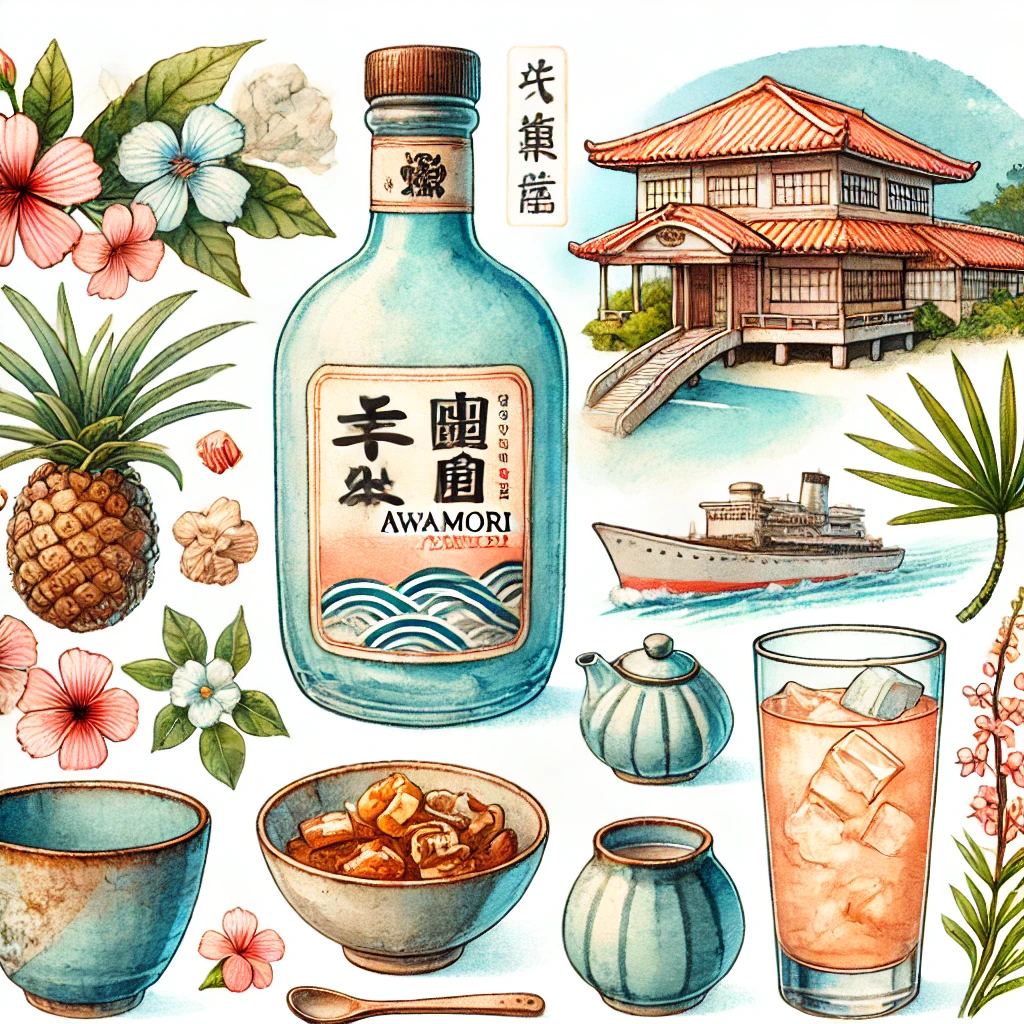
Okinawa’s blue sea, white sandy beaches, and cheerful people – this is the image that attracts many visitors to the island. However, there is much more to Okinawa than meets the eye. Deeply rooted in its long history and rich culture is the very heart of Okinawa, best expressed through its proud distilled spirit, “Awamori.”
Awamori is more than just a drink; it is a tradition passed down since the Ryukyu Kingdom era. It reflects the joys, sorrows, and hopes of the Okinawan people. To understand Awamori is to understand Okinawa. Let us invite you into this profound world.
The mellow taste, fruity aroma, and long-lasting finish of Awamori capture the essence of Okinawa’s sun, sea, and smiles. The rich flavor of aged Awamori contains the passage of time and the thoughts of its people. Through Awamori, you will feel and understand the heart of Okinawa.
This article covers a broad spectrum, from the history and brewing methods of Awamori to how to enjoy it and its cultural significance. Whether you’ve visited Okinawa before or long to visit for the first time, this guide will introduce you to new charms of the island.
Let’s embark on a journey into the world of Awamori. This journey promises to be an irreplaceable experience that will enrich your life. Cheers! Here begins a wonderful adventure to taste the heart of Okinawa.
- History of Awamori
- The History of Awamori Reveals the Charm of Okinawa
- The Brewing Process of Awamori
- The Charm and Future Prospects of Awamori Production
- How to Enjoy Awamori
- Mastering the Enjoyment of Awamori
- Awamori and Okinawan Food Culture
- The Deep Connection Between Awamori and Okinawan Food Culture
- The Cultural Significance of Awamori
- The Future of Awamori Culture
- Recommended Awamori Brands
- A Journey to Rediscover the Allure of Awamori
- Places to Enjoy Awamori
- Explore the Essence of Okinawa Through Awamori
- Conclusion: The Spirit of Okinawa Through Awamori
- The Heart of Okinawa Revealed Through Awamori
- Q&A
- Summary of the Article
History of Awamori
Awamori, the traditional distilled spirit representing Okinawa, continues to captivate many with its deep flavor and rich aroma. But its charm goes beyond taste. Exploring the history of Awamori reveals a narrative that has evolved with the lives of the islanders from the glory of the Ryukyu Kingdom to modern-day Okinawa.
In this article, we delve into the history of Awamori from its origins to the present day. We follow the transformation of Awamori through the trade splendor of the Ryukyu Kingdom era, the changes after the Meiji era, and its place in contemporary times.
Origins in the Ryukyu Kingdom Era
The history of Awamori is deeply intertwined with the prosperity of the Ryukyu Kingdom. It is believed that distillation techniques were introduced to Ryukyu in the 15th century through trade with Southeast Asia.
Introduction of Distillation Techniques in the 15th Century
The birth of Awamori is closely linked to the international trade activities of the Ryukyu Kingdom. In the 15th century, Ryukyu flourished as a hub for trade connecting China, Southeast Asia, and Japan. During this period, distillation techniques were introduced from the Ayutthaya Kingdom in Thailand.
At that time, Ryukyu thrived through tributary trade with China. Records indicate that distilled spirits were among the tribute items offered to the Chinese emperor. This distilled spirit was the prototype of Awamori.
The introduction of distillation techniques revolutionized Ryukyu’s sake brewing. Unlike brewed sake, it became possible to produce high-alcohol distilled spirits. This new drink, with its foamy appearance, was named “Awamori.”
Trade with China and the Development of Awamori
Trade with China played a significant role in the development of Awamori. Ryukyu imported black koji mold from China, which became an essential element in creating Awamori’s unique flavor and aroma.
Trade with China also contributed to improving Awamori’s quality. To meet the sophisticated tastes of Chinese officials and literati, Ryukyu’s brewing techniques evolved daily. Especially, the long-aged “Kusu” (old liquor) was highly valued in China.
Awamori also played a crucial role in diplomacy. At banquets welcoming Chinese envoys, the finest Awamori was served. Through such exchanges, Awamori became more than just a drink; it symbolized Ryukyu’s culture and technical prowess.
During the Ryukyu Kingdom era, Awamori was a status symbol enjoyed by royalty and nobility. It was always served at significant ceremonies and feasts at Shuri Castle, solidifying its place as part of Ryukyu’s high culture.
Development After the Meiji Era
With the end of the Ryukyu Kingdom, Awamori’s history entered a new phase. From the Meiji era onwards, Awamori evolved further as a specialty product of Okinawa Prefecture.
Transition to Okinawa Prefecture and Changes in the Awamori Industry
In 1879, the Ryukyu Kingdom was annexed by Japan and became Okinawa Prefecture. This political change significantly impacted the Awamori industry.
Firstly, regulations regarding the production and sale of Awamori were altered. During the Ryukyu Kingdom era, Awamori production was limited to specific families and regions, but the Meiji government relaxed these restrictions. This led to the emergence of new distilleries and a substantial increase in production.
Additionally, the active trade with mainland Japan expanded the market for Awamori. Okinawa’s Awamori, known for its high alcohol content and unique flavor, became popular among connoisseurs on the mainland.
However, applying Japan’s liquor tax law to Okinawa posed new challenges for the Awamori industry. To adapt to the new tax system, many small distilleries had to merge or close down. Nonetheless, the surviving distilleries established more efficient production systems and succeeded in improving quality.
From the Meiji to the Taisho era, there were advances in Awamori production methods. For example, improvements in distillation equipment allowed for more efficient production of purer Awamori. Enhanced aging techniques also enabled the production of more complex-flavored aged liquor.
Thus, the Awamori industry, while preserving tradition, continued to develop amidst modernization. This transformation helped establish Awamori as a representative product of Okinawa Prefecture.
Post-War Reconstruction and the Awamori Boom
World War II dealt a devastating blow to Okinawa’s Awamori industry. Many distilleries were destroyed by war, and securing raw materials became extremely difficult. However, the passion and efforts of the Okinawan people led to a remarkable recovery of the Awamori industry.
Immediately after the war, under U.S. military rule, production was severely restricted due to regulations and material shortages. Yet, by the 1950s, production gradually resumed. During this period, Awamori served as a source of solace and hope for the Okinawan people recovering from the war.
The return of Okinawa to mainland Japan in 1972 marked a significant turning point for the Awamori industry. With easier distribution within Japan, the market for Awamori expanded rapidly. Particularly from the 1980s to the 1990s, a phenomenon known as the “Awamori Boom” occurred, with a surge of interest in Awamori across mainland Japan.
This boom was significantly influenced by the increase in tourists visiting Okinawa. Tourists who experienced Awamori’s charm in Okinawa began seeking it back on the mainland. Additionally, attention to the health benefits of Awamori further boosted its popularity.
The Awamori boom brought significant changes to Okinawa’s liquor industry. Many distilleries modernized their facilities and expanded their production capacity. New product development became active, leading to the emergence of liqueur-type products and low-alcohol products aimed at younger audiences.
During this period, significant progress was also made in improving Awamori quality. In 1989, “Ryukyu Awamori” was designated as a regional brand by the National Tax Agency, clarifying quality standards and enhancing the credibility and evaluation of Awamori.
Overcoming post-war difficulties, the Awamori industry achieved significant development. The traditional and technical heritage passed down since the Ryukyu Kingdom era continued to evolve, making Awamori a beloved drink by many.
The Position of Awamori in the Modern Era
Entering the 21st century, the environment surrounding Awamori has significantly changed. Let’s take a detailed look at the current state of the Awamori industry, which continues to innovate while preserving tradition.
Fusion of Tradition and Innovation
In the modern Awamori industry, there is a trend of “fusion of tradition and innovation,” where traditional methods are preserved while incorporating new technologies and ideas.
First, there is the inheritance and improvement of traditional methods. The basics of using black koji mold and single distillation to make Awamori remain unchanged, but more efficient and stable production methods are being researched. For example, improvements in temperature control technology now allow for more precise control of the fermentation process.
At the same time, many new attempts are being made. For example, more distilleries are using Okinawa-grown sake rice, emphasizing local production and consumption and producing more distinctive Awamori. Additionally, innovations in aging methods, such as low-temperature aging and underwater aging, have led to Awamori with unprecedented flavors and aromas.
Moreover, new ways to enjoy Awamori are actively being proposed. Using it as a base for cocktails, suggesting new pairings with various cuisines, and introducing Western-style products like Awamori gin and vodka have expanded the possibilities of Awamori.
Product development targeting younger generations and women has also increased. Products with lower alcohol content or added fruity aromas are emerging, changing the traditional image of Awamori.
In this way, the modern Awamori industry continues to innovate while valuing tradition. This “fusion of tradition and innovation” is key to the future of Awamori.
Youth Disengagement from Awamori and Countermeasures
Recently, a decline in interest in Awamori among young people in Okinawa has become a concern
. Let’s examine the background of this phenomenon and the industry’s countermeasures.
The decline can be attributed to several factors:
1. Changes in drinking habits: There is a general trend of reduced alcohol consumption among young people.
2. Taste preferences: Young people tend to prefer lighter, more easily drinkable alcohol.
3. Image problem: Awamori is perceived as “an old man’s drink.”
4. Increased options: There are more choices like beer and chuhai (shochu highballs).
To address this issue, the Awamori industry is taking various measures.
Firstly, new product development for young people is active. For example, products with lower alcohol content or added fruity aromas cater to younger tastes. Sparkling types of Awamori are also being developed, overturning the traditional image.
Next, new ways to enjoy Awamori are being proposed. Using Awamori as a cocktail base, suggesting pairings with various cuisines, and introducing it in ways that are more accessible to young people are being promoted.
Additionally, education and awareness activities to convey the charm of Awamori to young people are thriving. For example, seminars for university students and information dissemination through social media are being conducted. These activities aim to teach young people about Awamori’s history, cultural value, and modern appeal.
Events where the brewing process can be observed, like brewery open house events, and Awamori cocktail contests are also increasing opportunities for young people to experience Awamori. These events serve as venues to discover new charms of Awamori.
Government support is also coming into play. Okinawa Prefecture has formulated the “Awamori Industry Promotion Strategy” to revitalize the Awamori industry and counter the decline in interest among young people. This strategy includes promoting Awamori’s appeal, supporting new product development, and encouraging overseas expansion.
Efforts are also starting in educational settings. Some high schools offer opportunities to learn about Awamori’s history and culture during integrated studies. This is an important initiative to help young people, the future consumers, understand the cultural value of Awamori.
In this way, the Awamori industry is taking multifaceted approaches to tackle the challenge of declining interest among young people. Balancing tradition with modern needs is crucial for the future of Awamori.
The History of Awamori Reveals the Charm of Okinawa
So far, we have examined the history of Awamori in detail, from the Ryukyu Kingdom era to the present day. The history of Awamori is indeed the history of Okinawa itself. The prosperity of the Ryukyu Kingdom through international trade, modernization after the Meiji era, post-war reconstruction, and contemporary challenges and innovations—all these eras have seen Awamori develop alongside the lives of the Okinawan people as an integral part of their culture.
Understanding Awamori means understanding the history, culture, and way of life of the Okinawan people. For instance, the unique brewing method of Awamori reflects the ingenuity and craftsmanship of the people of Ryukyu. Additionally, the culture of cherishing aged “Kusu” (old liquor) reveals a unique sense of time among Okinawans.
Furthermore, the challenges faced by the modern Awamori industry and the measures taken to address them reflect the flexible and innovative spirit of the Okinawan people as they strive to preserve tradition while embracing new ideas. The various initiatives to counter the decline of Awamori consumption among the youth are efforts to ensure that this traditional culture is passed down to the next generation.
By learning about the history and culture of Okinawa through Awamori, you can gain a deeper understanding of not only the drink itself but also the rich and profound region of Okinawa. This understanding enhances your appreciation and enjoyment of Awamori.
Next, we will delve into the brewing methods of Awamori, which has such a rich history. We will focus on the role of black koji mold, the characteristics of the single distillation method, and the aging process of Kusu. By understanding how Awamori is made, you will be able to appreciate and enjoy its flavors even more.
Awamori is not just a drink; it is a cup filled with the history and culture of Okinawa. When enjoying Awamori, take a moment to think about its deep historical and cultural background. You will likely find new dimensions in its taste.
If you have the chance to visit Okinawa, be sure to stop by a local izakaya or Awamori distillery. The Awamori you encounter there, along with the conversations with the locals, will surely teach you the true charm of Okinawa.
The history of Awamori will continue to be written alongside the people of Okinawa. Why not become a part of this history? Experience the deep and rich allure of Okinawa through Awamori.
The Brewing Process of Awamori
Awamori, the soul of Okinawa. What creates its unique aroma and deep flavor? In this section, we will explain the brewing process of Awamori in detail. By learning the secrets of Awamori production, your experience with this drink will become even richer.
Ingredients and Distillation Process
The distinct features of Awamori’s production lie in its ingredients and distillation methods. Its unique brewing techniques differentiate it from other Japanese sake and create Awamori’s unique taste.
The Role of Black Koji Mold
The first crucial step in Awamori production is the use of black koji mold. This microorganism is indispensable for Awamori brewing and plays a vital role.
Black koji mold is sprinkled on steamed Thai rice, producing enzymes that convert the rice starch into sugar. This process, called “seikiku,” forms the foundation of Awamori’s flavor.
Characteristics of black koji mold:
1. Resilience to high temperatures and humidity: Suitable for Okinawa’s climate.
2. High production of citric acid: Prevents the growth of unwanted bacteria and ensures safe fermentation.
3. Strong enzyme production capacity: Efficiently converts starch into sugar.
The use of black koji mold imparts Awamori with its unique aroma and deep flavor. For example, aromatic components derived from black koji mold create the rich fragrance characteristic of Awamori. Additionally, the presence of citric acid contributes to the clean aftertaste of the drink.
In Awamori production, creating koji with black koji mold is of paramount importance. Skilled brewers meticulously control the temperature and humidity to produce the optimal koji. This process can be seen as a fusion of science and art.
Interestingly, black koji mold originally came from China but is now used exclusively in Japanese Awamori production. This continuity of tradition from the Ryukyu Kingdom to the present day is a testament to the enduring legacy of Awamori.
Characteristics of the Single Distillation Method
Another essential aspect of Awamori production is the single distillation method. This process is key to achieving Awamori’s rich flavor and high alcohol content.
Characteristics of the single distillation method:
1. Obtains high alcohol concentration in a single distillation.
2. Richly extracts the flavors and aromas of the ingredients.
3. The simplicity of the distillation apparatus highlights the skills of the craftsmen.
The single distillation process:
1. The fermented mash is placed in the distillation apparatus.
2. It is heated to generate steam.
3. The steam is cooled back into liquid form.
4. The high-alcohol portion is selectively collected.
This method results in Awamori typically having an alcohol content of over 40%. Additionally, it preserves the rich flavors and aromas of the raw ingredients, creating Awamori’s distinctive and robust character.
The single distillation method heavily relies on the brewer’s skill and experience. For example, precise temperature control during distillation and decisions on which portions to collect are crucial. These adjustments significantly impact the final quality of Awamori.
Interestingly, this single distillation method is also used in the production of high-end distilled spirits worldwide, such as Scotch whisky’s single malt. This demonstrates that Awamori is made using globally respected methods.
Moreover, there have been recent developments in eco-friendly distillation apparatus. For example, energy-efficient distillation equipment has been introduced to reduce the environmental impact of Awamori production.
Thus, the Awamori production process is a fascinating blend of traditional techniques and modern technology. If you have the opportunity to visit an Awamori distillery, be sure to observe the distillation process. Your appreciation of Awamori will deepen even further.
Aging Process of Kusu (Aged Awamori)
A discussion of Awamori would be incomplete without mentioning “Kusu” (aged Awamori). The transformation of its flavor over time makes Kusu the pinnacle of Awamori. Here, we delve into the aging methods and allure of Kusu.
The Aging Process of Awamori
Awamori is typically aged at room temperature, a traditional method that takes advantage of Okinawa’s warm climate.
The basic aging process:
1. The fresh spirit is transferred to pottery or Ryukyu glass containers.
2. It is stored in a cool, dark place.
3. It is aged for a minimum of three years, with some being aged for decades.
Chemical changes during aging:
1. Esterification: Alcohol and acids combine, creating fruity aromas.
2. Aldehyde production: Enhances floral scents.
3. Reduction of fusel oils: Softens harsh aromas.
These changes mellow the rough edges of fresh Awamori, resulting in a smoother and deeper flavor. For example, a three-year-old Kusu features fruity aromas and a soft mouthfeel. Aged for over ten years, the Kusu develops more complex aromas and profound flavors.
Interestingly, the alcohol content can increase during aging, contrary to the common belief that it evaporates and decreases. In the case of Awamori, water evaporates faster than alcohol, sometimes increasing the alcohol content. This phenomenon is known as the “angel’s share” and adds value to aged Kusu.
Recently, new aging methods have been explored in addition to traditional room-temperature aging. For example:
1. Low-temperature aging: Enhances fruity aromas by aging at a consistent low temperature.
2. Underwater aging: Aged underwater to produce unique flavors.
3. Barrel aging: Aged in barrels previously used for whisky, adding new flavor dimensions.
These innovative methods further expand the possibilities of Awamori. Comparing the flavors resulting from different aging methods can be an enjoyable way to explore Awamori.
The Flavor Changes of Kusu
The flavor of Kusu changes significantly with its aging period. Here, we explore the characteristic flavor changes according to the aging duration.
Fresh Awamori (no aging):
– Aroma: Fresh and sharp.
– Flavor: Crisp and cutting, with a strong alcohol presence.
– Characteristics: Youthful vigor and strength.
Three-year-aged Kusu:
– Aroma: Fruity aromas begin to emerge.
– Flavor: Mellow and easier to drink.
– Characteristics: Balanced, with the rough edges of fresh Awamori smoothed out.
Five-year-aged Kusu:
– Aroma: More floral aromas.
– Flavor: Smoother and deeper.
– Characteristics: Increased complexity, enjoyable to savor slowly.
Ten-year-aged Kusu:
– Aroma: Strong mature aromas with complex notes.
– Flavor: Very smooth with long-lasting depth.
– Characteristics: Profound flavor unique to aged Kusu.
Over twenty years of aging:
– Aroma: Deep aromas similar to barrel-aged whisky.
– Flavor: Extremely smooth with intricate flavors.
– Characteristics: Known as “time’s masterpiece,” offering the pinnacle of taste.
The dramatic changes in flavor with aging are one of Awamori’s greatest charms.
Tips for enjoying Kusu:
1. Temperature: Best enjoyed at room temperature to slightly warmed. Around 20°C is ideal for appreciating the aroma.
2. Glassware: Use a glass with a narrow mouth to concentrate the aroma.
3. Drinking style: Sip slowly and savor the complex flavors over time.
Kusu pairs well with various foods due to its complex flavors. For example
:
– Ten-year-old Kusu with cheese: The mature aromas complement each other.
– Five-year-old Kusu with braised fish: The smoothness enhances the fish’s umami.
– Twenty-year-old Kusu with chocolate: The deep flavors harmonize beautifully.
Thus, Kusu can be enjoyed not just as a drink but also in combination with food, leading to new flavor discoveries. Try various aging periods of Kusu to find your favorite.
Types and Characteristics of Awamori
Awamori comes in many varieties, each with its unique characteristics. Let’s explore the diversity of Awamori in detail.
Classification by Alcohol Content
Awamori is classified into several categories based on its alcohol content. Let’s look at the features and ways to enjoy each category.
1. Awamori under 30% alcohol:
– Characteristics: Easy to drink, recommended for beginners.
– Flavor: Mellow with a subdued Awamori aroma.
– How to enjoy: On the rocks, diluted with water, or as a cocktail base.
2. Awamori with 30-39% alcohol:
– Characteristics: The most common type. Well-balanced flavor.
– Flavor: Enjoyable traditional Awamori aroma and taste.
– How to enjoy: Straight, diluted with water, or warm.
3. Awamori with 40%+ alcohol:
– Characteristics: Strong Awamori character.
– Flavor: Rich and robust with a full-bodied aroma.
– How to enjoy: Best straight, sipped slowly.
4. Awamori with 60%+ alcohol:
– Characteristics: The raw spirit of Awamori. Extremely intense flavor.
– Flavor: Potent and concentrated Awamori essence.
– How to enjoy: Typically diluted with water to your preferred strength.
The difference in alcohol content not only affects strength but also significantly impacts the flavor and aroma. For instance, high-alcohol Awamori tends to highlight the characteristics of the raw ingredients and brewing methods. Conversely, lower-alcohol Awamori is characterized by its smoothness and drinkability.
Choosing the right alcohol content for the occasion and your preference is key to enjoying Awamori. For example:
– For pairing with meals: Awamori in the 30% range is recommended.
– For slow savoring: Enjoy high-alcohol Awamori in small amounts.
– For casual settings: Use lower-alcohol Awamori in cocktails.
Recently, even lower-alcohol (under 20%) Awamori has emerged, targeting younger audiences and women. These new types of Awamori maintain the characteristic flavors and aromas while being easier to drink. Innovations such as fruity aromas and sparkling types are being introduced.
Additionally, the trend of “Awamori-wari” involves diluting high-alcohol Awamori with water to the desired strength. This method allows for a personalized tasting experience.
Differences Between Fresh Awamori and Kusu
Understanding the differences between fresh Awamori and Kusu is essential. The same Awamori can offer entirely different experiences depending on its aging period.
1. Fresh Awamori:
– Definition: Awamori that has not undergone significant aging.
– Characteristics:
– Aroma: Fresh and sharp, with a strong raw ingredient scent.
– Flavor: Crisp and intense, with a pronounced alcohol presence.
– How to enjoy: Best served chilled, perfect for hot Okinawan summers.
– Food pairings: Sashimi, chilled somen, Goya champuru.
2. Kusu (aged Awamori):
– Definition: Generally aged for three years or more.
– Characteristics:
– Aroma: Mellow and complex, with matured notes.
– Flavor: Smooth with depth and long-lasting aftertaste.
– How to enjoy: Best enjoyed at room temperature or slightly warmed.
– Food pairings: Okinawa soba, rafute (braised pork), cheese.
Flavor changes with aging:
– Three years: Smoother and easier to drink.
– Five years: Increased complexity and depth.
– Ten years: Profound flavor and long aftertaste.
– Twenty years: Exquisite richness and intricate complexity.
Ways to enjoy the differences between fresh Awamori and Kusu:
1. Comparative tasting: Sample the same brand’s fresh and aged versions to appreciate the changes.
2. Seasonal preferences: Fresh for summer, aged for winter.
3. Food pairings: Light dishes with fresh Awamori, rich dishes with Kusu.
An intriguing middle ground is “middle-aged” Awamori, aged between one to three years. It offers a balance of the freshness of new Awamori and the mellowness of aged Kusu.
Recently, blended Kusu, combining fresh and aged Awamori, has emerged. This new type offers the freshness of new Awamori with the depth of aged Kusu.
Everyone has their own way of enjoying Awamori, but understanding the differences between fresh Awamori and Kusu allows for a deeper appreciation. For example, tasting both fresh and aged versions of the same brand can highlight the transformation of flavors, enriching your experience.
The Charm and Future Prospects of Awamori Production
So far, we have explored the detailed production methods of Awamori. The use of black koji mold, the single distillation method, and the aging process of Kusu all contribute to its unique flavor.
Awamori production is the result of traditional techniques inherited from the Ryukyu Kingdom era combined with modern scientific knowledge. For example, while the use of black koji mold is an ancient tradition, its cultivation and management benefit from the latest microbiological research.
Similarly, while the basic principles of the single distillation method have remained unchanged, the design and temperature control of the distillation apparatus utilize modern engineering technology. Thus, Awamori production stands on a delicate balance between tradition and innovation.
Looking ahead, several points are noteworthy for the future of Awamori production:
1. Development of environmentally friendly production methods:
– Introduction of energy-efficient distillation equipment.
– Effective use of by-products (e.g., using distillation waste as fertilizer).
2. Exploration of new aging methods:
– Researching new aging environments, such as low-temperature or underwater aging.
– Experimenting with aging in different barrels.
3. Focus on ingredients:
– Development of Okinawa-grown sake rice.
– Use of organically grown rice.
4. Development of new types of Awamori:
– Further development of low-alcohol Awamori.
– Research into Awamori with added fruity aromas.
These new initiatives do not undermine the traditional value of Awamori. Instead, they are challenges aimed at expanding its possibilities and making it a beloved drink for a broader audience.
When enjoying Awamori, take a moment to think about its production process. The power of black koji mold, the craftsmanship in single distillation, and the magic of aging. These elements combine to create the unique flavor that you savor.
If possible, visiting an Awamori distillery is highly recommended. Many distilleries offer tours where you can see the production process up close. Seeing is believing, and witnessing the production firsthand will deepen your understanding and affection for Awamori.
Awamori is a drink infused with the history and culture of Okinawa. Knowing its production process allows you to appreciate not only the drink itself but also the profound nature of Okinawa.
Next, we will discuss how to best enjoy Awamori, with insights into traditional and unique Okinawan ways of drinking, as well as cocktail recipes. Understanding its production will surely lead to new discoveries in its flavors.
If you have the opportunity to visit Okinawa, be sure to visit a local izakaya or Awamori distillery. The Awamori you encounter and the conversations with the people there will undoubtedly reveal the true charm of Okinawa. Experience the depth and richness of Okinawa through Awamori.
How to Enjoy Awamori
Awamori, the soul of Okinawa, can be enjoyed in various ways that highlight its rich flavors and aromas. In this section, we will detail how to make the most of your Awamori experience. From basic drinking methods to unique Okinawan styles, and even creative cocktail recipes, you’ll discover how to bring out the best in this distinctive spirit.
Basic Drinking Methods
There are three primary ways to enjoy Awamori: straight, diluted with water, and on the rocks. Let’s explore each method in detail.
Enjoying Awamori Straight
To fully appreciate the pure taste of Awamori, drinking it straight is recommended. This method allows you to experience the full spectrum of its flavors and aromas directly.
How to Enjoy Awamori Straight:
1. **Choosing the Glass:**
– Use a snifter or brandy glass to enhance the aroma.
– A narrow-mouthed glass helps to concentrate the fragrance.
2. **Optimal Temperature:**
– Room temperature (around 20°C) is ideal.
– Avoid chilling it too much, as cold temperatures can mute the aroma.
3. **Drinking Tips:**
– First, enjoy the aroma by gently swirling the glass and inhaling the rising scent.
– Sip slowly and savor a small amount at a time. Avoid gulping.
– Roll the liquid around your tongue to fully experience the flavor.
4. **Recommended Awamori:**
– Aged Awamori (over three years) is ideal.
– Especially those aged for more than ten years offer complex aromas and deep flavors.
5. **Pairings:**
– Pairs excellently with cheese and dried fruits.
– Also complements Okinawan “rafute” (braised pork belly).
Important Tips for Drinking Straight:
– Due to its high alcohol content, it’s important to sip slowly.
– Keep water or tea on hand for hydration.
Enjoying Awamori straight is akin to mastering the “Way of Awamori.” Take your time to savor its complex flavors and changing aromas, and you’ll discover new dimensions of this spirit.
The Perfect Water Dilution Ratio
Diluting Awamori with water can make it more accessible and bring out its subtle flavors. The right balance of water can lower the alcohol content and enhance the delicate aromas.
The Ideal Water Dilution Ratio:
– A typical ratio is 6:4 or 7:3 (Awamori to water).
– Adjust according to your preference and the type of Awamori.
Tips for Enjoying Awamori with Water:
1. **Choosing the Water:**
– Soft water is recommended as hard water can alter the flavor.
– Mineral water is also a good choice.
2. **Water Temperature:**
– Room temperature to lukewarm (around 30°C) is best.
– Avoid cold water as it can suppress the aroma.
3. **Dilution Method:**
– Pour Awamori into the glass first, then slowly add water.
– Stir gently with a spoon.
4. **Choosing the Glass:**
– A rock glass or a small tumbler is ideal.
– For aroma, use a narrow-mouthed glass.
5. **Recommended Awamori:**
– Enjoy both fresh and aged Awamori this way.
– Higher alcohol content (over 40%) Awamori is particularly good with water.
6. **Pairings:**
– Pairs well with a wide range of Okinawan dishes.
– Especially good with Goya Champuru and Okinawa Soba.
Advantages of Diluting with Water:
– Lower alcohol content makes it enjoyable over a longer period.
– Water can open up the aromas, revealing new flavors.
Important Tips for Water Dilution:
– Add water gradually to find your preferred strength.
– Avoid ice as it can change the flavor profile, enjoy them separately.
Diluting Awamori with water is a popular and traditional method. It’s especially recommended for beginners. Find your preferred ratio and enjoy the deeper aspects of Awamori.
Enjoying Awamori on the Rocks
On the rocks is a great way to enjoy Awamori, especially in the hot Okinawan climate. Ice can change the flavor profile, providing a refreshing way to enjoy this spirit.
Tips for Enjoying Awamori on the Rocks:
1. **Choosing the Ice:**
– Large ice cubes are recommended as they melt slowly, preventing dilution.
– Clear ice looks beautiful and melts evenly.
2. **Amount of Ice:**
– Fill the glass about 70-80% with ice.
– Too little ice will melt quickly and dilute the drink.
3. **Pouring Awamori:**
– Slowly pour Awamori over the ice.
– Fill the glass to about 60-70%.
4. **Choosing the Glass:**
– An old-fashioned or rock glass is ideal.
– Thick glasses retain the cold longer.
5. **Recommended Awamori:**
– Fresh Awamori is recommended for its fresh aroma and flavor.
– Awamori with 30-35% alcohol content is suitable.
6. **Pairings:**
– Perfect with cold dishes.
– Pairs well with summer vegetables like Goya dishes.
Advantages of On the Rocks:
– Enjoy the changing flavors as the ice melts.
– Ideal for hot weather, providing a refreshing experience.
Important Tips for On the Rocks:
– Don’t let the ice melt too much to avoid over-dilution.
– Use a coaster to catch condensation.
On the rocks is a favorite way to enjoy Awamori in Okinawa’s warm climate. As the ice melts, the flavor evolves, offering a dynamic tasting experience. It also serves as a base for Awamori cocktails, allowing for various creative combinations.
Unique Okinawan Ways to Enjoy Awamori
Beyond the basic methods, Okinawa has unique ways to enjoy Awamori. Here are some traditional Okinawan styles of drinking Awamori.
How to Make a “Haisai Ball”
The “Haisai Ball” is a popular Awamori cocktail originating from Okinawa. “Haisai” means “hello” in Okinawan dialect, making it an inviting and approachable drink for visitors.
How to Make a Haisai Ball:
1. **Ingredients (per glass):**
– Awamori: 45ml
– Soda water: 120ml
– Lime: 1/8 piece
– Ice: as needed
2. **Steps:**
(1) Fill the glass with ice.
(2) Pour in Awamori.
(3) Add soda water.
(4) Squeeze lime juice into the glass and drop the lime wedge in.
(5) Stir lightly and serve.
3. **Choosing the Glass:**
– Use a highball or Collins glass.
– A tall glass enhances the fizz of the soda.
4. **Recommended Awamori:**
– Fresh Awamori or young aged Awamori (3-5 years).
– Awamori with 30-35% alcohol content is ideal.
5. **Variations:**
– Substitute lime with Shikuwasa (Okinawan citrus) for a local twist.
– Use ginger ale instead of soda water for a “Haisai Ginger.”
Advantages of the Haisai Ball:
– Refreshing and easy to drink, great for Awamori beginners.
– The fizziness and Awamori aroma blend perfectly.
– Ideal for hot Okinawan weather.
Tips for Enjoying a Haisai Ball:
– Add soda last to maintain the bubbles.
– Float lime slices for added aroma.
– Use plenty of ice to keep it cold.
The Haisai Ball is a popular choice at Okinawan izakayas and bars. The combination of Awamori and soda creates a refreshing drink that captures the essence of Okinawa. Be sure to try this delightful cocktail when visiting Okinawa.
The Origin and Taste of Sanshin-wari
“Sanshin-wari” is a unique way of drinking Awamori, named after Okinawa’s traditional three-stringed instrument, the sanshin. The name reflects the drink’s 1:1:1 ratio of Awamori, water, and hot water.
The Origin of Sanshin-wari:
– Believed to have originated in Okinawan entertainment settings.
– The drink was created as people enjoyed Awamori while playing the sanshin.
How to Make Sanshin-wari:
1. **Ingredients (per glass):**
– Awamori: 30ml
– Water: 30ml
– Hot water: 30ml
2. **Steps:**
(1) Pour Awamori into a glass.
(2) Add an equal amount of water.
(3) Finally, add an equal amount of hot water.
(4) Stir gently and serve.
3. **Choosing the Glass:**
– Use a small tumbler or sake cup.
– Ensure the glass is heat-resistant.
4. **Recommended Awamori:**
– Aged Awamori is preferred as the warmth enhances the aroma.
– Awamori with 40% alcohol content or higher is suitable.
Advantages of Sanshin-wari:
– Adding water and hot water enhances the aroma of Awamori.
– Lower alcohol content allows for leisurely enjoyment.
– The contrast of warm and cool creates a unique taste experience.
Tips for Enjoying Sanshin-wari:
– The hot water should be around 60-70°C to prevent alcohol evaporation.
– Start with a 1:
1:1 ratio and adjust to taste.
– Enjoy with Okinawan dishes like rafute or mimiga (vinegared pork ear).
Sanshin-wari draws out the rich flavors of Awamori while making it easy to drink. It’s especially favored during colder seasons or long evening gatherings. This method truly enhances the charm of aged Awamori.
Awamori Cocktail Recipes
Awamori isn’t just for traditional drinking methods; it also makes an excellent base for cocktails. Here are some popular Awamori cocktail recipes.
Shikuwasa Sour
Shikuwasa, an Okinawan citrus fruit, adds a unique tang to the “Shikuwasa Sour.” This cocktail blends the flavors of Awamori and the refreshing tartness of Shikuwasa.
Recipe for Shikuwasa Sour:
1. **Ingredients (per glass):**
– Awamori: 45ml
– Shikuwasa juice: 15ml
– Soda water: 90ml
– Ice: as needed
2. **Steps:**
(1) Fill the glass with ice.
(2) Pour in Awamori and Shikuwasa juice.
(3) Add soda water.
(4) Stir lightly and serve.
(5) Garnish with a slice of Shikuwasa if desired.
3. **Choosing the Glass:**
– Use a highball or Collins glass.
– A tall glass complements the refreshing look.
4. **Recommended Awamori:**
– Fresh Awamori or young aged Awamori (3-5 years).
– Awamori with 30-35% alcohol content.
Advantages of Shikuwasa Sour:
– The tartness and aroma of Shikuwasa enhance Awamori’s flavor.
– The soda water adds a refreshing fizz.
– Perfect for Okinawa’s hot climate.
Variations:
– Adjust the amount of Shikuwasa juice to taste.
– Add a touch of honey for a smoother flavor.
– Garnish with mint leaves for added freshness.
Shikuwasa Sour is a must-try cocktail when visiting Okinawa. The blend of Awamori and Shikuwasa offers a refreshing and uniquely Okinawan taste.
Awamori Mojito
The “Awamori Mojito” is a sophisticated take on the classic Mojito, using Awamori as the base. The refreshing mint and lime flavors pair beautifully with Awamori’s distinctive aroma.
Recipe for Awamori Mojito:
1. **Ingredients (per glass):**
– Awamori: 45ml
– Lime: 1/2
– Mint leaves: 8-10
– Sugar: 2 teaspoons
– Soda water: to top
– Ice: as needed
2. **Steps:**
(1) Cut the lime into wedges and place in a glass with sugar. Muddle together.
(2) Add mint leaves and gently muddle (don’t overdo it to avoid bitterness).
(3) Fill the glass with ice and pour in Awamori.
(4) Top with soda water and stir lightly.
(5) Garnish with mint leaves and a lime wedge.
3. **Choosing the Glass:**
– Use a highball or Collins glass.
– A tall glass enhances the mint aroma.
4. **Recommended Awamori:**
– Fresh Awamori or young aged Awamori (3-5 years).
– Awamori with 30-35% alcohol content.
Advantages of Awamori Mojito:
– The mint’s freshness and Awamori’s aroma blend perfectly.
– The lime’s tartness and sugar’s sweetness balance well.
– Visually appealing, ideal for a resort feel.
Variations:
– Substitute lime with Shikuwasa for an Okinawan twist.
– Use honey instead of sugar for a richer taste.
– Add tropical fruits like pineapple or mango for a fruity twist.
The Awamori Mojito is perfect for Okinawa’s hot summers. Whether enjoyed by the beach or made at home, this cocktail brings a taste of Okinawa’s vibrant culture.
Mastering the Enjoyment of Awamori
From basic drinking methods to unique Okinawan styles and creative cocktails, we’ve explored various ways to enjoy Awamori. This spirit offers a deep and versatile drinking experience that goes beyond just “drinking.”
Key Points for Enjoying Awamori:
1. **Temperature:** Choose the appropriate temperature based on the type and drinking method.
2. **Glassware:** Select glassware that enhances the aroma and flavor.
3. **Pairing:** Awamori pairs excellently with Okinawan cuisine. Enjoy it with complementary dishes.
4. **Creativity:** Experiment with cocktails and sours for a variety of experiences.
5. **Time:** Take your time to savor and appreciate the evolving flavors of Awamori.
Awamori embodies the history and culture of Okinawa. Understanding how to enjoy it enhances your appreciation of both the drink and the region’s rich heritage.
If you have the chance to visit Okinawa, be sure to visit local izakayas and Awamori distilleries. The Awamori and conversations you encounter there will reveal the true charm of Okinawa.
Even at home, try the various methods and recipes introduced here. You’ll discover new aspects of Awamori’s appeal.
There are as many ways to enjoy Awamori as there are drinkers. Find your unique way to appreciate Awamori and experience the deep and rich allure of Okinawa.
Next, we will delve into the food culture of Okinawa, focusing on dishes that pair well with Awamori, ways to enjoy Awamori at home, and recipes that incorporate Awamori. By exploring the culinary side of Awamori, you’ll uncover new discoveries and enrich your appreciation for this unique spirit.
Embark on a journey to enjoy Okinawa’s Awamori culture. It’s sure to become a new and enriching hobby that will add depth to your life.
Awamori and Okinawan Food Culture
Okinawan food culture has developed uniquely, distinct from mainland Japan, due to its unique history and geographical characteristics. Awamori is not just a beverage but a vital element closely intertwined with Okinawan cuisine. This section delves into the relationship between Awamori and Okinawan food culture.
Okinawan Dishes that Pair with Awamori
Awamori’s unique flavors and aromas complement many Okinawan dishes beautifully. Here are some classic Okinawan dishes that pair well with Awamori.
Pairing with Rafute
Rafute, a slow-cooked pork belly dish, is a quintessential Okinawan dish known for its tender texture and rich flavor, making it an excellent match for Awamori.
Why Rafute Pairs Well with Awamori:
1. **Flavor Balance:** The richness of Rafute complements Awamori’s crisp finish.
2. **Aromatic Harmony:** The sweet aroma of Rafute enhances the rich fragrance of Awamori.
3. **Textural Match:** The tender texture of Rafute harmonizes with the smoothness of Awamori.
Recommended Awamori:
– Aged Awamori (over five years) provides deep flavors that match Rafute’s richness.
– Awamori with 40% alcohol content or higher helps cut through the pork’s fat.
How to Enjoy Rafute and Awamori:
1. Start with a bite of Rafute, savoring its tender texture and rich flavor.
2. Follow with a sip of Awamori to blend the lingering flavors with the spirit’s aroma.
3. Take your time to enjoy the complex interplay of flavors.
Simple Rafute Recipe:
1. **Ingredients (for 4 servings):**
– Pork belly: 600g
– Soy sauce: 100ml
– Sugar: 50g
– Awamori: 50ml
– Ginger: 1 piece
2. **Instructions:**
(1) Cut the pork belly into bite-sized pieces and parboil to remove impurities.
(2) In a pot, combine pork, soy sauce, sugar, Awamori, and sliced ginger. Simmer on low heat for 2-3 hours.
(3) Once the pork is tender and glossy, it’s ready to serve.
Adding Awamori to this recipe enhances the dish’s flavor depth and aroma. A splash of Awamori before serving can elevate the experience further.
Rafute and Awamori are a classic pairing that symbolizes Okinawan culinary culture. The balance of rich flavors and harmonious aromas represents the essence of Okinawa.
Pairing with Goya Champuru
Goya Champuru, a stir-fry dish featuring bitter melon, is another iconic Okinawan dish. The bitterness of Goya contrasts beautifully with the mellow flavor of Awamori.
Why Goya Champuru Pairs Well with Awamori:
1. **Flavor Contrast:** The bitterness of Goya balances Awamori’s mellow profile.
2. **Textural Harmony:** The crunchiness of Goya complements Awamori’s smoothness.
3. **Nutritional Balance:** Goya’s rich vitamin C content complements the alcohol’s effects.
Recommended Awamori:
– Fresh Awamori or young aged Awamori (about three years) for a fresh taste.
– Awamori with 30-35% alcohol content is suitable.
How to Enjoy Goya Champuru and Awamori:
1. Take a bite of Goya Champuru to appreciate the bitterness and softness of the dish.
2. Follow with a sip of Awamori to refresh your palate.
3. Alternate bites and sips to enjoy the evolving flavors.
Simple Goya Champuru Recipe:
1. **Ingredients (for 2 servings):**
– Goya (bitter melon): 1
– Tofu: 1/2 block
– Eggs: 2
– Spam (or pork): 50g
– Salt: a pinch
– Soy sauce: 1 teaspoon
2. **Instructions:**
(1) Cut the Goya in half, remove seeds and pith, and slice thinly.
(2) Stir-fry tofu and Spam (or pork) in a pan.
(3) Add Goya and salt, and stir-fry until tender.
(4) Add beaten eggs and soy sauce, stirring until cooked.
Adding a splash of Awamori to the finished dish enhances the flavor and aroma, making it a more sophisticated treat.
The pairing of Goya Champuru and Awamori represents Okinawan everyday cuisine. The combination of bitter and mellow flavors showcases the wisdom of Okinawan culinary traditions, perfect for enjoying during the hot summer months.
Enjoying Awamori at Home
Awamori is deeply ingrained in Okinawan households. Here, we’ll explore how to enjoy Awamori at home, from storage tips to selecting the perfect snacks.
How to Store Awamori
Proper storage is essential for enjoying Awamori at its best. Here are some tips for storing Awamori at home.
1. **Storage Location:**
– Keep it away from direct sunlight in a cool, dark place.
– A location with minimal temperature fluctuations is ideal.
– A kitchen cabinet or pantry works well.
2. **Storage Temperature:**
– The ideal storage temperature is 15-20°C.
– Avoid high humidity and heat, which can degrade quality.
3. **Storage Container:**
– After opening, store Awamori in its original bottle.
– Clean the bottle rim and cap tightly to prevent oxidation.
– For long-term storage, consider transferring to a light-resistant container.
4. **Storage Duration:**
– Unopened bottles can be stored for several years if kept properly.
– Consume within 3-6 months after opening for optimal taste.
– Aged Awamori continues to mature, even after opening, so long-term storage is possible.
5. **Tips for Preservation:**
– Awamori is less prone to oxidation but will change slightly over time after opening.
– Use smaller bottles for remaining portions to minimize air exposure.
6. **Advanced Storage:**
– Consider using a traditional Awamori storage container called “Kara.” These containers are excellent for preserving flavor and temperature stability.
7. **Aging at Home:**
– For aging at home, store in a stable environment and taste periodically to enjoy the evolution of flavors.
Properly stored Awamori can develop richer flavors over time. By optimizing storage methods, you can enjoy Awamori at its finest for longer.
Choosing Snacks for Home Drinking
Pairing the right snacks with Awamori can enhance its flavor. Here are some tips for selecting snacks and a few recommended recipes.
Characteristics of Good Awamori Snacks:
1. **Salty:** Enhances the aroma of Awamori.
2. **Fatty:** Complements Awamori’s crisp finish.
3. **Sour:** Balances Awamori’s smoothness.
4. **Bitter:** Harmonizes with Awamori’s deep flavor.
Recommended Snacks:
1. **Shima Rakkyo:**
– Okinawan pickled shallots with a refreshing tang and slight spiciness.
– Enhances the clean finish of Awamori.
2. **Mimiga (Vinegared Pork Ears):**
– Crunchy texture with a tangy flavor, a traditional Okinawan dish.
– Balances well with Awamori’s smoothness.
3. **Champuru Dishes:**
– Versatile stir-fries with various ingredients.
– Pairs well with Awamori, especially Goya Champuru.
4. **Shiokara (Fermented Seafood):**
– Salty and umami-rich, pairs excellently with Awamori.
– Enhances the spirit’s aroma.
5. **Cheese:**
– Pairs surprisingly well with Awamori.
– Especially good with aged cheese and Kusu.
6. **Jimami Tofu:**
– Creamy peanut tofu unique to Okinawa.
– Harmonizes with Awamori’s aroma.
Simple Snack Recipes:
1. **Easy Mimiga:**
– **Ingredients (for 2 servings):**
– Boiled mimiga: 100g
– Vinegar: 2 tablespoons
– Sugar: 1 teaspoon
– Soy sauce: 1 teaspoon
– Red chili pepper: to taste
– **Instructions:**
(1) Cut the boiled mimiga into bite-sized pieces.
(2) In a bowl, mix vinegar, sugar, and soy sauce.
(3) Add mimiga to the mixture and let marinate in the refrigerator for 30 minutes.
(4) Sprinkle with finely chopped red chili pepper before serving.
2. **Pickled Shima Rakkyo:**
– **Ingredients:**
– Shima rakkyo: 200g
– Salt: 1 tablespoon
– **Instructions:**
(1) Wash the shima rakkyo thoroughly and trim the roots and leaves.
(2) Place in a clean jar with salt, shaking to coat evenly.
(3) Store in the refrigerator for a week.
(4) Rinse lightly before serving.
These snacks not only enhance the flavor of Awamori but also allow you to experience Okinawan culinary culture. To further enhance your home Awamori experience, consider the following points:
3. **Optimal Drinking Methods:**
– Enjoy at room temperature or slightly warmed.
– Use a glass that enhances aroma, such as a narrow-mouthed one.
– Sip slowly to savor the flavors.
4. **Family and Friends:**
– Enjoying Awamori with family and friends is a common Okinawan practice.
– Participate in “O-toori,” a custom of sharing drinks, to strengthen bonds.
5. **Seasonal Enjoyment:**
– Drink chilled in the summer; ice can be a refreshing addition.
– Warm in the winter for a comforting experience.
Enjoying Awamori at home provides a wonderful opportunity to immerse yourself in Okinawan culture. Pair it with snacks and enjoy leisurely moments.
Cooking with Awamori
Awamori can also enhance your cooking, adding depth and flavor to dishes. Here are some recipes incorporating Awamori.
Awamori-Infused Stewed Dishes
Awamori’s unique aroma and flavor make it perfect for stewed dishes. Here’s a classic recipe for Awamori-infused Rafute.
Awamori Rafute Recipe:
1. **Ingredients (for 4 servings):**
– Pork belly: 600g
– Awamori: 100ml
– Soy sauce: 100ml
– Sugar: 50g
– Ginger: 1 piece
– Garlic: 2 cloves
– Shima Togarashi (Okinawan chili pepper): 1 (optional)
2. **Instructions:**
(1) Cut the pork belly into bite-sized pieces and parboil to remove impurities.
(2) In a pot, combine Awamori, soy sauce, sugar, sliced ginger, crushed garlic, and shima togarashi. Bring to a boil.
(3) Add the pork and simmer on low heat for 2-3 hours, skimming off any scum.
(4) When the pork is tender and glossy, it’s ready to serve.
Recipe Tips:
– Adding Awamori enhances the dish’s aroma and flavor complexity.
– Long simmering creates a melt-in-your-mouth texture.
– The alcohol evaporates, leaving behind a rich fragrance.
Awamori Rafute is a staple of Okinawan home cooking. With this recipe, you can recreate an authentic Okinawan flavor in your own kitchen.
Using Awamori in Desserts
Awamori can also be incorporated into sweet dishes and desserts. Here, we introduce a simple and delicious dessert recipe that uses Awamori.
Awamori Tiramisu Recipe:
**Ingredients (serves 4):**
– Mascarpone cheese: 200g
– Heavy cream: 200ml
– Sugar: 50g
– Awamori: 50ml
– Coffee: 100ml (strongly brewed)
– Biscuits: 12 pieces
– Cocoa powder: to taste
**Instructions:**
1. Place the mascarpone cheese in a bowl and whisk until it becomes creamy.
2. In a separate bowl, whip the heavy cream until it forms soft peaks, then add the sugar and continue whipping until well combined.
3. Fold the mascarpone cheese and whipped cream together, then gently mix in the Awamori.
4. Add a small amount of Awamori (about 10ml) to the coffee.
5. Lightly dip the biscuits into the coffee mixture and arrange them at the bottom of a serving dish.
6. Spread a layer of the mascarpone mixture over the biscuits, then add another layer of dipped biscuits.
7. Finish with a final layer of the mascarpone mixture and refrigerate for about 2 hours.
8. Just before serving, dust the top with cocoa powder.
**Tips for this Recipe:**
– The aroma of Awamori adds depth to the tiramisu.
– Adding Awamori to the coffee infuses the biscuits with its unique flavor.
– Adjust the amount of Awamori to your taste preference.
Awamori Tiramisu is a unique dessert that combines the traditional Italian treat with the distinctive flavors of Okinawa. It’s a delightful adult dessert that’s perfect for parties.
Through these recipes, you can see that Awamori is not just a drink but also an excellent ingredient for expanding your culinary repertoire. Enjoying dishes made with Awamori allows you to savor Okinawan food culture more deeply.
The Deep Connection Between Awamori and Okinawan Food Culture
We have explored the close relationship between Awamori and Okinawan food culture. Awamori is not just a beverage; it is deeply intertwined with the history, culture, and daily life of Okinawa.
Awamori pairs exceptionally well with Okinawan cuisine, and there are many ways to enjoy it at home. Additionally, it can be used as an ingredient in cooking, offering endless possibilities.
When enjoying Okinawan food culture, make sure to have Awamori by your side. Through Awamori, you can feel the essence of Okinawa’s landscape, history, and the daily lives of its people.
Try the dishes and snacks introduced in this article at home. You’ll discover new dimensions of Awamori’s charm that you hadn’t noticed before.
There are as many ways to enjoy Awamori as there are drinkers. Find your unique way to savor Awamori and experience the rich and profound food culture of Okinawa.
Next time, we will delve into the cultural significance of Awamori. We will explore its role in traditional ceremonies, its relationship with Okinawan spirituality, and the modern-day preservation of Awamori culture. Understanding the cultural background of Awamori, in addition to its connection with food culture, will surely lead to new insights.
Embark on a journey to enjoy the culture of Awamori in Okinawa, and incorporate that experience into your home dining. It will undoubtedly become a new hobby that enriches your life.
The Cultural Significance of Awamori
Awamori is not just a beverage; it is deeply intertwined with Okinawa’s history, culture, and daily life, making it a “liquid cultural heritage.” In this chapter, we will delve into the cultural significance of Awamori. From its role in traditional ceremonies to its connection with Okinawan spirituality and the modern preservation of Awamori culture, we will explore the various cultural aspects of this unique drink.
The Role of Awamori in Ceremonies and Festivals
In Okinawa, Awamori is an indispensable element in ceremonies and festivals, marking significant life events and rituals. How does Awamori contribute to these important occasions?
The Role of Awamori in Weddings
At Okinawan weddings, Awamori is more than just a celebratory drink. It symbolizes blessings for the couple’s future happiness and strengthens the bond between families.
1. **San-san-kudo (Three-Three-Nine):**
– Similar to the sake-sharing ritual in mainland Japan, Okinawan weddings use Awamori.
– The bride and groom take three sips each from three different cups.
– This ritual signifies the deepening bond and wishes for a happy married life.
2. **Karei:**
– A post-wedding banquet ritual where participants drink Awamori together.
– This communal drinking symbolizes the guests’ blessings for the couple’s happiness and strengthens the bonds among attendees.
3. **Awamori as a Gift:**
– It is customary to give aged Awamori (Kusu) as a wedding gift.
– The long maturation of Kusu symbolizes the wish for a long and happy marriage.
4. **Toasts at the Reception:**
– Awamori is often used for the wedding toast.
– Toasting with Awamori shows respect for Okinawan traditions and culture.
5. **Awamori Couple:**
– A popular modern twist where the bride and groom pour Awamori from a large bottle into glasses together.
– This act symbolizes their commitment to walking together through life.
6. **Wedding Favors:**
– Mini bottles of Awamori are given as wedding favors.
– These favors serve as a reminder of the wedding and spread Okinawan culture.
7. **Awamori Time:**
– A special segment during the reception where guests are introduced to Awamori and its history.
– This deepens the guests’ appreciation of Okinawan culture.
Through these customs, Awamori plays a significant role in Okinawan weddings, enriching the couple’s bond and connecting them with their guests.
Additionally, the Awamori used in weddings often holds special meanings, such as:
– Awamori from the year the couple was born.
– Awamori carefully stored by both families.
– Custom-labeled Awamori with the couple’s names.
Thus, Awamori in Okinawan weddings is a profound symbol of blessings and connection, beyond just a celebratory drink.
The Use of Awamori in Funerals
Awamori also holds significant roles in Okinawan funerals, used to honor and remember the deceased. How is Awamori incorporated into these rituals?
1. **During the Wake:**
– It is customary to offer the deceased’s favorite Awamori.
– Attendees may also drink Awamori in memory of the deceased.
2. **Offering at the Deceased’s Bedside:**
– Awamori is placed by the deceased’s bedside as a tribute.
– This is believed to comfort the deceased’s spirit.
3. **The “Twelve-Day” Ritual:**
– Awamori is used twelve days after the funeral to bid a final farewell to the deceased’s spirit.
4. **”Uchikabi” Ritual:**
– A unique Okinawan offering ritual where Awamori is sprinkled on the ground to soothe the deceased’s spirit.
5. **Role in “Ukui”:**
– “Ukui” is a gathering held after a funeral, similar to a wake.
– Participants drink Awamori while sharing memories of the deceased.
6. **Grave Offerings:**
– Awamori is offered at the gravesite, often the deceased’s favorite brand.
– This act honors and remembers the deceased.
7. **During the “Shijukunichi”:**
– Awamori is offered during the 49-day memorial service.
– Attendees drink Awamori together to bid a final farewell.
8. **Role in Annual Memorial Services:**
– Awamori is essential in annual memorial services, such as the first anniversary and third anniversary of death.
– Offering the deceased’s favorite Awamori maintains their memory.
9. **The “Ufuri-gusa” Ceremony:**
– Part of Okinawan harvest festivals, this ceremony sends off ancestral spirits.
– Awamori is used to comfort the spirits.
10. **The “Mishikuui” Ceremony:**
– Held when a new tomb is built, Awamori is offered to welcome ancestral spirits to the new resting place.
These rituals demonstrate Awamori’s crucial role in funerals, bridging the living and the deceased, and ensuring the continuity of memory and respect.
Awamori chosen for funerals often carries special significance:
– Awamori cherished by the deceased.
– Awamori from the year of the deceased’s birth.
– Awamori from meaningful places or brands for the deceased.
Thus, Awamori in Okinawan funerals serves as a bridge, maintaining connections and honoring the deceased through deeply rooted cultural practices.
Awamori and Okinawan Spirituality
Awamori is closely linked with the spirituality and values of the Okinawan people. Let’s explore how Awamori intersects with Okinawan spiritual culture.
The Connection Between Yuta and Awamori
Yuta are traditional Okinawan spiritual mediums who play a crucial role in connecting the spiritual and physical worlds. Awamori is significant in Yuta’s rituals and divinations.
1. **Role of Awamori in Yuta’s Rituals:**
– Awamori is often offered to deities and spirits in Yuta’s ceremonies.
– It acts as a medium connecting the earthly and spiritual realms.
2. **Awamori in Divination:**
– Some Yuta use Awamori for divination.
– They read the shapes and movements of bubbles on the surface of a cup of Awamori.
3. **Awamori as a Purification Tool:**
– Yuta rituals often involve sprinkling Awamori to purify spaces and objects.
– Awamori is believed to have the power to dispel evil spirits.
4. **Communicating with Spirits:**
– Some Yuta drink Awamori to enhance their connection with the spiritual world.
– They receive messages from ancestors and deities through Awamori.
5. **Use in “Ugan” (Prayers):**
– Awamori is always offered during prayer rituals performed by Yuta.
– This symbolizes respect and gratitude to the deities and spirits.
6. **Role in “Yuparukumi”:**
– “Yuparukumi” is a healing ritual performed by Yuta.
– Awamori is sometimes applied to the afflicted area or given to drink.
7. **Use in “Mefai”:**
– “Mefai” is a ritual for purifying new homes or buildings.
– Yuta use Awamori to cleanse and bring good fortune to new spaces.
8. **Role in “Ugansaa” (Apology) Rituals:**
– Awamori is crucial in rituals apologizing to ancestors or deities.
– Yuta use Awamori to pacify the spirits.
9. **”Yudachi” (Spiritual Awakening) and Awamori:**
– During the initiation of Yuta, Awamori may be used to awaken spiritual abilities.
– Drinking Awamori is believed to enhance spiritual awareness.
10. **Awamori in Prophecy:**
– Some Yuta predict the future by interpreting changes in the taste or aroma of Awamori.
– Awamori is considered a conduit for spiritual messages.
In the Yuta’s world, Awamori is regarded as a sacred liquid with spiritual power, used to bridge the physical and spiritual realms, providing various spiritual services to the community.
This relationship reflects Okinawan spirituality and worldview, where Awamori holds significant cultural and spiritual value.
Prayers Embedded in Awamori
Awamori embodies various prayers and wishes of the Okinawan people. Let’s explore the forms and meanings of these prayers.
1. **Prayers for Health and Longevity:**
– Drinking aged Awamori is believed to promote health and longevity.
– The phrase “Nuchigusui” signifies that moderate Awamori is beneficial for health.
2. **Prayers for Household Safety:**
– Offering Awamori during housewarming signifies prayers for safety and prosperity.
– Sprinkling Awamori in the four corners of a house is a protective prayer.
3. **Prayers for a Bountiful Harvest:**
– Farmers sprinkle Awamori on the ground before and after planting as a prayer for a good harvest.
– Awamori is essential in harvest festivals, expressing gratitude and hope for future abundance.
4. **Prayers for Safe Voyages:**
– Fishermen pour Awamori into the sea before departure as a prayer for safe voyages.
– Launching new boats with Awamori signifies safety and blessings.
5. **Prayers for Business Success:**
–
New businesses sprinkle Awamori to pray for prosperity.
– Business meals often include Awamori, symbolizing successful partnerships.
6. **Prayers for Protection:**
– Drinking or applying a small amount of Awamori is believed to ward off evil.
– Aged Awamori is especially considered powerful for protection.
7. **Prayers for Descendant Prosperity:**
– Drinking Awamori at weddings signifies prayers for descendant prosperity.
– Gifting aged Awamori at births symbolizes wishes for a child’s healthy growth.
8. **Prayers of Gratitude to Ancestors:**
– Offering Awamori at ancestral graves during festivals like Obon shows gratitude and respect.
– Daily offerings at home altars express continual gratitude to ancestors.
9. **Prayers for Love and Connection:**
– Offering Awamori at specific shrines for romantic success.
– Couples sharing Awamori symbolize strong bonds and future happiness.
10. **Prayers for Peace:**
– Offering Awamori at war memorials symbolizes prayers for peace.
– Important peace ceremonies also use Awamori to express wishes for harmony.
Awamori embodies the Okinawan people’s prayers and wishes. Whether drinking, offering, or sprinkling, these actions are profound expressions of prayers.
Through Awamori, the Okinawan people connect with nature, ancestors, and deities in their daily lives, expressing various prayers. This cultural practice vividly reflects Okinawan spirituality and values.
Understanding the prayers embedded in Awamori helps us appreciate Okinawan culture and spirituality more deeply. When enjoying Awamori, we can also reflect on the prayers and wishes of the Okinawan people.
Modern Youth and the Continuation of Awamori Culture
Awamori culture is a vital part of Okinawan heritage, but the recent trend of younger generations drifting away from Awamori is a concern. Let’s explore the relationship between modern youth and Awamori culture, and the efforts to ensure its continuation.
Efforts in Awamori Education
To pass Awamori culture to future generations, various educational initiatives are being implemented. These efforts aim to teach young people about Awamori’s history and cultural value, sparking their interest.
1. **School Education Initiatives:**
– Okinawan high schools include Awamori history and culture in their regional studies curriculum.
– Some schools organize field trips to Awamori distilleries.
2. **University Research on Awamori:**
– Okinawan universities, like the University of the Ryukyus, conduct active research on Awamori.
– Specialized courses cover Awamori production processes and history.
3. **Awamori Meister Program:**
– A program to train individuals with deep knowledge of Awamori.
– Young people can attend Meister courses, contributing to cultural preservation.
4. **Young Toji Training Programs:**
– Distilleries focus on training young Toji (master brewers).
– The government and industry associations offer Toji training seminars.
5. **Awamori Cultural Experience Programs:**
– Distilleries offer simulated Awamori-making experiences for elementary and middle school students.
– These programs focus on production processes and cultural aspects without tasting.
6. **Awamori Cocktail Competitions:**
– Competitions for creating new Awamori cocktails attract young people’s interest.
– These events encourage young people to explore new ways to enjoy Awamori.
7. **Awamori Cultural Seminars:**
– Regular seminars teach young people about Awamori’s history and cultural value.
– Topics include Awamori’s role in traditional ceremonies and festivals.
8. **Internship Programs:**
– Some distilleries offer internships for students.
– These programs provide insights into the Awamori industry, fostering future career interest.
9. **Young Entrepreneur Support Programs:**
– Programs support young people in developing new Awamori-related products or businesses.
– Encourages innovation and new perspectives in the Awamori industry.
10. **Awamori Cultural Exchange Programs:**
– Programs facilitate exchanges between young people in Okinawa and other regions.
– These exchanges promote Awamori culture beyond Okinawa.
Through these educational initiatives, efforts continue to instill the cultural value and appeal of Awamori in younger generations. Understanding the rich history and traditions behind Awamori fosters greater appreciation and interest among youth.
These initiatives not only ensure the preservation of Awamori culture but also contribute to the broader preservation and development of Okinawan traditions. Awamori helps young people reconnect with their roots and cultural identity.
Using Social Media to Promote Awamori Culture
For today’s youth, social media is an integral communication tool. The Awamori industry is actively using social media to promote Awamori culture and engage with young people.
1. **Visual Appeal on Instagram:**
– Posting beautiful photos of Awamori bottles and Awamori cocktails.
– Sharing videos of distilleries and production processes to showcase the charm of Awamori making.
– Using hashtags (#AwamoriLife, #OkinawaAwamori) to build a community of Awamori fans.
2. **Real-Time Updates on Twitter:**
– Sharing timely information about new products and distillery events.
– Tweeting Awamori trivia and recommended ways to enjoy it.
– Engaging directly with fans by responding to their questions and comments.
3. **Video Content on YouTube:**
– Posting detailed videos explaining Awamori production processes.
– Featuring interviews with young Toji and behind-the-scenes looks at distilleries.
– Creating popular content such as Awamori cocktail recipes and tasting guides.
4. **Community Building on Facebook:**
– Creating groups for Awamori enthusiasts to exchange information and interact.
– Using distillery and Awamori bar pages to share event news and exclusive product announcements.
– Leveraging “like” and “share” functions to spread the appeal of Awamori widely.
5. **Youth-Oriented Content on TikTok:**
– Sharing fun Awamori facts through short, engaging videos.
– Demonstrating easy Awamori cocktail recipes in quick, dynamic clips.
– Presenting traditional Awamori culture with modern, pop-style flair.
6. **Information Delivery via LINE:**
– Using official LINE accounts to send push notifications about Awamori news.
– Creating LINE stickers to incorporate Awamori into everyday conversations.
7. **In-Depth Content on Blogs:**
– Publishing detailed articles about Awamori’s history and culture.
– Featuring interviews with distillers and insights into the Awamori-making process.
– Sharing practical information like Awamori and Okinawan food pairings.
8. **Audio Content on Podcasts:**
– Broadcasting discussions about Awamori-related topics and distiller interviews.
– Offering accessible Awamori cultural programs that can be listened to during commutes or household chores.
9. **Visual Marketing on Pinterest:**
– Sharing images of Awamori bottle designs and Awamori-based recipes.
– Pinning beautiful photos combining Okinawan scenery with Awamori.
10. **Industry Updates on LinkedIn:**
– Sharing the latest trends and career opportunities in the Awamori industry.
– Highlighting research findings and business initiatives related to Awamori.
These social media initiatives aim to achieve several goals:
1. **Sparking Interest Among Youth:**
– Using visually appealing content to attract young people’s interest in Awamori.
– Presenting Awamori culture in a relatable and engaging way to reduce psychological barriers.
2. **Spreading Information:**
– Utilizing share functions to naturally spread information about Awamori.
– Collaborating with influencers to reach a broader audience.
3. **Two-Way Communication:**
– Using comments and direct messages to hear young people’s voices directly.
– Incorporating feedback into product development and marketing strategies.
4. **Tracking Trends:**
– Analyzing social media reactions to understand young people’s preferences and trends in real-time.
– Using this information to develop more effective products and marketing strategies.
5. **Branding:**
– Consistently delivering messages and visual imagery to enhance Awamori’s brand value.
– Creating a contemporary and approachable image for Awamori.
6. **Educational Impact:**
– Providing easy-to-access information about Awamori’s history and cultural background.
– Creating an environment where young people can naturally deepen their knowledge of Awamori.
7. **Community Building:**
– Promoting connections among Awamori fans to form online communities.
– Establishing a foundation for sharing and continuing Awamori culture.
8. **Global Expansion:**
– Using social media to promote Awamori culture to young people overseas.
– Contributing to increased inbound tourism.
While social media is an effective tool for promoting Awamori culture, it’s crucial to use it responsibly. For instance, avoiding content that encourages excessive drinking and promoting responsible consumption.
Moreover, integrating online engagement with offline experiences is essential. For example, directing interested young people from social media to actual distillery tours or events creates a holistic experience.
Preserving Awamori culture involves maintaining traditions while adapting to modern ways of communicating its appeal. Social media plays a crucial role in this effort, connecting the rich heritage of Awamori with the interests of the younger generation.
The Future of Awamori Culture
In our exploration of the cultural significance of Awamori, we have delved into its role in ceremonies, its connection to Okinawan spirituality, and the efforts to preserve its heritage in modern times. Awamori is deeply rooted in the culture and daily life of the Okinawan people, serving as more than just a beverage.
Awamori culture reflects Okinawa’s history, spirituality, and way of life. However, as society evolves, Awamori culture faces new challenges. The decline in Awamori consumption among younger generations is a notable concern, but it also presents an opportunity to reinvent and promote Awamori culture in contemporary ways. Educational initiatives and the use of social media for outreach are just some of the strategies being employed.
For Awamori culture to thrive in the future, several key perspectives should be considered:
1. **Balancing Tradition and Innovation:**
– Preserving traditional production methods and cultural values while exploring new ways to enjoy and market Awamori.
2. **Global Expansion:**
– Promoting the charm of Awamori internationally to gain global recognition.
3. **Sustainability:**
– Adopting environmentally friendly production methods and fostering a symbiotic relationship with local communities.
4. **Health-Conscious Trends:**
– Researching the health benefits of Awamori and promoting responsible drinking culture.
5. **Collaboration with Tourism:**
– Positioning Awamori as a key element of Okinawa tourism and enhancing experiential tourism programs.
The future of Awamori culture lies in the hands of the Okinawan people. However, each of us can contribute to its preservation and development. Here are some ways you can get involved:
1. **Enjoying Awamori:**
– Explore different brands and styles to find your favorite way to enjoy Awamori.
– Cherish the moments shared with friends and family over a glass of Awamori.
2. **Continuous Learning:**
– Actively learn about the history and culture of Awamori.
– Participate in distillery tours and seminars to deepen your knowledge.
3. **Sharing Information:**
– Use social media to share the appeal of Awamori in your own words.
– Share your experiences and impressions of Awamori with others.
4. **Creative Enjoyment:**
– Experiment with new Awamori-based cocktails and recipes.
– Create artistic or literary works inspired by Awamori.
5. **Practicing Responsible Drinking:**
– Promote moderate drinking and healthy Awamori culture.
– Cooperate in preventing underage drinking.
6. **Participating in Community Activities:**
– Join events and volunteer activities related to Awamori.
– Experience and support traditional Awamori-related events in your community.
7. **Bridging International Exchanges:**
– Introduce Awamori culture to people overseas.
– Compare Awamori with other alcoholic cultures to appreciate its uniqueness.
Awamori culture is a source of pride for the people of Okinawa and a precious cultural heritage of Japan. Preserving and developing this culture is not merely about protecting a beverage; it is about respecting and passing on Okinawa’s history, spirituality, and way of life to future generations.
Through Awamori, we can connect with the rich culture and history of Okinawa, enriching our own lives in the process. When you hold a glass of Awamori, take a moment to appreciate the long history and deep cultural significance it embodies.
Lastly, the preservation and development of Awamori culture is not solely the responsibility of the Okinawan people. It requires collective efforts from all over Japan and the world. Each of us can become a custodian of Awamori culture, passing its charm to the next generation.
By enjoying, learning about, and sharing Awamori, we can pave the way for a bright future for Awamori culture. Let’s explore the deep world of Awamori together and continue this cultural heritage.
Next, we will delve into recommended Awamori brands. From beginner-friendly Awamori to Kusu (aged Awamori) for connoisseurs, and even rare and limited editions, we will explore a wide range of options. Understanding the cultural significance of Awamori will surely lead to new discoveries as you taste these unique spirits. Let’s embark on this journey together.
Recommended Awamori Brands
The world of Awamori is deep, rich, and incredibly diverse. Okinawa is home to about 40 distilleries, each with its unique methods and traditions, producing Awamori with distinctive character. In this chapter, we will introduce recommended Awamori brands for beginners and seasoned enthusiasts alike. We will also highlight limited editions and rare Awamori, uncovering the profound allure of this exceptional spirit.
Awamori for Beginners
Choosing the first bottle of Awamori is crucial for those new to this spirit. Here, we recommend some brands perfect for beginners, characterized by their mellow and approachable flavors.
Brands with a Mellow Taste
For beginners, we recommend Awamori with a smooth and mellow taste. These selections offer a friendly introduction to Awamori, toning down the strong aroma and intensity typical of this spirit.
1. **Kumesen Gold (Kumesen Distillery)**
– Alcohol content: 30%
– Features:
– Soft and mellow mouthfeel.
– Fruity aroma and light taste.
– Highly popular among beginners.
– Recommended Drinking Methods:
– Enjoy on the rocks or with water.
– Also great as a cocktail base.
– Price Range: Around ¥1,500 (720ml)
2. **Chura Sato (Ie Island Distillery)**
– Alcohol content: 25%
– Features:
– Low alcohol content for easy drinking.
– Refreshing aroma and mellow taste.
– Popular among women.
– Recommended Drinking Methods:
– Enjoy straight.
– Mix with soda for a refreshing drink.
– Price Range: Around ¥1,200 (720ml)
3. **Danryu (Helios Distillery)**
– Alcohol content: 30%
– Features:
– Clear and mellow taste.
– Refreshing aftertaste.
– Changes the typical image of Awamori.
– Recommended Drinking Methods:
– Best enjoyed on the rocks.
– Also delicious mixed with soda.
– Price Range: Around ¥1,300 (720ml)
These brands strike a balance between preserving the unique characteristics of Awamori and offering a milder flavor profile, making them ideal for those new to Awamori or those who might have been hesitant to try it.
Tips for Enjoying Awamori for the First Time:
1. **Temperature:** Serve chilled at 10-15 degrees Celsius.
2. **Glass:** Use a narrow-mouthed glass to savor the aroma.
3. **Start Small:** Begin with small amounts and gradually increase as you get accustomed to the taste.
4. **Add Water or Ice:** If straight Awamori is too strong, add water or ice.
5. **Pair with Food:** Enjoy Awamori with Okinawan cuisine to enhance its flavors.
Using these selections as an entry point, you can gradually immerse yourself in the world of Awamori, discovering its many layers and unique charms.
Awamori with Fruity Aromas
For beginners, Awamori with fruity aromas can be an appealing choice. These Awamori varieties offer a refreshing and approachable flavor profile, breaking away from the traditional image of Awamori.
1. **Haru Same Kari (Tsunagoriko Distillery)**
– Alcohol content: 25%
– Features:
– Fruity aroma reminiscent of lychee.
– Crisp and refreshing aftertaste.
– Balances traditional Awamori notes with new flavors.
– Recommended Drinking Methods:
– Best enjoyed with soda.
– Pairs well with fruit juices.
– Price Range: Around ¥1,400 (720ml)
2. **Todoru (Takamine Distillery)**
– Alcohol content: 30%
– Features:
– Sweet banana-like aroma.
– Mellow taste with a touch of sweetness.
– Very approachable for beginners.
– Recommended Drinking Methods:
– Enjoy on the rocks.
– Use as a base for fruity cocktails.
– Price Range: Around ¥1,500 (720ml)
3. **Namino Riku (Higa Distillery)**
– Alcohol content: 30%
– Features:
– Refreshing pineapple aroma.
– Light and crisp taste.
– Combines traditional Awamori characteristics with a fruity twist.
– Recommended Drinking Methods:
– Best enjoyed with water.
– Excellent with tropical fruits.
– Price Range: Around ¥1,300 (720ml)
These fruity Awamori selections offer a fresh perspective, making them ideal for those who prefer lighter, fruitier beverages.
Tips for Enjoying Fruity Awamori:
1. **Savor the Aroma:** Take time to appreciate the aroma before sipping.
2. **Serve Chilled:** Best served chilled at around 8-10 degrees Celsius.
3. **Try in Cocktails:** Experiment with mixing fruity Awamori with juices or soda.
4. **Pair with Light Foods:** These Awamori varieties pair well with salads and seafood.
5. **Seasonal Enjoyment:** Especially refreshing during warm seasons, served over ice.
These fruity Awamori options can break preconceived notions and reveal new layers of enjoyment, helping you find a favorite in the diverse world of Awamori.
Recommended Kusu (Aged Awamori) for Connoisseurs
For those seeking
the essence of Awamori, Kusu (aged Awamori) is a must-try. Typically aged for three years or more, Kusu develops a smoother and more complex flavor profile over time, offering a rich and profound drinking experience.
Aged for Over 10 Years
Aged for over a decade, these Kusu are the pinnacle of Awamori, offering extraordinary depth and complexity. Here are some highly recommended Kusu for connoisseurs.
1. **Zanpa Premium 12-Year-Old Kusu (Higa Distillery)**
– Alcohol content: 43%
– Features:
– Rare Kusu aged for over 12 years.
– Beautiful amber color.
– Complex aroma and deep flavor.
– Recommended Drinking Methods:
– Enjoy straight to fully appreciate the depth.
– Add a few drops of water for a different experience.
– Price Range: Around ¥10,000 (720ml)
2. **Zuisen 15-Year-Old Kusu (Zuisen Distillery)**
– Alcohol content: 43%
– Features:
– Aged for 15 years in traditional clay pots.
– Rich aroma and smooth mouthfeel.
– Long, lingering finish.
– Recommended Drinking Methods:
– Best enjoyed at room temperature, straight.
– Pairs wonderfully with aged cheese.
– Price Range: Around ¥15,000 (720ml)
3. **Seifuku 1999 (Seifuku Distillery)**
– Alcohol content: 43%
– Features:
– Distilled in 1999 and aged for over 20 years.
– Full-bodied aroma and deep flavor.
– Highly sought-after limited edition.
– Recommended Drinking Methods:
– Sip slowly, savoring the layers of flavor.
– Ideal for special occasions.
– Price Range: Around ¥20,000 (720ml)
These long-aged Kusu represent the pinnacle of Awamori craftsmanship, offering flavors and aromas that young Awamori cannot match. They are indeed “liquid masterpieces.”
Tips for Enjoying Long-Aged Kusu:
1. **Temperature:** Enjoy at room temperature (18-20 degrees Celsius).
2. **Glass:** Use a brandy glass or a narrow-mouthed glass.
3. **Savor Slowly:** Sip slowly and take your time to appreciate the complex flavors.
4. **Appreciate the Aroma:** Savor the aroma before tasting.
5. **Add Water:** A few drops of water can open up different flavor notes.
6. **Pair with Food:** Pair with rich foods like aged cheese or hearty dishes.
These long-aged Kusu are perfect for special occasions or moments with loved ones. Though expensive, their taste offers an unparalleled experience.
Unique Aging Methods
Some distilleries use unique aging methods, creating Awamori with distinct flavors and aromas, demonstrating the innovative potential of this traditional spirit.
1. **Ryuu Blue Label (Koba Kawashima Distillery)**
– Alcohol content: 41%
– Features:
– Aged in Ryukyu glass.
– Smooth mouthfeel with a refreshing finish.
– Beautiful blue Ryukyu glass bottle.
– Recommended Drinking Methods:
– Enjoy straight to savor the smoothness.
– Also delightful on the rocks.
– Price Range: Around ¥5,000 (720ml)
2. **Kikunotsuyu VIP (Kikunotsuyu Distillery)**
– Alcohol content: 43%
– Features:
– Aged underwater off the coast of Okinawa.
– Unique flavor and rich aroma.
– Limited production, high rarity.
– Recommended Drinking Methods:
– Best enjoyed at room temperature, straight.
– Adding a bit of water enhances the flavor.
– Price Range: Around ¥10,000 (720ml)
3. **Ryukyu Awamori Kuba (Kumesen Distillery)**
– Alcohol content: 40%
– Features:
– Aged wrapped in leaves of the Kuba palm.
– Distinct aroma and deep flavor.
– Revives a traditional Okinawan aging method.
– Recommended Drinking Methods:
– Enjoy straight at room temperature.
– Pairs excellently with Okinawan cuisine.
– Price Range: Around ¥3,000 (720ml)
These uniquely aged Awamori represent the innovative spirit of their distilleries, offering new ways to experience Awamori’s rich flavors.
Tips for Enjoying Uniquely Aged Awamori:
1. **Comparative Tasting:** Compare with traditionally aged Awamori.
2. **Enjoy Temperature Variations:** Try at room temperature and slightly chilled.
3. **Observe Aroma Changes:** Note the aroma changes over time.
4. **Pair with Complementary Foods:** Experiment with food pairings.
5. **Understand the Story:** Learn about the unique aging methods for deeper appreciation.
These innovative Awamori provide delightful surprises for connoisseurs, blending tradition with modern creativity.
Limited Editions and Rare Awamori
The world of Awamori also includes rare and limited-edition bottles that are difficult to find in regular markets. These Awamori hold high value due to their rarity and are highly sought after by collectors and enthusiasts.
Awamori from Small-Scale Distilleries
Okinawa is home to many small-scale distilleries that produce limited quantities of Awamori, often only available locally.
1. **Hounen Masahiro (Masahiro Distillery)**
– Alcohol content: 30%
– Features:
– Meticulously crafted by a small-scale distillery.
– Fruity aroma and light taste.
– Available only in Naha City.
– Recommended Drinking Methods:
– Enjoy on the rocks or with water.
– Pairs well with Okinawan cuisine.
– Acquisition: Sold only at local liquor stores and the distillery.
2. **Kamimura (Kamimura Distillery)**
– Alcohol content: 30%
– Features:
– Made with underground water from Izena Island.
– Mellow mouthfeel and refreshing aftertaste.
– Rarely distributed outside the island.
– Recommended Drinking Methods:
– Enjoy straight or with a bit of water.
– Best enjoyed with local island cuisine.
– Acquisition: Sold only on Izena Island.
3. **Taragawa (Taragawa Distillery)**
– Alcohol content: 25%
– Features:
– Made with underground water from Miyako Island.
– Crisp taste with a rich aroma.
– Extremely limited distribution.
– Recommended Drinking Methods:
– Enjoy chilled and straight.
– Pairs well with Miyako Island seafood.
– Acquisition: Sold only on Miyako Island.
These small-scale distillery Awamori reflect the local terroir and culture, offering unique, handcrafted flavors.
Tips for Enjoying Awamori from Small-Scale Distilleries:
1. **Taste Locally:** Visit the distillery and enjoy the Awamori with local dishes.
2. **Learn the Story:** Understanding the distillery’s history enhances the experience.
3. **Appreciate Local Culture:** Learning about the local culture and environment deepens the appreciation.
4. **Cherish Limited Opportunities:** Relish each sip due to its rarity.
5. **Collect:** Consider adding these rare bottles to your collection.
These rare Awamori make exceptional souvenirs from Okinawa, providing a unique taste that will remain a lasting memory of your travels.
Special Ingredients and Methods
Some Awamori use unique ingredients or methods, resulting in limited editions that stand out for their originality and rarity.
1. **Kurokoji Awamori (Chuko Distillery)**
– Alcohol content: 30%
– Features:
– Made with black koji instead of the usual yellow koji.
– Deep flavor and rich aroma.
– Limited annual production.
– Recommended Drinking Methods:
– Enjoy at room temperature, straight.
– Ages well for even deeper flavors.
– Price Range: Around ¥3,000 (720ml)
– Acquisition: Available directly from the distillery or specialty stores.
2. **Ryukyu Glass-Aged Awamori (Zuisen Distillery)**
– Alcohol content: 43%
– Features:
– Aged in Ryukyu glass pots.
– Unique taste and smooth texture.
– Beautiful Ryukyu glass bottle.
– Recommended Drinking Methods:
– Enjoy on the rocks or with a splash of water.
– Ideal for special occasions.
– Price Range: Around ¥10,000 (720ml)
– Acquisition: Available directly from the distillery or high-end liquor stores.
3. **Awamori Plum Wine (Ginoza Distillery)**
– Alcohol content: 15%
– Features:
– Made with Awamori and Okinawan green plums.
– Harmonious blend of Awamori aroma and plum freshness.
– Limited production.
– Recommended Drinking Methods:
– Enjoy on the rocks or with soda.
– Also delightful as a dessert wine.
– Price Range: Around ¥2,500 (720ml)
– Acquisition: Available directly from the distillery or select Okinawan liquor stores.
These special Awamori represent the distilleries’ creativity and dedication, offering a fresh perspective on this traditional spirit.
Tips for Enjoying Special Awamori:
1. **Understand the Ingredients and Methods:** Learn about the unique ingredients and processes to enhance appreciation.
2. **Compare with Traditional Awamori:** Compare with standard Awamori to highlight the unique features.
3. **Proper Storage:** Follow storage advice from the distillery to maintain quality
.
4. **Perfect Gifts:** These special Awamori make excellent gifts for enthusiasts.
5. **Add to Collection:** These rare bottles are valuable additions to any collection.
These special Awamori showcase the depth and diversity of Awamori culture, providing unique and memorable experiences for enthusiasts.
A Journey to Rediscover the Allure of Awamori
Thus far, we’ve explored a wide array of Awamori, from beginner-friendly options to Kusu for aficionados, and even limited-edition and rare selections. The world of Awamori is much broader and deeper than one might initially imagine.
Enjoying Awamori is not just about savoring a drink; it’s a journey through Okinawa’s history, culture, and the daily lives of its people. Each bottle encapsulates the unique characteristics of its origin and the dedication of its brewers.
For beginners, start with the more accessible and smooth varieties, gradually discovering your personal preferences. As you become more familiar, venture into the realm of aged Awamori and limited editions to uncover new dimensions of this traditional spirit.
For seasoned enthusiasts, challenging yourself with rare and limited-edition Awamori can be a thrilling adventure. Visiting small distilleries on Okinawa’s remote islands can offer an extraordinary experience, deepening your connection with the culture.
The more you drink, the more you learn, and the deeper your appreciation for Awamori grows. After reading this article, I encourage you to hold a glass of Awamori and savor its flavors. If possible, visit Okinawa and immerse yourself in the local Awamori culture. This could become a fulfilling new hobby that enriches your life.
Next time, we’ll delve into places where you can enjoy Awamori. From recommended distilleries on the main island of Okinawa, to izakayas, bars, and even festivals and events dedicated to Awamori, we will explore a variety of venues. Knowing the brands is one thing, but experiencing them in their native setting will offer a more profound and enriched Awamori experience. Embark on a journey to explore Okinawa’s charm more deeply and richly through Awamori.
Places to Enjoy Awamori
To truly enjoy Awamori, it’s essential to understand not just its taste but also the places where it’s crafted and consumed. This chapter will introduce you to recommended distilleries on the main island of Okinawa, izakayas and bars where you can savor Awamori, and festivals and events celebrating this unique spirit. Visiting these locations will allow you to experience the full depth and richness of Awamori.
Recommended Distilleries on Okinawa’s Main Island
Okinawa’s main island boasts numerous distilleries, many of which welcome visitors for tours. Seeing the production process firsthand and understanding the depth behind Awamori can significantly enhance your appreciation. Here are some highly recommended distilleries to visit.
Distilleries Open for Tours
1. **Zuiho Distillery**
– Location: 1669 Kona Naha, Nishihara-cho, Nakagami-gun, Okinawa
– Tour Hours: Weekdays 9:00 AM – 4:00 PM (Reservation Required)
– Features:
– Over 100 years of history
– Comprehensive tour covering all stages of Awamori production
– Tasting corner with various brands
– Highlights:
– Access to aged Kusu storage
– English guided tours available (reservation required)
– Access: About 30 minutes by car from Naha Airport
2. **Ryukyu Awamori Distillery**
– Location: 1-10 Kinjo-cho, Shuri, Naha, Okinawa
– Tour Hours: Daily 10:00 AM – 5:00 PM (Last entry at 4:30 PM)
– Features:
– Located near Shuri Castle
– Preserves traditional Ryukyu Kingdom brewing methods
– Live demonstrations of Awamori production
– Highlights:
– Tasting of limited editions recreating royal era Awamori
– Ideal to visit along with Shuri Castle
– Access: About 10 minutes walk from Shuri Station on Yui Rail
3. **Chuko Distillery**
– Location: 1865-1 Konbu, Uruma City, Okinawa
– Tour Hours: Weekdays 9:00 AM – 5:00 PM (Reservation Required)
– Features:
– Includes a museum to learn about Awamori history and culture
– Interactive tours with brewers
– Access to Kusu aging warehouse
– Highlights:
– Awamori brewing experience programs (reservation required)
– Purchase limited and seasonal products
– Access: About 1 hour by car from Naha Airport
Points to note when visiting these distilleries:
1. **Reservation:** Many distilleries require advance reservations. Always confirm beforehand.
2. **Dress Code:** Wear comfortable and clean attire suitable for touring production areas.
3. **Photography:** Some areas may restrict photography. Always ask for permission.
4. **Questions:** Prepare questions in advance to make the most of your tour.
5. **Time Management:** Allow extra time for tasting and purchasing after the tour.
Benefits of Distillery Tours:
1. **Understanding Production:** Seeing the production process offers a deeper understanding of Awamori.
2. **Interaction with Brewers:** Direct conversations with the experts can be enlightening.
3. **Exclusive Purchases:** Opportunity to buy limited editions not available elsewhere.
4. **Tasting Opportunities:** Discover your preferences by sampling various brands.
5. **Cultural Insights:** Learn about the historical and cultural context of Awamori.
Visiting these distilleries will deepen your understanding and appreciation of Awamori. It’s not just about drinking; it’s about connecting with the history, culture, and passion of the makers. Incorporate a distillery tour into your Okinawa travel plans for a richer experience.
Distilleries with Tasting Experiences
Many Awamori distilleries offer tasting sessions at the end of their tours, where you can sample special selections available only at the distillery. Here are some distilleries known for their exceptional tasting experiences.
1. **Higa Distillery**
– Location: 470 Oki, Yomitan Village, Nakagami-gun, Okinawa
– Tasting Hours: Weekdays 9:00 AM – 5:00 PM, Saturdays 9:00 AM – 12:00 PM
– Features:
– Over 10 types of Awamori available for free tasting
– Wide range from new brews to aged Kusu
– Tasting guided by knowledgeable staff
– Highlights:
– Rare long-aged Kusu tastings available (for a fee)
– Awamori cocktail tasting corner
– Access: About 1 hour by car from Naha Airport
2. **Kumesen Distillery**
– Location: 1-30-1 Furujima, Naha City, Okinawa
– Tasting Hours: Weekdays 10:00 AM – 4:00 PM (Reservation Required)
– Features:
– Taste the differences based on alcohol content
– Experience flavor changes from fresh to aged Awamori
– Detailed explanations from expert staff
– Highlights:
– Tasting of original Awamori cocktails
– Awamori and Okinawan food pairing experience (reservation required)
– Access: About 10 minutes walk from Furujima Station on Yui Rail
3. **Kamimura Distillery**
– Location: 2690 Onna, Onna Village, Kunigami-gun, Okinawa
– Tasting Hours: Daily 9:00 AM – 5:00 PM
– Features:
– Scenic location surrounded by Onna’s natural beauty
– Free tasting of over 20 types of Awamori
– Tour of the production process with tastings along the way
– Highlights:
– Unique items like Awamori ice cream for sale
– Terrace seating with ocean views for tasting
– Access: About 1 hour and 30 minutes by car from Naha Airport
Tips for Enjoying Tastings:
1. **Tasting Order:** Generally, start with lower alcohol content and younger brews, progressing to higher alcohol and older brews.
2. **Hydration:** Drink water between tastings to cleanse your palate.
3. **Note-taking:** Write down your impressions to remember your favorites.
4. **Ask Questions:** Engage with staff to learn more about what you’re tasting.
5. **Food Pairings:** If possible, taste Awamori with local dishes to understand pairing options.
Points to Note During Tastings:
1. **Driving:** Avoid tasting if you’re the designated driver. Use public transport or taxis.
2. **Pacing:** Enjoy at your own pace, without rushing.
3. **Sharing Impressions:** Discuss your thoughts with companions to enhance the experience.
4. **Respect:** Be considerate of other visitors and follow the tasting room rules.
These distilleries provide an excellent opportunity to dive deep into Awamori’s diverse profiles through guided tastings. Sampling different types in one place helps in discovering personal favorites and understanding the subtleties of this unique spirit. When visiting Okinawa, make sure to include these tasting experiences for a comprehensive Awamori adventure.
Izakayas and Bars to Enjoy Awamori
The best way to experience Awamori in a relaxed and authentic setting is at local izakayas and bars. Okinawa boasts numerous establishments specializing in Awamori, offering extensive selections. Here are some recommended spots in Naha City.
Recommended Spots in Naha City
Naha City, the heart of Okinawa, is home to many izakayas and bars where you can enjoy a variety of Awamori.
1. **Awamori Club Ryukyu**
– Location: 3-11-17 Makishi, Naha City, Okinawa
– Hours: 6:00 PM – 3:00 AM (Closed Sundays)
– Features:
– Specializes in Awamori with over 100 types
– Staff well-versed in Awamori
– Popular tasting sets
– Recommended Menu:
– 5 Awamori tasting set (¥1,500)
– Secret aged Kusu (varies daily)
– Awamori-paired Okinawan dishes
– Access: About 5 minutes walk from Makishi Station on Yui Rail
2. **Island Song Live Yagi’s House**
– Location: 1-14-15 Matsuyama, Naha City, Okinawa
– Hours: 6:00 PM – 2:00 AM (Irregular holidays)
– Features:
– Enjoy Awamori with live Okinawan folk music
– Welcoming atmosphere for locals and tourists
– Over 40 types of Awamori
– Recommended Menu:
– Recommended Awamori set (3 types, ¥1,000)
– Live show and all-you-can-drink course (3 hours, ¥4,000)
– Okinawan dishes perfect for Awamori
– Access: About 7 minutes walk from Kencho-mae Station on Yui Rail
3. **Bar KUCHU**
– Location: 2F, Night Market Building, 3-12-1 Makishi, Naha City, Okinawa
– Hours: 8:00 PM – 5:00 AM (Open all year)
– Features:
– Sophisticated atmosphere with premium Awamori
– Popular for Awamori cocktails crafted by bartenders
– Informative bar talks on Awamori history and culture
– Recommended Menu:
– Premium aged Kusu flight (3 types, ¥2,500)
– Original Awamori cocktails (from ¥1,200)
– Creative appetizers paired with Awamori
– Access: About 3 minutes walk from Makishi Station on Yui Rail
Tips for Visiting these Spots:
1. **Reservations:** Especially on weekends, reservations are recommended to secure your spot.
2. **Awamori Consultation:** Share your preferences with the staff to get personalized recommendations.
3. **Food Pairing:** Okinawan dishes pair excellently with Awamori. Ask for the best matches.
4. **Trying Various Styles:** Explore different styles like straight, on the rocks, and mixed with water.
5. **Local Interaction:** Engage with locals to learn more about Awamori and its culture.
Notes for Enjoying Naha City Spots:
1. **Avoid Drunk Driving:** Use public transport or taxis to return safely.
2. **Mind Your Manners:** Respect other patrons and keep noise levels appropriate.
3. **Pace Yourself:** Awamori is often higher in alcohol content; enjoy it responsibly.
4. **Payment Methods:** Some places may not accept credit cards, so carry cash.
These spots in Naha offer not only great Awamori but also a chance to immerse yourself in Okinawan culture, food, and hospitality. Enjoy the lively atmosphere and discover new favorites in Awamori through these recommended venues.
Resort Area Awamori Bars
Okinawa’s resort areas also feature delightful bars where you can enjoy Awamori in a luxurious setting. Here are some standout bars in popular resort destinations.
1. **The Bar OKINAWA** – Onna Village
– Location: Inside The Ritz-Carlton Okinawa, 1808 Tancha, Onna Village, Kunigami-gun, Okinawa
– Hours: 5:00 PM – 12:00 AM (Open all year)
– Features:
– Elegant bar in a luxury resort hotel
– Over 100 types of Awamori
– Popular Awamori cocktails crafted by professional bartenders
– Recommended Menu:
– Premium Awamori flight (3 types, ¥3,000)
– Ryukyu Mojito (Awamori-based mojito, ¥2,000)
– Awamori and chocolate pairing (¥2,500)
– Access: About 1 hour by car from Naha Airport
2. **Bar Blue Voyage** – Miyako Island
– Location: Inside Shigira Bayside Suite Allamanda, 914 Yonaha, Shimoji, Miyakojima City, Okinawa
– Hours: 8:00 PM – 12:00 AM (Open all year)
– Features:
– Enjoy Awamori with a stunning ocean view
– Focus on Miyako Island’s Awamori, over 30 types
– Live music some nights
– Recommended Menu:
– Miyako Island Awamori tasting set (3 types, ¥1,800)
– Blue Voyage cocktail (ocean-inspired Awamori cocktail, ¥1,500)
– Local salt-paired appetizers
– Access: About 10 minutes by car from Miyako Airport
3. **Bar Ordorika** – Ishigaki Island
– Location: Inside Fusaki Resort Village, 2484-1 Arakawa, Ishigaki City, Okinawa
– Hours: 7:00 PM – 12:00 AM (Open all year)
– Features:
– Sip Awamori under the starry sky of Ishigaki
– Focus on Yaeyama Islands’ Awamori, over 50 types
– Live local music performances
– Recommended Menu:
– Yaeyama Awamori flight (3 types, ¥2,000)
– Starry Night cocktail (¥1,800)
– Ishigaki beef appetizers
– Access: About 25 minutes by car from Ishigaki Airport
Enjoying Resort Area Awamori Bars:
1. **Scenic Delight:** Enhance the experience by enjoying Awamori with beautiful ocean or star views.
2. **Regional Specialties:** Focus on Awamori from the specific region to appreciate local variations.
3. **Luxurious Setting:** Indulge in the elegant atmosphere and premium service of resort bars.
4. **Musical Ambiance:** Many bars feature live music, enriching the experience.
5. **Unique Cocktails:** Try signature cocktails unique to each bar for a special treat.
Considerations for Resort Bars:
1. **Dress Code:** Some bars have dress codes, so check in advance.
2. **Reservations:** Popular resort bars can be busy, so booking in advance is advisable.
3. **Cost Awareness:** Prices can be higher in resort areas, so plan your budget accordingly.
4. **Transport:** Ensure you have a safe return plan, as public transport might be limited.
These resort area bars provide a unique opportunity to enjoy Awamori in stunning settings, complementing the drink with breathtaking views and high-class service. Incorporate a visit to these bars into your Okinawa trip for an unforgettable experience.
Awamori Festivals and Events
Okinawa hosts numerous festivals and events centered around Awamori throughout the year. These events offer an excellent opportunity to fully immerse yourself in the culture, taste a variety of Awamori, and interact with locals. Here are some must-visit Awamori events.
Annual Awamori Event Calendar
1. **Awamori Day Event (Around October 1)**
– Location: Various locations across Okinawa, mainly in Naha
– Content:
– Tasting over 100 types of Awamori
– Live demonstrations of Awamori production
– Seminars and lectures on Awamori
– Features:
– Celebrates “Awamori Day” on October 1 each year
– Large-scale event with many distilleries participating
– Highlights:
– Taste rare Awamori varieties not usually available
– Opportunity to speak directly with master brewers
2. **Island Sake Festival (May)**
– Location: Onoyama Park, Naha City
– Content:
– Tasting Awamori from Okinawa’s main island and remote islands
– Sales of regional delicacies
– Performances of Okinawan folk music and traditional arts
– Features:
– Sample Awamori from various islands in one place
– Enjoy the lively atmosphere and local interaction
– Highlights:
– Taste unique Awamori from remote islands
– Pair Awamori with local dishes
3. **Awamori Spirits (August)**
– Location: Tenbusu Naha, Naha City
– Content:
– Introduction of new Awamori by young brewers
– Awamori cocktail contest
– Sales of Awamori-based dishes
– Features:
– Proposes new ways to enjoy Awamori
– Fresh ideas targeting younger generations
– Highlights:
– Discover the latest Awamori trends
– Sample innovative Awamori cocktails
4. **Yanbaru Distillery Festival (November)**
– Location: 21st Century Forest Park, Nago City
– Content:
– Tasting Awamori from the Yanbaru region (northern Okinawa)
– Hands-on Awamori production experience
– Sales of Yanbaru region’s specialty products
– Features:
– Enjoy Awamori amidst Yanbaru’s natural beauty
– Warm, community-focused atmosphere
– Highlights:
– Taste unique Awamori from the Yanbaru region
– Experience Awamori production firsthand
5. **Awamori Night (
Every Third Friday)**
– Location: Kokusai Street, Naha City
– Content:
– Special Awamori menus at participating establishments
– Awamori stamp rally
– Street PR events for Awamori
– Features:
– Regular monthly Awamori event in the heart of Naha
– Enjoyable for both locals and tourists
– Highlights:
– Special Awamori menus across various restaurants
– Experience Awamori culture while strolling the streets
Tips for Attending These Events:
1. **Check Updates:** Event details may change yearly. Confirm the latest information on official websites or tourism sites.
2. **Tickets:** Some events require advance tickets or have entry limits. Secure tickets early.
3. **Transport:** Plan your transport, as some venues may have limited public transit access.
4. **Gear Up:** Bring necessary items like tasting glasses or chopsticks if required.
5. **Stay Hydrated:** Drink water between tastings to stay hydrated and moderate your consumption.
These festivals and events are perfect for immersing yourself in Awamori culture, tasting various types, and enjoying the rich heritage of Okinawa. They provide an excellent opportunity to learn more about the history, culture, and passion behind Awamori. When planning your Okinawa trip, consider timing it to coincide with one of these events for a more enriching experience.
Opportunities to Meet Awamori Meisters
Awamori Meisters are certified specialists recognized by Okinawa Prefecture for their extensive knowledge of Awamori’s history, production, and cultural background. Meeting them offers a deep dive into the world of Awamori. Here are some opportunities to interact with Awamori Meisters.
1. **Awamori Meister Seminars**
– Frequency: Monthly
– Location: Okinawa Sake Brewers Association Hall (Naha City)
– Content:
– Lectures on the basics of Awamori
– Tastings with detailed flavor explanations
– Pairing Awamori with Okinawan cuisine
– Features:
– Direct instruction from Awamori Meisters
– Thorough answers to participants’ questions
– Participation:
– Reservation via Okinawa Sake Brewers Association website
– Fee: Around ¥3,000 (including tastings)
2. **Awamori Meister Bar**
– Location: Awamori Meister Bar, Makishi, Naha City
– Hours: 6:00 PM – 12:00 AM (Closed Sundays)
– Features:
– Meisters always present
– Over 100 types of Awamori
– Personalized explanations of Awamori
– Highlights:
– Tailored Awamori recommendations
– On-the-spot resolution of Awamori-related queries
3. **Awamori Brewery Tours**
– Frequency: Varies by brewery (check in advance)
– Location: Various breweries across Okinawa
– Content:
– Brewery tours
– Production process explanations by Meisters
– Tastings with flavor analysis
– Features:
– Learn directly from Meisters at the production sites
– In-depth understanding of each brewery’s history and features
– Participation:
– Reservation via brewery websites or tourist information centers
– Fee: Varies by brewery (¥1,000 – ¥3,000)
4. **Awamori Festival**
– Timing: Annually (typically in October)
– Location: Okinawa Convention Center (Ginowan City)
– Content:
– Large-scale Awamori tasting event with many breweries
– Seminars by Awamori Meisters
– Awamori cocktail contests
– Features:
– Many Meisters gathered in one place
– Learn about Awamori from various perspectives
– Participation:
– Tickets available on the day or in advance
– Fee: Around ¥3,000 (including tastings)
5. **Hotel Awamori Seminars**
– Frequency: Irregular (varies by hotel)
– Location: Major resort hotels in Okinawa
– Content:
– Meister-led lectures
– Tastings
– Awamori cocktail-making experiences
– Features:
– Relaxed learning environment
– Enjoy Awamori in a luxurious hotel setting
– Participation:
– Often part of hotel guest programs
– Fee: Varies (often free or discounted for guests)
Meeting Awamori Meisters:
1. **Prepare Questions:** Have questions ready to make the most of your time with the experts.
2. **Take Notes:** Valuable insights from Meisters are worth noting down.
3. **Open Mind:** Enjoy the interaction and be open to new discoveries.
4. **Tasting Moderation:** Be mindful of your limits during tastings, especially if you’re driving.
5. **Follow-Up:** Explore more about the Awamori or information that intrigued you later.
Meeting Awamori Meisters provides a profound understanding of Awamori, enriching your appreciation and enjoyment. Their expertise offers insights into the history, culture, and craftsmanship behind each bottle. When visiting Okinawa, take advantage of these opportunities to deepen your knowledge and connection with Awamori.
Explore the Essence of Okinawa Through Awamori
So far, we have introduced various places where you can fully enjoy Awamori, from recommended distilleries on Okinawa’s main island to izakayas and bars where you can savor Awamori, and even events and festivals centered around it. Visiting these spots will allow you to experience the depth and richness of Awamori’s charm.
Awamori is not just a drink. It is a reflection of Okinawa’s history, culture, and the way of life of its people. Visiting a distillery allows you to connect with the local environment and the passion of the brewers. In izakayas and bars, you can feel the lifestyle and culture of Okinawa firsthand through interactions with the locals. During events and festivals, you can immerse yourself in the celebratory culture that revolves around Awamori.
Traveling through Okinawa with Awamori is a deep cultural experience that goes beyond merely visiting tourist spots. Within the aromas and flavors of Awamori, you can sense the sun, sea, and the smiles of the Okinawan people.
For your next trip to Okinawa, make sure to visit the places introduced in this article. Experience the deeper and richer aspects of Okinawa through Awamori, and you are sure to discover something new that will enrich your life.
Finally, it is essential to enjoy Awamori responsibly. Drink in moderation and savor both Awamori and Okinawan culture to the fullest.
May your journey through Okinawa with Awamori become an unforgettable and wonderful experience. Cheers!
Conclusion: The Spirit of Okinawa Through Awamori
Awamori is not just a drink. It is a “liquid cultural heritage” that embodies the history, culture, and heart of the Okinawan people. In this section, let’s reflect on the content covered so far and deeply explore the spirit of Okinawa that can be felt through Awamori.
The Connections Awamori Creates
For the people of Okinawa, Awamori is not merely a drink for intoxication. It plays a crucial role in deepening human connections and strengthening community bonds.
1. **The Culture of “Otori”:**
– “Otori” is a unique Okinawan practice where people take turns drinking from the same cup of Awamori.
– This custom symbolizes unity as everyone shares the same cup.
– Through “Otori,” even strangers can quickly become friends.
2. **Roles in Ceremonies:**
– At weddings, the bride and groom share Awamori to deepen their bond.
– During funerals, drinking Awamori while reminiscing about the deceased fosters a connection between the living and the dead.
– Thus, Awamori accompanies significant life events, strengthening bonds among people.
3. **The Spirit of “Yuimaaru”:**
– “Yuimaaru” refers to Okinawa’s mutual aid spirit.
– Conversations around Awamori help nurture this spirit.
– This practice of helping each other in times of need is passed down through Awamori gatherings.
4. **Intergenerational Communication:**
– Awamori gatherings naturally foster interactions between young and older generations.
– It provides opportunities for cultural and traditional knowledge to be passed from elders to the youth.
– Such interactions are vital for preserving and passing on Okinawan culture.
5. **The “Nankurunaisa” Spirit:**
– “Nankurunaisa” means “it will work out somehow” in Okinawan dialect.
– Sharing worries over Awamori fosters this resilient spirit.
– It embodies the strength of Okinawan people to live positively even in adversity.
Thus, Awamori is indispensable for communication and building bonds among Okinawan people. When drinking Awamori, consider the thoughts and culture embedded in it for a deeper experience.
Passing Awamori Culture to Future Generations
While Awamori is a precious cultural heritage of Okinawa, it faces challenges such as a decline in popularity among the youth and decreased production. However, various initiatives are underway to pass this valuable culture to future generations.
1. **Developing New Awamori:**
– Efforts are being made to develop fruitier, easier-to-drink Awamori to change its traditional image.
– Low-alcohol Awamori aimed at young people and Awamori liqueurs targeting women have also emerged.
– These new Awamori types play a crucial role in attracting younger generations.
2. **Promoting Awamori Education:**
– Schools in Okinawa increasingly include Awamori history and culture in their local studies curriculum.
– The Awamori Meister system helps train specialists in Awamori.
– These educational efforts aim to convey the value of Awamori culture to the younger generation.
3. **Collaboration with Tourism:**
– Distillery tours and Awamori cocktail classes for tourists are becoming more popular.
– These initiatives help promote Okinawa’s charm globally while contributing to preserving Awamori culture.
4. **Blending Tradition and Innovation:**
– By preserving traditional methods while incorporating modern technology, quality and efficiency in Awamori production are being improved.
– For example, advancements in temperature control technology enable the production of more stable quality Awamori.
– Such efforts enhance the sustainability of the Awamori industry.
5. **International Expansion:**
– Efforts to promote Awamori’s charm internationally are increasing.
– Awamori is being entered into international liquor competitions and featured in overseas events.
– These activities aim to elevate Awamori’s global recognition and open new markets.
6. **Environmental Considerations:**
– Initiatives to effectively utilize waste products from Awamori production are advancing.
– For example, distillation residue is being used as compost, promoting a circular production system.
– These efforts contribute to the sustainable inheritance of Awamori culture.
7. **Utilizing Digital Technology:**
– Awamori information is being actively disseminated through SNS and online sales are expanding.
– Virtual distillery tours are among the new types of Awamori experiences being offered.
– These efforts increase opportunities for younger generations and distant individuals to engage with Awamori culture.
8. **Collaborating with Regional Revitalization:**
– Regional revitalization projects centered around Awamori are developing in various areas.
– These include creating tourism routes focused on distilleries and hosting events pairing Awamori with local ingredients.
– Such initiatives contribute to the inheritance of Awamori culture while also boosting regional economies.
9. **Responding to Health Trends:**
– Research on the health benefits of Awamori is progressing.
– Moderate consumption is suggested to have positive health effects, offering new value propositions for Awamori.
– As health consciousness rises, new aspects of Awamori culture are being explored.
10. **Re-evaluating Cultural Assets:**
– Efforts to preserve and pass down the manufacturing techniques and related cultural assets of Awamori are intensifying.
– These activities highlight the historical and cultural value of Awamori, ensuring its preservation for future generations.
These efforts are crucial for passing Awamori culture to the future. However, true cultural preservation begins with each individual understanding its value and incorporating Awamori into daily life with appreciation and enjoyment.
When enjoying Awamori, take a moment to reflect on its history, culture, and the aspirations for its future. In doing so, you too can become a bearer of Awamori culture to future generations.
The Heart of Okinawa Revealed Through Awamori
So far, we have explored the history, production methods, ways to enjoy, and cultural significance of Awamori. Finally, let’s delve deeply into the essence of Okinawa that can be felt through Awamori.
1. **The Spirit of “Ichari Bachoode”:**
– This phrase means “once we meet, we are all brothers,” embodying Okinawa’s open-hearted nature.
– Awamori gatherings often bring people closer, even those meeting for the first time.
– Awamori serves as a medium for this inclusive spirit.
2. **Concept of Time:**
– As exemplified by aged Kusu, Awamori improves with time.
– This represents the Okinawan way of life, valuing patience and slow nurturing.
– “Cherish the present, but look forward to the future” is an Okinawan time sense reflected in Awamori culture.
3. **Harmony with Nature:**
– Awamori’s ingredients and methods are deeply rooted in Okinawa’s climate and environment.
– The use of black koji mold, for instance, is suited to Okinawa’s hot and humid climate.
– Awamori is a testament to the wisdom of Okinawans living in harmony with nature.
4. **Symbol of “Champuru Culture”:**
– “Champuru” is a representative Okinawan dish made by mixing various ingredients.
– Similarly, Awamori has evolved by integrating external influences since the Ryukyu Kingdom era.
– This adaptability and creativity symbolize Okinawa’s “Champuru culture.”
5. **Identity as “Uchinaanchu”:**
– “Uchinaanchu” refers to the people of Okinawa.
– Awamori is a cultural symbol that confirms and instills pride in the identity of Okinawans.
– Worldwide, Uchinaanchu confirm their bonds through Awamori.
6. **Faith in “Niraikanai”:**
– “Niraikanai” is a traditional belief in an ideal land across the sea.
– Offering Awamori to gods and ancestors is closely linked to this belief.
– Through Awam
ori, one can glimpse the spiritual world and religious views of Okinawans.
7. **Culture of “Yuta”:**
– “Yuta” are traditional Okinawan shamans, and Awamori plays a crucial role in their rituals.
– Awamori embodies Okinawan sensitivity to unseen worlds.
– This spiritual culture elevates Awamori beyond a mere beverage.
8. **Spirit of “Moai”:**
– “Moai” refers to Okinawa’s mutual aid system.
– Conversations around Awamori foster this Moai spirit.
– Helping each other in times of need, this Okinawan heart is passed down through Awamori.
9. **Culture of “Ukui”:**
– “Ukui” refers to Okinawa’s feast culture.
– Centered around Awamori, Ukui is more than a drinking party; it strengthens community bonds.
– It reflects the Okinawan value of treasuring human connections.
10. **Respect for “Nmari Mun”:**
– “Nmari Mun” means “things that are born,” referring to nature’s blessings.
– The focus on quality ingredients and water in Awamori making reflects deep respect for Nmari Mun.
– Gratitude for nature’s gifts and their careful use is a cornerstone of Okinawan ethos.
11. **Sense of “Uchinaa Time”:**
– “Uchinaa Time” refers to the relaxed sense of time unique to Okinawa.
– Enjoying Awamori, especially aged Kusu, embodies this Uchinaa Time.
– The leisurely savoring of things is reflected in Awamori culture.
12. **Spirit of “Ichari Bachoode”:**
– This phrase, meaning “once we meet, we are all brothers,” highlights Okinawa’s open-hearted human relationships.
– Awamori gatherings exemplify this spirit, fostering open exchanges with strangers.
– The warmth of Okinawans is encapsulated in Awamori culture.
These Okinawan spirits are continuously passed down through Awamori. When enjoying Awamori, consider not just its taste but also the embedded thoughts and culture of the Okinawan people for a richer experience.
Awamori is indeed a “liquid cultural heritage” that encapsulates the history, culture, and heart of Okinawa. It is more than a drink; it embodies the way of life of Okinawans. Enjoying Awamori is thus about feeling and understanding the heart of Okinawa.
Next time you visit Okinawa, take the opportunity to gather with locals around Awamori. You will likely feel the Okinawan heart more directly and deeply, creating precious memories that will enrich your life.
Understanding and appreciating Awamori culture contribute to its preservation and continuation. Recognizing and enjoying Awamori’s value allows us to pass this cultural heritage to future generations. Experiencing and cherishing the heart of Okinawa through Awamori is an opportunity you should embrace.
Awamori reveals the Okinawan heart, emphasizing human connections, coexistence with nature, and the patient, slow nurturing of things. Understanding this heart through Awamori can significantly enrich your life.
So, raise your glass of Awamori and embark on a journey to feel the heart of Okinawa. Wonderful discoveries and heartwarming experiences await you.
Q&A
What is the difference between Awamori and Japanese sake?
Although both Awamori and Japanese sake use rice as their primary ingredient, they are significantly different. Awamori is a distilled spirit made using black koji mold and a single distillation process. In contrast, Japanese sake is a brewed alcohol made using yellow koji mold and does not involve distillation after fermentation. Moreover, Awamori is known for its long-term aging culture, which produces the unique Kusu (aged Awamori).
What is the best way to enjoy Awamori?
There are many ways to enjoy Awamori. You can savor it straight to appreciate its aroma and flavor or enjoy it on the rocks or with water for a refreshing taste. In Okinawa, there is also the tradition of “Otori,” where the drink is shared among friends in a ceremonial manner. New Awamori is best served chilled, while aged Awamori is often enjoyed at room temperature or warmed. Recently, Awamori cocktails have also gained popularity.
What is the cultural significance of Awamori?
Awamori is deeply intertwined with Okinawan culture and spirituality. It plays a crucial role in ceremonial events, fostering human connections and mutual support. It embodies Okinawan spirits like “Yuimaaru” (mutual aid) and “Nankurunaisa” (it will work out somehow). Through Awamori, one can feel the history, culture, and heart of the Okinawan people.
What are some recommended places to enjoy Awamori in Okinawa?
In Okinawa’s main island, many Awamori bars can be found around Kokusai Street in Naha City. Distillery tours at Mizuho Distillery and Chuko Distillery are also popular. In resort areas, bars like those at The Ritz-Carlton in Onna Village are recommended. On the islands, you can enjoy Awamori at Bar Blue Voyage in Miyako Island and Bar Ordorika in Ishigaki Island, with beautiful views. Don’t miss the events around Awamori Day (October 1).
What efforts are being made for the future of Awamori?
To address the declining interest among younger generations, various efforts are being made. These include developing new types of Awamori that are fruity and easy to drink and promoting Awamori cocktails. Educational programs to convey the cultural value of Awamori and efforts to expand overseas markets are also underway. Additionally, research into sustainable production methods considering the SDGs is actively pursued, ensuring the future of Awamori culture.
Summary of the Article
In this article, we have extensively covered Awamori, Okinawa’s representative distilled spirit, from its history, production methods, and ways to enjoy it, to its cultural significance.
Awamori boasts a long history dating back to the Ryukyu Kingdom era. Made using black koji mold and a unique single distillation process, it offers distinctive flavors. The culture of aged Awamori, or “Kusu,” is a significant characteristic.
There are various ways to enjoy Awamori, whether straight, on the rocks, or with water. It pairs excellently with Okinawan cuisine, reflecting its deep connection to local food culture. Recently, Awamori cocktails have also become popular.
Culturally, Awamori is more than just a drink. It plays crucial roles in ceremonies and functions as a medium to strengthen human connections. It symbolizes Okinawan spirits like “Yuimaaru” (mutual aid) and “Nankurunaisa” (it will work out somehow).
During your visit to Okinawa, exploring distilleries and experiencing Awamori at local izakayas is highly recommended. Various spots in Naha City and resort areas offer unique Awamori experiences. Additionally, numerous events related to Awamori provide deeper cultural immersion.
The Awamori industry faces challenges such as declining interest among young people, but various efforts, including developing new types of Awamori and expanding internationally, are being made. These endeavors aim to ensure that Awamori culture continues into the future.
Awamori is truly a “liquid cultural heritage” that encapsulates the history, culture, and heart of Okinawa. Enjoying Awamori offers a chance to reflect on our own lives and values. Dive deep into Okinawa’s charm through Awamori and discover how it can enrich your life.

コメント