
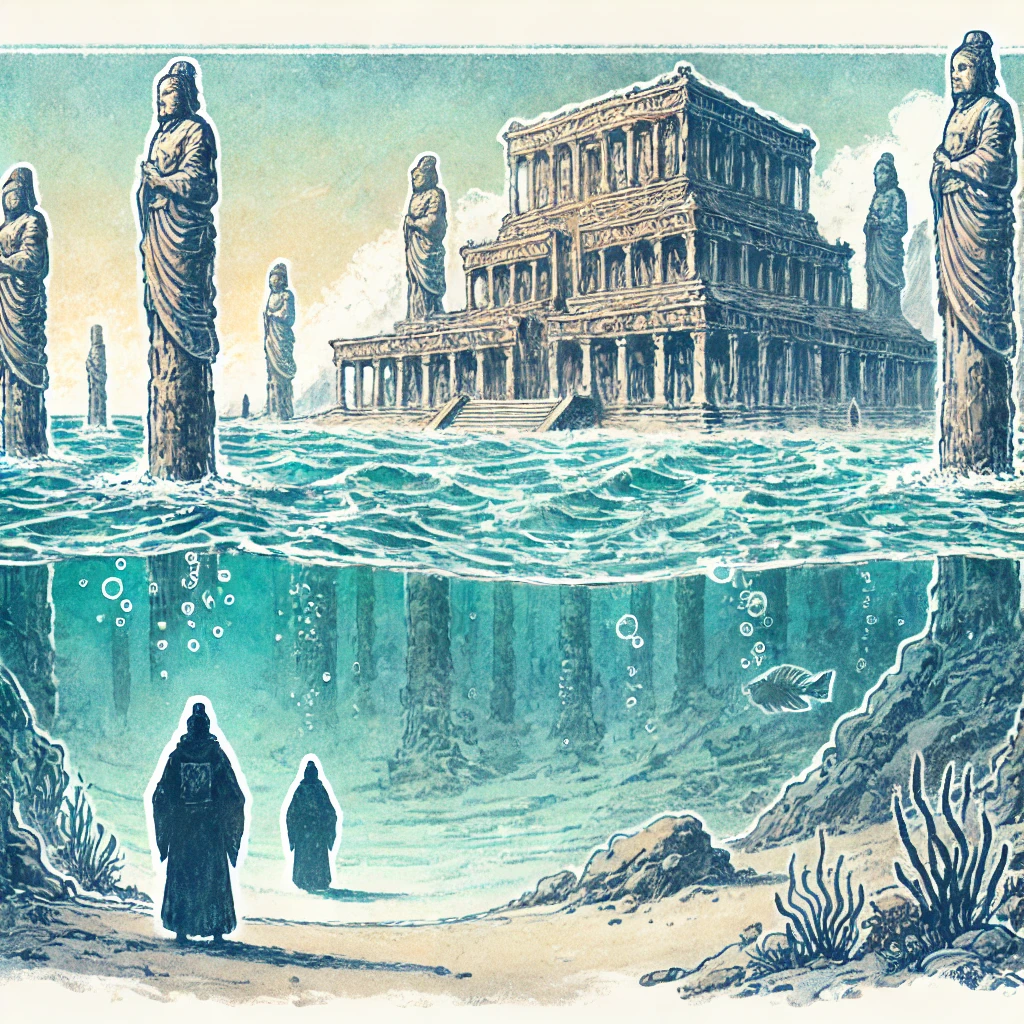
Do you know the legend of the ancient city submerged beyond the sea? This mystical tale from Yonaguni Island in Okinawa may seem like a fantasy, but it deeply reflects the spiritual world cherished by the people of Okinawa.
The legend of the underwater city of Yonaguni Island conveys the awe and reverence for the natural forces and mysteries, hinting at the existence of an ideal world called “Nirai Kanai,” and suggesting a continuity between this world and the other.
In the legend, the “Yuta,” spiritual mediums who communicate with gods and ancestral spirits, play a crucial role as intermediaries between this world and the other. The presence of Yuta highlights the Okinawan belief in the close relationship between nature, humans, the present world, and the afterlife.
The underwater city legend of Yonaguni Island vividly expresses the core of Okinawan spiritual culture, centered on nature worship and ancestor worship. The people of Okinawa have long believed that gods reside in all aspects of nature and have lived in harmony with their environment. They have also revered the spirits of the dead and ancestors, passing down their wisdom through legends.
The legend of the underwater city of Yonaguni Island is a mirror reflecting this spiritual world of Okinawa. The stories passed down through legends have served as guides for maintaining a proper relationship with nature and mystery, and for achieving peace of mind.
For those of us living in modern society, the lessons conveyed by Okinawan legends are rich in insights. These legends teach the importance of respecting nature and listening to the wisdom of our ancestors. By holding reverence for the unseen world, we can cultivate a humble heart.
Exploring the deep meanings hidden within the underwater city legend of Yonaguni Island is a journey into the essence of Okinawan spirituality. Let’s consider the questions this mystical story poses to us in our contemporary lives.
- The Legend of the Underwater City of Yonaguni Island – The Mystery of the Ancient City Submerged Beneath the Sea
- The Deep Connection Between Okinawans and Nature
- The Heart that Respects the Dead and Ancestors
- The Importance of Myths and Legends
- The Blurred Boundary Between This World and the Afterlife
- Awe and Reverence Evoked by Legends
- The Connection Between Okinawan Spirituality and Legends
- Q&A
- Conclusion: “The Underwater City Legend of Yonaguni Island Reflecting Okinawan Spirituality”
The Legend of the Underwater City of Yonaguni Island – The Mystery of the Ancient City Submerged Beneath the Sea
Yonaguni Island, located at the westernmost point of Okinawa Prefecture, is just 111 kilometers away from Taiwan. This small island holds a mysterious legend that has been passed down through generations: the tale of an ancient city that once flourished beneath the waters off its coast.
According to the legend, this city was called “Nirai Kanai,” a place where gods from beyond the sea resided. Nirai Kanai was described as a paradise with luxurious palaces and temples made of gold, and beautiful gardens, truly a utopian place.
However, one day, a great earthquake and tsunami struck, sinking Nirai Kanai into the sea overnight. Since then, the people of Yonaguni Island have kept the legend of the submerged city alive.
Beyond the legend, there are indeed mysterious underwater formations off the coast of Yonaguni Island. One such feature, known as the “underwater monument,” resembles an artificial stepped structure. Some believe it to be the ruins of the ancient city.
Additionally, stories among the fishermen of Yonaguni tell of strange lights seen underwater. Fishermen have reported seeing golden lights shining from the depths at night, thought to be emanating from the golden palaces of the sunken city.
The legend of the underwater city of Yonaguni Island continues to captivate people, with its mysteries remaining unsolved.
The Deep Connection Between Okinawans and Nature
The Spirit of Nature Worship
The Worldview that Regards Nature as Sacred
The people of Okinawa have long regarded nature as sacred. They believe that gods reside in every element of the natural world, worshipping mountains, seas, forests, and rivers. This worldview, known as “animism,” forms the core of Okinawan spiritual culture.
The reverence for nature is deeply ingrained in the daily lives of Okinawans. For example, rituals are performed to seek the land gods’ permission before building a house. Similarly, during harvests or fishing, ceremonies are held to offer gratitude for nature’s blessings. In this way, the people of Okinawa have lived in close harmony with nature.
Prayers and Rituals to Thank Nature’s Blessings
Okinawans have performed various prayers and rituals to express gratitude for nature’s blessings and to live harmoniously with nature. One notable example is the prayer at sacred sites called “Utaki.” These are holy places located in forests or rocky areas, where people offer prayers to nature’s gods.
During harvests, festivals like “Honen Matsuri” are held, and for safe and abundant fishing, the “Kaijin Matsuri” is celebrated. These festivals not only express gratitude for nature’s blessings but also pledge to continue coexisting with nature. Through such prayers and rituals, Okinawans have maintained a deep connection with nature.
Living in Harmony with Nature
Traditional Farming and Fishing in Harmony with Nature
Okinawans have engaged in traditional farming and fishing practices that harmonize with nature. In agriculture, the “slash-and-burn” method, based on natural cycles, has been practiced. This method involves burning forest land to create fields, growing crops for several years, and then allowing the land to rest and return to nature. This sustainable farming method has enabled the long-term use of land without depleting its fertility.
In fishing, knowledge of tides and fish behavior has been utilized for efficient fishing practices. Traditional methods like fish farming in enclosed areas have also been developed, reflecting a harmonious relationship with nature. Thus, Okinawans have lived a lifestyle that leverages nature’s blessings while coexisting with the environment.
Wisdom for a Lifestyle that Respects Nature
Okinawans have cultivated wisdom for living in harmony with and respecting nature. One example is the concept of “mottainai,” which means cherishing and using things without waste. Okinawans have devised ways to make the most of nature’s blessings, avoiding waste as much as possible.
The spirit of “yuimaru,” or mutual assistance, has also supported a lifestyle in harmony with nature. Yuimaru means helping and cooperating with each other within the community. In various situations, such as farming and house building, people have worked together, facing natural threats and building a sustainable lifestyle. Thus, Okinawans have nurtured wisdom for a lifestyle that respects nature.
The Heart that Respects the Dead and Ancestors
The Customs of Ancestor Worship
Events for Honoring Ancestors such as Bon and Higan
In Okinawa, honoring and comforting the spirits of ancestors through various events has been important. Among these, “Bon” and “Higan” are significant. During Bon, it is believed that ancestral spirits return home, and families gather to offer prayers and pay respects, visiting graves and offering favorite foods to the spirits.
Higan, another event for honoring ancestors, occurs twice a year in spring and autumn. During this time, “Ohagi,” a sweet rice cake, is made and offered to the ancestors. Through these events, Okinawans have honored their ancestors and comforted their spirits.
The Importance of Ancestor Worship in Strengthening Family Bonds
Ancestor worship in Okinawa not only comforts the spirits of ancestors but also plays a crucial role in strengthening family bonds. Many ancestor-honoring events are conducted with the participation of the entire family. For example, during Bon, the entire family visits graves and welcomes ancestral spirits home. These activities strengthen family unity.
Additionally, ancestor worship provides an opportunity to reaffirm the family’s history and traditions passed down from ancestors. Hearing stories of the ancestors’ achievements and hardships instills a sense of pride and responsibility in being part of the family. Thus, ancestor worship is a vital custom for deepening family bonds and preserving family history.
The Existence of Spiritual Mediums Known as Yuta
The Role and Social Status of Yuta
In Okinawa, there are spiritual mediums known as “Yuta.” Yuta are believed to have the ability to communicate with gods and ancestral spirits, conveying their will to people. When faced with illness or misfortune, people seek advice from Yuta and follow their guidance. Yuta hold a central place in folk beliefs and have occupied an important position in Okinawan society.
Most Yuta are women, and their abilities are considered to be innate. Those who become Yuta are said to have a high spiritual sensitivity from a young age, hearing the voices of gods and ancestors. Yuta have become a source of comfort for people, sharing their worries and suffering, thus becoming a cornerstone of Okinawan society.
Customs of Connecting with the World of the Dead Through Yuta
The people of Okinawa believe they can connect with the world of the dead through Yuta. It is believed that the spirits of the deceased communicate with their families through the voice of Yuta. Especially during rituals called “Misees,” where the spirits of the dead are summoned, Yuta acts as a spokesperson for the deceased, engaging in dialogue with the bereaved.
In this way, Yuta serves as a mediator between the living and the dead. Knowing the thoughts of the deceased through Yuta brings peace of mind to the bereaved. The words conveyed by the spirits during Misees can also become guiding principles for the bereaved. Yuta’s existence is a crucial custom for Okinawans to connect with and inherit the thoughts of the deceased.
The Importance of Myths and Legends
Lessons Embedded in Myths and Legends
Stories Conveying the Threats and Mysteries of Nature
Okinawa has numerous myths and legends that convey the threats and mysteries of nature. For instance, the story of “Kijimuna,” small spirits of
the forest, suggests that nature harbors mysterious powers beyond human understanding. Kijimuna are believed to help or play tricks on humans.
The legend of the “Shisa,” lion-like imaginary creatures, is also well-known. Shisa are considered guardian deities that protect villages from disasters and are placed on rooftops and gates. The Shisa legend teaches the necessity of seeking divine power to protect oneself from natural threats. Thus, Okinawan myths and legends have conveyed the threats and mysteries of nature and shown people how to relate to nature appropriately.
The Role of Passing Down the Wisdom and Values of Ancestors
Okinawan myths and legends also play an important role in passing down the wisdom and values of ancestors. For example, the legend of “Nirai Kanai” reflects the desire of people for an ideal world. Nirai Kanai is said to be a paradise beyond the sea, where there is no conflict or poverty, and everyone lives happily.
This legend conveys the hope for a peaceful and prosperous world, giving people the courage to face the hardships of the present. The legend of “Kuba God,” who rewards hardworking and honest people and punishes lazy ones, teaches the values of diligence and honesty. Thus, Okinawan myths and legends have conveyed the wisdom and values of ancestors, guiding people’s ways of life.
The Importance of Oral Tradition in Preserving Myths and Legends
The Importance of Oral Tradition in Families and Communities
In Okinawa, myths and legends have been mainly preserved through oral tradition. Stories have been passed down from parents to children and grandparents to grandchildren, keeping them alive to this day. This oral tradition has been cherished within families and communities.
In the past, families would gather at night to share and listen to myths and legends in a practice called “Yuntaku.” During regional festivals and events, elders would tell stories to children. Thus, oral tradition within families and communities has been a vital culture for passing down myths and legends to future generations.
The Spirit of Okinawa Reflected in the Stories Passed Down
The myths and legends preserved through oral tradition are not just stories; they reflect the spirituality and worldview of the Okinawan people. For example, the legend of “Nirai Kanai” represents the belief in an ideal world different from the present. The story of “Kijimuna” reflects the Okinawan worldview of coexistence between nature and humans.
In this way, myths and legends form the core of Okinawan spiritual culture. Through these stories, Okinawans confirm and pass down the spirituality and values inherited from their ancestors. Oral tradition has been the foundation for nurturing and preserving Okinawan spirituality.
The Blurred Boundary Between This World and the Afterlife
The Concept of the Afterlife Represented by Nirai Kanai
Nirai Kanai as an Ideal World Different from the Present
Okinawans have believed in the existence of an ideal world different from the present, represented by “Nirai Kanai.” Nirai Kanai is said to be a paradise beyond the sea, where everyone maintains youth and beauty and lives in happiness.
Nirai Kanai is a world free from the sufferings and worries of the present, a place of longing for Okinawans. It was believed that those who performed good deeds in the present life could go to Nirai Kanai after death. The concept of Nirai Kanai has provided hope for overcoming the difficulties of the present and has been a source of comfort for people.
The Afterlife as a Realm Where the Dead and Gods Reside
Okinawans have believed in the existence of another dimension, the afterlife, where the spirits of the dead and gods reside. This afterlife is a mystical world governed by different laws than the present world.
It is believed that the spirits of the dead go to the afterlife and reunite with their ancestral spirits. Gods are also said to reside in the afterlife, occasionally appearing in the present world. The afterlife is filled with mysterious powers incomprehensible to the present world, and people have held awe and reverence for it.
For Okinawans, the afterlife is a continuous world with the present, with the boundaries between the two being blurred. The present world and the afterlife influence each other. This worldview allows for interactions with the spirits of the dead and gods, providing a spiritual foundation for people.
Yuta as a Bridge Between the Present World and the Afterlife
The Spiritual Powers and Role of Yuta
In Okinawa, Yuta are known as special beings who can cross the boundary between the present world and the afterlife. Yuta are believed to possess spiritual powers and communicate with gods and ancestral spirits.
Yuta have played a role in resolving people’s worries and problems by borrowing the power of the afterlife. They investigate the causes of illnesses and misfortunes and provide solutions. Yuta also comfort the spirits of the deceased and guide them to the afterlife. Thus, Yuta has occupied an important position in Okinawan society as mediators between the present world and the afterlife.
Yuta as Mediators Connecting the Present World and the Afterlife
Yuta can freely traverse the boundary between the present world and the afterlife. They directly communicate with gods and ancestral spirits, conveying their messages to people. Yuta also deliver the wishes of people to the afterlife, seeking their fulfillment.
In this way, Yuta have served as bridges connecting the present world and the afterlife. Through Yuta, people can borrow the power of the afterlife to solve problems in the present world. The existence of Yuta embodies the Okinawan worldview of the inseparable connection between the present world and the afterlife. Yuta are central to Okinawan spiritual culture.
Awe and Reverence Evoked by Legends
Awe for the Threats of Nature
The Significance of Legends Conveying the Threats of Natural Disasters
Okinawa has many legends conveying the threats of natural disasters. For example, the legend of “Kijimuna” suggests that the forest’s small spirits can sometimes bring calamity to humans. The legendary monster “Kanaman” is believed to bring disease and famine to villages.
These legends warn of the hidden threats within nature. Through legends, people have learned to fear the power of nature and prepare for its threats. Simultaneously, legends teach the importance of respecting nature and expressing gratitude for its blessings.
Fear of the Inescapable Power of Nature
Okinawan legends convey the fear of the inescapable power of nature. Natural disasters like “tornadoes” and “tsunamis” have been perceived as expressions of divine wrath. People have recognized their powerlessness before nature and have held a sense of awe.
The legends of venomous snakes like “Habu” and “Irabu” also symbolize the threats of nature. These snakes have been feared as deadly creatures. Legends highlight the dangers hidden within nature and the human powerlessness against them. Thus, legends have fostered a sense of awe for nature’s power and prompted respect for nature.
Reverence for Mystical Beings
Respect and Worship for Gods and Spiritual Beings
Okinawan legends are deeply imbued with respect and worship for gods and spiritual beings. For example, the legend of “Nirai Kanai” expresses a longing for the ideal world where gods reside. The legends of “Kijimuna” and “Yuta” reflect the belief in the unseen spiritual powers.
These legends have nurtured a sense of reverence for mystical beings beyond human understanding. People have sought the help of gods and spiritual beings to overcome the difficulties of the present world. The reverence and worship embedded in legends form the foundation of Okinawan spiritual culture.
Awe for Beings with Mystical Powers
Okinawan legends also express awe for beings with mystical powers. For example, “Yuta” are believed to have the power to communicate with gods and ancestral spirits, garnering both fear and respect from people. The “Shisa” have been worshipped as sacred beings protecting villages.
These legends evoke a sense of awe for beings with supernatural powers. Believing in these beings’ powers and seeking their protection have provided people with peace of mind. Legends have fostered reverence for mystical powers, supporting the spiritual world of Okinawa.
The Connection Between Okinawan Spirituality and Legends
Worldview Reflected in Okinawan Legends
The Close Relationship Between Nature and Humans
Okinawan legends vividly reflect the close relationship between nature and humans. For example, the legend of “Kijimuna” illustrates the coexistence of the forest and humans, while the legend of “Nirai Kanai” shows the deep connection between the sea and humans.
These legends narrate how the people of Okinawa have lived as one with nature. Through these tales, people have cultivated a deep respect for nature and a heart of gratitude for its blessings. In the Okinawan worldview, nature and humans are inseparably intertwined.
The Continuity and Intersection of This World and the Other
Okinawan legends also depict the continuity and intersection of this world and the other. The existence of “Yuta,” for example, serves as an intermediary between the present world and the otherworld. Additionally, the legend of “Nirai Kanai” suggests the existence of an ideal world different from the current one.
These legends indicate that the people of Okinawa perceive this world and the otherworld as intimately connected. Through these tales, they have crossed the boundaries between the two realms, fostering interaction between them. In the Okinawan worldview, this world and the otherworld are continuous and mutually influential.
The Spirituality Cultivated by Okinawan Legends
Ancestors’ Wisdom Passed Down Through Legends
Okinawan legends are imbued with the wisdom of the ancestors. For instance, the legend of the “Kuba God” teaches the importance of diligence and honesty, while the legend of “Shisa” emphasizes the significance of community cooperation for protecting the village.
These legends convey the wisdom gained from the ancestors’ long experiences in the form of stories. Through legends, people have learned from the ancestors’ wisdom, using it as a guide for their lives. Legends are a crucial medium for nurturing Okinawan spirituality.
The Importance of Awe and Reverence Created by Legends
The awe and reverence generated by Okinawan legends play an essential role in disciplining people’s hearts. The awe for natural threats fosters a respect for nature and encourages actions that promote harmony with the environment. Likewise, reverence for mystical beings nurtures a humble heart, providing spiritual support.
The awe and reverence created by legends form the core of Okinawan spirituality. They have served as guides for maintaining proper relationships with nature and mystery, and for achieving peace of mind. Through awe and reverence, legends have guided the hearts of the Okinawan people.
Okinawan legends are more than mere stories; they are mirrors reflecting the worldview and spirituality of the people. Legends express various aspects of Okinawan spiritual culture, such as the relationship between nature and humans, the continuity between this world and the other, the wisdom of the ancestors, and the sense of awe and reverence.
Through legends, the people of Okinawa have found their spiritual foundations. Legends have been sources of encouragement during difficult times and have provided spiritual support. They also play a crucial role in passing down Okinawan spirituality to future generations.
Okinawan legends will continue to be told, guiding the hearts of the Okinawan people and nurturing their spiritual culture. Legends are inseparably connected to the spiritual world of Okinawa.
Q&A
Why do the people of Okinawa regard nature as sacred?
The people of Okinawa have an animistic worldview, believing that gods reside in all aspects of nature. Based on this belief, they have lived lives of respect for nature and gratitude for its blessings.
What is a Yuta?
A Yuta is a spiritual medium believed to have the power to communicate with gods and ancestral spirits. As intermediaries between this world and the otherworld, they play a crucial role in resolving people’s worries and problems.
What is the significance of Okinawan legends?
Okinawan legends convey the threats and mysteries of nature, as well as the wisdom and values of the ancestors, in the form of stories. Through legends, people have learned to appropriately face nature and have found spiritual guidance.
What is “Nirai Kanai”?
Nirai Kanai is an ideal world in Okinawan legends, said to be a paradise beyond the sea where everyone maintains youth and beauty and lives happily. It has been believed to provide hope for overcoming the hardships of the present world.
What is the relationship between this world and the otherworld in Okinawan spirituality?
In the Okinawan worldview, this world and the otherworld are inseparably connected, showing continuity and intersection. Intermediaries like Yuta facilitate interaction between the two realms, with legends fostering this connection.
Conclusion: “The Underwater City Legend of Yonaguni Island Reflecting Okinawan Spirituality”
In Okinawa, a unique spiritual culture thrives, deeply connected to nature and honoring the spirits of the dead and ancestors. The underwater city legend of Yonaguni Island, in particular, vividly reflects the Okinawan worldview.
This legend conveys the threats and mysteries of nature, evoking awe and reverence in people. It also suggests the existence of the ideal world “Nirai Kanai,” illustrating the continuity between this world and the other.
The Yuta, who appear in the legend, are spiritual mediums with the power to communicate with gods and ancestral spirits, acting as intermediaries between this world and the other.
Okinawan legends are spiritual guides filled with the wisdom of the ancestors, serving as compasses for maintaining appropriate relationships with nature and mystery. The underwater city legend of Yonaguni Island is also a mirror reflecting Okinawan spirituality.
Through this blog, I hope readers can appreciate the depth of Okinawan spirituality. The stories conveyed by the legends offer many insights for those of us living in the modern world.


コメント