
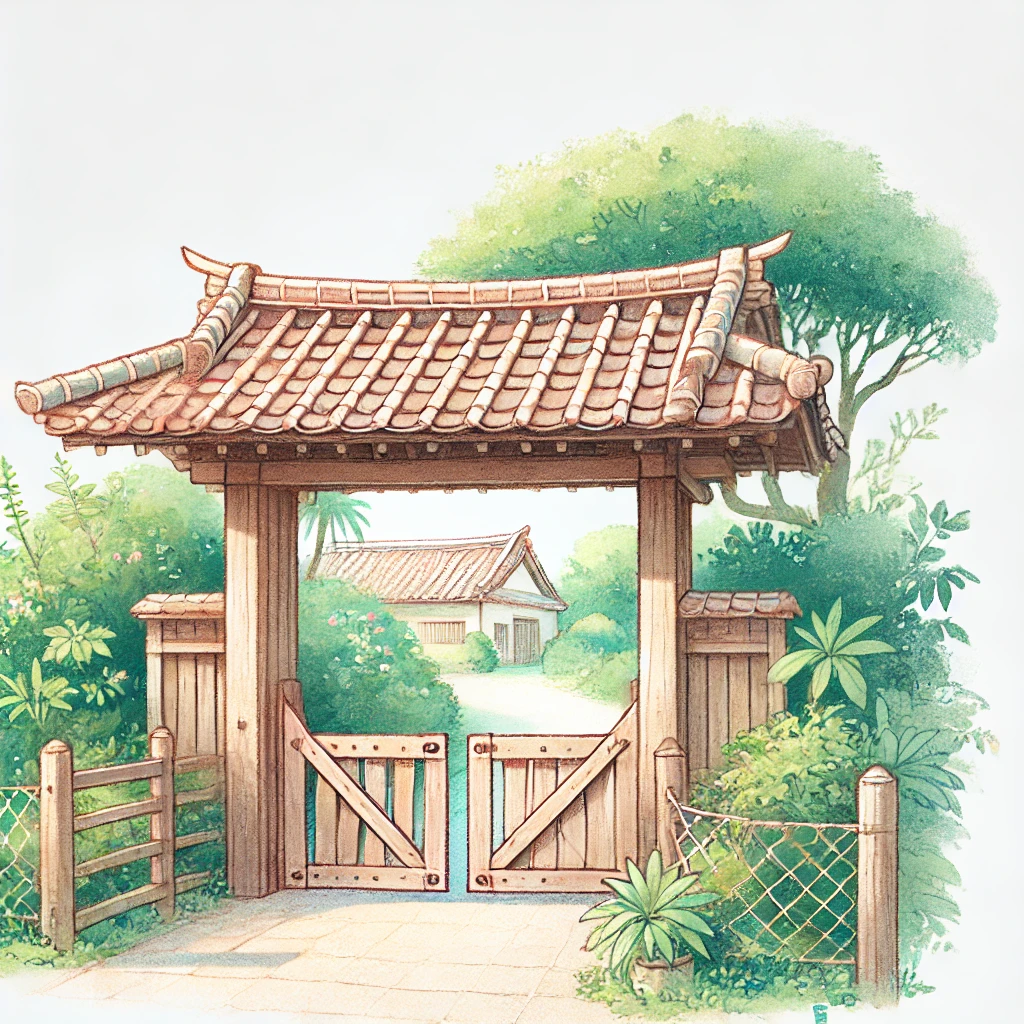
When you visit Okinawa, there is a traditional architectural element that will catch your eye. The red-tiled roofs and the curved beauty created by the trees. This is the “Fukugi Gate,” a gate that encapsulates the essence of Okinawa.
Fukugi Gate is not just a passageway. It is an entrance to a special space filled with the prayers and wishes of the Okinawan people.
As you pass through the gate, you unconsciously transition from the everyday world to a sacred one. Fukugi Gate acts as a barrier that separates the secular from the sacred, purifying both body and soul.
Moreover, Fukugi Gate symbolizes the bonds of family and community. Families and villages that share the gate find a sense of unity within it. Gates passed down through generations are essentially a representation of Okinawan history itself.
So, why has Fukugi Gate captured the hearts of Okinawan people to such an extent? To explore this, let us delve into the history and characteristics of Fukugi Gate from various angles.
The properties of the Fukugi wood used to make the gates, the structure and decorations of the gates, and the symbolic meanings embedded in them. Decoding Fukugi Gate is tantamount to entering the spiritual world of Okinawa.
While Fukugi Gates are also popular tourist attractions, their true charm lies in the invisible aspects. The tradition that has been preserved and the spirit of Okinawa that lives within them.
Our exploration of Fukugi Gate is also a journey into these “invisible things.”
So, let’s pass through the Fukugi Gate and touch the essence of Okinawan culture. Unexpected discoveries and deep impressions await you there.
- Introduction
- What Are Fukugi Gates?
- Features of Fukugi Gates
- Symbolic Significance of Fukugi Gates
- Folklore and Legends About Fukugi Gates
- The Role of Fukugi Gates in Modern Times
- Conclusion
- The Unique Cultural Significance of Fukugi Gates in Okinawa
- The Importance of Fukugi Gates in Understanding Okinawa’s Spiritual World
- References
- Q&A
- Summary
Introduction
Okinawan Culture and Tradition
Historical Background of Okinawa
The Ryukyu Kingdom Era
One cannot discuss Okinawan culture and tradition without mentioning the historical background of the Ryukyu Kingdom era. From the 14th to the 19th century, Okinawa formed its own kingdom and developed a unique culture through trade with Asian countries. Interactions with China, Japan, and Southeast Asian countries influenced Okinawa’s language, art, religion, and architecture.
Especially significant was the tributary relationship with China, which played a major role in the formation of Ryukyu culture. Confucian thoughts and architectural styles from China became the foundation of Okinawa’s traditional culture. Meanwhile, relations with Japan were also crucial. The Satsuma clan’s control over Ryukyu added Japanese elements to Okinawan culture.
Thus, during the Ryukyu Kingdom era, Okinawa actively integrated foreign cultures while building its own unique culture. The cultural diversity and uniqueness nurtured in this period form the cornerstone of modern Okinawan culture.
Annexation by Japan and Postwar Changes
In 1879, the Ryukyu Kingdom was annexed by Japan, and Okinawa Prefecture was established. During this period, Okinawan culture was strongly influenced by Japanese culture. Traditional values and customs gradually fused with Japanese values. However, there were also movements to preserve Okinawa’s unique culture.
During World War II, Okinawa was devastated by intense battles, and many cultural heritage sites were lost. Postwar, under American occupation, Okinawan culture faced new challenges. While influenced by American culture, Okinawans continued to strive to preserve and pass on their own culture.
Since returning to Japan in 1972, Okinawa has developed as part of Japan while maintaining a strong commitment to its unique culture. Amid postwar turmoil and changes, Okinawan culture has adapted flexibly and continues to live on in new forms.
Unique Customs and Values
Uniqueness Born from Geographic Characteristics
Okinawan cultural uniqueness is greatly influenced by its geographic characteristics. Located at the southernmost tip of Japan, close to Taiwan, China, and Southeast Asia, Okinawa has developed a unique culture.
The subtropical climate has encouraged Okinawans to coexist with nature. Rich natural surroundings are reflected in Okinawan beliefs, performing arts, and crafts. The reverence for nature, such as mountains, seas, and forests, is deeply ingrained in Okinawan culture.
Moreover, the island geography fostered distinctive cultures in each region. Unique dialects, festivals, and traditional crafts developed in each island, creating a rich cultural diversity.
On the other hand, being surrounded by the sea has given Okinawans an open and flexible nature. The willingness to accept and integrate foreign cultures is a significant feature of Okinawan culture.
Thus, Okinawa’s geographic characteristics have fostered a unique culture while also generating diversity and flexibility.
Diversity Brought by Interregional Exchanges
As a historical trade hub, Okinawa has gained cultural diversity through exchanges with various regions. Contact with diverse cultures, including China, Japan, and Southeast Asian countries, has enriched Okinawan culture.
From China came Confucian thought, Chinese characters, and architectural techniques, significantly influencing Okinawan social structure, values, and aesthetics. Japanese language, religion, and lifestyle elements also merged into Okinawan culture.
Interactions with Southeast Asian countries have added vibrant elements such as textile techniques, music, and dance to Okinawan culture.
Historical events such as the arrival of Chinese envoys and the Satsuma clan’s control further diversified Okinawan culture.
Thus, active interregional exchanges have played a crucial role in shaping Okinawa’s unique and diverse culture. The charm of Okinawan culture lies in this vibrant diversity.
The Importance of Fukugi Gates
The Role of Fukugi Gates in Okinawan Culture
Significance as Architectural Structures
Among Okinawa’s traditional structures, Fukugi Gates hold a particularly important place. These decorative gates, used at the entrances of homes, are one of the quintessential elements of Okinawan architecture due to their beauty and symbolism.
Fukugi Gates possess artistic value beyond their function as mere gates. Intricate carvings and vibrant colors reflect Okinawan aesthetics. Additionally, the construction techniques of Fukugi Gates demonstrate the high skills of Okinawan craftsmen.
The use of Fukugi Gates in traditional houses, public facilities, and religious sites underscores their architectural significance. Fukugi Gates symbolize Okinawan architectural culture, and their preservation and inheritance are vital for maintaining Okinawan culture.
Spiritual Symbolism of Fukugi Gates
Fukugi Gates are not only important as architectural structures but also symbolize the spirituality of Okinawans. These gates embody wishes for family prosperity, happiness, and safety.
Passing through a Fukugi Gate involves a ritual of purification and transition to a sacred space. This spiritual act indicates that Fukugi Gates serve as spiritual boundaries beyond their physical presence.
Fukugi Gates also symbolize family and community cohesion. Families and communities sharing a gate feel a spiritual connection and strengthen their communal bonds.
Furthermore, Fukugi Gates play a crucial role in ancestor worship, connecting the living with the afterlife.
In this way, Fukugi Gates occupy a culturally significant position, representing the spirituality, beliefs, and values of the Okinawan people.
The Symbolic Meaning of Fukugi Gates
Symbol of Family and Community Bonds
Fukugi Gates play an important role as symbols of family and community bonds. Families sharing a gate affirm their unity and solidarity through it. The gate also tells the family’s history and promotes its continuity.
Similarly, Fukugi Gates at village entrances symbolize community cohesion, serving as a spiritual anchor for the locals and fostering a sense of unity within the community.
During festivals and rituals, Fukugi Gates play a central role, strengthening family and community ties and providing opportunities to pass on traditions.
Thus, Fukugi Gates symbolize and reinforce the bonds of family and community. Through Fukugi Gates, Okinawans feel a deep connection to their family and community, passing on this awareness to the next generation.
Symbol of Ancestor Worship and Prosperity
Fukugi Gates are symbolic of ancestor worship. Through them, Okinawans express respect and gratitude to their ancestors, seeking their protection and recalling their teachings.
Fukugi Gates also symbolize family prosperity across generations. Constructing a magnificent Fukugi Gate signifies the family’s wishes for prosperity and serves as a symbol of that hope.
Additionally, Fukugi Gates are considered points of connection between the present and the afterlife, facilitating communication between the living and the deceased.
Thus, Fukugi Gates hold significant cultural importance, representing Okinawans’ ancestor worship and aspirations for prosperity. Through Fukugi Gates, Okinawans affirm their bond with ancestors and pray for family prosperity.
What Are Fukugi Gates?
Definition of Fukugi Gates
Origin and Meaning of Fukugi Gates
Have you ever heard of the term “Fukugi Gate”? As the name suggests, Fukugi Gates are traditional Okinawan gates made from Fukugi wood.
“Fukugi,” also known as “Garcinia subelliptica,” is an evergreen tree native to Okinawa. It has long been used as building material and for windbreaks due to its straight and sturdy trunks, making it ideal for gates and pillars.
Why are they called “Fukugi Gates”? The name comes from the kanji “福” (fuku), which means “happiness” or “blessed.” Gates made from Fukugi wood were believed to bring happiness and good fortune to the household.
Moreover, the kanji “木” (ki) signifies “growth” and “development.” Thus, Fukugi Gates symbolize the prosperity and growth of the family.
In this way, the name “Fukugi Gate” reflects the wishes for happiness and growth embedded in Okinawan culture.
Basic Characteristics of Fukugi Gates
Fukugi Gates have distinct characteristics that set them apart from typical gates. Let’s look at the basic features of Fukugi Gates.
First, Fukugi Gates are made from Fukugi wood, known for its hardness and durability, making it ideal for the harsh natural environment of Okinawa.
The shape of Fukugi Gates is also uniquely beautiful. Generally, they consist of two pillars with a horizontal beam and a roof. The pillars often retain the natural curves of Fukugi wood, giving an elegant impression.
Fukugi Gates are often adorned with various decorations, such as family crests, dragons, and lions, or painted in vibrant colors like red and blue. These decorations are not just aesthetic but also believed to ward off evil spirits.
The size of Fukugi Gates varies depending on the house or purpose. Typically, gates for ordinary houses are around 2 meters tall and 1 meter wide, but larger estates or public facilities may have bigger gates.
Thus, Fukugi Gates combine unique materials, shapes, and decorations to create their distinct beauty and presence.
History of Fukugi Gates
Origin and Development
Background of the Birth of Fukugi Gates
When did Fukugi Gates start to be constructed? Their origin is said to date back to the ancient Ryukyu period.
During the ancient Ryukyu period, Okinawa was under the Chinese tributary system and was greatly influenced by Chinese culture. The architectural styles of Okinawa at that time predominantly adopted Chinese designs. Fukugi Gates also developed as one of these Chinese-style architectural elements.
However, it is believed that Fukugi Gates began to be widely used during the Second Sho Dynasty (1470-1879). This period marked the era of great trade, bringing significant economic development to Okinawa. Wealthy individuals started to build luxurious residences.
Fukugi Gates gradually spread as symbols of these luxurious residences. Having a Fukugi Gate indicated wealth and authority, serving as a status symbol.
Styles of Early Fukugi Gates
So, what were the styles of early Fukugi Gates like?
Early Fukugi Gates heavily reflected Chinese gate styles. Particularly, many Fukugi Gates adopted the design of the Chinese temple gates known as “Shanmen.”
Specifically, the typical design involved two pillars with a large horizontal beam across them, topped with a roof. The roofs were often made with Ryukyu red tiles in a hip-and-gable style and were sometimes adorned with elaborate decorations.
Moreover, early Fukugi Gates incorporated many Chinese-style carvings and decorations. Auspicious motifs such as dragons, lions, and birds were commonly used to enhance the gate’s grandeur.
However, in the early stages, Fukugi Gates were mainly seen in the homes of the wealthy. They did not become widespread among the common people until a later period.
Changes Over Time
Fukugi Gates During the Dynasty Era
Fukugi Gates are said to have truly flourished during the Ryukyu Kingdom era, particularly during the Second Sho Dynasty (1470-1879), which can be considered the golden age of Fukugi Gates.
During this period, the Ryukyu Kingdom experienced a great era of trade and prospered significantly as the hub of East Asian trade. The royal family and nobles accumulated wealth and began to build luxurious residences.
Fukugi Gates became prominent features of these grand residences. The gates of the royal family were especially lavish, adorned with intricate carvings and vivid colors. For instance, the main gate of Shuri Castle, “Kankaimon,” with its red gate doors and gold fittings, symbolized royal authority.
During this period, Fukugi Gates incorporated influences from not only Chinese culture but also Japanese culture, especially after coming under the control of the Satsuma Domain, which introduced Japanese design elements.
The Fukugi Gates of the dynasty era were not merely architectural structures but also highly valued as works of art, symbolizing the prosperity and prestige of the Ryukyu Kingdom.
Changes in Fukugi Gates Since the Modern Era
In 1879, the Ryukyu Kingdom was annexed by Japan, and Okinawa Prefecture was established. This period brought significant changes to Fukugi Gates.
First, the opulent Fukugi Gates of the dynasty era gradually disappeared. Instead, simpler and more practical Fukugi Gates became mainstream. These gates began to spread among commoners, leading to various styles adapted to different household economic situations.
With modernization, the materials used for Fukugi Gates also changed. In addition to traditional Fukugi wood, concrete and steel began to be used.
However, many Fukugi Gates were destroyed during the Battle of Okinawa in World War II. Post-war reconstruction efforts included the restoration of Fukugi Gates, though wooden gates became less common.
Today, there are efforts to preserve and restore traditional Fukugi Gates. In tourist areas, you can see Fukugi Gates reconstructed to reflect their historical appearance.
Moreover, contemporary designs are being integrated into Fukugi Gates, creating a fusion of tradition and innovation in the new styles of Fukugi Gates.
Fukugi Gates have evolved over time. However, their essential role as the “face of the home” continues to be passed down unchanged. Fukugi Gates are invaluable symbols that narrate the history and culture of Okinawa.
Features of Fukugi Gates
Materials and Structure
Use of Fukugi Wood
Characteristics and Advantages of Fukugi Wood
When discussing Fukugi Gates, it is essential to talk about their primary material, “Fukugi” wood. Fukugi is one of the representative evergreen trees of Okinawa and has long been valued as a building material due to its excellent properties.
Fukugi, known scientifically as “Garcinia subelliptica,” belongs to the Clusiaceae family and is native to Okinawa, Taiwan, and Southeast Asia.
The most notable characteristic of Fukugi wood is its robustness. Fukugi is a very hard and durable wood, making it highly resistant to the elements. It can withstand the harsh natural environment of Okinawa for many years.
Additionally, Fukugi wood is highly resistant to water and insects. Its resistance to rot in Okinawa’s humid climate is a significant advantage. Its strength against termites and other pests also makes it highly valued as a building material.
Due to these excellent properties, Fukugi has been an indispensable material in Okinawan architecture for centuries. It is widely used not only for Fukugi Gates but also for house pillars, beams, and outdoor railings.
Selection and Processing Techniques of Fukugi Wood
Choosing suitable Fukugi wood for making Fukugi Gates is crucial. The wood used for Fukugi Gates is selected under strict criteria.
First, the Fukugi used for the gates must be mature. Young trees lack the necessary strength, so trees at least 50 years old are generally selected.
Trees with straight and thick trunks are chosen. The pillars of Fukugi Gates are cut from a single tree, requiring minimal curvature and sufficient length and thickness.
The selected Fukugi trees are felled at the appropriate time. As Fukugi wood takes a long time to dry, it requires a thorough drying period after felling. Typically, it is naturally dried for one to two years.
After drying, the wood is processed by skilled craftsmen. Fukugi is hard, requiring advanced techniques for processing. Traditional handcrafting techniques are still passed down today.
Assembling the wood into the shape of a gate is also a crucial task for the craftsmen. Historically, a traditional method called “hozogumi” was used. Nowadays, stronger metal joints are also commonly used.
Thus, the Fukugi wood used in Fukugi Gates is carefully selected and processed to maximize its potential. The selection and processing techniques of Fukugi wood are critical factors determining the quality of Fukugi Gates.
Structure and Decoration of the Gates
Basic Structure of the Gates
The basic structure of Fukugi Gates is simple yet robust.
Fukugi Gates generally consist of two pillars with a horizontal beam (called “kasagi”) on top. The pillars stand on either side of the gate, with the beam resting on them. This combination of pillars and beam forms the basic framework of the gate.
The pillars are often cut from a single Fukugi tree. The thickness of the pillars varies depending on the gate’s size, but for typical residential Fukugi Gates, pillars with a diameter of 20 to 30 centimeters are commonly used.
The horizontal beam is generally made from a thicker timber than the pillars. This beam not only connects the pillars but also supports the gate doors, playing a crucial role.
The gate doors are a distinctive feature of Fukugi Gates. Traditional gate doors were made of wooden planks, but now metal doors are also used. The doors are attached to the horizontal beam and can be opened and closed.
The roof of a Fukugi Gate serves as an awning at the top of the gate. It protects the gate from the elements and adds an aesthetic element. The roofs are often made with Ryukyu red tiles, creating beautiful curves.
Additionally, stone walls and pavements are often found alongside Fukugi Gates. Stone walls on either side of the gate enhance its grandeur, while stone pavements in front of the gate beautify and highlight the entrance.
Thus, the basic structure of Fukugi Gates comprises pillars, a horizontal beam, gate doors, a roof, and sometimes stone walls and pavements. This simple yet strong and beautiful structure is characteristic of Fukugi Gates.
Decorative Elements and Their Meanings
Fukugi Gates serve not only as functional entrances but also play a significant role in decoration. The various ornaments on these gates do not just enhance their beauty but also carry symbolic meanings.
The most striking decorative feature of Fukugi Gates is the carvings. These gates often feature intricate carvings of various motifs. Dragons, lions, flowers, and birds are commonly used auspicious symbols that elevate the gate’s prestige.
Decorations with protective purposes are also crucial. For instance, statues of mythical lion-like creatures called “Shisa” are often placed on either side of the gate. Shisa are believed to ward off evil spirits and protect the household’s peace.
The colors used on Fukugi Gates are another decorative element. Red, black, and gold are favored, enhancing the gate’s grandeur. Among these, red is particularly significant as a protective color.
The metal fittings on the gate doors also serve as decorations with symbolic meanings. For example, fittings shaped like plovers, known as “chidori kanagu,” symbolize the family’s prosperity and good fortune.
Thus, the decorations on Fukugi Gates are not merely aesthetic but are imbued with symbolic meanings. Through these decorations, wishes for the family’s prosperity and safety are expressed.
Types of Gates
Common Fukugi Gates
Fukugi Gates in Residential Homes
Fukugi Gates were not only found in the homes of royalty and nobility but were also widespread in ordinary residences. While not as lavish as those of the wealthy, the simple elegance of residential Fukugi Gates is their charm.
The design of residential Fukugi Gates varied according to the family’s economic status. Wealthier households might have larger gates with intricate carvings, whereas simpler gates were common in more modest homes.
Regardless of their complexity, residential Fukugi Gates were cherished as the face of the home. Maintaining and beautifying the gate was considered a family duty.
Fukugi Gates at Village Entrances
Fukugi Gates were also erected at the entrances of villages, serving as symbols of the community. These gates were typically larger and more imposing than those of individual homes, often flanked by stone walls to enhance their dignity.
Passing through a village Fukugi Gate was seen as a sign of belonging to that community. It was an opportunity to renew one’s sense of pride and membership in the village.
Additionally, village Fukugi Gates played a protective role, believed to safeguard the community from evil spirits. The gate acted as a barrier, preventing negative energies from entering the village.
Thus, village Fukugi Gates were more than just physical entrances; they were crucial symbols of community identity and protection.
Special Fukugi Gates
Fukugi Gates in Shrines and Temples
Fukugi Gates were also used at the entrances of shrines and temples, holding unique meanings distinct from those in residential areas.
In shrines, these gates are often referred to as “Torii.” Made from Fukugi wood, these torii mark the entrance to sacred spaces and possess a distinct charm different from other materials.
In temples, Fukugi Gates are commonly called “Sanmon.” These gates mark the entrance to the temple grounds and are sometimes constructed using Fukugi wood, offering a serene and warm aesthetic.
Shrine and temple Fukugi Gates are typically larger and more elaborately decorated than ordinary gates. This grandeur is intended to reflect the sanctity of the spaces they guard.
These gates also have protective roles, acting as boundaries between the secular and sacred worlds, keeping out evil influences.
Royal Fukugi Gates
During the Ryukyu Kingdom era, royal Fukugi Gates were particularly grand, symbolizing the authority and prestige of the royal family.
These gates were much larger and more imposing than ordinary Fukugi Gates. Flanked by stone walls and statues of stone lions, they exuded a majestic presence.
The royal gates featured intricate carvings of auspicious motifs like dragons, lions, and birds, meticulously detailed. Bright colors were also used, making the gates fitting symbols of royal grandeur.
Passing through a royal Fukugi Gate was a significant ritual, signifying loyalty to the king. Proper etiquette was required to show respect and submission to the royal authority.
The most famous example today is the “Kankaimon” at Shuri Castle, an exquisitely decorated gate that serves as a vital cultural heritage symbolizing the glory of the Ryukyu Kingdom.
Thus, royal Fukugi Gates were more than mere entrances; they were symbols of authority and prestige, captivating people with their grandeur and elegance.
We have explored the features of Fukugi Gates in detail. These gates are a crucial element of Okinawan traditional architecture, reflecting the culture and history of Okinawa through their materials, structures, and decorations.
Fukugi Gates are not just gates; they are the face of the house, symbols of the community, and sometimes, symbols of authority. They encapsulate the lifestyle, beliefs, and aesthetics of the Okinawan people.
In the next chapter, we will delve deeper into the symbolic significance of Fukugi Gates. We will explore their connections to family, community, and ancestors, uncovering fascinating themes.
Continue your journey into the profound cultural world of Okinawa through the lens of Fukugi Gates.
Symbolic Significance of Fukugi Gates
Fukugi Gates are not just architectural structures. They are symbolic entities infused with the lives and hearts of the Okinawan people. Here, we will explore the deep connections these gates have with family, community, and ancestors.
Prosperity and Protection of the Family
Wishes for Family Safety and Health
Standing at the entrance, Fukugi Gates serve as guardians of the family. As one passes through the gate, there is an unspoken sense of being protected by it.
Indeed, Fukugi Gates are imbued with wishes for the family’s safety and health. The decorations on the gates often include motifs believed to ward off evil spirits. For example, “Shisa,” lion-like guardian statues, are placed on either side of the gate to protect the household from evil spirits.
The carvings on the gates also include motifs related to health, such as turtles symbolizing longevity and baskets representing fertility. These motifs express the family’s desire for a healthy and prosperous life.
Moreover, Fukugi Gates are thought to purify negative energy from entering the home. As people pass through the gate , they may subconsciously imagine shedding calamities and keeping out malevolent forces.
Thus, Fukugi Gates are more than physical structures; they are guardians of the family’s well-being and prosperity, offering a sense of security and peace.
Fukugi Gates and Family Heritage
Fukugi Gates are also deeply tied to family heritage. They symbolize the history of the family, passed down from generation to generation.
Traditionally, Fukugi Gates were among the most important assets inherited within a family. Owning a grand Fukugi Gate was a mark of the family’s status and pride.
These gates also served as memory keepers, witnessing the family’s prosperity and hardships, joys, and sorrows over generations. Maintaining the gate was a way of honoring ancestors and preserving family traditions.
Even today, families that inherit old Fukugi Gates take great care in their restoration and maintenance, striving to pass on their family’s history to the next generation.
As symbols of family heritage, Fukugi Gates quietly convey the strength of family bonds in Okinawa, embodying the unseen history of the family.
Unity in the Community
Fukugi Gates as Symbols of Community Cohesion
Fukugi Gates symbolize not only family unity but also the cohesion of the community. The gates at village entrances are particularly significant, serving as important landmarks representing the village’s identity.
Passing through a village Fukugi Gate might give people an unconscious sense of belonging, reinforcing the idea that they are part of a unified community. The gate marks the invisible boundary, delineating the inside from the outside.
These gates are also symbolic unifiers, bringing the community together in their construction. It is common for villagers to collaborate on the process, from sourcing materials to building, thereby strengthening their collective bonds.
Furthermore, Fukugi Gates serve as historical markers for the community. Old gates have witnessed the village’s development over time. Preserving and passing these gates down to future generations is a way to connect the community’s history to its future.
In this way, Fukugi Gates foster a sense of unity and symbolize the history of the community, embodying the strong bonds among its members.
The Role of Fukugi Gates in Festivals and Events
Fukugi Gates are deeply intertwined with regional festivals and events, serving as symbolic stages that bring the community together.
In many regions of Okinawa, the “Ukui” Obon festival is held according to the lunar calendar in August. During this time, Fukugi Gates become crucial entry points for welcoming the spirits of ancestors. The sight of lanterns hanging from the gates to greet ancestors is a quintessential summer scene in Okinawa.
During the New Year, it is customary to decorate Fukugi Gates with “shimenawa” (sacred ropes). Shimenawa signify a sacred space, and adorning the gate with them is a way to wish for the purification and renewal of the household. This practice is an important annual event shared by the community.
Thus, Fukugi Gates are indispensable in regional festivals and events. Rituals performed around the gates unify people and strengthen community bonds.
Fukugi Gates are invaluable symbols of regional unity. By maintaining and cherishing these gates, people reaffirm their pride in being part of their community.
Connection to Ancestor Worship
Fukugi Gates and Respect for Ancestors
Fukugi Gates are closely associated with ancestor worship in Okinawa, symbolizing a gateway between the present world and the eternal world.
In Okinawa, there is a long-standing tradition of revering and cherishing the spirits of ancestors. People believe that ancestral spirits return home and prepare to welcome them. During this time, Fukugi Gates serve as vital passageways for these spirits.
During Obon, lanterns are hung on Fukugi Gates to welcome the spirits of ancestors. As the spirits pass through the gates and enter the house, they are greeted with respect and reverence by their descendants. The light from the lanterns symbolizes gratitude towards the ancestors.
Moreover, Fukugi Gates also serve as the passageway for sending off the spirits of ancestors at the end of Obon. On the final day, rituals are performed to bid farewell to the spirits, and the gates symbolize the connection between the earthly and eternal realms.
Thus, Fukugi Gates are essential for expressing respect to ancestors. The communication through the gates between the present and the eternal worlds forms a crucial part of the spiritual lives of Okinawan people.
Connecting with Ancestors Through Fukugi Gates
Fukugi Gates are not just symbolic of respect for ancestors but are also special places for experiencing a connection with them.
People in Okinawa believe that the spirits of ancestors occasionally visit the Fukugi Gates. There might be moments when they feel the presence of their ancestors near the gate, enjoying a spiritual communion with them.
Additionally, when repairing or constructing a new Fukugi Gate, it is customary to report this to the ancestors and seek their blessing. This practice reaffirms the connection with ancestors and renews the protective power of the gate.
Fukugi Gates thus serve as special places where people can sense the invisible presence of their ancestors. Standing by the gate, people feel the bond that links their family from the past to the present and into the future.
In this way, Fukugi Gates are spiritual anchors for connecting with ancestors. The traditions surrounding these gates enrich the hearts of the Okinawan people, fostering a deep respect for family and community history.
Having explored the symbolic significance of Fukugi Gates, we see that they serve as guardians of the family, symbols of community cohesion, and special places for connecting with ancestors.
The sentiments embedded in Fukugi Gates reflect the Okinawan people’s deep respect for family, community, and ancestors. The invisible exchanges through these gates support Okinawa’s rich spiritual culture.
In the next chapter, we will delve into the folklore and legends surrounding Fukugi Gates. The stories passed down through generations will offer further insight into the hearts and minds of the Okinawan people.
Continue your journey into the profound worldview of Okinawa through the lens of Fukugi Gates in the next chapter.
Folklore and Legends About Fukugi Gates
Fukugi Gates are deeply ingrained in the lives of the Okinawan people, and as such, numerous legends and folklore have been passed down through generations. Here, we will unravel these stories to gain deeper insight into the hearts and minds of the Okinawan people.
Etiquette for Passing Through the Gate
Mindset When Passing Through a Fukugi Gate
Fukugi Gates are not mere passageways; they are symbolic boundaries between the mundane world and sacred spaces. Therefore, passing through a Fukugi Gate requires a special mindset.
Traditionally, people would purify themselves before passing through a Fukugi Gate. By clasping their hands and calming their hearts in front of the gate, they prepared themselves to enter a sacred space.
Additionally, it was customary to utter words of blessing for the household’s safety and prosperity when passing through the gate. Phrases like “Family safety” and “Business prosperity” were spoken to invoke the gate’s protective powers.
These practices highlight that Fukugi Gates were more than architectural structures; they were spiritual sanctuaries. Passing through the gate marked a special moment of transition from the everyday to the sacred.
Even today, households with old Fukugi Gates often maintain these practices. Clasping hands and praying for ancestral protection while passing through the gate remains a cherished tradition in Okinawa.
Order and Direction for Passing Through the Gate
There were also traditional customs regarding the order and direction in which people passed through a Fukugi Gate, reflecting the symbolic significance of the gate.
In the past, it was common for the head of the household or elders to pass through the gate first. This practice symbolized that the head of the family would first receive the gate’s protective power and lead the family.
Additionally, it was considered auspicious to step through the gate with the right foot first. The right side was associated with “good” and “correct,” and stepping through with the right foot was believed to bring good fortune.
During funerals, the order of passing through the gate changed. The hearse or coffin would go through first, followed by the family and relatives. This symbolized sending the deceased ahead into the eternal world, with the family following in farewell.
These customs highlight the symbolic significance of the gate, marking it as a special place for life transitions rather than a mere passageway.
Even today, some households continue to honor these traditions. The wisdom passed down from ancient times still lives on in the hearts of the people.
Superstitions and Customs Related to Gates
Auspicious Symbols on Fukugi Gates
Fukugi Gates are adorned with various motifs believed to bring good fortune, reflecting people’s desires for the safety and prosperity of their homes.
One common motif is the carving of fish, which are considered symbols of abundance due to the wordplay with “abundance” in Japanese. Fish carvings represent the wish for prosperity in the household.
Pumpkin carvings are another example. Pumpkins are associated with fertility and the prosperity of descendants due to their shape. These carvings express the desire for the family’s lineage to flourish.
Other motifs include bats, cranes, and turtles, which symbolize longevity and health. These carvings reflect the wish for the family’s well-being and long life.
Such auspicious symbols are not just decorations; they are imbued with the heartfelt wishes of the people who carved them.
When we gaze upon these symbols on Fukugi Gates, we are reminded of the enduring hopes and dreams of those who came before us. These wishes continue to reside in the gates to this day.
Taboos and Prohibitions Related to Gates
While there are auspicious customs associated with Fukugi Gates, there are also actions considered taboo. These taboos highlight the sacredness of the gates.
For instance, drying clothes on a Fukugi Gate was strongly avoided. As a sacred place, performing mundane activities there was considered disrespectful. Particularly, drying underwear was strictly forbidden, seen as an act of desecration.
Raising one’s voice or fighting near the gate was also avoided. The gate was the face of the house, and such behavior was thought to degrade the family’s dignity.
When repairing or rebuilding Fukugi Gates, various taboos were observed. For example, it was important to choose an auspicious day for construction. Additionally, rituals were performed to ward off evil spirits during the construction.
These taboos and prohibitions emphasize that Fukugi Gates were not mere architectural elements but sacred entities. Any disrespect towards the gates was believed to anger the protective spirits and bring misfortune.
Although such taboos are less known today, many families with old Fukugi Gates continue to honor these traditions, reflecting the respect for the wisdom of their ancestors.
Real Events and Legends
True Stories Related to Fukugi Gates
Fukugi Gates have occasionally been the stage for historical events. Let’s explore some true stories and incidents related to these gates.
One famous story involves “Gosamaru,” a warrior who was active in the Ryukyu Kingdom during the 16th century. Known for his bravery in battle, Gosamaru was once pursued by enemies and sought refuge at a Fukugi Gate of a certain house. The homeowner opened the gate and hid Gosamaru, allowing him to escape the pursuit safely.
This anecdote suggests that Fukugi Gates served as sanctuaries, akin to a place of refuge. The belief in the safety provided by passing through a Fukugi Gate reflects the trust in the gate’s protective power.
Fukugi Gates have also been central to significant historical events. For instance, during the “Satsuma Invasion of Ryukyu” in 1609, the main gate of Shuri Castle, “Kankaimon,” became a battlefield. This gate symbolized the Ryukyu Kingdom’s honor and pride in the face of conflict.
Such events illustrate that Fukugi Gates have been silent witnesses to history. The human dramas that unfolded before these gates are woven into the fabric of Okinawa’s history and continue to be told today.
Exploring these true stories associated with Fukugi Gates provides a deep insight into the rich history of Okinawa. The ancient gates, standing quietly, may still hold memories of the past.
Folklore and Legends About Fukugi Gates
Fukugi Gates also play a significant role in folklore and legends. Here, we will introduce some of these stories.
One well-known tale is the folktale of “The Master of the Fukugi Gate.” This story tells of an old guardian spirit, known as “Fukugi-jii,” who lived in a Fukugi Gate of a village. Fukugi-jii protected and helped the villagers, defending them from evil spirits.
However, when the villagers neglected Fukugi-jii, he disappeared, and misfortune befell the village. Realizing their mistake, the villagers began to care for the Fukugi Gate with renewed devotion. Fukugi-jii reappeared, and peace was restored to the village.
This tale illustrates the strong belief in the guardian spirits of Fukugi Gates. These gates were considered more than just architectural structures; they were seen as abodes of protective spirits.
Fukugi Gates are also central to heroic legends. For example, in the legend of the hero “Kanna Kenkei,” it is said that Kenkei fought demons in front of a Fukugi Gate. He displayed the demon’s head on the gate to protect the village.
These folktales and legends show that Fukugi Gates stimulated people’s imagination. They were seen as mystical places that connected the real world with the supernatural.
Enjoying these folktales and legends allows us to touch the rich spiritual world of the Okinawan people. The Fukugi Gates in these stories continue to live on in people’s hearts.
We have explored the stories and legends associated with Fukugi Gates, from the etiquette of passing through the gates, the superstitions and taboos, to true historical events and folklore. These stories highlight that Fukugi Gates have long been spiritual anchors for the Okinawan people.
In the next chapter, we will consider the role of Fukugi Gates in modern society. We will examine how the traditional value of Fukugi Gates is being utilized in contemporary times, revealing the wisdom in preserving Okinawan culture for the future.
The Role of Fukugi Gates in Modern Times
Fukugi Gates, symbols of Okinawan traditional culture, continue to hold significant value today. Let’s explore their contemporary significance from various perspectives.
Value as Tourist Attractions
The Appeal of Fukugi Gates as Tourism Resources
In recent years, Okinawa has become a popular tourist destination, attracting visitors from Japan and abroad. Fukugi Gates are now recognized as valuable tourism resources that offer a tangible experience of Okinawa’s history and culture.
The greatest appeal of Fukugi Gates lies in their beauty and historical significance. The gates, with their red-tiled roofs and intricate carvings, instantly evoke the essence of Okinawa. Many of these gates, despite their age, retain their beauty, embodying the traditional aesthetics of Okinawa.
Fukugi Gates are also invaluable historical assets. For example, the main gate of Shuri Castle, “Kankaimon,” a UNESCO World Heritage Site, symbolizes the glory of the Ryukyu Kingdom. The historical weight of Kankaimon deeply resonates with visitors.
These beautiful and historically rich Fukugi Gates are attractive spots for tourists. Passing through these ancient gates feels like stepping back in time, linking the past and present of Okinawa.
Tourism Promotion Strategies Using Fukugi Gates
With the increasing recognition of Fukugi Gates as valuable tourism resources, various tourism promotion strategies are being implemented. Let’s look at some specific initiatives.
One such initiative is the “Fukugi Gate Tour,” which involves visiting historical Fukugi Gates across different regions. These tours, guided by knowledgeable experts, offer a deep understanding of Okinawa’s history and culture.
Souvenirs featuring Fukugi Gate motifs are also popular. Keychains shaped like Fukugi Gates, T-shirts with gate designs, and other related merchandise attract tourists and help spread the charm of Fukugi Gates.
Additionally, events centered around Fukugi Gates are held in various locations. Traditional performances in front of the gates and tours offering the experience of passing through the gates are examples of such events. These activities provide a tangible experience of the gates’ appeal.
These tourism promotion strategies play a crucial role in showcasing Okinawa’s charm through Fukugi Gates. They serve not only as tourist attractions but also as cultural gateways to the heart of Okinawa.
Through these efforts, the value of Fukugi Gates can be widely recognized, helping to preserve Okinawa’s culture for future generations.
The potential of Fukugi Gates as tourism resources is limitless. These historical gates are being revitalized through modern tourism, reflecting the enduring strength of Okinawa’s culture.
Preserving and Passing Down Traditional Culture
Efforts to Preserve and Restore Fukugi Gates
Fukugi Gates are precious cultural heritage of Okinawa, many of which are centuries old. To pass these historic gates to the future, proper preservation and restoration efforts are essential.
Currently, surveys are being conducted across Okinawa to assess the condition of Fukugi Gates and identify those needing restoration. Some gates are significantly damaged and at risk of collapse. Neglecting these gates would mean losing valuable cultural heritage.
Gates identified for restoration are carefully repaired by skilled artisans using traditional techniques. Restoring these ancient gates requires not only traditional construction skills but also historical knowledge. Artisans blend ancestral wisdom with modern technology to revive the Fukugi Gates.
For example, the Fukugi Gate of Seifa Utaki in Nanjo City underwent significant restoration in 2000. Seifa Utaki is a UNESCO World Heritage Site, and its Fukugi Gate, built during the Ryukyu Kingdom era, holds substantial historical value. The gate was meticulously repaired using traditional methods, preserving its historical significance.
Such restoration efforts are crucial for transmitting Fukugi Gates to future generations. Preserving these historical gates is synonymous with preserving Okinawa’s culture.
Moreover, preserving and restoring Fukugi Gates contributes to the inheritance of traditional skills. During the restoration process, young artisans learn and inherit the techniques of their predecessors, ensuring the continuity of Okinawan cultural wisdom.
Preserving and restoring Fukugi Gates are vital lifelines for Okinawan culture. By protecting these cultural assets built by our ancestors, we ensure their legacy for future generations.
Passing Down Fukugi Gate Culture to Future Generations
To truly pass down the value of Fukugi Gates to future generations, it’s not enough to physically preserve the gates. The spirituality and aesthetics embodied in Fukugi Gates must also be conveyed.
One approach is through education and outreach activities about Fukugi Gate culture. In Okinawa, educational opportunities to learn about the history and significance of Fukugi Gates are being incorporated into school curriculums. Children learn about Okinawa’s traditional culture through these gates.
Museums and cultural centers also host exhibitions and lectures about Fukugi Gates. These venues help disseminate knowledge about the gates’ history and appeal, promoting their cultural value.
Community-based efforts to pass down Fukugi Gate culture are also crucial. Traditional events centered around Fukugi Gates are still cherished in many villages. These include gate-opening ceremonies and traditional performances held in front of the gates. Participating in these events allows children to experience and learn about their cultural heritage firsthand.
Passing down Fukugi Gate culture involves more than just knowledge transfer. It’s about learning the mindset and respect for the gates through personal experience.
The continuation of Fukugi Gate culture to future generations is essential for the future of Okinawan culture. By inheriting the cultural assets from our ancestors and passing them down, we ensure the vitality of Okinawan culture.
Seeing children standing before Fukugi Gates, reflecting on their history, brings hope for Okinawa’s cultural future. Passing down Fukugi Gate culture is truly an endeavor to connect the heart of Okinawa to the future.
In this chapter, we’ve explored the role of Fukugi Gates in modern times. As valuable tourist attractions and cultural heritage sites, Fukugi Gates hold diverse significance in contemporary society.
To preserve the value of Fukugi Gates for the future, it is crucial to widely promote their appeal and continue efforts in preservation and cultural transmission. By combining tourism promotion and cultural preservation, Fukugi Gate culture can be successfully passed down to future generations.
In the next chapter, we will review what we’ve discussed and delve into the unique cultural significance of Fukugi Gates in Okinawa. Let’s revisit the essence of these gates, nurtured by history and revitalized in modern times.
The exploration of the deep cultural richness reflected in Fukugi Gates continues. More intriguing discoveries await you in the next chapter.
Conclusion
As our journey of exploring the history and features of Fukugi Gates comes to an end, let’s reflect on the unique cultural significance these gates hold for Okinawa.
The Unique Cultural Significance of Fukugi Gates in Okinawa
Fukugi Gates as Embodiments of Okinawan Spirituality
Fukugi Gates are not just architectural structures; they are spiritual anchors for the people of Okinawa, embodying their spirituality.
When people pass through a Fukugi Gate, they unconsciously transition from the mundane to the sacred. The gate serves as a boundary that separates the secular from the holy, purifying both body and mind.
Moreover, Fukugi Gates symbolize the unity of families and communities. Families and villages that share a gate find a sense of spiritual unity there.
Additionally, Fukugi Gates are significant as centers for ancestor worship. Through these gates, the living and the eternal worlds connect, reaffirming the bond with ancestors.
Thus, Fukugi Gates embody the spirituality of the Okinawan people. Invisible prayers and thoughts are concentrated within these gates.
The Okinawan Worldview Reflected in Fukugi Gates
Fukugi Gates reflect the unique worldview of Okinawa.
The people of Okinawa have long held a worldview where the present world and the otherworld coexist. Fukugi Gates symbolically express this worldview.
Gates are seen as more than mere entrances; they symbolize spaces that connect the sacred and the secular, life and death, the present world and eternity. When passing through a gate, people may unconsciously sense the intersection of different dimensions.
The decorations on Fukugi Gates also reflect this worldview. For instance, “Oni-gawara” (demon tiles) placed atop gates are believed to ward off evil spirits, symbolizing reverence for the unseen world.
Fukugi Gates serve as mirrors reflecting the rich spiritual world that the Okinawan people have cherished for generations.
Fukugi Gates as Symbols of Okinawan Cultural Identity
Fukugi Gates also symbolize the cultural identity of Okinawa.
Due to its unique historical background, Okinawa holds a special cultural position within Japan. Fukugi Gates symbolically express this distinct Okinawan identity.
The red-tiled roofs and intricate carvings of Fukugi Gates evoke the traditional beauty of Okinawa at a glance. They embody the essence of Okinawan culture, influenced by but distinct from Chinese and Southeast Asian cultures.
Moreover, Fukugi Gates are deeply rooted in the everyday lives of the Okinawan people. The practices and respect for the gates reflect traditional Okinawan values.
In this way, Fukugi Gates embody the cultural identity of Okinawa. The dedication to preserving and honoring these gates reflects the pride in Okinawan culture.
The Influence of Fukugi Gates on Okinawan Culture
Fukugi Gates have had a significant impact on Okinawan culture. Let’s delve into the specific ways in which they have influenced this rich cultural heritage.
The Relationship Between Fukugi Gates and Traditional Okinawan Values
Fukugi Gates have not only reflected but also shaped the traditional values of Okinawan society.
For instance, the custom of letting the head of the household or elder members pass through the gate first symbolizes the deep respect for elders, which is a cornerstone of traditional Okinawan values.
Moreover, maintaining the beauty of the Fukugi Gate has been regarded as a family duty. Taking care of the gate is linked to preserving the family’s honor and living in a way that would not bring shame to one’s ancestors, reflecting another core aspect of Okinawan traditional values.
In these ways, Fukugi Gates are intricately connected with Okinawa’s traditional values. Through these gates, the cultural heritage and refined sensibilities of Okinawa have been preserved and perpetuated.
Fukugi Gates and the Cultural Diversity of Okinawa
Fukugi Gates have also played a role in shaping and reflecting the cultural diversity of Okinawa.
Historically, Okinawa has interacted with various regions such as China and Southeast Asia. The Fukugi Gates embody these cultural exchanges.
For example, many decorative motifs on Fukugi Gates, such as dragons and lions, have been influenced by Chinese culture. These auspicious motifs highlight the cultural exchanges that have shaped Okinawan society.
Additionally, the styles of Fukugi Gates have evolved over time, blending old and new elements. This coexistence of different styles in Fukugi Gates symbolizes the cultural diversity of Okinawa.
Thus, Fukugi Gates have not only reflected but also fostered the cultural richness of Okinawa. They have been points of intersection where different cultures meet, contributing to the cultural wealth of Okinawa.
The Importance of Fukugi Gates in Understanding Okinawa’s Spiritual World
Decoding Okinawa’s Worldview Through Fukugi Gates
Understanding Fukugi Gates is crucial for decoding the spiritual world of Okinawa. The symbolism and aesthetics embedded in these gates mirror the inner lives of the Okinawan people.
Nature’s Reflection in Fukugi Gates
Fukugi Gates are a testament to the Okinawan people’s profound relationship with nature.
Okinawans have long cultivated wisdom for coexisting with the natural environment. This knowledge is evident in the design of Fukugi Gates, which are built low to withstand typhoons and have roofs designed to efficiently shed rain. These features reflect traditional Okinawan wisdom in harmonizing with nature.
Furthermore, the materials used for Fukugi Gates also reflect Okinawa’s natural ethos. The Fukugi wood, well-suited to Okinawa’s climate, is a cherished resource. The respect for and utilization of natural gifts exemplify the Okinawan people’s reverence for nature.
Thus, Fukugi Gates serve as a conduit for the Okinawan wisdom of coexisting with nature, preserving this heritage for future generations.
Fukugi Gates and Okinawan Views on Life and Death
Fukugi Gates also symbolically express the Okinawan views on life and death.
Traditionally, Okinawans have honored and comforted the spirits of the deceased. Fukugi Gates play a role in these practices, serving as gateways for the spirits of ancestors. During the Obon festival, for example, lights are placed at the gates to welcome ancestral spirits, reflecting the importance of maintaining a bond between the living and the dead.
Fukugi Gates are also perceived as symbolic links between the present and the eternal. These gates represent places where the spirits of the deceased can pass through, illustrating a worldview that embraces coexistence with the deceased rather than fearing death.
In this way, Fukugi Gates mirror the Okinawan perspective on life and death, embodying a cyclical view of existence.
Research on Fukugi Gates and the Deepening Understanding of Okinawan Culture
The study of Fukugi Gates holds significant importance for deepening the understanding of Okinawan culture. By uncovering the wisdom and aesthetics embedded in these gates, we can gain deeper insights into Okinawa’s cultural essence.
Current State and Challenges of Fukugi Gate Research
Recent years have seen a broadening of research on Fukugi Gates. Scholars from various fields, including history, architecture, and folklore, are exploring these gates from multiple perspectives.
In history, researchers use historical documents and drawings to uncover the origins and transformations of Fukugi Gates. In architecture, detailed studies are conducted on the structure and techniques used in these gates.
However, there are still many challenges in Fukugi Gate research. In particular, studies on the symbolic and aesthetic values of these gates are not yet comprehensive. More effort is needed to deeply understand the sentiments of the Okinawan people embedded in Fukugi Gates.
Expanding the scope of Fukugi Gate research is essential for a more profound understanding of Okinawan culture.
Contributions of Fukugi Gate Research to Understanding Okinawan Culture
Research on Fukugi Gates significantly contributes to the understanding of Okinawan culture.
Revealing the history and structure of Fukugi Gates highlights the richness of Okinawan history and craftsmanship. These gates, embodying the wisdom and ingenuity of our ancestors, deepen our appreciation of Okinawan culture.
Moreover, decoding the symbolic and aesthetic aspects of Fukugi Gates allows us to appreciate the depth of Okinawa’s spiritual culture. The respect for invisible values within Okinawan society can be more deeply understood through these gates.
Furthermore, research on Fukugi Gates also supports the preservation and development of Okinawan culture. By highlighting the value of these gates, there is greater motivation for their conservation and use. Through Fukugi Gates, we can connect Okinawa’s cultural heritage to the future.
Fukugi Gate research is thus an essential endeavor for deepening the understanding of Okinawan culture and promoting its preservation and development. Each of us has the responsibility to recognize the value of Fukugi Gates and share their charm with future generations.
As we conclude our exploration of the history and features of Fukugi Gates, we have reflected on their cultural significance.
Fukugi Gates embody the spirituality, aesthetics, and worldview of the Okinawan people. Nurtured by history and rooted in daily life, Fukugi Gates are indeed the heart of Okinawan culture.
In contemporary society, Fukugi Gates continue to play important roles. Their value as tourist attractions and their significance as centers for cultural heritage are just a few of the ways they continue to be relevant.
We must recognize the value of these gates and ensure their charm is passed on to the future. Protecting and contemplating the significance of Fukugi Gates is crucial for preserving the cultural flame of Okinawa.
References
Our journey through the history and features of Fukugi Gates has been supported by the wisdom and discoveries of many predecessors. Here, we introduce the references used in writing this text. These sources are invaluable intellectual resources that provide a multifaceted view of the charm of Fukugi Gates.
Books
Books on Okinawan Culture
First, we introduce books that have deepened our understanding of Okinawan culture in general. These books provide clear explanations of the history and spiritual world surrounding Fukugi Gates.
“The History and Culture of Okinawa” by Takara Kurayoshi (Yoshikawa Kobunkan, first edition 1996) is a renowned work that offers a comprehensive overview of Okinawa’s history and culture. With rich illustrations, it covers the journey of Okinawa from ancient times to the present. Understanding the historical background is essential for grasping the significance of Fukugi Gates, and this book serves as an excellent guide.
“Folklore of Okinawa” edited by Tanigawa Kenichi (Kawade Shobo Shinsha, first edition 1989) presents a multifaceted introduction to Okinawan folk culture. It vividly depicts the festivals, beliefs, and everyday life of Okinawan people. This book is a valuable resource for understanding the sentiments embedded in Fukugi Gates from a folkloric perspective.
“Gods and Beliefs of Okinawa” by Iha Fuyu (Heibonsha, first edition 1993) explores the traditional spiritual world of Okinawa. Detailed explanations are provided about the gods and rituals that have been revered by the Okinawan people. Understanding the spiritual symbolism of Fukugi Gates requires knowledge of Okinawan beliefs, and this book offers deep insights into this aspect.
These books have been instrumental in grasping the broader context of Okinawan culture surrounding Fukugi Gates. To comprehensively understand the significance of Fukugi Gates, it is essential to deepen our understanding of Okinawan culture as a whole.
Specialized Books on Fukugi Gates
Next, we introduce specialized books that focus on Fukugi Gates themselves. These works delve deeper into the history, structure, and symbolism of Fukugi Gates.
“Traditional Houses and Villages of Okinawa” by Soma Taniyo (Borderink, first edition 2010) showcases the traditional dwellings and village landscapes of Okinawa. Fukugi Gates are a crucial element in these settings. This book provides detailed explanations of the structures and styles of Fukugi Gates, making it indispensable for understanding their architectural characteristics.
“Stone Carvings of Okinawa” by Kaneshiro Toshio (Nirai-sha, first edition 1995) introduces the traditional stone carvings of Okinawa. Fukugi Gates often feature stone carvings, and this book offers detailed insights into their motifs and symbolism. It is a valuable resource for understanding the decorative aspects of Fukugi Gates.
“Gates of Okinawa” by Takara Tsutomu (Okinawa Education Publishing, first edition 1993) is one of the few specialized books focusing on Fukugi Gates. It provides comprehensive explanations of the history, classification, and symbolism of Fukugi Gates, complemented by beautiful photographs that visually convey their charm. This book is essential for anyone looking to deepen their understanding of Fukugi Gates.
These specialized books are invaluable intellectual resources that offer multifaceted insights into the charm of Fukugi Gates. To understand the depth of Fukugi Gates, referencing such specialized works is essential.
Research Papers
Academic Papers on Fukugi Gates
Research on Fukugi Gates has also been presented in academic papers. Here, we introduce key papers that discuss Fukugi Gates.
“On Traditional Gates of Okinawa” by Tsuhako Toshiko (Okinawa Folklore Studies, No. 15, Okinawa Folklore Society, 1996) discusses the classification and features of Fukugi Gates. It analyzes various Fukugi Gates across Okinawa, considering their regional characteristics and historical changes. This paper is valuable for understanding the diversity of Fukugi Gates.
“Symbolism of Gates in Okinawan Houses” by Miyagi Masamitsu (Folklore Architecture, No. 105, Japan Folklore Architecture Society, 2001) focuses on the symbolism of Fukugi Gates. It explores the sentiments embedded in these gates from a folkloric perspective. This paper provides insightful content for understanding the spiritual significance of Fukugi Gates.
“Architectural Characteristics and Utilization of Fukugi Wood” by Uezu Takuji (Okinawa Culture, No. 45, Menude Research Association, 2010) discusses the architectural features of Fukugi Gates. It provides detailed analyses of the characteristics of Fukugi wood and the structure of the gates. This paper is valuable for understanding the architectural aspects of Fukugi Gates.
These papers are invaluable intellectual resources that convey the forefront of Fukugi Gate research. By exploring these scholarly discussions, we can gain a deeper understanding of Fukugi Gates. Academic inquiries provide essential elements for appreciating the multifaceted charm of Fukugi Gates.
Conference Presentations and Abstracts
Research findings on Fukugi Gates are also shared through conference presentations. Here, we introduce key conference presentations that discuss Fukugi Gates.
“Decorations and Symbolism of Traditional Okinawan Gates” by Sasaki Naomi (57th Annual Meeting of the Japanese Folklore Society, 2000) discusses the symbolism embedded in the decorations of Fukugi Gates. It explores the motifs of carvings and colors from a folkloric perspective. The abstract is included in the ’57th Annual Meeting Abstracts’ (Japanese Folklore Society, 2000).
“The Role of Fukugi Gates in Village Landscapes of Okinawa” by Shimabukuro Mika (Research Report Meeting of the Kyushu Branch of the Architectural Institute of Japan, 2012) discusses the role of Fukugi Gates in village landscapes. It examines specific cases to consider the role of Fukugi Gates in shaping village landscapes. The abstract is included in the ‘Kyushu Branch Research Report’ No. 51 (Architectural Institute of Japan, Kyushu Branch, 2012).
These conference presentations provide valuable insights into the latest developments in Fukugi Gate research. Listening to the voices of researchers through these presentations can deepen our understanding of Fukugi Gates. The knowledge shared in conference presentations is a crucial element for conveying the multifaceted charm of Fukugi Gates.
Websites
Official Websites on Okinawan Culture
Information about Fukugi Gates can also be found on the internet. Here, I will introduce pages from official websites related to Okinawan culture that mention Fukugi Gates.
The “Okinawa Culture Information Database” on the Okinawa Prefecture’s official website (https://www.pref.okinawa.jp/bunka/index.html) provides comprehensive information on Okinawan culture. This database includes explanations and photos of Fukugi Gates. It is a useful resource for understanding the place of Fukugi Gates within the broader context of Okinawan culture.
The “Exhibition of Masterpieces from the Kyoto National Museum” page by the National Institutes for Cultural Heritage (https://www.kyohaku.go.jp/jp/special/okinawa/index.html) features photos and explanations of Fukugi Gates. This page offers valuable insights into the artistic aspects of Fukugi Gates.
These websites provide highly reliable information from official sources. While the internet is filled with a mix of reliable and unreliable information, referring to these official pages can help you obtain more accurate knowledge.
Blogs and Articles by Experts on Fukugi Gates
Finally, I will introduce blogs and articles by experts on Fukugi Gates. These pages offer more personal and subjective discussions from researchers and specialists.
The blog “Traditional Houses and Landscapes of Okinawa” by architect Shimajo Shinpei (https://ameblo.jp/shimojyo/) includes various insights on Fukugi Gates. Shimajo, who has been researching traditional Okinawan houses for many years, discusses the charm of Fukugi Gates from a field-based perspective.
Folklorist Kazumi Miyagi’s article “Forms of Prayer Seen in Okinawan Gates” (https://www.aozora-bunka.com/column/okinawa-mon/) explores the symbolism of Fukugi Gates from a folkloric viewpoint. Miyagi articulates the thoughts and feelings of the Okinawan people embedded in these gates with unique sensitivity.
These experts’ publications are characterized by their personal and subjective perspectives on Fukugi Gates. By engaging with the authentic voices of researchers and specialists, you might discover new charms of Fukugi Gates. To understand Fukugi Gates from multiple angles, it is essential to explore such diverse viewpoints.
In conclusion, I have introduced various references for deepening your understanding of Fukugi Gates, including books, academic papers, and websites. The charm of Fukugi Gates is conveyed in various forms through these references. Learning from the wisdom of our predecessors will undoubtedly deepen our exploration of Fukugi Gates.
The journey to understand Fukugi Gates is not one you undertake alone. Guided by the wisdom of many who came before, you delve into the depth of Fukugi Gates. These references teach us the thrill of such an exploration.
The references listed here are just a small part of the whole. The charm of Fukugi Gates likely lies hidden in countless other words. Our journey of exploration may indeed be endless.
When you close the page of these references, a new beginning in the journey to explore Fukugi Gates is announced. Carrying the wisdom of our predecessors in your heart, you add your own experiences to the exploration of Fukugi Gates. There are sure to be new discoveries awaiting you.
Why not visit the Okinawan villages where Fukugi Gates quietly stand? When you pass through the gate, you will surely see an unprecedented expression of the Fukugi Gate.
With the references as your guideposts, the journey through Fukugi Gates continues. Enjoy the rich world of Okinawan culture that lies beyond.
Q&A
Why are Fukugi Gates considered important as traditional Okinawan architecture?
Fukugi Gates are made from materials and structures suited to Okinawa’s climate and environment. They symbolize the wish for the prosperity and safety of the household, embodying the spirituality of the Okinawan people.
What symbolic meanings are embedded in the decorations of Fukugi Gates?
The decorations on Fukugi Gates include motifs like Shisa (guardian lions) for warding off evil spirits, pumpkins for wishing family prosperity, and turtles symbolizing longevity. These reflect the hopes and prayers of the Okinawan people.
What role do Fukugi Gates play in modern society?
Fukugi Gates are valued as tourist attractions and serve as important symbols for preserving and passing on Okinawan traditional culture to future generations.
What is the unique cultural significance of Fukugi Gates in Okinawa?
Fukugi Gates embody the spirituality and worldview of the Okinawan people, symbolizing the unity of family and community. They express the cultural identity of Okinawa.
How does research on Fukugi Gates contribute to the understanding of Okinawan culture?
By revealing the history, structure, and symbolism of Fukugi Gates, the richness of Okinawa’s history, technology, and spiritual culture is highlighted, deepening the understanding of Okinawan culture.
Summary
This blog titled “The History and Characteristics of Fukugi Gates” explores the traditional Okinawan architectural feature known as Fukugi Gates from their origins to their contemporary significance.
Fukugi Gates are made from materials and structures suited to Okinawa’s climate and environment. They symbolize the wish for the prosperity and safety of the household, embodying the spirituality of the Okinawan people. The decorations on these gates, imbued with hopes for warding off evil and wishing for prosperity, reflect the Okinawan worldview.
In modern society, Fukugi Gates continue to play important roles as valued tourist attractions and as centers for the preservation and transmission of traditional culture.
Fukugi Gates symbolize the unity of family and community, expressing the cultural identity of Okinawa. Their study is essential for a deeper understanding of Okinawan culture.
Nurtured by history and rooted in everyday life, Fukugi Gates are indeed the heart of Okinawan culture. We have a responsibility to learn from the wisdom of our predecessors and pass on the charm of Fukugi Gates to the future.
When you visit Okinawa, stand before a Fukugi Gate and reflect on its history and spirituality. Passing through the gate, you will surely feel the profound depth of Okinawan culture.


コメント