
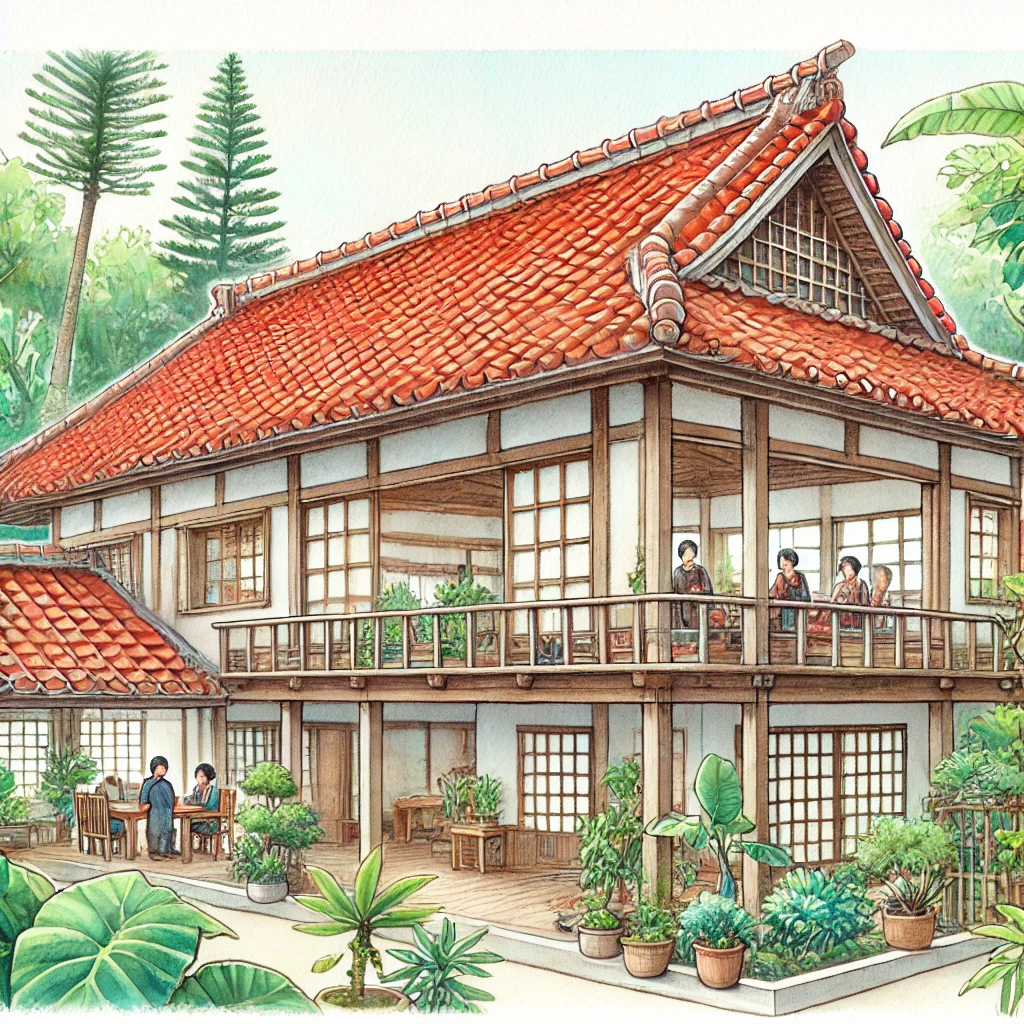
Okinawan traditional houses are much more than mere dwellings. They are spaces filled with wisdom and charm, deeply reflecting Okinawa’s climate, culture, and the spirit of its people.
To adapt to the hot and humid subtropical climate, high-floored wooden houses were developed, utilizing the space under the floors for moisture control and ventilation. The red tiles adorning the roofs combine beauty and durability, creating a distinctly Okinawan landscape. Wooden lattice windows and storm shutters adeptly control light and wind while ensuring sturdiness to withstand typhoons.
The layout of these houses also mirrors the lifestyle of Okinawans. The central courtyard, or “hinpun,” serves as a family gathering place, while the underfloor space, or “tougura,” is used for multiple purposes. The “yuntaku,” or veranda, fosters communication with neighbors. These homes are stages where family and community bonds are strengthened.
Furthermore, the spirit of mutual assistance called “yuimaaru” practiced in the process of house building is fundamental to Okinawan community culture. This reflects the communal spirit of the “shima” (village) and the wisdom of living in harmony with nature, evident in traditional houses.
However, in modern society, these traditional houses are gradually disappearing. Therefore, we need to re-evaluate their value and apply their wisdom to contemporary living. By learning from traditional houses, we can achieve a richer and more sustainable lifestyle.
This blog explores the charm and wisdom of Okinawan traditional houses from various angles. We will carefully explain elements that can be applied to modern house building, such as the features of red tile roofs and high-floored structures, unique layouts, and the spirit of yuimaaru. We will also touch on the challenges faced by traditional houses and efforts to preserve and inherit them.
Okinawan traditional houses are treasures filled with the wisdom and thoughts of our ancestors. Rediscovering their value and passing it on to the modern age is our mission. Let’s embark on a journey to explore the charm of Okinawan traditional houses together.
- Characteristics of Okinawan Traditional Houses
- Adaptation to Okinawa’s Climate and Environment
- House Layout and Space Utilization
- Traditions and Customs in House Building
- Preservation and Inheritance of Traditional Houses in Modern Times
- The Spiritual World Fostered by Traditional Houses
- Q&A
- Summary
Characteristics of Okinawan Traditional Houses
High-Floored Wooden Houses
A distinguishing feature of Okinawan traditional houses is their high-floored wooden structures. The space under the floors helps with moisture control. Due to Okinawa’s hot and humid climate, this underfloor space prevents the floorboards from rotting, enhancing the house’s durability. It also promotes ventilation, aiding in moisture expulsion from the house.
The choice of wood and structural ingenuity are also notable. Local wood like itajii and Ryukyu pine, known for their durability, is used. These woods are resistant to water and insects, suitable for the humid climate. Additionally, the jointing techniques and wood assembly provide robust structures that can withstand typhoons.
Red Tile Roofs
The roofs of Okinawan traditional houses are famously covered with red tiles, a material long used due to its suitability for the local climate. The history of red tiles dates back to the Ryukyu Kingdom era. Made by firing clay at high temperatures, these tiles are highly durable. Their red color reflects sunlight, helping to keep the interior cool.
Red tile roofs are not only beautiful but also practical. They are highly durable and can be used for long periods. The overlapping structure of the tiles prevents rainwater infiltration, keeping the interior dry. Red tile roofs are symbolic of Okinawan traditional houses and a significant element of Okinawan culture.
Wooden Lattice Windows and Storm Shutters
Okinawan traditional houses feature wooden lattice windows and storm shutters, crucial for ventilation and lighting. Given the hot and humid climate, lattice windows promote airflow, expelling moisture from the house. They also soften the sunlight, allowing gentle light into the interior.
Storm shutters are vital for typhoon protection. Being in a typhoon-prone region, Okinawa uses these shutters to protect homes from strong winds and flying debris. When closed, they prevent window glass from breaking and water from entering the house. When not in use, they can be opened to ensure ventilation. These features combine functionality and aesthetic appeal in Okinawan traditional houses.
Adaptation to Okinawa’s Climate and Environment
Adaptation to the Hot and Humid Subtropical Climate
Okinawa’s climate is characterized by high temperatures and humidity throughout the year, demanding house designs that adapt to these conditions. Traditional Okinawan houses prioritize ventilation through their layout and window placement.
The house layout adopts an open design to improve airflow, with large openings and minimal partitions between rooms. South-facing windows are large to let in sunlight, while north-facing windows bring in cool breezes. Eaves are another feature to block direct sunlight, reducing indoor temperature rises. Made from wood or bamboo, these eaves are also aesthetically pleasing. Such adaptations significantly influence the design of Okinawan traditional houses.
Structural Innovations for Typhoon Protection
As a typhoon-prone area, Okinawa’s traditional houses incorporate various structural innovations for typhoon protection. Strengthened foundations using stone walls and stone pavements, along with wind-resistant wooden frameworks, are common.
Stone walls and pavements strengthen the foundation, leveraging the abundant limestone from coral reefs in Okinawa. These structures withstand strong typhoon winds and also offer earthquake resistance. The flexibility of wooden joints enables the house to adapt to wind deformation. Techniques like strong jointing of pillars and beams and roof designs that minimize wind resistance or allow wind to pass through are employed.
Emphasis on Harmony with Nature
Traditional Okinawan houses reflect the local ethos of living in harmony with nature, evident in their design and materials. Natural materials like wood and stone, which are locally sourced and suited to the climate, are extensively used. These materials are durable and eco-friendly, returning to nature after use and reducing environmental impact.
The design also incorporates sustainable living practices. For example, rainwater harvesting systems are common, and gardens for growing food promote self-sufficiency. The placement and orientation of houses based on feng shui principles also emphasize harmony with nature.
House Layout and Space Utilization
Hinpun (Courtyard): A Space for Family Gatherings
In traditional Okinawan houses, the hinpun (courtyard) is a significant space. Located at the center of the house, it serves as a family gathering spot and a venue for entertaining guests.
The layout revolves around the hinpun, with living rooms and kitchens arranged around it. It often features a well or water source, providing essential water for household use, and is adorned with plants, creating a lush environment. The hinpun fosters family bonds as members naturally gather here, sharing meals and conversations, thereby strengthening their connections.
Tougura (Underfloor Space): Storage for Food and Tools
The tougura (underfloor space) is an essential area in traditional Okinawan houses, used for storing food and tools. This multipurpose space is ideal for storing items like sweet potatoes and taro, as well as agricultural and fishing tools. Its resistance to moisture makes it perfect for preserving food and tools, supporting Okinawa’s rich culinary traditions and food culture.
Yuntaku (Veranda): A Place for Neighborly Communication
The yuntaku (veranda) is a crucial feature in traditional Okinawan houses, designed for interaction with neighbors. Positioned facing roads or neighboring houses, the yuntaku is furnished with benches or chairs, inviting people to sit and chat. Eaves provide shade, making it a comfortable space even during the day. The yuntaku fosters community ties, enabling casual visits and conversations that strengthen neighborhood bonds and support mutual aid agreements.
Traditions and Customs in House Building
Okinawan house building is steeped in unique traditions and customs. Rituals like “Yuukui” (house building ceremony) and “Yadui” (gate building ceremony) reflect the wisdom of ancestors and are still observed today. Beliefs related to feng shui, and folklore and legends about house building, also enrich Okinawa’s cultural heritage.
Yuukui (House Building): Rituals and Cooperative Efforts
Yuukui refers to the house building rituals in Okinawa. When constructing a new house, family, relatives, and neighbors gather for collaborative work. The process starts with stone stacking for the foundation, followed by wood framework assembly, and ends with red tile roofing and a completion ceremony. Yuukui is not just about building a house; it’s a communal event that deepens family and community bonds. This tradition continues today, fostering connections through cooperative efforts.
Yadui (Gate Building): Constructing a Gate for the Guardian Deity
Yadui is the ritual for building traditional gates in Okinawa, which are more than just entry points; they are sacred spaces for enshrining the household guardian deity, “Hinpun-gami.” Family, relatives, and neighbors participate in constructing these gates, which is followed by a ceremony to enshrine the deity, praying for the household’s safety and prosperity. Yadui highlights the cultural importance of gates in protecting families and ensuring their well-being.
Legends and Traditions Related to House Building
Numerous legends and traditions influence Okinawan house building. Feng shui principles guide house orientation and layout, balancing yin and yang. Folklore, like placing “shisa” lion statues on roofs to ward off evil spirits, reflects cultural beliefs in protecting homes. These traditions and legends are vital cultural elements, ensuring they continue to be valued and preserved.
Preservation and Inheritance of Traditional Houses in Modern Times
Okinawan traditional houses are valuable cultural heritage representing the region’s history and culture. However, urbanization and lifestyle changes threaten their existence. Efforts
are underway to preserve and inherit these traditional houses.
The Value of Old Houses as Cultural Heritage
Reevaluating Historical and Cultural Significance
Okinawan old houses are not just old buildings; they are cultural heritage that encapsulates the wisdom and techniques of the past. They offer much to learn from their unique beauty and traditional construction methods, which are gaining renewed interest. Recognizing these old houses as cultural treasures is essential, as they represent the history and identity of the region.
Potential for Tourism Promotion Using Old Houses
Old houses are also valuable tourism resources. Villages with traditional houses exude a unique atmosphere, attracting many tourists. Utilizing old houses for tourism can revitalize local economies, creating jobs and economic circulation. Additionally, offering tourists the experience of staying in traditional houses can deepen their understanding of local culture and history, promoting cultural exchange.
Preservation and Revival Projects for Traditional Houses
Preservation Activities by Government and Private Organizations
Preserving and inheriting traditional houses require efforts from both government and private organizations. The government needs to establish systems for investigating and preserving old houses and support their owners. Private organizations, such as NPOs and volunteer groups, play a significant role in repairing and utilizing old houses, complementing government efforts and advancing preservation and inheritance.
Passing on Traditional Techniques and Developing Skilled Craftsmen
Passing on traditional techniques and training skilled craftsmen is crucial for preserving traditional houses. These houses are built with unique techniques different from modern construction methods. Therefore, it is essential to pass these skills to future generations. Training craftsmen involves support from both the government and private organizations, and providing opportunities to learn these techniques through education and public engagement.
Learning Sustainable Living from Okinawan Traditional Houses
Environmentally Friendly Materials and Design Techniques
Okinawan traditional houses incorporate many environmentally friendly materials and design techniques, such as natural materials like wood, stone, and bamboo, which are renewable and eco-friendly. These materials offer excellent insulation and moisture control, creating comfortable indoor environments. Design techniques like ventilation-focused layouts and sun-shading eaves embody passive design principles, reducing reliance on artificial heating and cooling.
Ecological Features of Traditional Houses and Modern Applications
Traditional Okinawan houses showcase ecological features that can be applied to modern housing. The high-floored design effectively uses the underfloor space for moisture control, while roof shapes reflect sunlight, maintaining cooler indoor temperatures. House layouts promote natural ventilation, and courtyards provide shaded, bright interiors. These features, combined with modern technology, can create more sustainable homes today.
Okinawan traditional houses embody wisdom for living in harmony with the environment. By applying this wisdom to contemporary housing, we can achieve a richer and more sustainable lifestyle. These houses are not just dwellings but a testament to Okinawan spirituality, offering valuable lessons for modern society.
The Spiritual World Fostered by Traditional Houses
Okinawan traditional houses are more than homes; they reflect the spiritual world of Okinawan people, teaching us their values and worldview through their architecture.
The Spirit of Yuimaaru (Mutual Assistance)
Practicing Yuimaaru in House Building
The spirit of “yuimaaru,” meaning mutual assistance, is inherent in Okinawan traditional house building. This spirit, derived from the word “yui” (to tie), emphasizes helping and cooperating with each other. During house building, family, relatives, and community members collaborate, deepening bonds through shared effort.
Yuimaaru in Everyday Life
Yuimaaru extends beyond house building into everyday life. In Okinawa, mutual assistance is a valued practice in daily activities like farming and fishing and during significant life events like weddings and funerals. This spirit is crucial in contemporary society, where individualism often weakens communal ties. Yuimaaru teaches the importance of human connections, which remains relevant today.
Traditional houses embody the yuimaaru spirit, illustrating the importance of mutual aid and community. By valuing this spirit in modern society, we can enhance our connections with others.
Community Consciousness and Bonds in Shima (Villages)
Spatial Structure of Traditional Houses and Villages
Okinawan traditional houses are not isolated structures; they are integral parts of “shima” (villages), which are social units bound by strong communal ties. The spatial structure of shima revolves around “utaki,” sacred groves that serve as spiritual hubs. Traditional houses are oriented towards these utaki, reflecting the communal consciousness and the village’s spatial organization.
Strengthening Community Bonds Through Houses
Traditional houses play a crucial role in fostering shima’s communal bonds. Building a house involves the community’s collective effort, reinforcing unity. These houses are also passed down through generations, preserving the village’s history and culture. Additionally, spaces like yuntaku and hinpun facilitate social interactions, strengthening community ties. In modern society, where community bonds are often weak, the communal spirit of shima offers valuable lessons.
Traditional houses embody shima’s communal consciousness, teaching us the importance of pride and responsibility as community members. Preserving this spirit can help rejuvenate modern communities.
Wisdom for Living in Harmony with Nature
Adaptability and Resilience to Natural Threats
Okinawa’s harsh natural environment, with frequent typhoons and high humidity, has fostered adaptability and resilience among its people. Traditional houses embody this wisdom, incorporating structural innovations to withstand natural threats and promoting recovery through community cooperation. In today’s world, facing increasing climate challenges, learning from these traditional practices is vital.
Utilizing Nature’s Blessings
Traditional Okinawan houses also showcase wisdom in utilizing nature’s blessings. Courtyards for growing food, wells for water supply, and protective fukugi trees are examples of integrating natural resources into daily life. Modern housing can benefit from such practices, incorporating green roofs, vertical gardens, and rainwater harvesting to create more sustainable living environments.
Traditional houses teach us valuable lessons about living in harmony with nature, which can be applied to modern housing to create a more sustainable and fulfilling lifestyle.
Q&A
What are the reasons for the high-floored wooden houses characteristic of Okinawan traditional architecture?
To adapt to Okinawa’s hot and humid climate, the underfloor space helps control moisture and ensures ventilation, creating a comfortable living environment.
What benefits do the red tile roofs of Okinawan traditional houses provide?
Red tiles are durable and aesthetically pleasing, reflecting Okinawa’s climate. The red color reflects sunlight, helping to keep the interior cool.
What role does the “hinpun” (courtyard) play in the layout of Okinawan traditional houses?
The hinpun, a central courtyard, is crucial for family gatherings and household activities, often featuring a well or water source.
How is the concept of “yuimaaru” related to traditional Okinawan house building?
“Yuimaaru,” meaning mutual assistance, is practiced during house building, where family and community members cooperate, embodying the spirit of helping each other.
What modern housing insights can be learned from Okinawan traditional houses?
Using natural materials, designing for natural ventilation, and incorporating features like courtyards, Okinawan traditional houses offer valuable lessons for creating sustainable and comfortable modern homes.
Summary
The design of Okinawan traditional houses reflects the climate, environment, and spirituality of its people. With features like high-floored wooden structures, red tile roofs, and wooden lattice windows, these houses are adapted to the subtropical climate and typhoon-prone conditions.
Their layout, including the hinpun (courtyard), tougura (underfloor space), and yuntaku (veranda), is deeply connected to the lifestyle of the inhabitants. The spirit of “yuimaaru” (mutual assistance) practiced during house building fosters strong family and community bonds. This communal ethos and harmony with nature are integral to Okinawan traditional houses.
In modern society, preserving and inheriting these traditional houses is a challenge, but their value is being re-evaluated. Utilizing old houses for tourism, passing on traditional techniques, and adopting sustainable living practices are crucial for preserving this heritage.
By integrating the wisdom of Okinawan traditional houses into modern housing, we can achieve a richer and more sustainable lifestyle. These houses are not just historical artifacts but hold universal values relevant to contemporary living.


コメント