
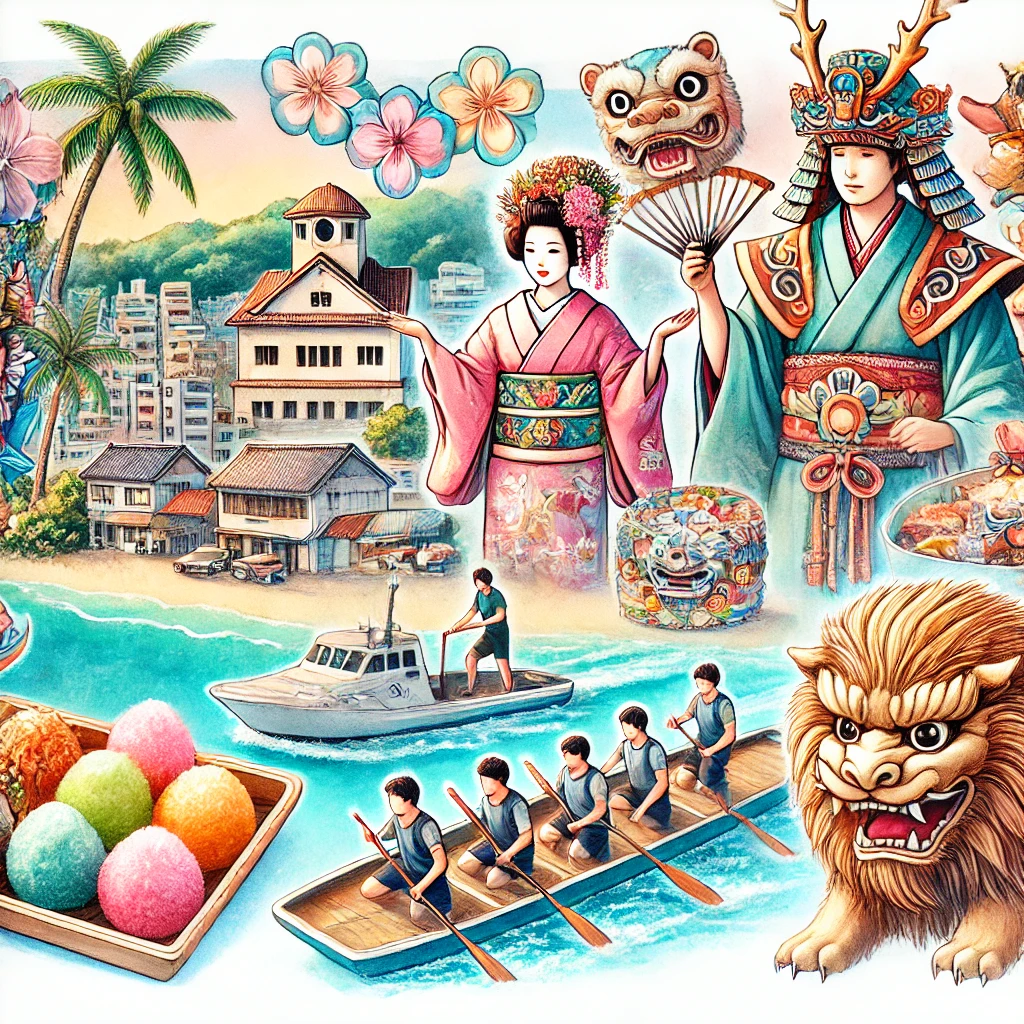
What comes to your mind when you hear the word “Okinawa”? Beautiful beaches, blue seas, and vibrant flowers, perhaps. But there’s more to Okinawa than that. The island is also home to a wealth of unique customs and traditions that have been passed down through the ages.
From the spiritual guidance of Yuta, who convey the words of gods and ancestors, to the Hāri boat races that pray for bountiful catches and safe voyages, to the dynamic drum dances of Eisa, to the harmonious symbol of Munmun, and the guardian lion-dogs known as Shisa that protect homes and families—these are invaluable cultural treasures reflecting the spirituality and values of the Okinawan people.
However, the significance of these customs in modern society extends beyond mere preservation of heritage. Yuta provide emotional support, Hāri embody the symbiosis of nature and humanity, Eisa fosters a sense of community, Munmun teaches the importance of diversity and harmony, and Shisa strengthens family bonds. Okinawan customs remind us of crucial values that modern society is in danger of losing.
In our increasingly globalized world, safeguarding and passing down regional cultures to future generations is no easy task. Yet, the distinctiveness and universal appeal of Okinawan customs have the power to captivate people worldwide. It is essential for each of us to understand and practice the values embedded in Okinawan culture.
So, why not delve into the soul of this island through its customs? You’re bound to find something that resonates with your heart. Now is the time to embark on a journey to explore the traditions and spirit of Okinawa.
- Introduction
- Okinawan Custom: Yuta
- Okinawan Custom: Hāri
- Okinawan Custom: Eisa
- Okinawan Custom: Munmun
- Okinawan Custom: Shisa
- Conclusion
- Q&A
- Summary
Introduction
About Okinawa’s Unique Culture
Historical Background of Okinawa
Okinawa has cultivated a unique culture for centuries, with its history tracing back to the Ryukyu Kingdom era. The Ryukyu Kingdom developed its distinctive culture through trade with China, Japan, and Southeast Asia. Even under Japanese rule, Okinawa maintained its unique language and customs. This historical backdrop plays a crucial role in shaping Okinawa’s unique culture.
Characteristics of Okinawan Culture
Okinawan culture is characterized by a symbiotic relationship with nature, ancestor worship, unique language and music, and rich performing arts. The people of Okinawa have a deep respect for nature and a strong sense of reverence for their ancestors. The Ryukyuan language and traditional instruments like the sanshin (three-stringed lute) are essential elements that convey the charm of Okinawan culture to the world. Additionally, performing arts such as Eisa and Ryukyuan dance embody Okinawa’s history and spirit. These features make Okinawan culture distinct and unique from other regions.
Purpose and Overview of This Article
Purpose of Introducing Okinawa’s Unique Customs
The purpose of this article is to introduce Okinawa’s unique customs. Okinawa boasts many distinctive customs not found in other regions. These customs reflect the history, spirituality, and values of Okinawa and form the core of its culture. This article will explore notable Okinawan customs, such as Yuta, Hāri, Eisa, Munmun, and Shisa, delving into their origins, meanings, and roles in contemporary society to deepen readers’ understanding of Okinawan culture.
Structure of the Article and Message to Readers
This article is structured to introduce five unique Okinawan customs in separate chapters. Each chapter provides detailed explanations of the historical background, meanings, and contemporary roles of these customs, including intriguing legends and stories to highlight the depth of Okinawan culture. The conclusion discusses the backgrounds that nurtured these customs, their significance in modern society, and the importance of cultural preservation. Through this article, readers will fully appreciate the uniqueness and charm of Okinawan culture and the values and spirituality of its people.
Okinawan Custom: Yuta
What is Yuta?
Definition and Role of Yuta
Yuta refers to spiritual mediums in Okinawa who convey the words of gods and ancestors. Often women, Yuta, also known as kankakariya, listen to people’s troubles and deliver messages from the divine to provide solutions. Yuta also perform rituals for healing illnesses, exorcising evil spirits, and praying for safe childbirth. For Okinawans, Yuta are a source of emotional support and spiritual guidance.
Types and Characteristics of Yuta
There are generally two types of Yuta: “ninju” and “oshiete Yuta.” Ninju are believed to possess innate spiritual abilities and directly receive messages from gods and ancestors. Oshiete Yuta acquire their abilities through training and knowledge passed down from senior Yuta. Yuta can read people’s situations from their belongings or photos, with some specializing in communicating with specific gods or ancestors.
History and Role of Yuta
Origin and Development of Yuta
The origin of Yuta dates back to the ancient Ryukyu period, when they were a type of female priest called “Noro.” Noros played a crucial role in supporting the royal authority by conducting rituals and divination. After the Ryukyu Kingdom’s fall and under Japanese rule, the Noro system declined, but the tradition of Yuta continued and evolved as folk beliefs. Today, Yuta are symbolic of Okinawan culture.
Importance of Yuta in Okinawan Society
In Okinawan society, Yuta play an essential role. They provide spiritual support by addressing people’s troubles and delivering divine messages. Yuta also perform rituals during significant life events, such as weddings, births, and new home constructions, alleviating anxieties and wishing for happiness. Additionally, Yuta sometimes assist in healing illnesses beyond the reach of conventional medicine. Yuta are indispensable to Okinawan society, upholding its spiritual and cultural fabric.
Presence of Yuta in Modern Society
Contemporary Perception of Yuta
The perception of Yuta is evolving in modern society. With the advancement of Western medicine, the medical role of Yuta is diminishing. However, as societal complexities increase, there is a growing need for emotional and spiritual support. Yuta continue to provide essential guidance, offering a spiritual refuge in contemporary times.
Activities and Influence of Yuta
Modern Yuta engage in traditional activities and new ones. They share their knowledge and experiences through media like television, radio, and the internet, contributing to cultural tourism by organizing tours that showcase Okinawan culture. Some Yuta also focus on environmental protection and cultural preservation. Thus, contemporary Yuta exert influence across various fields.
Famous Legends About Yuta
Yuta’s Prophecies and Real-Life Events
One of the famous legends about Yuta involves their accurate prophecies. Numerous instances of Yuta’s predictions matching real-life events have been reported. For example, a renowned Yuta once warned a family about fire hazards, and they subsequently experienced a fire. Such accurate prophecies highlight the profound spiritual abilities of Yuta, leaving a lasting impression on people.
Mystical Experiences Related to Yuta
There are many mystical experiences related to Yuta. Some people recount being possessed by a Yuta, suddenly speaking divine words against their will. Others report encounters with ancestral spirits through Yuta, receiving messages from deceased relatives. These mystical stories underscore the mysterious spiritual power attributed to Yuta, captivating people’s imaginations.
Okinawan Custom: Hāri
Origin and Meaning of Hāri
Historical Background of Hāri
Hāri refers to traditional boat races in Okinawa, with origins dating back to the 15th century. During this period, the Ryukyu Kingdom engaged in active trade with China and Southeast Asia, and Hāri began as a competition to hone maritime skills. It also served as a training ground for fishermen and sailors, reflecting Okinawa’s historical and industrial context.
Purpose and Symbolism of Hāri
The purpose of Hāri extends beyond mere competition. It is imbued with prayers for abundant catches and safe voyages. Hāri, held in May, coincides with the planting season in Okinawa, symbolizing a wish for a bountiful harvest. Additionally, Hāri is a means to express gratitude and prayers to sea deities for maritime safety, embodying Okinawans’ faith and hopes.
Timing and Locations of Hāri
When Hāri is Held
Hāri is typically held on the 4th day of the 5th month of the lunar calendar, coinciding with “Tango no Sekku” (Boys’ Festival) from China. In Okinawa, this day features Hāri races, martial arts demonstrations, and offerings cast into rivers. Hāri occurs in May, the peak fishing season after the planting of crops.
Locations and Preparations for Hāri
Hāri is celebrated across Okinawa’s main island, notably in Naha, Urasoe, and Itoman. Preparations for Hāri begin months in advance, involving boat repairs, selection and training of participants, and venue setup, with widespread community cooperation. On Hāri day, rituals are conducted early in the morning, and participants compete in a purified state.
Progress and Content of Hāri Competitions
Typical Flow of Hāri
On Hāri day, the event starts with rituals praying for safety and success. Participants then board the boats, which are rowed by dozens to hundreds of rowers. As the race begins, the boats surge forward across the water, cheered on by enthusiastic spectators along the shore. The race typically covers several kilometers to a designated turnaround point, with the first team to return to the starting line declared the winner.
Types and Rules of Hāri Competitions
Hāri features various competitive categories. The most prominent is the “Hon Hāri,” involving large boats rowed by dozens to hundreds of rowers. Other categories include “Junior Hāri,” for children, and “Women’s Hāri,” for female participants. Rules vary by region but generally include specifications for boat size, number of rowers, and course length. Interference or dangerous conduct during the race is strictly prohibited.
Okinawan Sentiments Embodied in Hāri
Community Unity Through Hāri
Hāri is a community event that fosters unity. The preparation and execution involve extensive participation from local residents, including volunteers for boat repairs and venue setup. On race day, the community gathers to cheer on the participants, reinforcing a sense of togetherness and cooperation. Hāri deepens community bonds and creates a shared sense of pride and belonging.
Spiritual Significance of Hāri
Hāri reflects the spiritual values of Okinawans. Beyond being a competition, it is a ritual of prayer. The prayers for maritime safety and abundant catches express reverence for nature. Participation in Hāri, regardless of winning, is seen as meaningful, preserving traditions passed down from ancestors and teaching the importance of community and spirituality. Hāri is a cultural practice that nurtures the Okinawan spirit.
Okinawan Custom: Eisa
History and Origin of Eisa
Origins and Spread of Eisa
Eisa is a traditional Okinawan dance performed during the Bon festival to honor the spirits of ancestors. Its origins are believed to be influenced by Chinese Taoist rituals for appeasing spirits, introduced to the Ryukyu Kingdom around the 16th century. Initially performed at the royal court, Eisa gradually spread to the common people and developed uniquely in each region, becoming a hallmark of Okinawan culture.
Evolution and Modern Forms of Eisa
Eisa has evolved over time. Initially led by royal bureaucrats, it was later taken over by local youth groups after the kingdom’s fall. Post-World War II, Eisa incorporated influences from American culture, seen in its music and costumes. Today, Eisa varies by region, each with its distinctive style, yet the core spirit of ancestor reverence and community remains unchanged.
Characteristics of Eisa Dance and Music
Basic Movements of Eisa Dance
Eisa dance is characterized by vigorous and dynamic movements synchronized with drum rhythms. Men perform powerful drumming while dancing, and women add graceful hand movements to their fluid dance. Basic movements include the “Haneru,” a bouncing step, and the “Charanka-charanka,” a distinctive footwork. These movements combine to create Eisa’s lively and energetic performance.
Music and Rhythm of Eisa
Eisa music prominently features powerful drum rhythms. The main drum used is the “paranku,” a double-sided drum unique to each region with distinct decorative elements. Other instruments like the sanshin (three-stringed lute) and flutes also accompany the dance. While musical styles vary by region, the drum’s rhythm remains central to guiding the dance.
Eisa Costumes and Props
Costumes Worn in Eisa
Eisa costumes vary by region but generally, men are bare-chested, wearing headbands and brightly colored sashes. Women often wear “chura,” a traditional Ryukyuan attire consisting of a blouse and skirt, adorned with vibrant patterns. Floral or bingata hair ornaments are common for women. Costumes are designed for ease of movement to withstand the vigorous dance.
Essential Props in Eisa
The paranku drum is a crucial prop in Eisa, providing the dance’s rhythmic foundation. Men also carry “chindami,” handkerchiefs used for wiping sweat and as part of the dance movements. Fans and sanshin are other common props, adding visual and auditory richness to the performance.
Impact of Eisa on Okinawan People
Fostering Regional Identity Through Eisa
Eisa plays a vital role in fostering regional identity. Each community’s Eisa reflects its unique history and culture, instilling pride and a sense of belonging in its people. Participating in Eisa strengthens community ties, fostering intergenerational exchanges and deepening communal bonds.
Intergenerational Exchange Through Eisa
Eisa promotes intergenerational exchange, involving participants from children to the elderly. Veteran dancers pass down skills and traditions to younger generations, ensuring the continuity of Eisa. The shared practice of Eisa builds connections across age groups, reinforcing the importance of community and cultural preservation.
Okinawan Custom: Munmun
Meaning and Origin of Munmun
Etymology and History of Munmun
Munmun, an Okinawan term meaning “charm” or “amulet,” derives from the words “munu” (thing) and “munu” (protect). This custom has been cherished by Okinawans for generations, with mothers making Munmun for their children to ensure their health and safety. Munmun also serves various purposes, such as wishing for love or healing, reflecting the hopes and prayers of its creators.
Symbolic Meanings of Munmun
Munmun carries various symbolic meanings. The materials used are believed to have specific significance: shells represent health, stones symbolize strength, and plant seeds denote abundance. The shapes of Munmun, like triangles for harmony of mind, body, and spirit, circles for unity, and crosses for protection, also hold symbolic importance, embodying the wishes and thoughts of Okinawan people.
Making and Materials of Munmun
Steps in Making Munmun
The process of making Munmun begins with gathering materials like shells, stones, and plant seeds. These natural elements are then combined to form the charm, typically using threads to string them together. Once assembled, a loop is added for wearing as an amulet. The crafting process imbues the charm with the maker’s prayers and wishes.
Materials and Tools Used in Munmun
Munmun primarily uses natural materials. Shells, often used for Shisa’s eyes, and coral stones are popular choices. Seeds from plants like balsam and hibiscus are also favored. Other materials include animal bones and nuts. Tools for making Munmun include threads, scissors, and needles, reflecting the tradition’s simplicity and connection to nature.
Munmun as Gifts
Tradition of Giving Munmun and Its Significance
Munmun is also significant as a gift. Mothers or grandmothers often make Munmun for newborns, wishing for their healthy growth. Munmun is also given as wedding favors, symbolizing care and gratitude. The act of giving Munmun conveys deep feelings of affection and appreciation.
Building Bonds Through Munmun
Making Munmun together fosters deeper bonds among family and friends. The process involves time and effort, creating opportunities for conversation and connection. Giving and receiving Munmun strengthens mutual understanding and appreciation, making it a vital part of Okinawan social fabric.
Intriguing Legends About Munmun
Folktales About Munmun
Various folktales highlight Munmun’s significance. For example, a Munmun made with banyan seeds is said to bring fertility, while one with hibiscus seeds is believed to ensure romantic success. Legends also suggest that Munmun made on a full moon night has particularly strong effects, reflecting the deep-rooted beliefs and hopes of the people.
Real-Life Stories and Anecdotes About Munmun
Numerous real-life stories and anecdotes also emphasize Munmun’s power. Some families have made Munmun for generations, with all children growing up healthy and happy. A woman once made a Munmun to strengthen her relationship, which led to a successful marriage. These stories underscore the faith people place in Munmun’s efficacy.
Okinawan Custom: Shisa
Origin and Meaning of Shisa
Birth and Introduction of Shisa
Shisa, lion-dog statues placed on rooftops and gates, originate from Chinese lion worship. In China, lions are believed to ward off evil spirits, a belief that migrated to Okinawa. The Okinawan adaptation, called Shisa, evolved uniquely and became a symbol of protection. Today, Shisa are emblematic of Okinawan craftsmanship and culture.
Role of Shisa as Guardians
Shisa serve as guardians, believed to protect homes and villages from evil spirits and bring health, safety, and prosperity. Placing Shisa is thought to create a secure environment, allowing residents to live with peace of mind. Shisa symbolize the Okinawan faith in protective spirits, continuing to be cherished by many households.
Types and Features of Shisa
Various Designs and Expressions of Shisa
Shisa come in many designs and expressions. The most common type has an open-mouthed male Shisa and a closed-mouthed female Shisa, symbolizing the
protection of the household. Other variations include different facial expressions and postures, each with specific meanings, adding to their unique charm.
Materials and Crafting of Shisa
Shisa are primarily made of ceramic, traditionally using Okinawan red clay. This clay contains high iron content, giving Shisa a distinctive appearance after firing. The crafting process involves shaping the clay, drying it, and then firing it in a kiln. After firing, the statues are painted and decorated. Today, Shisa are also made from other materials, showcasing the diversity of Okinawan artisanship.
Placement and Effects of Shisa
Where and How to Place Shisa
Shisa are commonly placed on rooftops or gates. On rooftops, they are positioned at the corners to guard against evil. At gates, Shisa are placed as pairs, with the male facing outward to ward off evil and the female facing inward to protect the home. This strategic placement enhances their protective efficacy.
Psychological Comfort Provided by Shisa
Shisa provide psychological comfort to residents. Belief in Shisa’s protective power alleviates anxieties, fostering a sense of security. Placing Shisa is also thought to bring positive energy into the home. Shisa remain an essential element in Okinawan households, serving as a source of spiritual reassurance.
Famous Legends About Shisa
Legends Demonstrating Shisa’s Power
Many legends highlight Shisa’s protective power. One legend tells of a village saved from plague by Shisa, while another recounts a house protected from fire by these guardian statues. Such stories reinforce Shisa’s role as powerful protectors, affirming people’s faith in their safeguarding abilities.
Mystical Experiences Related to Shisa
Mystical experiences about Shisa abound. Some tales describe Shisa moving at night, while others mention hearing mysterious voices near Shisa statues. These stories suggest that Shisa possess spiritual powers beyond mere decorative function, deeply rooted in Okinawan beliefs.
Conclusion
Background of Okinawa’s Unique Customs
Geographical and Historical Characteristics of Okinawa
Okinawa, Japan’s southernmost archipelago, is characterized by its subtropical climate, fostering a unique culture. Historically, the Ryukyu Kingdom developed its distinct culture through interactions with China and Southeast Asia. These geographical and historical factors have cultivated Okinawa’s unique customs.
Okinawan Spirituality and Values
Okinawan people have a deep respect for nature and ancestors, embodying values of cooperation and kindness. These values underpin Okinawan customs, reflecting the islanders’ way of life and spiritual beliefs. The customs are integral to Okinawan identity, preserving their cultural heritage.
Significance of Okinawan Customs in Modern Society
Fostering Regional Identity Through Customs
Okinawan customs play a vital role in fostering regional identity. They instill pride and attachment to the local community, strengthening social cohesion. Through customs, people learn the importance of cooperation and mutual support, reinforcing community bonds.
Learning Life Wisdom from Okinawan Customs
Okinawan customs offer valuable life lessons. Creating Munmun, for instance, teaches the importance of cherishing objects. Placing Shisa emphasizes the significance of living with a sense of security. These customs embody the wisdom of the ancestors, providing guidance for contemporary life.
Appeal and Future Preservation of Okinawan Culture
Uniqueness and Universality of Okinawan Culture
Okinawan culture combines uniqueness and universality. Its customs are distinct, with features not seen elsewhere, yet they also embody universal human values such as hope, prayer, and protection. This blend of uniqueness and universality enhances the appeal of Okinawan culture.
Legacy and Development of Okinawan Culture
Passing down and developing Okinawan culture is our responsibility. In a globalized world, preserving regional cultures like Okinawa’s is increasingly crucial. Okinawan culture can help restore lost connections between people and nature and among communities. Understanding and practicing the values of Okinawan culture is key to building a richer society.
This article has explored Okinawa’s unique customs in detail. The Yuta, Hāri, Eisa, Munmun, and Shisa are all invaluable cultural treasures reflecting the spirituality and values of the Okinawan people. These customs provide insights into essential values that modern society risks losing. Promoting the charm of Okinawan culture and preserving its values is a mission entrusted to us all. By passing down and developing Okinawan culture, we can build a more enriched society.
Q&A
What is a Yuta in Okinawa?
A Yuta is a spiritual medium in Okinawa who conveys messages from gods and ancestors, addressing people’s troubles and performing rituals for healing, protection, and blessings. Yuta are an essential source of spiritual support in Okinawan society.
What is the purpose of the Hāri festival?
The Hāri festival, featuring traditional boat races, prays for abundant catches and safe voyages. It expresses gratitude for the sea’s blessings and symbolizes the harmony between nature and humanity.
What are the characteristics of Eisa dance and music?
Eisa dance involves vigorous, dynamic movements synchronized with drum rhythms. The music features powerful drumbeats, often accompanied by sanshin (three-stringed lute) and flutes, creating a lively and energetic performance.
What symbolic meanings does Munmun carry?
Munmun, a traditional Okinawan charm, symbolizes various wishes and prayers. Its materials represent health, strength, and abundance, while its shapes symbolize harmony, unity, and protection.
What effects do Okinawans expect from placing Shisa?
Placing Shisa is believed to protect homes and families from evil spirits, ensuring safety and prosperity. Shisa provide psychological comfort, fostering a sense of security and well-being.
Summary
Okinawa boasts numerous unique customs, such as Yuta, Hāri, Eisa, Munmun, and Shisa. These customs reflect Okinawa’s history, spirituality, and values, holding significant meaning even in modern society.
Yuta serve as spiritual guides, providing emotional support. Hāri symbolizes the harmony between nature and humanity through boat races. Eisa fosters community spirit with its dynamic dance and music. Munmun represents wishes for health, protection, and happiness. Shisa serve as protective guardians, offering spiritual reassurance.
These customs foster regional identity and strengthen community bonds. They also convey essential values such as respect for nature and ancestor worship, offering wisdom for contemporary life.
Okinawan customs, with their unique and universal appeal, provide valuable insights into life. Preserving and promoting these customs is crucial in a globalized world. By understanding and practicing Okinawan cultural values, we can build a richer society. Sharing the charm of Okinawan culture and preserving its values is a mission entrusted to each of us.
コメント