
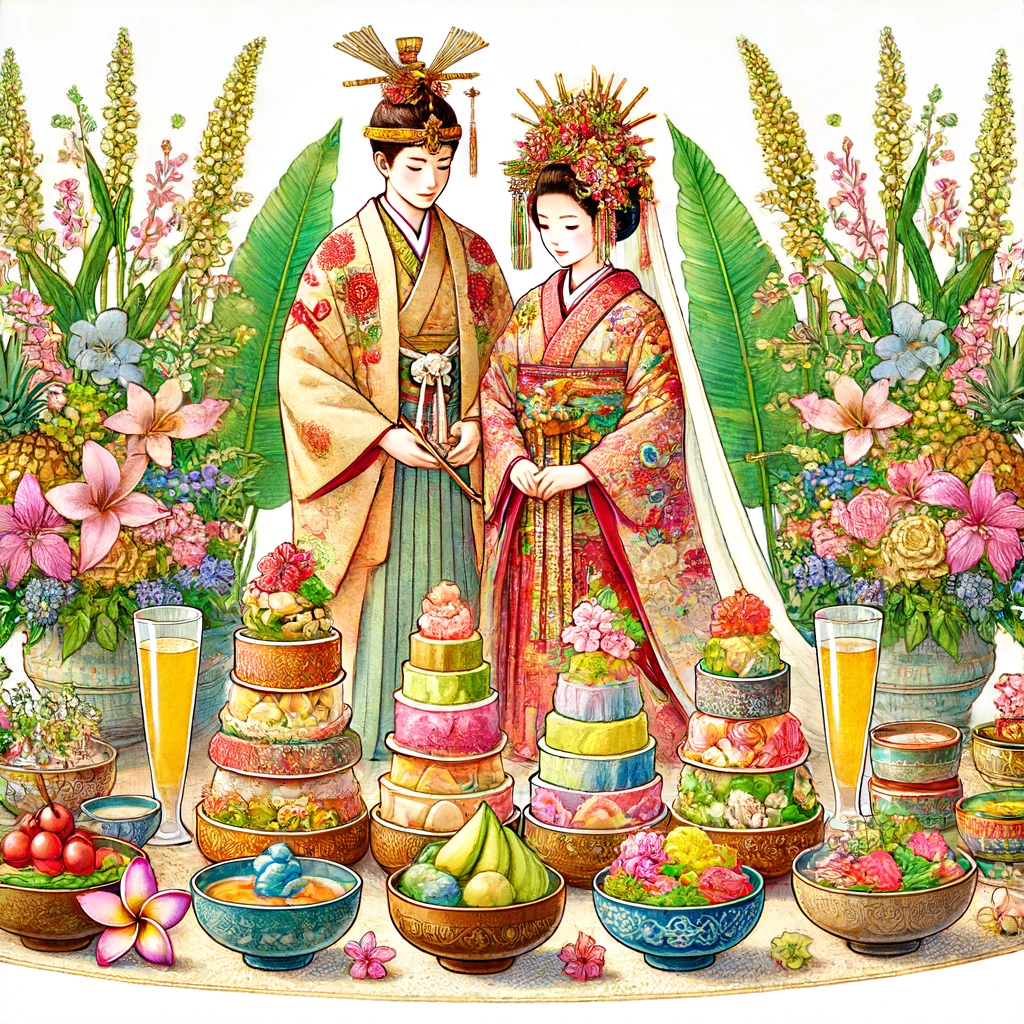
When you think of a wedding in Okinawa, the image of the bride and groom dressed in vibrant Ryukyu attire likely comes to mind. One indispensable part of these ceremonies is the “Wan-mori” ritual. This unique Okinawan tradition involves stacking bowls filled with auspicious foods, symbolizing the couple’s happiness and the prosperity of their descendants.
This custom dates back to the Ryukyu Kingdom era, where it was a common practice among the nobility. Unlike today’s more simplified version, it was once a much more elaborate and extravagant affair. Over time, the tradition of Wan-mori has evolved, blending with Western wedding styles and incorporating new elements while preserving its traditional format.
Each ingredient used in Wan-mori holds significant meaning. For instance, red and white fish cakes symbolize celebration, herring roe represents fertility, and shrimp signifies longevity. The number of bowls stacked is always an odd number, which is considered lucky and signifies the unbreakable bond of marriage.
Wan-mori is more than just a ritual; it reflects the Okinawan spirit. It embodies the respect for ancestors and the harmony with nature that is central to Okinawan culture. Through this ritual, the values of gratitude to ancestors and appreciation for nature’s blessings are conveyed.
Understanding the history and significance of Wan-mori deepens one’s appreciation for Okinawa’s cultural heritage. Experiencing this ritual firsthand can offer a profound connection to the Okinawan spirit. Various wedding venues and cultural events provide opportunities to witness or participate in Wan-mori, offering a unique glimpse into this cherished tradition.
Overview of Okinawan Weddings
Okinawan weddings are rich with unique traditions and customs distinct from those on mainland Japan. The traditional attire and rituals captivate visitors, leaving lasting impressions.
Features of Okinawan Weddings
Okinawan weddings are characterized by unique traditional attire and specific rituals not found in other regions.
Traditional Attire
The bride wears a vibrant kimono known as “Ryuso,” decorated with Bingata patterns, a traditional Okinawan dyeing technique. This kimono features bright and beautiful designs. The groom, on the other hand, wears “Kariyushi wear,” a casual yet unique Okinawan attire made from breathable materials suitable for the hot climate, often featuring traditional Okinawan designs.
The bride’s hair is adorned with a distinctive golden ornament called “Jiifa,” shaped like a butterfly, enhancing her beauty. Additionally, she applies traditional “Gakugumi” makeup, emphasizing her pure and beautiful appearance with a white face and red lipstick.
Unique Rituals
In addition to typical ceremonies like “Yuinou” (betrothal gifts) and receptions, Okinawan weddings feature unique rituals such as “Mizuage” and “Wan-mori.”
“Mizuage” is performed the day before the wedding, where the bride fetches water from her parental home to bring to her new home, symbolizing the transition from her parental home to her new family.
“Wan-mori” is conducted on the wedding day, where both sets of parents stack bowls filled with auspicious foods and exchange them. This ritual symbolizes the union of the families and the wish for the couple’s prosperous future, as detailed earlier.
Differences from Mainland Weddings
Okinawan weddings differ significantly from mainland Japanese weddings in several ways.
Flow of the Ceremony
Unlike the typical church or shrine weddings on the mainland, Okinawan weddings often center around the “wedding reception,” featuring unique Okinawan performances and entertainment for the guests.
Additionally, while mainland weddings often include a second party after the main reception, Okinawan weddings extend to a third party called “Ukui,” where guests engage in singing, dancing, and enjoying a more relaxed and lively atmosphere.
Roles of Attendees
In Okinawan weddings, family and friends play vital roles. Particularly, the parents of the bride and groom are deeply involved in the ceremony’s proceedings.
Unlike the limited roles of relatives in mainland weddings, Okinawan weddings see relatives actively participating. For instance, the parents play a crucial role in the Wan-mori ritual and often perform entertainment acts during the reception.
These distinct cultural and traditional elements contribute to the unique atmosphere of Okinawan weddings.
Origin of Wan-mori
Wan-mori is an essential traditional ritual in Okinawan weddings, with origins tracing back to the Ryukyu Kingdom era.
History of Wan-mori
The exact origins of Wan-mori are unclear, but it is an ancient Okinawan ritual.
Origins and Development
One theory suggests that Wan-mori was influenced by Chinese customs. In China, there is a tradition of gifting stacked boxes called “Chonghap” during weddings, which may have been adapted into the Okinawan Wan-mori.
During the Ryukyu Kingdom era, Wan-mori was a common practice among the nobility, featuring more luxurious and elaborate presentations than today.
Regional Variations
Wan-mori practices vary slightly across Okinawa. For instance, in the northern regions, “Jushi” (a type of mixed rice) is often used, while in the southern regions, “Inamuduchi” (pork stew) is common.
Despite these regional differences, the underlying wish for the couple’s prosperity and happiness remains consistent.
Influence of the Ryukyu Kingdom Era
The Ryukyu Kingdom era significantly shaped Okinawan culture, including Wan-mori.
Royal Culture and Wan-mori
During this era, Okinawa had active cultural exchanges with China and Japan, incorporating various foreign influences into its customs. Wan-mori reflects these influences, with luxurious foods and beautiful utensils used in the ritual, symbolizing the wealth and power of the kingdom.
Chinese Cultural Influence
Many of the foods used in Wan-mori, such as “Rafute” (braised pork belly), have origins in Chinese cuisine, like the “Hong Shao Rou.”
Similarly, the utensils used in Wan-mori, such as Arita and Kyoto ceramics, show Chinese cultural influences.
Understanding these historical connections enhances the appreciation of Okinawa’s cultural richness.
Contents of Wan-mori
Wan-mori involves various preparations, procedures, and specific tools and foods that reflect Okinawan culture and traditions.
Preparations for Wan-mori
Preparing for Wan-mori is a crucial part of the wedding, involving meticulous attention to tools and food selection.
Preparation of Tools
Tools used in Wan-mori include “Jubako” (stacked boxes) and “Wan” (bowls). Jubako are often wooden or lacquered with beautiful decorations, while Wan can be ceramic, wooden, or glass, depending on the region.
Selection of Foods
Auspicious foods are chosen for Wan-mori, such as “red and white fish cakes” for celebration, “kombu” (kelp) for joy, “herring roe” for fertility, and “shrimp” for longevity.
Procedure of Wan-mori
While there are regional and familial variations, the general flow of Wan-mori is as follows:
Start of the Ritual
Wan-mori typically takes place mid-wedding, with the bride and groom, their parents, and relatives seated in a line to begin the ritual.
Offering of Foods
The groom’s relatives first present the bride’s side with the stacked Jubako filled with food, followed by the bride’s relatives reciprocating. Each side bows deeply during the exchange.
Words of Celebration
After the exchange, representatives from both families give speeches, wishing the couple a prosperous and happy future.
Tools and Foods Used
The tools and foods used in Wan-mori carry specific meanings.
Types and Meanings of Bowls
Wan-mori bowls are classified into “men’s bowls” (Uinwan) and “women’s bowls” (Inbiwan). Uinwan are tall and cylindrical, while Inbiwan are shorter and wider. Stacking these bowls symbolizes the union of the couple. Odd numbers like three or five are used for stacking, as they are considered lucky.
Types and Meanings of Foods
Common foods used in Wan-mori include:
- Red and white fish cakes: Symbols of celebration.
- Kombu rolls: Represent joy.
- Herring roe: Signifies fertility.
- Shrimp: Symbolizes longevity.
- Braised pork: Represents prosperity.
These foods convey auspicious meanings and the wish for a happy life for the couple.
Significance of Wan-mori
Wan-mori is more than a ritual; it embodies the hopes and wishes of Okinawan people.
Symbols of Prosperity and Fertility
The foods used in Wan-mori symbolize prosperity and fertility.
Reasons for Food Selection
As mentioned, red and white fish cakes symbolize celebration, while herring roe represents fertility. Pork, considered a delicacy in Okinawa, symbolizes prosperity, wishing the couple a rich life.
Meaning of Bowl Stacking
The act of stacking bowls symbolizes the strength of family bonds. Odd numbers are used, signifying the wish for an eternal bond between the couple.
Strengthening Family Bonds
Wan-mori is important for both the couple and their families.
Importance of Collaborative Effort
Preparing for Wan-mori involves the cooperation of both families, deepening their bonds through the shared tasks of preparing foods and arranging the bowls.
Women,
particularly, play a central role in preparing the stacked foods, fostering intergenerational cooperation and unity.
Passing on Tradition
Wan-mori is a cultural tradition passed down through generations, teaching younger family members the importance and practices of this ritual, thus preserving it for the future.
Through Wan-mori, younger generations learn Okinawan values and traditions, which they will eventually pass on to their children.
Modern Changes in Wan-mori
Modern society’s lifestyle changes and diverse values have influenced traditional rituals, including Wan-mori.
Fusion with Western Weddings
More couples in Okinawa now incorporate Western wedding elements while maintaining the Wan-mori ritual.
Simplification of Wan-mori
To blend Western-style weddings with Wan-mori, the ritual is sometimes simplified by reducing the number of foods or shortening the ceremony.
Incorporation of New Elements
Some couples add modern touches to Wan-mori, such as using custom-designed boxes or incorporating new foods, making the ritual more personal and memorable.
Preserving Tradition with Modern Changes
Efforts are made to preserve traditional Wan-mori while adapting to modern times.
Regional Preservation Efforts
Various regions in Okinawa hold workshops and collect materials to preserve traditional Wan-mori practices, ensuring that these traditions are passed on to younger generations.
Teaching the Younger Generation
Educating young people about Wan-mori through school programs helps instill pride in their cultural heritage, ensuring the continuation of these traditions.
Thus, modern Wan-mori balances tradition with contemporary changes, preserving its cultural significance for future generations.
Legends and Anecdotes about Wan-mori
Wan-mori is surrounded by various legends and anecdotes that enrich its history and meaning.
Legend of Wan-mori’s Origin
Several legends explain the origin of Wan-mori, one of which involves the “King of Kin.”
Content of the Legend
Approximately 900 years ago, the King of Kin, a regional lord in the Motobu Peninsula, hosted a festival where a poor young man attended. Impressed by the young man’s sincerity, the king decided to marry his daughter to him. However, concerned about the young man’s poverty, the king provided lavish dowries. The young man, embarrassed, could not carry them home, so the king stacked bowls filled with food and gave them to him, marking the beginning of Wan-mori.
Significance of the Legend
This legend highlights that Wan-mori started from a parent’s wish for their child’s happiness, emphasizing the importance of heartfelt gifts over material wealth. Wan-mori is thus an expression of parental love and care.
Famous Anecdotes about Wan-mori
Many anecdotes about Wan-mori are passed down, illustrating its significance.
Historical Figures and Wan-mori
During the Ryukyu Kingdom era, Wan-mori was a staple at royal banquets. Once, a king asked, “How many layers does this Wan-mori have?” A servant replied, “A hundred layers.” Surprised, the king asked if it was possible. The servant answered, “Yes, if you stack with your heart, you can stack endlessly.” This anecdote underscores that Wan-mori is about heartfelt exchanges, not just the physical act of stacking bowls.
Modern Wan-mori Episodes
Modern adaptations of Wan-mori include personal touches, such as incorporating the couple’s favorite foods. For instance, one couple included the bride’s favorite fried chicken and the groom’s favorite Goya Champuru in their Wan-mori. This modern twist shows how Wan-mori can express the couple’s personalities while honoring tradition.
Legends and anecdotes about Wan-mori reveal the wisdom and sentiments of past generations, enhancing our understanding of its true meaning and encouraging us to cherish and preserve this cultural practice.
The Spiritual World of Okinawa and Wan-mori
Wan-mori is not merely a ritual; it is a profound ceremony that reflects the spiritual world and values of the Okinawan people.
Ancestor Worship and Wan-mori
In Okinawa, there is a deep-rooted culture of respecting and honoring ancestors, which is also reflected in the Wan-mori ceremony.
Gratitude and Prayers for Ancestors
During the Wan-mori ceremony, gratitude is expressed towards ancestors. The bride and groom offer food to show their appreciation to their ancestors who have watched over them and to wish for their happiness.
The ceremony also involves prayers to ancestors, hoping that the new family will live happily under their ancestors’ protection.
Commemorative Aspect
Wan-mori also serves as a memorial for ancestors. It includes remembering deceased relatives and offering their favorite foods as a way to honor and comfort their spirits.
In cases where a close family member has recently passed away, their favorite foods might be included in the ceremony as a form of remembrance and commemoration.
In this way, Wan-mori reflects the Okinawan spirit of cherishing connections with ancestors.
Harmony with Nature and Wan-mori
The people of Okinawa have a wisdom of living in harmony with nature, which is also evident in the Wan-mori ceremony.
Gratitude for Nature’s Blessings
The ingredients used in Wan-mori are blessings from Okinawa’s land and sea, such as rice, vegetables, and seafood. This ceremony expresses gratitude for nature’s bounties.
Seasonal ingredients are often used, as they are at their most delicious, representing gratitude for the natural cycle.
Symbol of Harmony with Nature
The food in Wan-mori is beautifully arranged to reflect the harmony with nature, combining vibrant ingredients to showcase natural beauty.
The utensils used in Wan-mori, such as wooden boxes and earthenware, also reflect a respect for natural materials, embodying the Okinawan value of living in harmony with nature.
Thus, Wan-mori is a ceremony that symbolizes the Okinawan spirit of living in harmony with nature, expressing gratitude through beautiful food presentations.
Wan-mori is a deep ritual reflecting the spiritual world of Okinawans, encompassing ancestor worship and harmony with nature. Through Wan-mori, one can learn about the core values of Okinawan life.
Places to Experience Wan-mori
If you visit Okinawa, experiencing Wan-mori is highly recommended. Through this traditional ceremony, you can connect with Okinawan culture and values.
Wedding Venues in Okinawa
Okinawa has many venues that host traditional weddings where you can experience authentic Wan-mori ceremonies.
Traditional Venues
At traditional venues, Wan-mori ceremonies are conducted in settings that recreate the atmosphere of the Ryukyu Kingdom era, providing a solemn and historical experience.
Notable venues include “Ryukyu Mura” and “Churaumi Aquarium,” both famous tourist spots. At “Shurijo Castle,” you can experience Wan-mori in a historical royal setting.
Modern Venues
There are also modern venues where traditional rituals blend with contemporary design, offering a new style of wedding.
Examples include “The Ginoza Resort” and “Arluis Suite,” where you can enjoy Wan-mori in an open, sea-view setting that harmonizes tradition and modernity.
Cultural Experience Events
Beyond weddings, cultural experience events for tourists also offer opportunities to experience Wan-mori.
Tourist Experience Programs
Some programs allow tourists to experience Okinawan culture, including Wan-mori. For instance, “Ryukyu Mura” offers a program that recreates traditional wedding ceremonies, including Wan-mori.
At “Okinawa World,” you can enjoy royal court cuisine from the Ryukyu Kingdom era served in Wan-mori style, blending history with gastronomy.
Local Cultural Events
Local cultural events also provide opportunities to experience Wan-mori. For example, during the traditional “Jugoya” festival, Wan-mori ceremonies are held in various locations.
The “Ryukyu Kingdom Festival Shuri” also features Wan-mori ceremonies, with people dressed in traditional attire performing the elegant ritual.
Thus, there are various opportunities to experience Wan-mori in Okinawa, from wedding venues to cultural events, offering a valuable glimpse into traditional Okinawan culture.
Conclusion
Wan-mori is a significant ritual in Okinawa’s traditional culture. Understanding its history and meaning provides insight into the Okinawan way of life.
Wan-mori as Okinawa’s Traditional Culture
Wan-mori is not just an exchange of food; it is a vital cultural tradition imbued with the wishes and sentiments of the Okinawan people.
Importance of Wan-mori
Wan-mori is an essential part of Okinawan weddings, symbolizing the wish for the couple’s happiness and the strengthening of family bonds.
It also reflects the Okinawan spiritual world, including ancestor worship and living in harmony with nature, providing crucial insights into Okinawan values and worldview.
Symbol of Okinawan Culture
Wan-mori epitomizes Okinawan culture, combining traditional attire, cuisine, and rituals that showcase the essence of Okinawa.
It reflects the history, geography, and lifestyle of Okinawa, allowing one to deeply appreciate Okinawan culture through Wan-mori.
Modern Significance of Wan-mori
In modern society, preserving traditional culture can be challenging, but the tradition of Wan-mori continues to be cherished.
Preservation and Development of Tradition
Wan-mori has been passed down from parents to children and grandparents to grandchildren, reflecting the Okinawan understanding of the importance of cultural traditions.
Modern adaptations also integrate new elements while preserving traditional forms, ensuring that Wan-mori evolves with the times while maintaining its essence.
Symbol of Okinawan Identity
Wan-mori symbolizes Okinawan identity, reflecting the respect for ancestors and harmony with nature.
Cherishing Wan-mori helps preserve Okinawan culture and values, crucial in maintaining Okinawan uniqueness in an increasingly globalized world.
Wan-mori is a significant ritual in Okinawa’s traditional culture. Understanding its history and meaning offers insight into the Okinawan way of life. Experiencing the modern significance of Wan-mori helps reaffirm the importance of Okinawan culture. When visiting Okinawa, experiencing Wan-mori at a wedding venue or cultural event can offer a valuable connection to the heart of Okinawan tradition, which you can share with others.
Q&A
What is believed to be the origin of Wan-mori?
Wan-mori is believed to have been influenced by Chinese customs, particularly the tradition of gifting stacked boxes called “Chonghap” during weddings.
What meanings are associated with the ingredients used in Wan-mori?
The ingredients in Wan-mori symbolize good fortune. For example, red and white fish cakes represent celebration, herring roe signifies fertility, and shrimp symbolizes longevity.
How has modern Wan-mori changed?
Modern Wan-mori has evolved to incorporate Western wedding styles and new elements, while still preserving its traditional format.
What aspects of the Okinawan spiritual world are reflected in Wan-mori?
Wan-mori reflects Okinawan spiritual values, including ancestor worship and living in harmony with nature, expressing gratitude and prayers for ancestors and appreciation for nature’s blessings.
Where can one experience Wan-mori in Okinawa?
Wan-mori can be experienced at traditional and modern wedding venues, as well as at cultural experience events and local cultural festivals throughout Okinawa.
Summary
Wan-mori is an indispensable ritual in traditional Okinawan weddings, with origins tracing back to the Ryukyu Kingdom era. It involves stacking bowls filled with auspicious foods, symbolizing the couple’s happiness and prosperity. Wan-mori reflects the Okinawan spiritual world of ancestor worship and harmony with nature and has evolved to incorporate modern elements while preserving its essence. As a symbol of Okinawan culture, Wan-mori is a cherished tradition passed down through generations. When visiting Okinawa, experiencing Wan-mori at wedding venues or cultural events offers a unique connection to the heart of Okinawan tradition.

コメント