
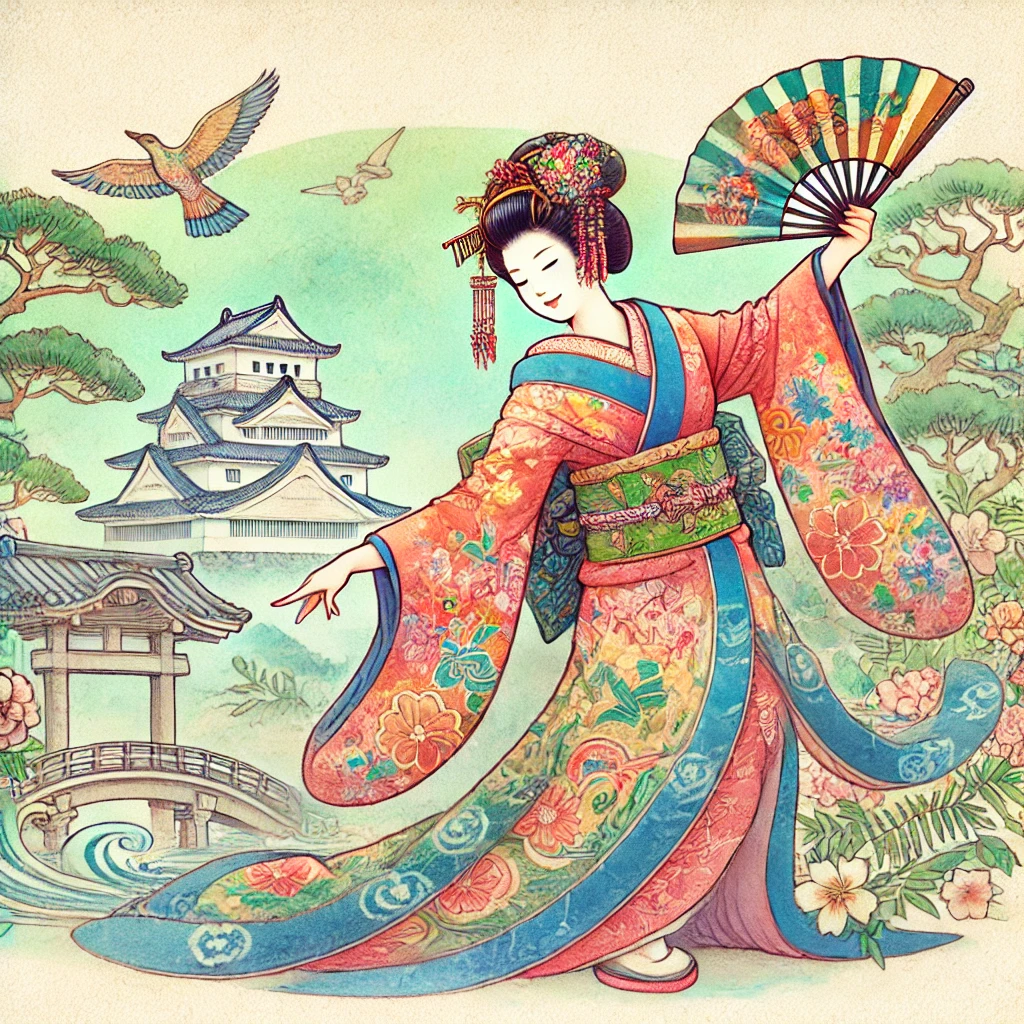
Surrounded by the beautiful sea, sky, and rich nature of Okinawa, Ryukyu dance has been nurtured over centuries. Its graceful movements and music seem to paint a picture of the islands’ landscapes. However, the charm of Ryukyu dance lies not only in its superficial beauty.
Ryukyu dance embodies the spirituality, values, history, and culture of the Okinawan people, passed down since ancient times. It conveys gratitude and prayers to the gods, respect for ancestors, and reverence for nature. These various sentiments embedded in the dance resonate quietly in the hearts of those living in the modern era.
Moreover, numerous legends and anecdotes are associated with Ryukyu dance. By exploring stories like that of the beautiful maiden taken by the wind or the tales of legendary dancers revered as deities, we can deepen our understanding of the worldview inherent in Ryukyu dance.
In modern times, Ryukyu dance is cherished as a symbol of Okinawan culture and is carefully passed down through school education and community initiatives to the next generation. Additionally, its use as a tourism resource and its promotion domestically and internationally help widely convey the allure of Okinawa.
Ryukyu dance, inherited from ancient times, is an art form that encapsulates Okinawa’s history, culture, and spirituality. How we can utilize this dance, infused with the thoughts and feelings of our predecessors, in the modern era is a question worth exploring. Through Ryukyu dance, let’s embark on a journey to delve into the essence of Okinawan culture. Undoubtedly, new discoveries and emotions await.
- Introduction
- The History of Ryukyu Dance
- Characteristics of Ryukyu Dance
- The Significance of Ryukyu Dance in Okinawan Culture
- Legends and Anecdotes of Ryukyu Dance
- The Role of Ryukyu Dance in Modern Times
- Conclusion
- Q&A
- Summary
Introduction
Diversity and Uniqueness of Okinawan Culture
Okinawa Prefecture, a cluster of beautiful islands at the southernmost tip of Japan, has developed a unique culture distinct from the mainland. Influenced by foreign cultures such as China and Southeast Asia over its long history, Okinawa has nurtured its own language, music, dance, and crafts. Among these, Ryukyu dance is one of the representative performing arts of Okinawan culture. Understanding its history and characteristics is essential to deeply appreciate the charm of Okinawa.
Okinawan culture is based on spirituality that harmonizes with nature, respects ancestors, and interacts with gods. This spirituality, fostered in daily life and expressed on special occasions such as festivals and rituals, is embodied in Ryukyu dance. Its beautiful movements and music never fail to captivate the hearts of the audience.
This article provides a detailed explanation of the history and characteristics of Ryukyu dance. It is a must-read for those interested in Okinawan culture and those fascinated by Japanese traditional performing arts. By discovering the charm of Ryukyu dance, one can deepen their understanding of Okinawan culture and history.
The Significance of Ryukyu Dance
Ryukyu dance is designated as an intangible cultural property of Okinawa Prefecture and is highly regarded both domestically and internationally. It has been passed down since the Ryukyu Kingdom era, with a history spanning over 600 years. The cultural exchanges during the prosperous period of the Ryukyu Kingdom, which traded with China, Japan, and Southeast Asia, significantly influenced the development of Ryukyu dance.
Today, Ryukyu dance performances are held not only within Okinawa but also throughout Japan and overseas. Its beautiful movements and music transcend language barriers, captivating many people. In Okinawa, a popular tourist destination, Ryukyu dance is also positioned as an important tourism resource, with many tourists enjoying dance shows and experience programs.
Ryukyu dance, symbolizing Okinawa’s traditional culture, holds significant meaning in modern society. Its artistic excellence is noted by dancers and musicians domestically and internationally, and efforts are made to explore new expressions while preserving tradition. Ryukyu dance plays a crucial role in conveying Okinawa’s history and culture.
The History of Ryukyu Dance
Origins and Development
Ancient Dance Culture
Okinawa’s dance culture has been continuously inherited since ancient times, with origins thought to lie in ancient rituals and ceremonies. The ancient people valued interactions with nature and the gods, using dance as a means of expressing gratitude and prayers to the deities.
In Okinawa, the ancient dance known as “Ashagi” is still performed. Ashagi is a simple dance where men and women face each other, dancing to the accompaniment of drums and bells. Its origins are said to involve offering Ashagi to pray for a bountiful harvest and safety. Even today, Ashagi is performed at festivals and events across Okinawa, showing that ancient dance culture has been preserved.
Influences from China and Mainland Japan
Significant influences on the development of Ryukyu dance came from cultural exchanges with China and mainland Japan. From the 14th century, the Ryukyu Kingdom established tributary relations with China, leading to active cultural exchanges. The highly developed court dances of China influenced the development of court dances in Ryukyu.
From the 17th century onwards, under the rule of the Satsuma domain, Ryukyu also absorbed cultural elements from mainland Japan, including Noh, Kabuki, and Joruri. Particularly, the movements and forms of Noh had a significant impact on the fundamental movements of Ryukyu dance.
Thus, Ryukyu dance has evolved by flexibly incorporating Chinese and mainland Japanese cultures while building on its ancient traditions. As a result, contemporary Ryukyu dance is a diverse performing art reflecting Okinawa’s history and culture.
Relationship with Royal Culture
The Role of Dance in the Royal Court
During the Ryukyu Kingdom era, dance played an essential role in the royal court. The court employed dedicated dancers and musicians who performed at court events and diplomatic occasions. Notably, grand dances were performed to welcome Chinese envoys, showcasing the richness of Ryukyu culture.
Court dance was not merely for entertainment but had political and diplomatic significance. Outstanding dancers were highly valued by the king and sometimes granted official ranks. Additionally, dance helped strengthen the connection between the court and the common people.
The Status and Treatment of Dancers
In the Ryukyu Kingdom era, dancers belonged to the official position known as “Yaku Bugyo” and were given high status. Exceptional dancers received the title “Mikyoku Uchi” from the king, enjoying special treatment. Mikyoku Uchi were responsible for instructing dance in the royal court and performing at significant events.
Moreover, dancers were respected by the general populace. Having a dancer in the family was considered an honor, and the dance skills were passed down within families. Even today, famous dancer families are recognized as crucial bearers of Okinawan culture.
The status and treatment of dancers in the royal era indicate that dance held substantial influence in Okinawan culture and politics. Dancers played a vital role in connecting the court with the populace, and their skills and knowledge were indispensable for the cultural development of Okinawa.
Changes After the Modern Era
Dance Culture After the Collapse of the Kingdom
In 1879, the Ryukyu Kingdom was dissolved, and Okinawa Prefecture was established. This change significantly impacted the environment surrounding Ryukyu dance. The demand for court dances vanished, leading many dancers to lose their livelihoods. Additionally, the influence of mainland Japanese culture intensified, raising concerns about the preservation of traditional dance culture.
Despite these challenges, dancers strived to preserve the tradition for future generations. Dance skills were passed down through master-disciple relationships within dancer families. Some dancers performed outside the prefecture to promote the charm of Ryukyu dance widely.
Post-War Revival and Development
During World War II, Okinawa suffered devastating ground battles, resulting in the loss of numerous cultural assets. Post-war, under U.S. administration, the revival of traditional culture was challenging. However, dancers gradually rebuilt the dance culture, relying on pre-war skills and knowledge.
From the 1950s onwards, along with Okinawa’s economic development, Ryukyu dance experienced new growth. Dance schools were established, and performance activities became more active, promoting and preserving the dance culture. Additionally, with the rise of tourism, Ryukyu dance gained attention as an important tourism resource.
Today, Ryukyu dance is highly valued both within and outside Okinawa as a representative of Okinawan culture. While preserving tradition, efforts are made to explore new expressions, making Ryukyu dance an indispensable part of Okinawa’s cultural development. Through its evolution over time, Ryukyu dance continues to be a living traditional art, captivating modern audiences.
Characteristics of Ryukyu Dance
Unique Music and Dance Style
Traditional Instruments like the Sanshin and Drums
The music of Ryukyu dance is primarily played with the sanshin, a three-stringed instrument. The sanshin sets the rhythm and colors the dance with its unique sound. Sanshin players often sing while playing, deepening the emotional expression of the dance.
Additionally, drums, bells, and gongs play crucial roles in Ryukyu dance. Drums enhance the dance with powerful rhythms, while bells and gongs add a delicate touch, creating the distinctive atmosphere of Ryukyu dance.
Dance Movements and Forms
The movements of Ryukyu dance have evolved independently, influenced by Chinese court dances and Japanese Noh. A fundamental stance called “Kamae” involves standing with feet shoulder-width apart, knees slightly bent, and the upper body kept straight.
Ryukyu dance includes fixed movements called “kata.” Notable kata include hand movements called “Nifee” and footwork called “Kakushi.” Combining these kata produces the graceful dance movements.
Ryukyu dance skillfully
varies the rhythm of movements to expressively dance to the music. Through years of practice, dancers master the control of kata. While kata form the basis, the dancer’s interpretation and expressiveness bring diversity to Ryukyu dance.
Costumes and Props
The Significance and Role of Beautiful Costumes
Costumes are crucial for enhancing the beauty of Ryukyu dance. Women wear “Ryuso,” beautiful kimonos characterized by vivid colors and intricate patterns. Men often wear kimonos dyed with “Bingata,” a traditional Okinawan dyeing technique.
Costumes vary depending on the performance and characters. For instance, a royal woman may wear luxurious golden costumes, while a common woman might wear simpler colors. Costumes are key to expressing the performance’s content and characters’ personalities.
Costumes also enhance the visual appeal of movements. Long sleeves and hems gracefully sway with the dancer’s movements, enhancing expressiveness. The colors and patterns of costumes shine under stage lights, captivating the audience.
Use of Fans and Combs as Props
Fans and combs are significant props in Ryukyu dance. Fans are one of the most frequently used props, skillfully handled by dancers to express various emotions and scenes. The way fans are opened, held, and waved conveys different feelings.
Combs are props used by female dancers, symbolizing elegance. Holding combs while dancing highlights feminine grace and is used in performances expressing romantic feelings.
These props enhance the dancer’s expressive power. Mastering the use of props is an essential skill for dancers, elevating the overall impact of the performance.
Representative Performances
Classical Dance Masterpieces
Ryukyu dance has numerous classical performances. One notable piece is “Kagiyadefu,” portraying a beautiful woman dancing in the wind, characterized by graceful movements and music. This piece is known for encapsulating the essential kata and movements of Ryukyu dance.
Another popular performance is “Nisei Gekikyu,” depicting the romantic interactions between young men and women using fans. It is one of the most beloved pieces in Ryukyu dance, performed by many dancers.
Classical performances represent the essence of Ryukyu dance passed down over generations. Mastering these pieces is a crucial practice for dancers, playing a vital role in preserving tradition and passing it to future generations.
Modern Performances
Modern performances, while incorporating traditional elements of Ryukyu dance, also introduce contemporary sensibilities. For example, “Urakaze” integrates modern music and lighting effects to create a fantastical atmosphere. “Kaze no Uta” uses modern dance elements to express Okinawa’s nature and landscape.
New performances expand the possibilities of Ryukyu dance, making traditional arts accessible to contemporary audiences. Balancing tradition and innovation, Ryukyu dance continues to evolve with the times.
The Significance of Ryukyu Dance in Okinawan Culture
Connection to Festivals and Rituals
Dance in Religious and Celebratory Contexts
Ryukyu dance has played a vital role in religious ceremonies and celebrations. Various dances are dedicated to different gods in Okinawa, reflecting deep-rooted spiritual beliefs. For instance, “Ashibi” is a dance performed during ceremonies to pray for a good harvest, symbolizing reverence for nature.
Ryukyu dance is also performed at weddings and significant life events, enhancing the atmosphere and uplifting participants’ spirits. It serves both as a means of expressing prayers and wishes and as entertainment.
The Role of Dance in Life Ceremonies
In Okinawa, various ceremonies mark life milestones, each incorporating specific dances. For example, “Kajadefu” is performed during rituals celebrating a child’s birth, with the mother dancing while holding the baby, praying for the child’s healthy growth. “Neire” is a dance performed in funerals to express gratitude and mourning for the deceased.
These dances express the significance of each ceremony, allowing people to participate emotionally through dance.
Connection to the Spiritual World
Prayers and Wishes Embodied in Dance
Ryukyu dance encompasses prayers and wishes for the gods and people. Dancers, through movements and forms, symbolically express these sentiments. For example, “Kachashi” represents a wish for abundant crops, and “Yonkashi” expresses the longing for a lover’s safety and happiness.
Dancers, through rigorous training, acquire the skills to express prayers and wishes in their dances, connecting with the audience emotionally.
The Relationship Between Ancestor Worship and Dance
Ancestor worship is deeply ingrained in Okinawan culture, with Ryukyu dance playing a crucial role. For example, “Eisa” is a traditional dance performed during Obon to welcome ancestral spirits, showcasing lively movements that entertain the spirits. “Rokushou” is performed to send off ancestral spirits, expressing gratitude and farewell through graceful movements.
Ryukyu dance, closely tied to ancestor worship, enhances the connection between the living and the spiritual world.
Transmission and Development of Tradition
Master-Disciple Relationship and Skill Transmission
Skills in Ryukyu dance are passed down through master-disciple relationships, with apprentices learning from masters over years of rigorous practice. This relationship nurtures not only dance skills but also personal bonds and cultural values.
Skill transmission often occurs through direct physical demonstration, emphasizing the importance of hands-on learning in understanding the depth of Ryukyu dance.
The Significance of Living Traditions in Modern Times
Preserving and developing traditional culture in modern society is a significant challenge. Ryukyu dance, embodying Okinawa’s historical and cultural identity, is crucial in this endeavor. Efforts to adapt and innovate while preserving tradition ensure that Ryukyu dance remains relevant and vibrant.
Modern dancers, while valuing traditional skills, incorporate new expressions to expand the possibilities of Ryukyu dance. Dance schools and experience programs create opportunities for more people to engage with Ryukyu dance, promoting its transmission and development.
Legends and Anecdotes of Ryukyu Dance
The Origin of “Utahana Goto”
The Legend and Its Interpretation
“Utahana Goto” is a representative Ryukyu dance performance depicting a romantic story. According to legend, a beautiful maiden from a village fell in love with a young man. However, others disapproved of their relationship, causing the young man to be driven to the sea. The maiden played the “Utahana Goto” every day by the shore, and one day, the young man emerged from the sea, reunited with his lover.
This legend symbolizes the enduring strength of love and the mystical power of music.
The Modern Performance of “Utahana Goto”
Today, “Utahana Goto” is a beloved performance in Ryukyu dance, portraying the emotional story through graceful movements and music. The dancers’ expressions and the traditional instruments’ melodies harmonize, vividly bringing the legend to life.
The Legend of “Kagiyadefu”
The Legend and Its Interpretation
“Kagiyadefu” is a Ryukyu dance performance expressing a woman dancing in the wind. According to legend, a beautiful maiden was swept away by a strong wind while dancing alone, leading villagers to believe she was taken by the wind god, naming her “Kagiyadefu.”
This legend symbolizes freedom from worldly constraints and the mysterious power of nature.
Impact on Ryukyu Dance
The legend has profoundly influenced Ryukyu dance, with performances embodying the woman’s free spirit through light, graceful movements and wind-like music.
Other Fascinating Anecdotes
Anecdotes of Famous Dancers
Ryukyu dance history is rich with anecdotes of famous dancers, like “Kiyan Mats,” a celebrated female dancer in the 18th century known as the “Goddess of Dance.” Her skill and grace earned her legendary status, and tales of her unwavering performance during unexpected events continue to inspire.
Mystical Tales in Dance
Mystical stories, such as the “Zashikiwarashi” tale, also enrich Ryukyu dance. Zashikiwarashi, a child-like spirit, was said to live with a dancer, enjoying dance and sometimes giving advice, symbolizing the spiritual depth of Ryukyu dance.
These legends and anecdotes enhance the understanding of Ryukyu dance’s depth and mysticism, offering a richer appreciation of its cultural significance.
The Role of Ryukyu Dance in Modern Times
Cultural Transmission and Education
Inclusion of Ryukyu Dance in School Education
Efforts to pass Ryukyu dance to the next generation include its integration into school curricula. In many Okinawan schools, students learn basic dance movements and forms from professional instructors, fostering interest and appreciation for traditional culture.
Higher education institutions, like the Okinawa Prefectural University of Arts, offer specialized courses, nurturing future dancers and instructors.
Community Initiatives and Human Resource Development
Community centers and cultural halls across Okinawa host dance classes for all ages, guided by experienced instructors. These classes foster the development of new talent and maintain the cultural foundation of Ryukyu dance.
Dance organizations and NPOs also contribute to human resource development through workshops and training programs, ensuring the continuation of Ryukyu dance traditions.
Utilization as a Tourism Resource
Tourist Shows and Experience Programs
Okinawa’s status as a major tourist
destination includes leveraging Ryukyu dance as a tourism resource. Many hotels and resorts host dance shows, allowing tourists to experience the rich cultural heritage of Okinawa firsthand. Experience programs offer tourists a chance to learn and perform basic dance movements.
These activities not only promote Ryukyu dance but also contribute significantly to the local economy by attracting tourists and creating employment opportunities.
Cultural Promotion and Economic Impact
Using Ryukyu dance as a tourism resource promotes Okinawa’s culture domestically and internationally. Tourists sharing their experiences helps spread the charm of Ryukyu dance, enhancing its cultural value and contributing to economic growth through increased tourism revenue.
Domestic and International Outreach
Performance Activities at Home and Abroad
Ryukyu dance performances are held regularly in major Japanese cities and globally in countries like the United States, Europe, and Asia. These performances transcend cultural and language barriers, spreading the beauty and strength of Ryukyu dance worldwide.
Media-Based Information Dissemination
The rise of media has amplified Ryukyu dance’s outreach. Television, radio, newspapers, and magazines frequently feature Ryukyu dance, increasing public awareness. The internet further expands access, with videos and social media posts engaging global audiences.
Media-based dissemination supports the preservation and development of Ryukyu dance, inspiring younger generations to become cultural bearers.
Ryukyu dance, through performances and media outreach, opens new possibilities in modern society, ensuring the legacy of this treasured cultural heritage.
Conclusion
The Charm and Importance of Ryukyu Dance
Ryukyu dance, a beautiful and powerful art form nurtured by Okinawa’s history and culture, continues to captivate with its unique music, graceful movements, and vibrant costumes. It has played a significant role in various ceremonies and events, embodying the spirituality and values of the Okinawan people.
In modern times, Ryukyu dance’s significance endures, with dedicated efforts ensuring its transmission and development. As a tourism resource and cultural ambassador, Ryukyu dance widely shares Okinawa’s cultural charm, contributing to both cultural preservation and economic growth.
The allure and importance of Ryukyu dance remain timeless, making it our mission to preserve and pass on this invaluable cultural heritage to future generations.
Ryukyu Dance as a Key to Understanding Okinawan Culture
Understanding Ryukyu dance is essential for a deeper appreciation of Okinawan culture. The history, stories, and spirituality embedded in the dance reveal the richness and diversity of Okinawan culture.
Through Ryukyu dance, we learn about the way of life, values, and worldview of the Okinawan people, providing insights into their deep respect for nature, interactions with deities, and gratitude towards ancestors. Ryukyu dance also connects to other cultural elements, offering a comprehensive view of Okinawan culture.
Ryukyu dance serves as a compass for exploring the vast sea of Okinawan culture, allowing us to decode the history, spirituality, and aesthetics of Okinawa. By understanding and valuing Ryukyu dance, we take the first step towards a deeper understanding of Okinawan culture as a whole.
Preserving and passing on Ryukyu dance is a responsibility entrusted to us, ensuring that this treasured cultural heritage continues to shine brightly as a key to understanding and appreciating Okinawan culture.
Q&A
Where does Ryukyu dance originate?
Ryukyu dance originates from ancient rituals and ceremonies, where it was used to express gratitude and prayers to deities, reflecting the people’s interactions with nature and gods.
What are the features of Ryukyu dance costumes?
Women’s costumes, known as “Ryuso,” feature vivid colors and intricate patterns, while men often wear kimonos dyed with “Bingata,” a traditional Okinawan dyeing technique. Costumes vary based on the performance and characters.
How is Ryukyu dance transmitted in modern Okinawa?
Ryukyu dance is incorporated into school curricula and taught at community centers, with programs for all ages. Higher education institutions offer specialized courses to nurture future dancers and instructors.
What legend is associated with “Kagiyadefu”?
“Kagiyadefu” involves a legend about a beautiful maiden swept away by the wind while dancing, believed to have been taken by the wind god, symbolizing freedom and the mysterious power of nature.
Why is Ryukyu dance utilized as a tourism resource?
Ryukyu dance represents Okinawan culture and attracts tourists through dance shows and experience programs, promoting cultural heritage and contributing to economic growth.
Summary
Ryukyu dance, a beautiful and powerful art form, embodies Okinawa’s history and culture. Its unique music, graceful movements, and vibrant costumes have captivated audiences for centuries. Serving as a key element in various ceremonies and events, Ryukyu dance reflects the spirituality and values of the Okinawan people. In modern times, efforts to preserve and develop Ryukyu dance ensure its transmission to future generations. As a tourism resource and cultural ambassador, Ryukyu dance shares Okinawa’s cultural charm widely, contributing to both cultural preservation and economic growth. Understanding Ryukyu dance is essential for a deeper appreciation of Okinawan culture, as it reveals the richness and diversity of the region’s history, stories, and spirituality. By preserving and passing on Ryukyu dance, we fulfill our mission of ensuring this invaluable cultural heritage continues to shine brightly, guiding us to a deeper understanding of Okinawan culture.

コメント